
Search by title, topic or phrase
Use our Crypto Search Engine 🔍 to find the topics and keywords you're looking for.
Assess upgradeability, oracles, admin privileges, external calls & bridge dependencies.
Enter an Ethereum address (demo heuristic).
Table of Contents
ToggleIn decentralized finance, understanding protocol vulnerability before deployment is critical. The smart contract risk calculator is a deterministic DeFi risk scanner designed to evaluate protocol architecture, identify weak points, and generate a structured risk score from 0–100.
Unlike traditional smart contract audit tools, this system focuses on design-level risks such as oracle dependencies, upgradeability patterns, admin control structures, and cross-chain bridge exposure giving developers and analysts a fast Web3 security scanner for early-stage risk detection.
In decentralized finance, most losses do not come from coding mistakes alone — they come from system design failures.
Upgradeable proxies, oracle manipulation, bridge exploits, and centralized admin keys have collectively caused billions in DeFi losses across protocols. It is a deterministic risk scoring system that evaluates how fragile a protocol is based on its architecture, before or after deployment., helping developers, auditors, and researchers identify systemic weaknesses early.
The smart contract risk calculator is designed to solve this problem by providing a deterministic, architecture-level DeFi security scanner that evaluates how a protocol behaves under real-world risk conditions. Instead of relying only on manual audits or post-exploit analysis, it enables early detection of systemic weaknesses before deployment or interaction.
This tool transforms complex protocol design into a clear risk score from 0–100, helping developers, auditors, and researchers quickly understand the safety profile of any smart contract system.

A smart contract risk calculator is a structured risk analysis system that evaluates blockchain protocols based on their architectural design rather than only their code. It assigns a numerical risk score by analyzing key security dimensions such as oracle dependencies, upgradeability models, admin privileges, external calls, and bridge integrations.
Unlike traditional smart contract audit tools,
which focus on identifying bugs in code, this system focuses on system-level fragility—how different components interact and create compounded risk across the protocol.
It helps answer a critical question:
“How likely is this protocol to fail when conditions become adversarial?”
The Smart Contract Risk Calculator is a DeFi security risk analysis tool that evaluates smart contracts based on architectural risk patterns instead of raw code inspection.
In decentralized finance, a single overlooked design decision can lead to millions of dollars in losses. From oracle manipulation and upgradeable proxy vulnerabilities to cross-chain bridge exploits, modern DeFi systems are exposed to complex structural risks that traditional reviews often fail to detect.
It analyzes five core attack surfaces:
Each category is scored independently, then combined into a final weighted risk score (0–100).
Smart Contract Input
        │
        ▼
┌──────────────────────────────┐
│ Risk Engine (Deterministic)  │
└──────────────────────────────┘
        │
        ├── Oracle Risk Analysis
        ├── Upgradeability Check
        ├── Admin Control Scan
        ├── External Call Mapping
        ├── Bridge Dependency Check
        │
        ▼
 Risk Score (0–100)
        │
        ├── Risk Category (Low → Critical)
        ├── Cascade Failure Simulation
        ├── Recommendations Engine
└── Visual Risk BreakdownThe Smart Contract Risk Calculator provides:
| Output | Description |
|---|---|
| Risk Score | 0–100 deterministic score |
| Risk Label | Low / Medium / High / Critical |
| Risk Breakdown | Category-level scoring |
| Cascade Simulation | Failure impact propagation |
| Recommendations | Security improvement suggestions |
Most smart contract failures in DeFi are not caused by simple coding errors but by flawed architectural decisions. These include:
These risks are often invisible during development but become catastrophic under real attack conditions. A DeFi risk scanner helps expose these structural weaknesses early by quantifying them into a transparent risk score.
The evolution of DeFi has significantly increased systemic risk complexity. Early protocols were relatively simple, but modern ecosystems now include:
This complexity introduces interconnected failure chains, where a single vulnerability can cascade across multiple systems.
For example:
Because of this, protocol risk scoring tools are becoming essential for evaluating real-world resilience in Web3 systems.
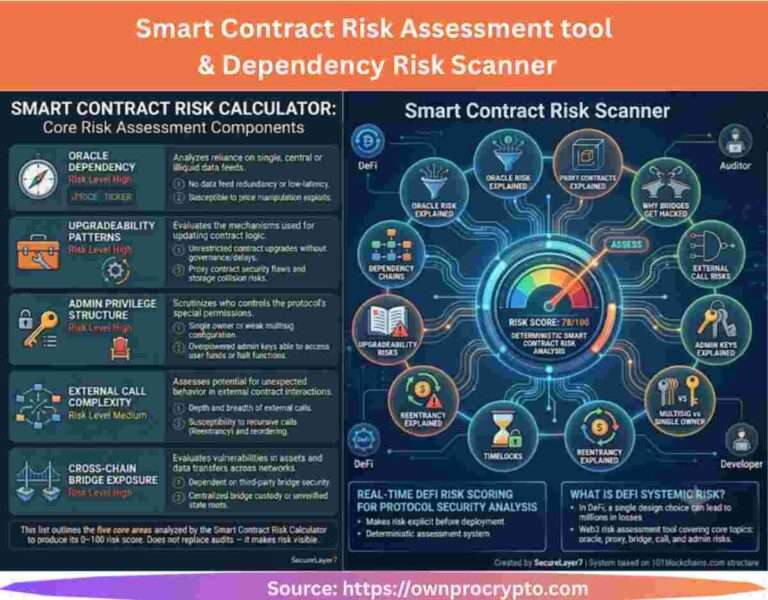
The Smart Contract Risk Scanner is a DeFi security analysis tool designed to evaluate the structural risk of a blockchain protocol before or after deployment. It works by examining key architectural components such as oracle dependencies, upgradeability patterns, admin control mechanisms, external contract interactions, and cross-chain bridge integrations. Instead of focusing only on code-level vulnerabilities, it assesses how a smart contract is designed and how those design choices can create systemic risk in real-world conditions. This makes it useful for identifying hidden weaknesses that traditional reviews may overlook.
By converting complex protocol behavior into a clear 0–100 risk score, the smart contract risk scanner helps developers, auditors, and researchers quickly understand the security posture of a system. It highlights how different risk factors combine and amplify each other, giving a more realistic view of potential failure scenarios in decentralized finance environments.
The scanner operates using a deterministic rule-based model. It evaluates predefined risk categories and assigns weighted scores based on detected attributes in the contract configuration.
Core analysis layers include:
Each factor contributes to a final weighted score that represents overall protocol risk.
Although both systems evaluate smart contract risk, they operate differently:
| Feature | Risk Calculator | Risk Scanner |
|---|---|---|
| Input Type | Manual configuration | Contract address |
| Analysis Method | User-defined assumptions | Heuristic simulation |
| Use Case | Design-time risk estimation | Runtime or post-deployment scan |
| Output | Risk score model | Simulated risk report |
| Accuracy Focus | Theoretical architecture | Pattern-based detection |
The smart contract risk calculator is ideal for planning and design, while the scanner simulates how a deployed contract might behave in practice.
The scanner uses heuristic pattern recognition and rule-based logic to identify common smart contract risk signals such as:
While it does not perform full bytecode analysis, it provides a fast Web3 security scanner-style overview of potential risk exposure.
The smart contract risk calculator uses a deterministic, rule-based scoring system to evaluate blockchain protocols. Instead of relying on subjective opinions or black-box AI models, it assigns consistent and reproducible risk scores based on predefined architectural signals.
Each contract is evaluated across five core risk dimensions, which are then combined into a final score from 0–100. This makes the system suitable as a protocol risk score tool for developers, auditors, and researchers who need consistent evaluation across multiple projects.
The goal is simple:
Convert complex DeFi architecture into a measurable, comparable risk profile.
Every analysis begins by breaking a smart contract system into five primary risk surfaces.
Oracle risk evaluates how a protocol depends on external data feeds such as price oracles or off-chain data providers.
Key risk patterns include:
Oracle failures can lead to incorrect pricing, faulty liquidations, and cascading protocol insolvency, making it one of the most critical oracle risk in DeFi factors.
Oracle manipulation is one of the most common causes of protocol failures. For a deeper explanation of oracle architectures and attack vectors, see our Blockchain Oracles Explained guide.
Upgradeability risk measures how easily a contract’s logic can be changed after deployment.
Common upgrade patterns:
While upgradeability enables flexibility, it also introduces centralized control points and hidden attack surfaces that increase exposure in a smart contract audit tool context.
Admin control risk evaluates how much authority a single entity or group has over the protocol.
Typical configurations:
Admin keys can override protocol logic, upgrade contracts, or drain funds if compromised, making them one of the most critical risk factors in DeFi systems.
If your protocol uses multisig governance, compare custody approaches in our MPC vs Multi Sig Wallets article.
External call risk measures how frequently a smart contract interacts with other contracts.
Higher external interaction leads to:
Protocols with many external calls are significantly more complex and harder to secure, which is why this is a core signal in any DeFi risk scanner.
Bridge risk evaluates exposure to cross-chain communication systems.
Cross-chain bridges introduce:
Bridge failures have historically led to some of the largest DeFi exploits, making them a critical component of any Web3 security scanner model.
Cross-chain bridges introduce additional trust assumptions. Learn more in our Crypto Bridge Risk guide.
The final risk score is calculated using a weighted system that reflects real-world attack impact:
| Risk Category | Weight |
|---|---|
| Oracle Risk | 25% |
| Upgradeability Risk | 20% |
| Admin Control Risk | 20% |
| External Calls Risk | 20% |
| Bridge Risk | 15% |
This weighting ensures that systemic risks like oracle failures and admin centralization have a higher impact on the final score than lower-impact factors.
Unlike traditional scoring systems, this model includes risk interaction effects, meaning that vulnerabilities do not exist in isolation.
Examples of risk amplification:
When multiple high-risk factors exist together, the system increases the final score to reflect real-world exploit behavior, where attackers chain vulnerabilities rather than exploiting a single flaw.
This makes the system more aligned with real DeFi attack patterns and improves the accuracy of the protocol risk score tool model.
The final output is normalized into a 0–100 scale:
| Score Range | Risk Level | Meaning |
|---|---|---|
| 0–30 | Low Risk | Strong decentralized design, minimal exposure |
| 31–55 | Medium Risk | Some centralized or upgrade components present |
| 56–75 | High Risk | Multiple vulnerabilities and dependency risks |
| 76–100 | Critical Risk | Highly centralized or fragile architecture |
This interpretation helps users quickly assess whether a protocol is safe, moderately risky, or structurally fragile.
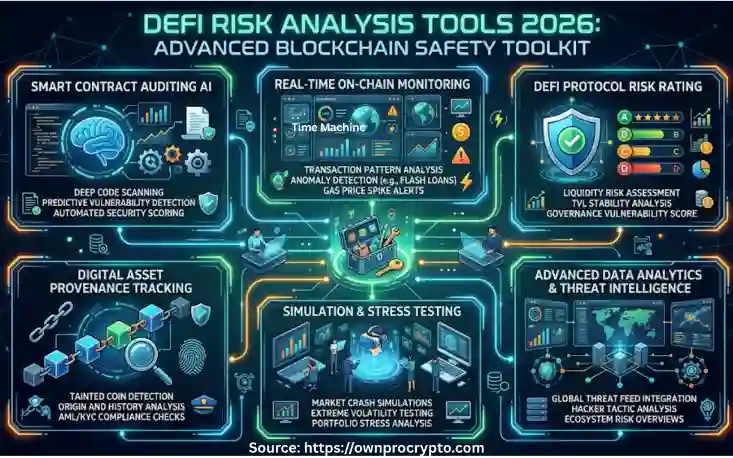
DeFi systemic risk refers to the possibility that a single failure in one part of the ecosystem can trigger cascading failures across multiple protocols, liquidity pools, or networks.
Unlike isolated smart contract bugs, systemic risk emerges from interconnected dependencies, making it far more dangerous and difficult to detect.
Contract risk is only one component of protocol evaluation. Our Crypto Protocol Evaluation System explains the broader assessment framework.
In traditional finance, systemic risk refers to the collapse of an entire financial system due to interconnected failures. In DeFi, this concept is amplified because protocols are composable and heavily interdependent.
A failure in one protocol can quickly spread across:
This interconnected nature makes systemic risk a core concern for any DeFi risk scanner or smart contract risk calculator.
Large ecosystems are affected by dependency chains discussed in our Cross Chain Blockchain Security guide.
Most DeFi protocols do not operate independently. Instead, they rely on:
These dependencies create hidden risk chains. If one dependency fails, the entire system may degrade or collapse.
For example:
Understanding these dependency chains is essential for accurate smart contract risk analysis.
Cascade failure occurs when a single vulnerability triggers a chain reaction of failures across a protocol or ecosystem.
Example scenarios:
This is why modern Web3 security scanners must evaluate not just isolated risks, but also how risks interact and amplify each other.
The Smart Contract Risk Scanner is designed to make invisible DeFi risks visible. Instead of waiting for exploits to happen, it helps teams understand how architectural decisions compound into systemic vulnerabilities.
It is not a replacement for audits—but a frontline defense layer for Web3 risk awareness.
In DeFi, the most dangerous bugs are not always in code—they are in design assumptions.
What is the Smart Contract Risk Scanner?
The Smart Contract Risk Scanner is a deterministic analysis system that evaluates a smart contract’s architecture and assigns a risk score from 0–100. It highlights vulnerabilities such as oracle dependency, upgradeability patterns, admin privileges, external calls, and bridge exposure. It is used to identify systemic risks before deployment or investment.
What does the risk score mean?
The risk score represents the overall security posture of a smart contract.
Higher scores indicate higher exposure to systemic vulnerabilities.
Is this a smart contract audit tool?
No. It is not a formal audit. It is a pre-audit risk assessment system that helps identify architectural weaknesses but does not replace manual security audits or bytecode analysis.
Is the DeFi risk scanner free to use?
Yes, most DeFi risk scanners (including this model) are designed as free analytical tools to help developers and researchers evaluate protocol safety before audits.
Is this smart contract safe?
Safety depends on architecture. A low score indicates fewer centralized components and lower systemic risk, but true safety requires a full professional audit and runtime testing.
What is a smart contract checker?
A smart contract checker is a tool that evaluates contract design patterns for known risks such as reentrancy, centralization, oracle dependency, and upgradeability vulnerabilities.
What is a crypto protocol risk analysis tool?
It is a system that evaluates DeFi protocols based on architecture-level risks rather than just code-level bugs. It focuses on systemic failures and dependency chains.
Can I trust DeFi risk scanner results?
Yes, but only as a risk estimation model, not a final security verdict. It uses deterministic scoring logic and should always be validated with audits.
What is oracle risk in DeFi?
Oracle risk occurs when a smart contract depends on external price feeds. If the oracle is manipulated or fails, it can lead to incorrect pricing, liquidation errors, or protocol exploitation.
Why are proxy contracts risky?
Proxy contracts introduce upgradeability, which allows logic changes after deployment. While flexible, they increase attack surface because compromised admin keys can modify core logic.
What is DeFi systemic risk?
DeFi systemic risk refers to cascading failures across protocols caused by interconnected dependencies like oracles, bridges, and shared liquidity pools.
What is external call risk in smart contracts?
External call risk refers to vulnerabilities introduced when contracts interact with other contracts, increasing exposure to reentrancy attacks and execution failures.
What is the difference between calculator and scanner?
Calculator Mode:
Manually selects risk parameters for estimation.
Scanner Mode:
Simulates real blockchain analysis using contract addresses to generate heuristic risk evaluation.
What is a DeFi security scanner?
A DeFi security scanner is a tool that evaluates decentralized finance protocols for structural vulnerabilities and assigns a measurable risk score.
What is an Ethereum contract analyzer?
It is a system that analyzes Ethereum smart contracts for security risks, dependency patterns, and centralization factors.
What is an ERC20 scanner?
An ERC20 scanner evaluates token contracts for risks like minting control, ownership privileges, and supply manipulation mechanisms.
Can this tool detect all vulnerabilities?
No. It does not analyze bytecode or runtime behavior. It focuses on architecture-level risk patterns only.
Is this a replacement for audit firms?
No. It is a complementary tool designed for early-stage evaluation, not full security certification.
Why use a DeFi risk scoring tool?
It helps identify hidden design risks early, before deployment or investment, reducing exposure to catastrophic failures.
How accurate is the risk scoring system?
It is deterministic and consistent but based on heuristics and weighted modeling—not real-time on-chain execution analysis.
To understand deeper system-level risks in decentralized ecosystems, explore these foundational domains:
Study secure digital system design and infrastructure standards 👉 https://www.nist.gov
Understand regulatory perspective on blockchain-based systems 👉 https://www.sec.gov
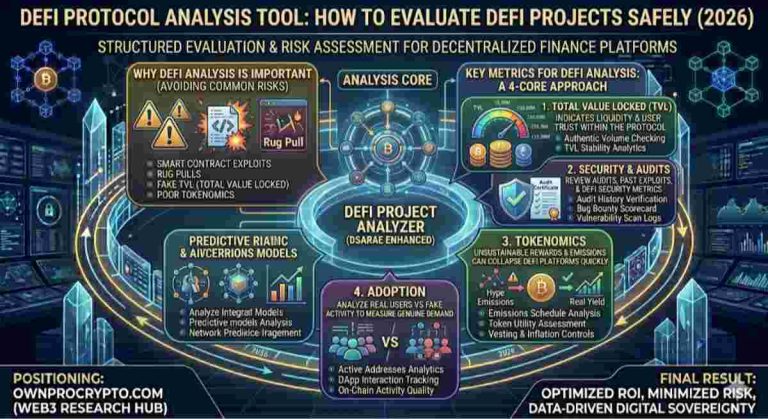
| Topic | Why Read It |
|---|---|
| DeFi Protocol Analysis | Learn how entire DeFi ecosystems are evaluated beyond individual contracts. |
| Crypto Protocol Evaluation System | Understand how protocol-level scoring complements smart contract risk analysis. |
| Asset Risk Assessment | Explore broader digital asset risks beyond contract security. |
| Crypto Security Hub | Learn core blockchain security principles and best practices. |
| Crypto Security Checklist | Follow a practical checklist before deploying or interacting with contracts. |
| Crypto Scam Checker | Check whether a project shows common scam indicators before investing. |
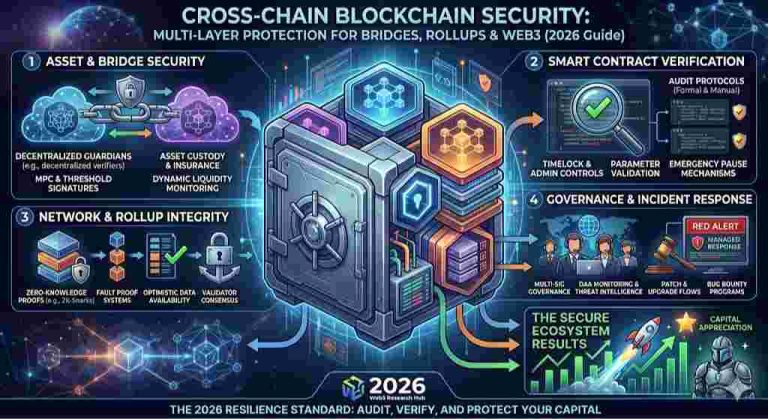
Smart contract security extends beyond a single risk score. Build a stronger understanding of protocol security, blockchain infrastructure, wallet protection, and token evaluation with these related OwnProCrypto resources and trusted industry references.
For internationally recognized cybersecurity standards, cryptographic guidance, secure software development practices, and risk management frameworks, explore the National Institute of Standards and Technology (NIST).
To explore peer-reviewed blockchain research, protocol attack models, oracle manipulation, and decentralized finance risk analysis, browse the arXiv Research Repository.
Learn practical smart contract security testing techniques and common blockchain vulnerabilities from the OWASP Smart Contract Security Project, a leading application security initiative.
Understand how Ethereum executes smart contracts, manages gas fees, supports protocol upgrades, and maintains ecosystem security through the official Ethereum Developer Documentation.