
Search by title, topic or phrase
Use our Crypto Search Engine 🔍 to find the topics and keywords you're looking for.
Map DAO vulnerability paths — identify voting concentration, bribery vectors, proposal exploits, and governance capture risk before attackers do
Compare your current settings against predefined attack scenarios.
The DAO Governance Risk Analysis Tool is a governance security framework designed to evaluate the resilience of decentralized decision-making systems. Instead of analyzing smart contract code, it examines the governance mechanisms that determine how protocols evolve, manage treasury assets, authorize upgrades, and respond to security threats.
Its primary objective is to identify structural governance weaknesses that may not be visible during conventional code audits. These weaknesses often emerge through governance participation, token distribution, voting mechanics, administrative permissions, or economic incentives rather than programming errors.
The framework evaluates governance across multiple dimensions, including:
Rather than assigning a simple “safe” or “unsafe” label, the assessment produces a layered governance profile that highlights where systemic risks may accumulate. This enables protocol teams to prioritize governance improvements before vulnerabilities evolve into operational failures.
Unlike traditional governance scorecards that rely on isolated metrics, the DAO Governance Risk Analysis Tool evaluates how these governance components interact as an integrated security system. A protocol may appear well decentralized in one area while simultaneously exposing significant governance risk through another. Understanding these relationships is essential for accurately evaluating protocol resilience.
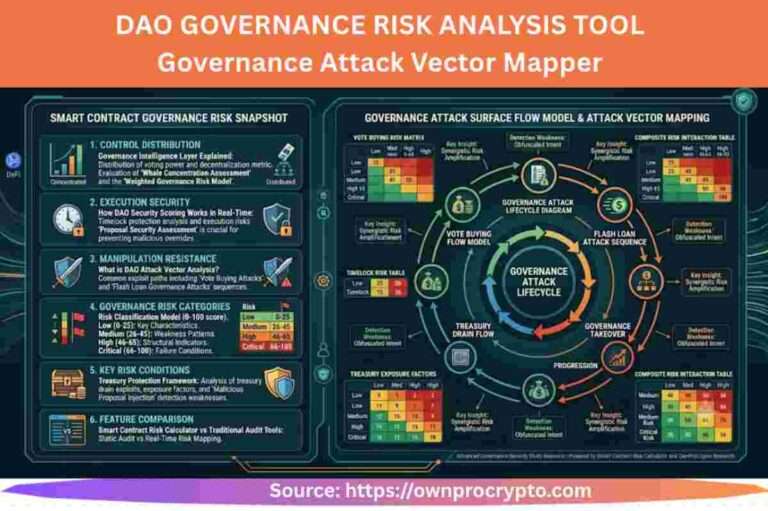
Decentralized Autonomous Organizations (DAOs) have become the decision-making backbone of modern blockchain ecosystems. They govern everything from protocol upgrades and treasury allocations to incentive programs, validator selection, and ecosystem expansion. While smart contracts automate execution, governance determines who has the authority to change those contracts and how those decisions are made.
As decentralized finance (DeFi) has matured, governance has evolved into one of the most critical layers of protocol security. A protocol may undergo multiple smart contract audits and still remain vulnerable if its governance structure allows concentrated voting power, weak proposal controls, inadequate execution safeguards, or poorly designed treasury permissions. In many cases, attackers no longer need to exploit software bugs—they can instead manipulate governance itself to achieve the same outcome.
The DAO Governance Risk Analysis Tool was developed to help identify these governance weaknesses before they become security incidents. Rather than evaluating contract code, this governance-focused framework analyzes voting systems, decentralization, proposal mechanics, treasury controls, and governance architecture to assess how resilient a protocol remains under both normal operation and adversarial conditions.
The DAO Governance Risk Analysis Tool combines these governance indicators into a structured assessment framework that helps developers, security researchers, DAO contributors, and institutional investors evaluate protocol governance before technical, operational, or financial decisions are made.
By transforming governance complexity into measurable security intelligence, the framework enables developers, protocol teams, investors, researchers, and DAO participants to evaluate governance risk using a structured methodology instead of assumptions. Whether assessing an emerging protocol or reviewing an established DAO, governance analysis provides valuable insight into how effectively a decentralized system can withstand manipulation, governance capture, and long-term operational risk.
Blockchain security is often associated with cryptography, consensus mechanisms, and smart contract audits. While these remain essential foundations, governance has increasingly become the layer that determines whether a secure protocol can remain secure over time.
Every decentralized protocol eventually reaches a point where governance—not code—controls its future direction.
Governance determines questions such as:
Each governance decision introduces opportunities to strengthen or weaken protocol security.
A technically flawless smart contract cannot prevent governance participants from approving malicious proposals, concentrating voting power, weakening treasury controls, or introducing insecure upgrades. Likewise, a well-designed governance framework can significantly reduce the impact of technical vulnerabilities by providing transparent review periods, distributed authority, and community oversight.
As decentralized ecosystems continue expanding across multiple blockchains, governance has become the operational control layer that protects billions of dollars in digital assets. Evaluating governance is therefore no longer optional—it has become a core component of comprehensive protocol security.
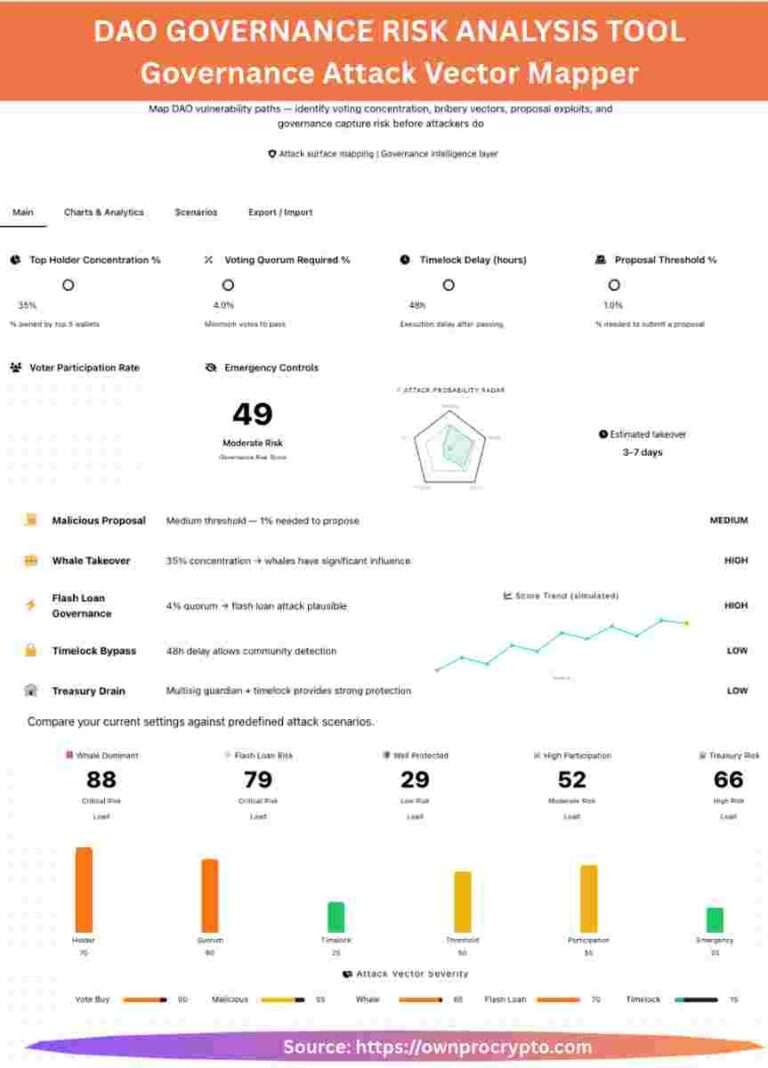
Most DAOs don’t fail because of smart contract bugs. They fail because of governance attacks — vote buying, whale capture, flash loan manipulation, weak quorum design, and treasury exploitation.
The core issue is simple: most governance systems are designed for ideal participants, not adversarial behavior. They assume rational, honest voters and rarely model how a determined attacker would actually break the system.
The Governance Attack Vector Mapper is built to close that gap. It systematically simulates how a DAO could be captured in practice — before it actually happens.
You define six core governance variables:
These parameters define the structural DNA of your governance system.
The tool then models six primary governance attack paths:
Each vector represents a real-world governance failure mode observed across DeFi ecosystems.
A DAO configured with:
Produces a 42/100 Governance Risk Score (Moderate Risk).
Key findings:
Recommended fixes:
After adjustments, risk drops to 28/100 (Low Risk).
Don’t assume your DAO is secure because it works in theory. Governance is not static — it is continuously attackable.
Map the vectors, understand the weaknesses, and close the gaps before someone else finds them first.
Traditional smart contract audits often miss operational vulnerabilities like vote manipulation and centralized treasury control. The DAO Governance Risk Analysis Tool matters because it maps these hidden attack vectors in real time, exposing how concentrated whale power and flash loan risks can bypass code-level security to exploit decentralized protocols.
Modern smart contract exploits increasingly target governance rather than code. As protocols mature and treasury values grow, attackers often find it more profitable to manipulate voting systems than to discover software vulnerabilities. Evaluating governance architecture therefore becomes just as important as auditing smart contracts, because governance ultimately determines who can upgrade contracts, move treasury assets, modify protocol parameters, and influence the future direction of a decentralized network.
Governance is not static. Token distribution changes, voter participation fluctuates, new stakeholders emerge, and treasury balances evolve over time. Periodic governance assessments help identify structural weaknesses before they become exploitable, allowing protocol teams to strengthen decentralization, improve execution safeguards, and maintain long-term governance resilience as the ecosystem grows.
Governance security cannot be measured using a single metric. Protocol resilience emerges from the interaction of multiple governance components, each influencing the others in different ways.
The DAO Governance Risk Analysis Tool approaches governance as an intelligence layer rather than a checklist.
Instead of asking whether individual controls exist, the framework evaluates whether those controls work together to resist manipulation, reduce operational risk, and maintain decentralized decision-making over time.
A comprehensive governance intelligence model typically considers several interconnected categories.
Evaluates how voting power is distributed across token holders and whether governance authority is concentrated within a limited number of wallets, organizations, or delegates.
Measures the effectiveness of proposal requirements, quorum thresholds, voting participation, and approval mechanisms to determine whether governance outcomes accurately reflect community consensus.
Reviews timelock implementation, proposal execution procedures, administrative permissions, and treasury authorization to determine whether approved governance actions can be safely implemented.
Assesses emergency governance procedures, protocol upgrade mechanisms, multisignature controls, oracle dependencies, and contingency planning that support long-term protocol stability.
Examines governance exposure introduced through bridges, cross-chain messaging systems, external contracts, validator networks, and supporting infrastructure that may influence governance execution.
Rather than treating these categories independently, governance intelligence evaluates how they interact. Multiple moderate weaknesses often create greater systemic risk than a single critical issue in isolation.
This systems-based perspective more closely reflects how governance failures develop in practice, where vulnerabilities typically emerge through combinations of technical architecture, economic incentives, and human decision-making.
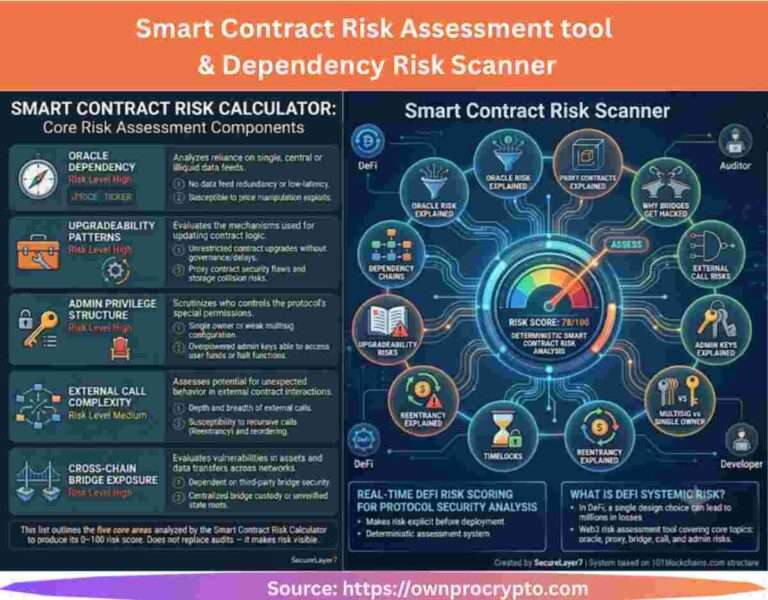
Although governance and smart contracts operate together, they address fundamentally different aspects of protocol security.
Smart contract security focuses on whether software behaves exactly as intended. Auditors examine source code, verify business logic, identify programming flaws, and test for implementation vulnerabilities before deployment.
Governance security asks a different question:
Can the protocol itself be manipulated even if the underlying code functions correctly?
This distinction is increasingly important because many modern protocol incidents originate from governance design rather than programming mistakes.
For example, governance analysis examines whether:
A protocol may receive excellent results during a technical audit while still exposing users to significant governance risk if decision-making authority becomes concentrated or governance controls prove ineffective.
For this reason, governance analysis complements—rather than replaces—traditional smart contract auditing. Together, they provide a more complete understanding of protocol security throughout the entire lifecycle of a decentralized application.
The DAO Governance Risk Analysis Tool translates governance characteristics into a structured risk profile using a weighted, multi-factor assessment model.
Instead of generating a binary outcome, the framework evaluates the relative influence of each governance component and how those components interact across the protocol’s broader security architecture.
Core evaluation categories typically include:
| Governance Category | Primary Evaluation Focus |
|---|---|
| Voting Decentralization | Distribution of governance influence |
| Governance Participation | Active voter engagement and consistency |
| Whale Concentration | Voting power accumulation among major holders |
| Proposal Controls | Submission requirements and validation safeguards |
| Quorum Design | Minimum participation required for governance decisions |
| Timelock Protection | Delay between proposal approval and execution |
| Treasury Governance | Authorization layers protecting protocol assets |
| Administrative Authority | Distribution of privileged operational control |
| Oracle Dependencies | External data sources influencing governance outcomes |
| Cross-Chain Governance | Governance communication across multiple blockchain networks |
| Upgrade Management | Security surrounding protocol upgrades and proxy administration |
Each category contributes differently to the final governance assessment based on its potential impact on protocol resilience.
For example, limited voter participation may represent a moderate governance concern on its own. However, when combined with concentrated token ownership, minimal proposal oversight, and unrestricted treasury permissions, those factors may collectively create conditions that enable governance capture or treasury compromise.
By evaluating governance relationships rather than isolated variables, the DAO Governance Risk Analysis Tool provides a more realistic representation of protocol security and helps identify weaknesses before they develop into significant operational or financial risks.
Governance failures rarely originate from a single weakness. Most successful DAO attacks combine multiple structural vulnerabilities that reinforce one another over time. A protocol with moderate voting concentration, weak proposal validation, and inadequate treasury controls may present a significantly greater security risk than one exhibiting only a single weakness.
Rather than relying on isolated security checks, the DAO Governance Risk Analysis Tool applies a weighted governance model that evaluates multiple variables simultaneously. Each governance component contributes differently to the protocol’s overall risk profile, producing a layered assessment instead of a simple pass-or-fail result.
The Governance Attack Vector Mapper evaluates governance across multiple security dimensions.
| Governance Component | Primary Question | Security Impact |
|---|---|---|
| Voting Power Distribution | Is governance decentralized? | Prevents governance capture |
| Whale Concentration | Can large holders dominate voting? | Reduces voting fairness |
| Proposal Threshold | Can malicious proposals be submitted easily? | Controls proposal quality |
| Voting Quorum | Can proposals pass with minimal participation? | Protects community consensus |
| Timelock Delay | Is there enough review time before execution? | Prevents instant attacks |
| Treasury Controls | How protected are protocol assets? | Limits financial damage |
| Emergency Controls | Can malicious proposals be stopped? | Adds recovery capability |
| Upgrade Authority | Who controls protocol upgrades? | Prevents centralized control |
Instead of assigning equal importance to every factor, the calculator prioritizes governance components according to their potential impact on protocol security.
Governance variables do not contribute equally to protocol security.
For example, a protocol with a highly centralized treasury presents significantly greater systemic risk than one with slightly lower voter participation.
The calculator therefore applies weighted governance scoring.
| Governance Variable | Example Weight |
|---|---|
| Voting Concentration | 25% |
| Treasury Governance | 20% |
| Timelock Protection | 15% |
| Proposal Security | 15% |
| Governance Participation | 10% |
| Emergency Controls | 10% |
| Upgrade Governance | 5% |
Conceptual Formula
Governance Risk Score. = (Governance Factor × Assigned Weight)Higher-risk governance variables contribute more heavily to the final score because they have a larger influence on protocol resilience.
The Governance Attack Vector Mapper converts governance characteristics into standardized security categories.
| Score | Risk Level | Interpretation |
|---|---|---|
| 0–25 | Very Low | Mature decentralized governance |
| 26–45 | Low | Minor governance improvements recommended |
| 46–65 | Moderate | Multiple weaknesses require monitoring |
| 66–80 | High | Governance vulnerable to coordinated attacks |
| 81–100 | Critical | Immediate governance redesign recommended |
Unlike traditional audits, governance scores remain dynamic because voting behavior and token ownership continuously evolve.
Token Distribution
        │
        ▼
Voting Concentration
        │
        ▼
Proposal Creation
        │
        ▼
Community Participation
        │
        ▼
Quorum Validation
        │
        ▼
Timelock Delay
        │
        ▼
Proposal Execution
        │
        ▼
Treasury Access
        │
        ▼
Protocol Security
Every stage introduces its own security assumptions. Weaknesses rarely exist in isolation. Instead, attackers combine multiple governance failures into a complete exploit chain.
Vote buying remains one of the fastest-growing governance threats across decentralized finance.
Unlike traditional corporate governance, DAO voting rights can often be accumulated rapidly through token purchases, delegation agreements, incentive campaigns, or borrowed liquidity.
The Governance Attack Vector Mapper evaluates whether governance outcomes can be economically influenced instead of reflecting genuine community consensus.
The analysis considers multiple variables simultaneously, including:
Protocols with highly liquid governance tokens and consistently low participation generally present greater vote-buying exposure than communities with active long-term governance engagement.
| Condition | Risk |
|---|---|
| High liquidity + Low participation | Very High |
| High liquidity + High participation | Moderate |
| Low liquidity + High participation | Low |
| Snapshot voting enabled | Lower |
| Delegated governance with transparency | Lower |
Key Insight
Governance decentralization depends on participation quality—not simply the number of token holders.
Large token holders are not inherently dangerous.
However, excessive ownership concentration increases governance dependence on a small number of participants.
The Governance Attack Vector Mapper evaluates concentration using governance influence rather than wallet counts alone.
Typical evaluation criteria include:
| Top Holder Concentration | Governance Exposure |
|---|---|
| Below 10% | Very Low |
| 10–25% | Low |
| 25–40% | Moderate |
| 40–60% | High |
| Above 60% | Critical |
Ownership distribution becomes particularly important when governance participation remains consistently low.
Every governance proposal represents executable protocol logic.
Weak proposal controls allow attackers to disguise treasury transfers, privilege escalation, or malicious upgrade paths within otherwise legitimate governance proposals.
The Governance Attack Vector Mapper evaluates proposal security through several dimensions.
| Evaluation Area | Purpose |
|---|---|
| Proposal Threshold | Prevent spam and malicious submissions |
| Community Review | Improve proposal transparency |
| Independent Security Review | Detect hidden attack logic |
| Execution Delay | Allow emergency response |
| On-chain Verification | Reduce manipulation risk |
Strong proposal governance significantly reduces long-term protocol risk.
Execution delays remain one of the simplest yet most effective governance defenses.
Rather than preventing malicious proposals entirely, timelocks provide time for:
| Execution Delay | Governance Security |
|---|---|
| None | Critical Risk |
| Less than 12 Hours | High Risk |
| 12–24 Hours | Moderate |
| 24–48 Hours | Good |
| More than 48 Hours | Strong Protection |
Longer delays are not automatically better. Excessive delays may reduce governance agility during legitimate protocol upgrades.
Participation matters more than token ownership.
A protocol may have hundreds of thousands of governance token holders while only a small percentage actively vote.
Low participation increases the probability of:
| Participation Rate | Governance Health |
|---|---|
| Above 25% | Excellent |
| 15–25% | Strong |
| 8–15% | Moderate |
| 5–8% | Weak |
| Below 5% | Critical |
Participation quality remains one of the strongest indicators of governance resilience.
Treasury governance ultimately determines whether protocol assets remain protected after governance proposals pass.
The Governance Attack Vector Mapper evaluates treasury security beyond simple wallet architecture.
Key evaluation areas include:
| Protection Layer | Risk Reduction |
|---|---|
| Multisignature Treasury | High |
| Execution Timelock | High |
| Independent Proposal Review | Moderate |
| Emergency Guardian | Moderate |
| Transparent Voting | Moderate |
| Single Administrator | Very Poor |
The strongest treasury security combines multiple defensive layers rather than relying on any single control.
Governance security cannot be evaluated through individual metrics alone. Voting distribution, proposal controls, treasury permissions, timelocks, participation quality, and administrative authority interact continuously to determine whether a decentralized protocol remains resilient under adversarial conditions.
The DAO Governance Risk Analysis Tool brings these components together into a unified governance intelligence framework, enabling developers, DAO contributors, auditors, researchers, and investors to identify structural weaknesses before they evolve into governance failures.
The most important insight from DAO governance security research is:
No successful DAO attack depends on a single vulnerability.
Instead, attackers chain multiple moderate weaknesses into a complete exploit path.
Low Participation
+ Whale Concentration
+ Weak Quorum
+ No Timelock Monitoring
= Full Governance Compromise
Individually, each factor may appear manageable.
Together, they become a complete governance failure path.
| Weakness Combination | Resulting Risk |
|---|---|
| Low participation + high liquidity | Vote buying vulnerability |
| Whale concentration + weak quorum | Governance takeover risk |
| No timelock + fast execution | Immediate treasury exposure |
| Weak proposals + poor review | Malicious injection risk |
| Cross-chain governance + bridge dependency | Infrastructure exploitation |
The DAO Governance Risk Analysis Tool evaluates governance not as isolated metrics, but as an interconnected attack surface graph:
Voting Power
     ↓
Governance Influence
     ↓
Proposal System
     ↓
Voting Participation
     ↓
Execution Layer
     ↓
Treasury Control
     ↓
Protocol Outcome
Each layer depends on the security of the one before it.
A weakness in any layer increases risk across the entire system.
DAO governance security is fundamentally about control pathways, not just voting rules.
The real question is not:
“Can the protocol be attacked?”
But instead:
“How many steps does it take to turn governance into control of assets?”
The shorter and simpler the attack path, the higher the governance risk.
Governance attacks in decentralized finance rarely occur as isolated incidents. Instead, they emerge through multi-step exploit chains where small governance weaknesses compound into full protocol compromise.
A protocol is usually not “broken” at a single point. It is progressively weakened until attackers can safely execute governance control or treasury extraction.
The DAO Governance Risk Analysis Tool models these sequences as attack vector flows, allowing governance risk to be evaluated as a dynamic system rather than a static score.
DAO attack vector analysis is the process of mapping how governance weaknesses can be combined into a sequential exploit path.
Instead of asking:
“Is governance secure?”
It asks:
“How could governance be compromised step by step?”
This shift in perspective is critical because most real-world DAO exploits are compositional attacks, not single-point failures.
Most governance exploits follow a predictable structure:
| Phase | Description | Example Weakness |
|---|---|---|
| 1. Entry Point | Identify governance weakness | Low participation |
| 2. Influence Building | Accumulate voting power | Token concentration |
| 3. Proposal Control | Submit governance action | Weak proposal threshold |
| 4. Approval Manipulation | Influence voting outcome | Vote buying |
| 5. Execution Window | Exploit timelock gaps | No monitoring |
| 6. Asset Extraction | Execute malicious change | Treasury drain |
Weak Governance Condition
        │
        ▼
Low Participation / Concentration
        │
        ▼
Voting Influence Accumulation
        │
        ▼
Proposal Injection
        │
        ▼
Vote Manipulation / Bribery
        │
        ▼
Quorum Achievement
        │
        ▼
Timelock Window Exploitation
        │
        ▼
Execution of Malicious Proposal
        │
        ▼
Treasury / Protocol Control
At each stage, governance assumptions are tested. If even one layer fails, attackers move closer to full protocol compromise.
While every protocol has unique governance rules, most real-world attacks follow a small number of recurring patterns.
The Governance Attack Vector Mapper classifies these into standardized exploit categories.
Vote buying occurs when governance influence is acquired through economic incentives rather than long-term participation.
Unlike traditional systems where voting rights are fixed, DAO governance tokens are liquid and transferable, making them vulnerable to temporary influence manipulation.
Token Acquisition → Temporary Voting Power → Proposal Influence → Exit Position| Condition | Risk Level |
|---|---|
| Low participation + high liquidity | Critical |
| Short-term token incentives | High |
| Delegated voting opacity | High |
| Active governance community | Reduced risk |
Vote buying does not require permanent ownership—only temporary control during voting windows.
Flash loan governance attacks exploit protocols where voting power is calculated using instantaneous token balances instead of historical snapshots.
Attackers borrow large amounts of governance tokens, vote within a single transaction, and repay the loan immediately afterward.
Flash Loan Borrowing
        │
        ▼
Temporary Token Inflation
        │
        ▼
Governance Vote Submission
        │
        ▼
Quorum / Approval Manipulation
        │
        ▼
Loan Repayment
        │
        ▼
Permanent Protocol Change| Governance Design | Risk |
|---|---|
| No snapshot mechanism | Critical |
| Real-time balance voting | High |
| Delayed voting window | Medium |
| Snapshot + delay system | Low |
Governance voting must be time-decoupled from token acquisition.
Governance takeover occurs when an attacker or coordinated group gains sufficient voting control to dominate protocol decisions.
This is usually not a sudden event—it is the result of gradual accumulation of influence.
Small Voting Influence
        │
        ▼
Whale Accumulation
        │
        ▼
Delegation Control
        │
        ▼
Quorum Influence
        │
        ▼
Proposal Approval Control
        │
        ▼
Full Governance Dominance| Indicator | Impact |
|---|---|
| Top 1–5 wallets control majority voting | Critical |
| Low voter turnout | High |
| Centralized delegate structure | High |
| Transparent delegation system | Reduced risk |
Treasury attacks represent the final objective of most governance exploits.
Once governance control is achieved, attackers typically redirect protocol funds through legitimate-looking proposals.
Governance Capture
        │
        ▼
Proposal Submission
        │
        ▼
Approval Manipulation
        │
        ▼
Timelock Execution
        │
        ▼
Treasury Asset Transfer| Security Layer | Effectiveness |
|---|---|
| Multisig wallets | High protection |
| Timelock delay | Medium protection |
| Proposal review process | Medium protection |
| Single admin control | Critical weakness |
Treasury security is not a wallet problem—it is a governance routing problem.
Malicious proposal injection occurs when attackers disguise harmful governance changes inside otherwise legitimate proposals.
These proposals often appear normal but contain hidden administrative or financial modifications.
Legitimate Proposal Appearance
        │
        ▼
Hidden Parameter Modification
        │
        ▼
Low Community Attention Period
        │
        ▼
Rapid Voting Approval
        │
        ▼
Execution Without Detection| Condition | Risk |
|---|---|
| Complex proposals without summaries | High |
| Low governance engagement | High |
| No standardized proposal format | Medium |
| Transparent review system | Reduced risk |
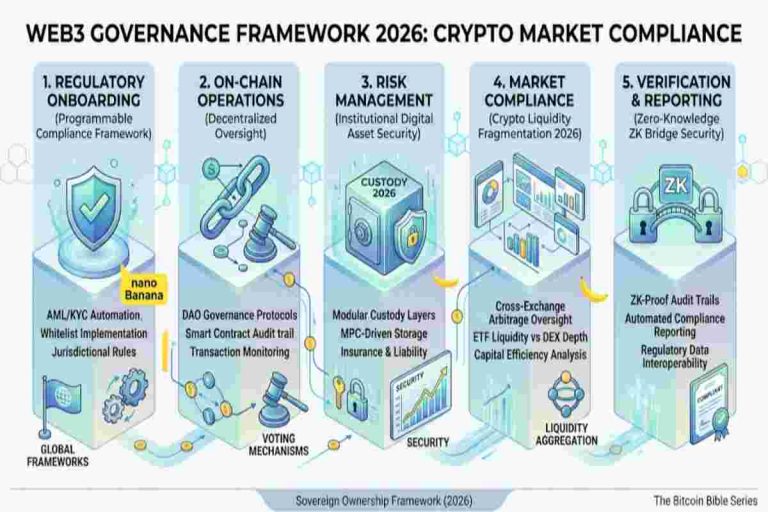
The following checklist summarizes the full evaluation model used by the DAO Governance Risk Analysis Tool.
Is voting power widely distributed?
Institutions, auditors, and risk analysts typically evaluate governance using three key dimensions:
Who ultimately controls the protocol?
How are decisions implemented?
How easily can governance be influenced?
Governance risk scoring transforms subjective analysis into a repeatable security framework.
Instead of asking:
“Does this DAO look decentralized?”
We ask:
“How resilient is this governance system under coordinated attack conditions?”
This shift enables:
Smart contracts define what a protocol can do.
Governance defines what a protocol will do next.
The DAO Governance Risk Analysis Tool exists to evaluate that second layer—the layer that determines:
In most modern DeFi systems, governance is no longer just an administrative layer. It is the primary control surface of the entire protocol.
Understanding governance risk is therefore not optional—it is a core requirement for:
A protocol is only as decentralized as its governance system is resilient.
The DAO Governance Risk Analysis Tool converts governance complexity into structured intelligence, allowing users to identify vulnerabilities before they become exploit paths.
Not all decentralized protocols operate with the same level of governance maturity. Some DAOs implement highly structured, transparent, and distributed governance systems, while others rely on concentrated control, informal decision-making, or weak execution safeguards.
The DAO Governance Risk Analysis Tool classifies governance security into four structured risk tiers, based on how resilient a protocol is against manipulation, governance capture, and treasury exploitation.
| Risk Level | Score Range | Governance Profile |
|---|---|---|
| 🟢 Low Risk | 0–25 | Strong decentralization, resilient governance |
| 🟡 Moderate Risk | 26–45 | Functional governance with minor weaknesses |
| 🟠 High Risk | 46–65 | Structural vulnerabilities present |
| 🔴 Critical Risk | 66–100 | Governance highly exposed to capture |
This classification is not static. Governance risk evolves over time as token distribution, participation rates, and treasury size change.
Low-risk DAOs demonstrate mature governance design, where decision-making is distributed, transparent, and resistant to manipulation.
| Component | Indicator |
|---|---|
| Voting Power | Broadly distributed |
| Participation | Consistently high |
| Treasury Control | Multi-layer authorization |
| Proposal System | Strict validation rules |
| Timelock | 24–72 hour delay |
| Upgrade Authority | Decentralized or DAO-controlled |
Low-risk governance systems are not “unhackable,” but they significantly increase the cost and complexity of executing a governance attack.
They require:
Medium-risk protocols typically function correctly but contain noticeable structural governance weaknesses that could become exploitable under stress conditions.
| Factor | Status |
|---|---|
| Technical security | Often strong |
| Governance resilience | Moderate |
| Attack resistance | Conditional |
| Long-term risk | Increasing with protocol size |
These systems are often in a transition phase between centralized and decentralized governance models.
High-risk governance structures contain multiple overlapping vulnerabilities that significantly increase exposure to coordinated attacks.
High-risk protocols are often vulnerable not because of a single flaw, but because:
multiple moderate weaknesses combine into a complete attack surface
| Weakness | Contribution |
|---|---|
| Whale concentration | High influence imbalance |
| Low participation | Easy quorum manipulation |
| Weak timelock | Fast execution risk |
| Poor proposal filtering | Malicious injection risk |
Critical governance systems lack fundamental safeguards required for decentralized control.
In these environments, governance may exist in name only, while actual control is effectively centralized.
These systems behave closer to centralized administrative systems than decentralized governance networks.
They require:
| Feature | Low Risk | Medium Risk | High Risk | Critical Risk |
|---|---|---|---|---|
| Voting Distribution | Strong | Moderate | Weak | Centralized |
| Participation | High | Medium | Low | Very Low |
| Treasury Controls | Multi-layer | Partial | Weak | None |
| Timelock | Strong | Moderate | Weak | Absent |
| Proposal Security | Strict | Standard | Weak | None |
| Upgrade Authority | Decentralized | Hybrid | Centralized | Single entity |
Building secure blockchain applications requires more than understanding smart contract governance. Explore our in-depth guides covering DeFi security, protocol evaluation, wallet protection, tokenomics, blockchain architecture, and digital asset risk analysis. These resources complement the Smart Contract Risk Calculator and help you develop a broader understanding of blockchain security and decentralized finance.
Together, these guides create a complete blockchain security knowledge base covering governance risk, protocol evaluation, smart contract security, digital asset protection, decentralized infrastructure, and Web3 architecture. Whether you’re a blockchain developer, security researcher, DeFi investor, or protocol auditor, exploring these related resources will help you make more informed technical and investment decisions.
Blockchain governance benefits from open standards, peer-reviewed research, and transparent security guidance. The following organizations publish respected references used by developers, auditors, researchers, and institutions worldwide.
Q: What is the DAO Governance Risk Analysis Tool?
A: The DAO Governance Risk Analysis Tool is a governance security framework that evaluates how decentralized a protocol is by analyzing voting power distribution, proposal mechanisms, treasury controls, timelocks, and governance participation. It focuses on governance attack surfaces rather than smart contract code vulnerabilities.
Q: How is governance risk different from smart contract risk?
A: Smart contract risk focuses on code-level vulnerabilities, while governance risk focuses on decision-making systems, voting control, treasury authority, and protocol upgrade power. Governance risk determines who can change the system even if the code itself is secure.
Q: Why is DAO governance considered a security risk?
A: DAO governance is a risk because attackers can manipulate voting systems, exploit low participation, accumulate voting power, or submit malicious proposals to gain control over treasury assets and protocol logic without needing to break the code.
Q: What is governance attack vector mapping?
A: Governance attack vector mapping is the process of identifying and modeling how multiple governance weaknesses can be combined into a step-by-step exploit path that leads to protocol compromise, treasury drain, or governance takeover.
Q: What is a governance attack in DeFi?
A: A governance attack occurs when an attacker manipulates voting mechanisms or governance structures to pass malicious proposals, change protocol rules, or redirect treasury funds in their favor.
Q: Can smart contracts be secure but governance still be unsafe?
A: Yes. A protocol can pass multiple smart contract audits and still be vulnerable if governance is centralized, participation is low, or voting power is concentrated among a small group of holders.
Q: What is vote buying in DAO governance?
A: Vote buying is when an attacker influences governance outcomes by purchasing tokens, bribing voters, or using incentives to temporarily gain voting power during a proposal window.
Q: What is a flash loan governance attack?
A: A flash loan governance attack happens when attackers borrow large amounts of governance tokens within a single transaction, use them to influence voting outcomes, and return the borrowed funds immediately after the vote.
Q: What is whale concentration in governance?
A: Whale concentration refers to situations where a small number of wallets control a large percentage of governance tokens, giving them disproportionate influence over voting outcomes and protocol decisions.
Q: Why is low governance participation dangerous?
A: Low participation makes it easier for attackers or whales to control voting outcomes because fewer active voters are needed to reach quorum or pass proposals.
Q: What is a governance quorum?
A: A governance quorum is the minimum percentage of voting participation required for a proposal to be valid. If quorum is too low, governance can be easily manipulated; if too high, governance may become inactive.
Q: What is a timelock in DAO governance?
A: A timelock is a delay between proposal approval and execution that gives the community time to review and respond to potentially malicious or harmful governance decisions.
Q: Why are timelocks important for DAO security?
A: Timelocks are important because they prevent immediate execution of malicious proposals and provide time for detection, intervention, or emergency response before funds or parameters are changed.
Q: What is treasury governance in DAOs?
A: Treasury governance refers to the rules and mechanisms that control how a DAO’s funds are stored, accessed, and allocated through governance decisions and smart contract execution.
Q: How can a DAO treasury be attacked?
A: A DAO treasury can be attacked when governance is compromised, allowing attackers to pass proposals that redirect funds, modify withdrawal rules, or change treasury permissions.
Q: What is a malicious governance proposal?
A: A malicious governance proposal is a disguised proposal that appears legitimate but contains hidden changes to treasury logic, upgrade authority, or protocol parameters that benefit an attacker.
Q: What are governance attack vectors?
A: Governance attack vectors are specific weaknesses in a DAO’s governance system such as low participation, whale dominance, weak quorum design, or missing timelocks that can be exploited individually or in combination.
Q: Can DAOs be fully secure from governance attacks?
A: No DAO is fully immune to governance attacks. Security depends on reducing attack surface through decentralization, participation, timelocks, treasury safeguards, and monitoring systems.
Q: Who should use a DAO governance risk tool?
A: It is useful for DeFi developers, auditors, DAO contributors, institutional investors, and blockchain researchers who need to evaluate governance resilience and protocol control risks.
Q: What is the main goal of governance risk analysis?
A: The main goal is to identify how easily a decentralized protocol can be manipulated through governance mechanisms before those weaknesses are exploited in real-world attacks.
Lorem ipsum dolor sit amet, consectetur adipiscing elit. Ut elit tellus, luctus nec ullamcorper mattis, pulvinar dapibus leo.