
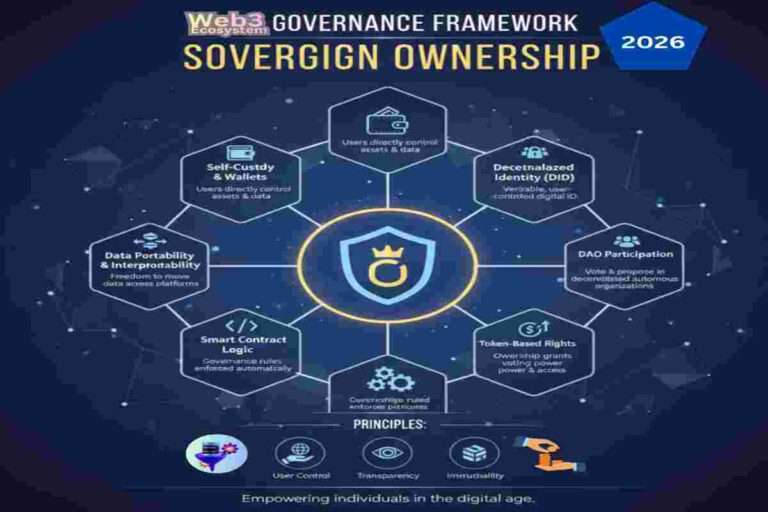
The era of Crypto Market Compliance 2026 marks the convergence of governance, legal oversight, and institutional rigor in the Web3 ecosystem. No longer an afterthought, governance frameworks now define how digital protocols align with MiCA CASP Authorization, the GENIUS Act 2026, and global VASP Licensing standards. This hub explains how structured governance, coupled with Compliance-by-Design, ensures institutional-grade resilience while meeting Supervisory Outcomes in an increasingly regulated market. Whether you are designing smart contract voting, decentralized treasury management, or layered decision hierarchies, this guide provides the blueprint for governance that’s compliant, auditable, and sustainable.
The shift toward Crypto Market Compliance is driven by three converging forces:
| 2022–2024 Era | 2026 Governance Era |
|---|---|
| Experimental DAOs | Institutional governance systems |
| Informal voting | Auditable decision architecture |
| Offshore regulatory arbitrage | MiCA & VASP-aligned compliance |
| Governance by token whales | Role-based accountability |
| Reactive legal strategy | Compliance-by-Design |
Modern governance frameworks now integrate:
The strongest protocols in 2026 are not simply decentralized.
They are governable, auditable, and institutionally resilient.
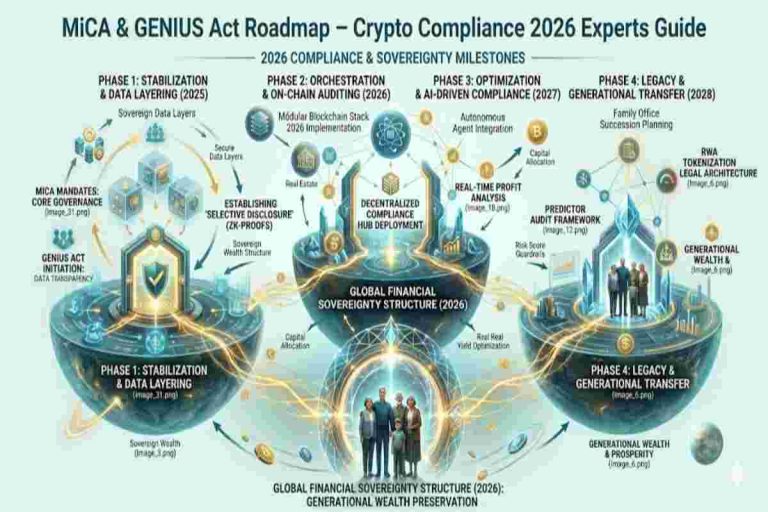
Governance is no longer a DAO voting widget.
It is now the coordination layer connecting:
Without governance frameworks:
Governance is now a systemic requirement for institutional crypto participation.
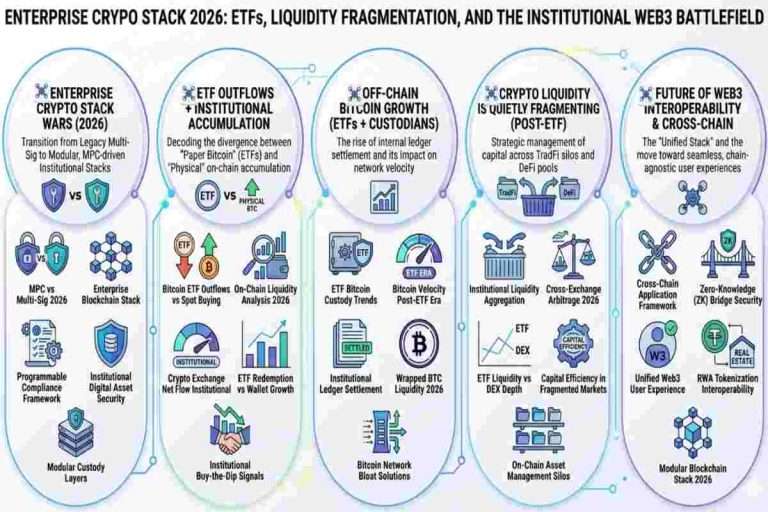
Governance in 2026 isn’t just about protocol rules—it’s about aligning decentralized decision-making with enforceable law. Regional silos are fading as regulators converge on common standards, including the MiCA CASP Authorization in the EU and the GENIUS Act 2026 in the US.
Crypto Market Compliance 2026: The MiCA & GENIUS Act Roadmap
Why read this: A deep dive into the July 2026 MiCA deadline and its impact on global VASP licensing.
Blockchain Regulation 2026: Global Law Changes for Investors
Why read this: How new laws in the UK and US are enabling banks to offer supervised stablecoin issuance.
Stablecoin Reserves & Redemption: The New 2026 Standards
Why read this: Understanding the shift toward high-quality, liquid reserves and par-redemption rights.
Global regulators are converging around common crypto governance standards.
| Region | Regulatory Framework | Governance Impact |
|---|---|---|
| European Union | MiCA CASP Authorization | Mandatory compliance infrastructure |
| United States | GENIUS Act 2026 | Stablecoin reserve and reporting rules |
| United Kingdom | FCA Digital Asset Framework | Institutional custody oversight |
| UAE / Singapore | VASP Licensing | Cross-border operational standards |
| Global FATF Alignment | Travel Rule Expansion | Identity and reporting obligations |
Regulatory convergence is reducing uncertainty while increasing operational expectations.
Protocols now compete on:
The “Four-Year Cycle” is dead. In 2026, market direction is driven by macro-integration and institutional capital flows.
Institutional Crypto Era: Why the 4-Year Cycle Ended in 2026
Why read this: Grayscale’s analysis on how macro demand and regulatory clarity have replaced retail-led boom-bust cycles.
Crypto as Portfolio Allocation: Implementation Quality in 2026
Why read this: Moving beyond single-token bets into systematic, rebalanced exposure for family offices.
Building for 2026 requires reconciling the “Right to Erasure” with the “Immutable Ledger.”
Blockchain GDPR Compliance: Off-Chain Hashing & Erasure
Why read this: Strategies for managing PII (Personally Identifiable Information) while maintaining on-chain integrity.
Zero-Knowledge Proofs (ZKP) for Institutional Verification
Why read this: How to prove accreditation or residency without revealing sensitive personal data.
Executing Institutional-Grade Governance
Governance frameworks must translate strategy into execution:
This module bridges policy and practice, ensuring that governance is not theoretical—it delivers measurable Supervisory Outcomes.
Governance logic defines:
| Governance Model | Strength | Weakness |
|---|---|---|
| Pure Token Voting | High decentralization | Whale concentration |
| Delegated Governance | Operational efficiency | Centralization drift |
| Council + DAO Hybrid | Institutional oversight | Higher complexity |
| Role-Based Governance | Compliance alignment | Reduced anonymity |
Most institutional DAOs now use:
Compliance is no longer external.
In 2026, compliance logic is embedded directly into governance architecture.
| Compliance Component | Purpose |
|---|---|
| AML transaction screening | Prevent illicit flows |
| Smart contract restrictions | Jurisdiction enforcement |
| KYC verification | Institutional onboarding |
| Travel Rule integration | Cross-border reporting |
| Automated audit trails | Supervisory reporting |
User Action
    ↓
Identity Verification (KYC/ZKP)
    ↓
Compliance Rule Engine
    ↓
Transaction Validation
    ↓
Governance Approval Logic
    ↓
Execution & Audit LoggingProtocols with embedded compliance infrastructure onboard institutions significantly faster than governance-light ecosystems.
Governance failures are usually treasury failures.
Modern governance frameworks secure execution through layered authorization systems.
| Security Layer | Function |
|---|---|
| Multi-signature wallets | Distributed authorization |
| MPC authorization | Key fragmentation |
| Time-lock execution | Delayed high-risk actions |
| Transaction simulation | Prevent execution errors |
| Risk scoring engines | Detect abnormal behavior |
| Attack Type | Impact |
|---|---|
| Governance takeover | Treasury theft |
| Flash-loan voting attack | Proposal manipulation |
| Key compromise | Unauthorized execution |
| Sequencer censorship | Governance delays |
Learn more: https://ownprocrypto.com/asset-security-2026/
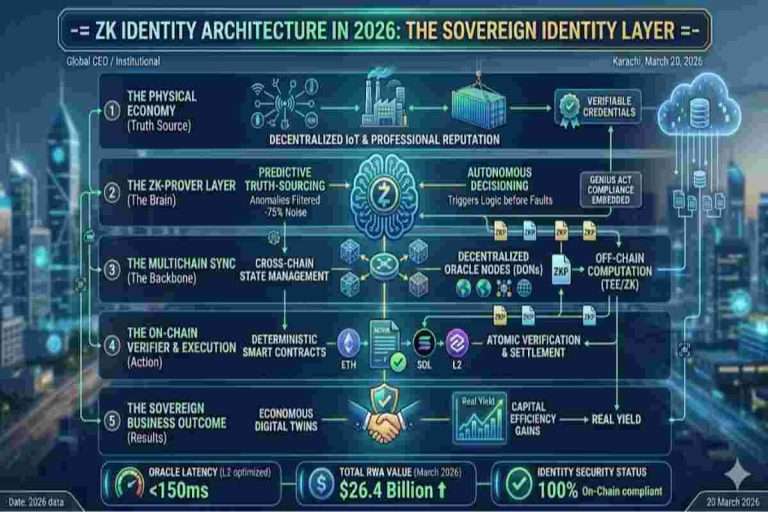
Web3 governance must balance:
| Component | Function |
|---|---|
| Off-chain encrypted storage | Protect sensitive data |
| ZK identity verification | Verify without exposing PII |
| Hash-linked attestations | Immutable compliance proof |
| Revocable credentials | Identity lifecycle management |
Zero-Knowledge Proofs now power:
Without exposing sensitive user data.
Treasury governance now resembles institutional portfolio management.
| Governance Area | Institutional Objective |
|---|---|
| Treasury diversification | Risk management |
| Stablecoin reserve controls | Liquidity stability |
| RWA allocation policies | Yield optimization |
| Treasury reporting | Investor transparency |
| Dynamic rebalancing | Capital efficiency |
Protocols increasingly manage:
Through automated governance frameworks.
Explore: https://ownprocrypto.com/rwa-tokenization-guide-2026/
Modern ecosystems operate across:
Governance must coordinate all of them simultaneously.
| Component | Purpose |
|---|---|
| Cross-chain voting | Unified governance |
| Bridge validation | Secure proposal execution |
| Shared messaging layers | State synchronization |
| Interoperable DAOs | Multi-network coordination |
Fragmented governance creates inconsistent execution across chains.
This is why governance interoperability is now a strategic requirement.
See: https://ownprocrypto.com/blockchain-interoperability-2026/
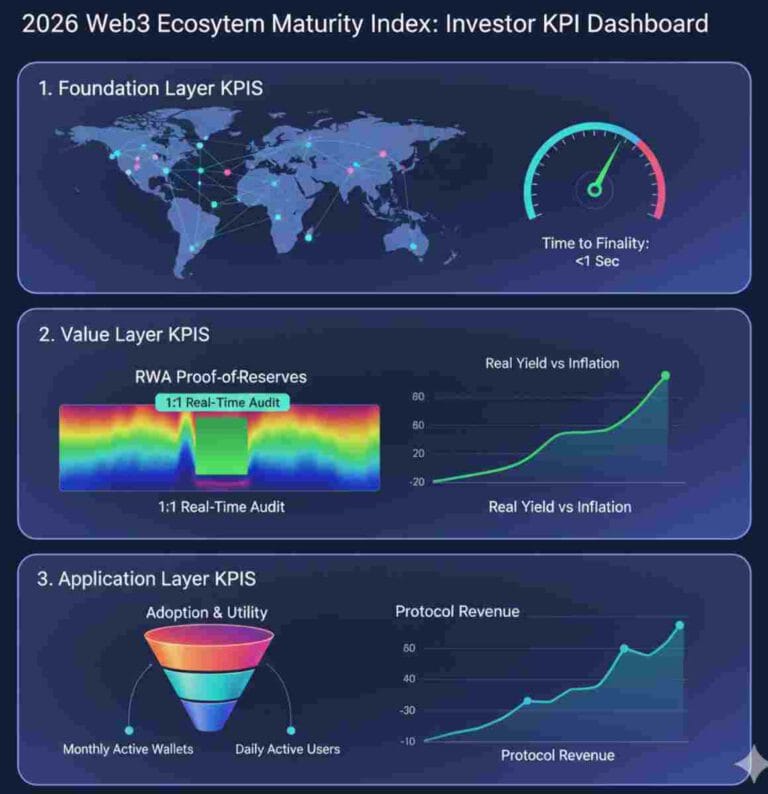
Institutional governance requires measurable oversight.
| KPI | Institutional Benchmark |
|---|---|
| Proposal execution reliability | >99.5% |
| Treasury authorization integrity | Zero unauthorized transfers |
| Governance participation rate | >35% active voting |
| Compliance reporting latency | <24 hours |
| Cross-chain execution consistency | >99% |
Governance Actions
        ↓
Immutable Audit Logs
        ↓
Compliance Analytics Layer
        ↓
Risk Monitoring Dashboard
        ↓
Regulatory Reporting Framework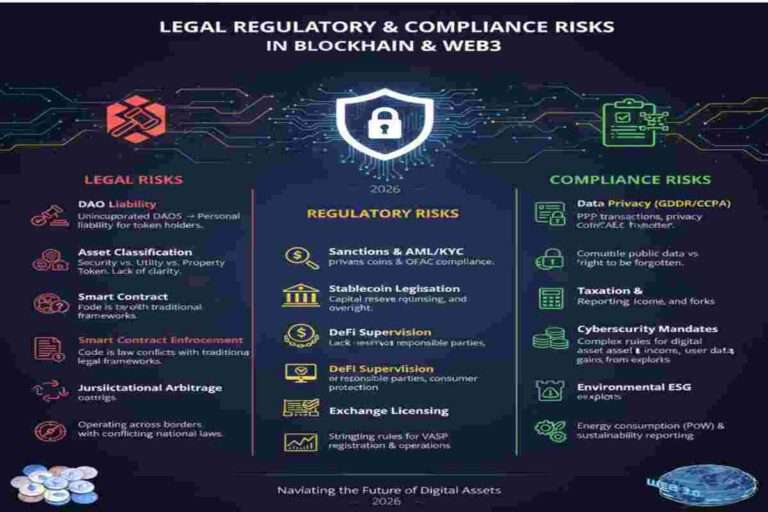
| Risk Area | 2026 Threat | Mitigation Strategy |
|---|---|---|
| Treasury Governance | Multi-sig compromise | MPC + role segmentation |
| DAO Voting | Whale capture | Quadratic voting |
| Cross-Chain Execution | Message inconsistency | ZK verification |
| Compliance Failure | Jurisdiction breach | Compliance-by-Design |
| Identity Exposure | GDPR violations | ZK identity systems |
The “community-only governance” era is fading.
Institutions now demand:
| Trend | Strategic Impact |
|---|---|
| DAO legal entities | Regulatory clarity |
| Programmable compliance | Faster institutional onboarding |
| AI governance monitoring | Automated anomaly detection |
| Real-time treasury analytics | Improved transparency |
| Cross-chain governance hubs | Ecosystem scalability |

Large DAOs now operate similarly to digital sovereign funds.
Key functions include:
Stablecoin frameworks now require:
| Governance Requirement | Purpose |
|---|---|
| Reserve transparency | Maintain trust |
| Redemption guarantees | Liquidity stability |
| Real-time attestations | Regulatory reporting |
| Custody governance | Operational integrity |
Global protocols now coordinate:
Across multiple jurisdictions simultaneously.
┌───────────────────────────────────┐
│ Layer 7 — Auditability & Reporting │
├───────────────────────────────────┤
│ Layer 6 — Cross-Chain Governance   │
├───────────────────────────────────┤
│ Layer 5 — Treasury & Capital Rules │
├───────────────────────────────────┤
│ Layer 4 — Privacy & Identity       │
├───────────────────────────────────┤
│ Layer 3 — Security Controls        │
├───────────────────────────────────┤
│ Layer 2 — Compliance-by-Design     │
├───────────────────────────────────┤
│ Layer 1 — Governance Logic         │
└───────────────────────────────────┘AI systems increasingly assist governance through:
The next evolution is autonomous supervision.
Future governance stacks will include:
The strongest protocols will not be those with the most aggressive decentralization narratives.
They will be the systems with:
I. The Core Infrastructure (Build & Connect)
II. Economic Sovereignty (Adopt & Move)
III. The Sovereign Shield (Secure & Govern)
IV. The Human Element (Legacy & Own)
Web3 Governance Frameworks in 2026 are no longer experimental coordination tools.
They are institutional operating systems.
The transition from policy ambiguity to enforceable governance marks the beginning of a mature digital financial infrastructure where:
The future of Web3 will not be defined by the most speculative protocols.
It will be defined by the systems capable of combining decentralization, compliance, capital efficiency, and institutional trust into a single operational framework.
In 2026, governance is no longer optional infrastructure—it is the operating system of institutional crypto.
The strongest protocols are not the most decentralized—they are the most governable, auditable, and compliant.
It is the foundation of sovereign digital finance.
| Strategic Priority | Why It Matters |
|---|---|
| Compliance-by-Design | Enables institutional adoption |
| Cross-chain governance | Prevents fragmented execution |
| Treasury security | Protects protocol solvency |
| ZK identity systems | Balance privacy with regulation |
| Auditability | Builds regulatory trust |
| Governance interoperability | Enables scalable ecosystems |
What is a Web3 governance framework?
A Web3 governance framework defines how decisions are made, validated, and executed within a blockchain system, including voting mechanisms, treasury control, and compliance rules.
Why is governance critical for Crypto Market Compliance 2026?
Because regulators now evaluate not just assets, but how decisions are made and enforced. Governance ensures alignment with frameworks like MiCA and VASP licensing. See Crypto Market Compliance 2026
3. What is Compliance-by-Design in Web3?
Compliance-by-Design embeds regulatory requirements directly into smart contracts and governance rules, ensuring systems are compliant from deployment rather than after enforcement.
How do DAOs handle regulatory compliance?
Modern DAOs integrate legal wrappers, KYC layers, and structured voting systems to meet regulatory standards while maintaining decentralization.
What is the role of multi-signature wallets in governance?
Multi-signature wallets enforce collective decision-making by requiring multiple approvals before executing transactions. Learn more in Crypto Asset Security 2026.
How does governance impact institutional investment in crypto?
Institutional investors require transparent, auditable governance systems before deploying capital. Weak governance structures often prevent large-scale adoption.
What is Zero-Knowledge Proof (ZKP) governance?
ZKP allows users to prove eligibility (e.g., accreditation or identity) without revealing sensitive data, enabling compliant yet private participation.
How does interoperability affect governance?
Cross-chain ecosystems require governance systems that can operate across multiple networks securely. See Blockchain Interoperability 2026.
What are the biggest risks in Web3 governance?
These risks are addressed in Digital Asset Risk Management Framework 2026.
What does the future of Web3 governance look like?
The future is hybrid governance—combining decentralized decision-making with regulatory compliance, institutional standards, and automated enforcement systems.
Welcome to OwnProCrypto (Own & Pro Crypto) — a next-generation Bitcoin and blockchain education platform where the science of finance meets the power of AI-driven automation.
Our mission is simple: to equip you with the knowledge, frameworks, and tools needed to make smarter financial and business decisions in the Web3 economy.
Beyond analysis, OwnProCrypto focuses on transparency, verifiable data, and practical frameworks that investors and builders can actually use. Our goal is not hype — but clear thinking, disciplined analysis, and long-term value creation in the decentralized economy.
Our Background: Salim (Sam) is the founder and lead researcher behind OwnProCrypto, a Web3 intelligence platform focused on crypto security, digital ownership, stablecoin systems, interoperability, and institutional blockchain infrastructure.
Crypto Tools & Analysis:
Crypto Fundamental Analysis Tool | Protocol Evaluation System | DeFi Risk Analysis Tools | Crypto Portfolio Dashboard | Token Risk vs Reward Tool
Guides:
Crypto Fundamental Analysis | Blockchain Project Evaluation | Tokenomics Analysis | DeFi Protocol Analysis | Capital Efficiency
© 2026 OwnProCrypto — Built for smarter crypto decisions