
Binance Fee & Portfolio Analyzer 2026 · Real-time simulation · Multi-exchange comparison
Table of Contents
Toggle
Binance remains one of the most widely used cryptocurrency exchanges in the world in 2026. Whether you are a beginner buying your first Bitcoin or an active trader managing multiple positions, Binance offers a wide range of tools, trading options, and portfolio features.
But with so many features comes confusion — especially around fees, safety, and whether it is actually worth using compared to other exchanges.
This Binance Review 2026 breaks everything down in a simple and practical way:
fees, features, pros and cons, and how Binance’s portfolio tools help you track your crypto more effectively.
The goal is not to overcomplicate things — but to help you understand if Binance is right for your trading style.
Binance is a global crypto exchange that allows users to:
It is known for:
However, it can feel overwhelming for beginners due to the number of tools available.
Binance provides a full ecosystem for crypto users:
For active users, it is one of the most feature-rich platforms available.
Here is a simple breakdown of Binance trading fees:
| Fee Type | Standard Rate | Notes |
|---|---|---|
| Spot Trading Fee | 0.10% | Maker/Taker same rate |
| Futures Trading Fee | 0.02% / 0.04% | Depends on order type |
| Deposit Fee | Free | Crypto deposits |
| Withdrawal Fee | Network fee only | Depends on blockchain |
| P2P Trading Fee | Usually 0% | Depends on region |
If you use Binance’s native token (BNB), you can reduce trading fees by up to ~25%, which is useful for frequent traders.
| Feature | Binance | Coinbase | Kraken | Bybit |
|---|---|---|---|---|
| Fees | Low | Higher | Medium | Low |
| Ease of Use | Medium | High | Medium | Medium |
| Features | Very High | Basic | Medium | High |
| Liquidity | Very High | High | Medium | High |
| Best For | All traders | Beginners | Security-focused | Derivatives traders |

One of Binance’s strongest features is its portfolio tracking system.
It allows users to:
For active traders, this helps reduce the need for external tracking spreadsheets.
However, beginners may still prefer simpler dashboards.
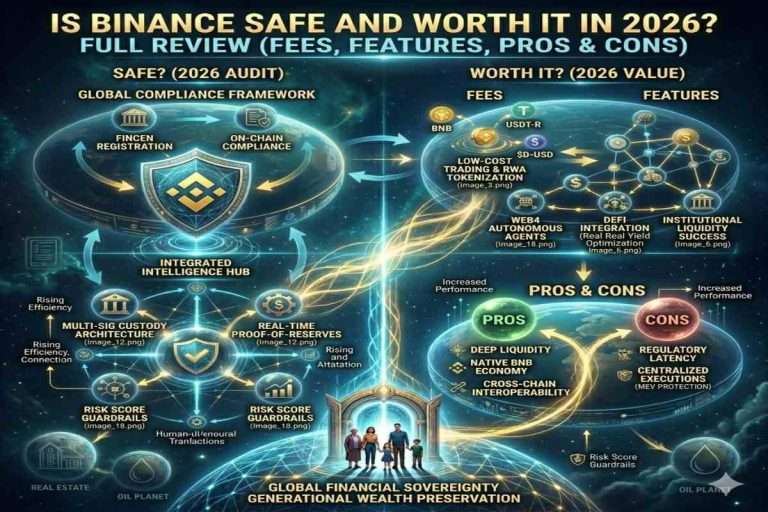
Binance remains one of the most secure exchanges in the industry, using:
That said, no exchange is risk-free. Users should always:
Binance in 2026 is still one of the strongest crypto exchanges in the world.
It is best suited for:
But beginners may need time to adjust to its complexity.
If you understand the platform and use it carefully, Binance offers one of the most complete crypto trading ecosystems available today.
For verified regulatory guidance, check this government/official regulator site: https://www.binance.com/en/academy
If you’re new to crypto, the safest way to start is by building a clear understanding of how everything works before making any investment decisions. Begin with Crypto for Beginners (2026) to learn the basics of Bitcoin, wallets, exchanges, and how people actually use crypto in real life. After that, move to the Crypto Security Guide, which focuses on protecting your funds, avoiding common scams, and setting up proper security habits that most beginners overlook.
These two guides are designed to help you go from confusion to confidence step by step, without unnecessary complexity or risk.

Binance’s spot trading fees start at 0.10% maker/taker, with lower tiers available through VIP levels and BNB discounts. Futures fees are typically 0.02% (maker) / 0.05% (taker) on major perpetual contracts. Fees vary by region and trading type.
Binance uses a maker‑taker model, tiered VIP levels, and discounts for users who pay fees with BNB. Deposit and withdrawal fees depend on asset type and region.
Binance’s analytics tools let you track performance, balances, and trading history. A built‑in portfolio analyzer dashboard helps assess profitability, risk, and allocation across assets — ideal for active traders and long‑term investors. (SERPs summarise overall features > portfolio analysis is key)
Binance supports spot, margin, futures, P2P trading, staking, Launchpad/Launchpool, NFT marketplace, savings, lending, and advanced order types — making it an all‑in‑one crypto ecosystem.
Binance implements strong security measures, such as 2FA, withdrawal whitelisting, and SAFU insurance funds, and also integrates Proof of Reserves signals. However, custodial risk remains inherent to centralized exchanges.
Binance is available in 180+ countries, but certain markets (like the United States) are served through Binance.US with limited products. Regulations continue shaping feature access by region.
You can reduce fees by:
Binance typically supports 450–500+ cryptocurrencies and over 1,000+ trading pairs, giving one of the widest asset selections among global exchanges.
Binance often ranks near the top due to low fees, deep liquidity, advanced tools, and broad product offerings, though rivals like Coinbase and Kraken may appeal for stronger regulatory compliance or simpler UIs.
Fiat fees vary by country and payment method. Crypto deposits are usually free; fiat withdrawals often incur fixed or percentage fees depending on currency and rail (e.g., SEPA for EUR).
Welcome to OwnProCrypto (Own & Pro Crypto) — a next-generation Bitcoin and blockchain education platform where the science of finance meets the power of AI-driven automation.
Our mission is simple: to equip you with the knowledge, frameworks, and tools needed to make smarter financial and business decisions in the Web3 economy.
Beyond analysis, OwnProCrypto focuses on transparency, verifiable data, and practical frameworks that investors and builders can actually use. Our goal is not hype — but clear thinking, disciplined analysis, and long-term value creation in the decentralized economy.
Our Background: Salim (Sam) is the founder and lead researcher behind OwnProCrypto, a Web3 intelligence platform focused on crypto security, digital ownership, stablecoin systems, interoperability, and institutional blockchain infrastructure.
Crypto Tools & Analysis:
Crypto Fundamental Analysis Tool | Protocol Evaluation System | DeFi Risk Analysis Tools | Crypto Portfolio Dashboard | Token Risk vs Reward Tool
Guides:
Crypto Fundamental Analysis | Blockchain Project Evaluation | Tokenomics Analysis | DeFi Protocol Analysis | Capital Efficiency
© 2026 OwnProCrypto — Built for smarter crypto decisions