
Table of Contents
ToggleCrypto airdrops have quietly created some of the most unexpected success stories in the industry. Many people entered crypto with a small investment, but a few lucky early users woke up one day to find thousands of dollars worth of tokens sitting in their wallets. They didn’t trade aggressively or predict market tops, they simply showed up early. The crypto market has always rewarded people who get involved before the crowd arrives. Some of the biggest airdrop payouts in history came from users who interacted with projects long before they became mainstream. Platforms like Uniswap, Arbitrum, and Optimism famously distributed tokens worth thousands of dollars to early community members who were just exploring new tools.
Crypto airdrops in 2026 have evolved from simple social tasks to advanced participation models that reward real on-chain activity, including staking, liquidity provision, and cross-chain interactions. Unlike previous years, the most valuable airdrops now prioritize active users over passive participants, making early engagement and consistent activity essential for maximizing rewards. With many projects distributing tokens before official listings, these airdrops represent one of the most effective ways to earn high-potential crypto assets with zero upfront investment. That’s why crypto enthusiasts constantly search for promising projects before they launch their tokens.
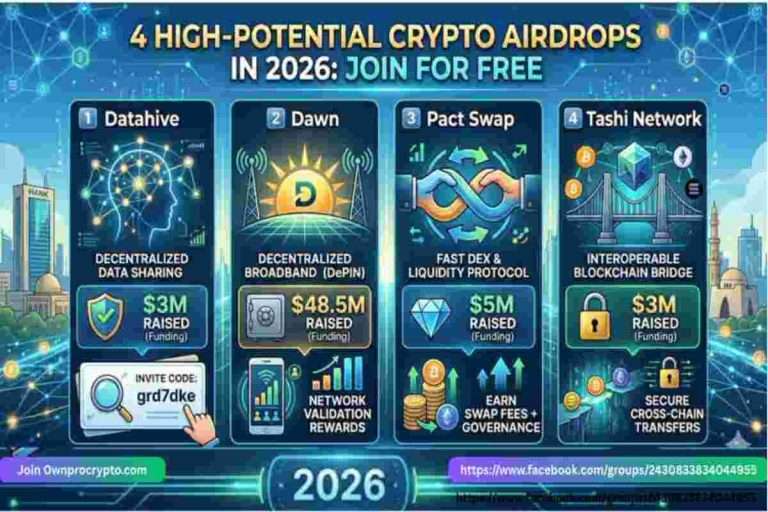
In this guide, we will explore four emerging crypto projects that have already raised millions of dollars in funding and are currently free to join. These include DataHive, Dawn Network, Pact Swap, and Tashi Network. While airdrops are never guaranteed, participating early in strong ecosystems can significantly increase your chances of receiving future rewards. While airdrops provide liquidity, their performance metrics are analyzed through the lens of our Digital Ownership in 2026: Crypto Asset Performance & ROI report. Review safety tips for new token claims at Coingecko.
Crypto airdrops are one of the most effective ways blockchain projects distribute tokens and grow their communities. Instead of spending large marketing budgets, projects reward early supporters who test their products, provide feedback, and help build the ecosystem.
Participating early offers several advantages.
First, early adopters usually receive larger allocations. When a project launches its token, it often distributes a percentage of the supply to users who interacted with the platform before the official launch.
Second, early participation requires minimal investment. Many airdrops only require tasks such as signing up, using a platform, running a node, or installing an application.
Third, strong venture funding can be an early signal of a project’s potential. Venture capital firms often conduct extensive research before investing in blockchain startups. While funding does not guarantee success, it often indicates that the project has a serious team and long-term plans.
The four projects below have already secured millions in funding and are attracting attention from the airdrop farming community.
To qualify for the best crypto airdrops in 2026, users must go beyond basic tasks and actively engage with blockchain ecosystems. This includes interacting with DeFi protocols, providing liquidity, using testnets, participating in governance, and maintaining consistent on-chain activity. Most high-value airdrops now use point-based systems or snapshots to reward genuine users, making early and repeated participation a key strategy for maximizing rewards.
Several early-stage crypto projects are building infrastructure for the next generation of decentralized applications. Among them, DataHive, Dawn Network, Pact Swap, and Tashi Network stand out due to their funding, development progress, and growing communities.
Let’s explore each project and how you can participate.
DataHive is a decentralized data network designed to collect and organize valuable internet data using community participation. The project aims to create a large-scale data infrastructure that can support artificial intelligence, analytics, and decentralized applications.
The project has reportedly raised around $3 million in early-stage funding, which has helped it build its core platform and expand its community.
Instead of traditional mining, DataHive allows users to contribute data through its browser extension or mobile application. Participants earn points for sharing anonymized data and contributing to the network. These points could potentially convert into tokens if the project launches a native cryptocurrency in the future.
This model is similar to other decentralized infrastructure projects where users provide resources and receive rewards later.
For people interested in early crypto opportunities, DataHive is currently one of the easiest projects to join.
Joining DataHive only takes a few minutes and does not require any financial investment.
Many successful airdrops have used similar point systems to track early participation before a token launch.
Dawn Network is another promising blockchain infrastructure project focused on decentralized connectivity and next-generation internet infrastructure.
The project has reportedly raised more than $48 million in funding from venture investors. This level of investment places Dawn Network among the better-funded early-stage crypto projects currently being discussed in the airdrop community.
While the project has not officially confirmed an airdrop, many users believe early interaction with the ecosystem could lead to future rewards. Historically, many blockchain networks have rewarded early testers once their tokens launched.
Dawn Network is still developing its infrastructure and preparing for future ecosystem expansion, which means early participation could be beneficial.
Pact Swap is an emerging decentralized exchange project that focuses on creating efficient and scalable trading infrastructure.
The platform aims to provide users with faster swaps, lower fees, and improved liquidity mechanisms compared to traditional decentralized exchanges.
Reports suggest the project has raised around $5 million in funding to support development and ecosystem growth.
Like many DeFi platforms before launching their native tokens, Pact Swap may reward early traders, liquidity providers, or testers who interact with the platform during its early stages.
Participating in decentralized exchanges early has historically been one of the most profitable airdrop strategies.
For example, early users of dYdX and 1inch received substantial token allocations when those platforms launched their governance tokens.
Tashi Network is another early-stage blockchain infrastructure project that has attracted attention from crypto researchers and early adopters.
The project is focused on building scalable network infrastructure designed to support decentralized services and applications.
Tashi Network has reportedly raised around $3 million in early funding to support development.
Although details about its tokenomics are still limited, projects at this stage often reward early testers, developers, and community contributors through future airdrops or incentive programs.
Because the project is still early, joining its ecosystem now could potentially position users ahead of the majority of participants.

Even though few brand-new crypto airdrops have been announced in April 2026, the current opportunity lies in actively farming ongoing airdrop campaigns. Most high-value projects now reward consistent on-chain activity rather than one-time participation, meaning users who engage early and regularly are more likely to receive significant token allocations. As a result, the focus has shifted from finding new airdrops to maximizing participation in existing ecosystems such as Layer 2 networks, DeFi protocols, and trading platforms that have yet to distribute tokens.
Meaning:
You’re in a “farm now, claim later” cycle
These are NOT new announcements, but:
Participating in airdrops is simple, but maximizing rewards requires a bit of strategy.
First, focus on high-quality projects with strong funding and active development. Many small projects launch every month, but only a few eventually release valuable tokens.
Second, stay active within the ecosystem. Projects often track engagement such as transactions, usage frequency, and community participation.
Third, diversify your participation. Instead of relying on a single project, join multiple promising ecosystems to increase your chances of receiving a valuable airdrop.
Fourth, keep track of your activities. Many experienced airdrop farmers maintain spreadsheets or notes to monitor which platforms they have used and what tasks they completed.
Finally, always prioritize security. Only interact with official websites and avoid connecting your wallet to unknown platforms.

| Problem | Objectives | Analysis / Situation | Implementation | Challenges | Results / Outcomes |
| Users spend hours on airdrops that end up being worth only $5. | To identify “Life-Changing” drops vs. “Dust” drops. | Projects with <$1M funding rarely give big airdrops. Projects with >$3M and Tier-1 VCs have a higher “Reward-to-Effort” ratio. | Filtered 50+ projects to focus only on these 4 based on VC backing and 2026 relevance. | Some projects (like Dawn) have extension bugs due to high traffic. | Users focus 100% of energy on high-probability winners, maximizing ROI on time. |
Q: Are these airdrops really free? A: Yes. These are “Social & Activity” airdrops. You contribute your data, bandwidth, or testing time instead of your money. Rooted in Case Study Failure: Many beginners lose money by “paying” for airdrop access. Real airdrops never ask for your seed phrase or a “fee” to join.
Q: When will I get the actual money? A: Most of these projects are eyeing a Token Generation Event (TGE) in mid-to-late 2026. You collect “Points” now, which convert to tokens later. Rooted in Case Study Failure: Users who stop “farming” after one week often miss the final snapshot. Consistency is the key to qualifying for the highest “tier” of rewards.
Q: What is the new IRS Form 1099-DA, and does it apply to me? A: Yes. Starting in the 2026 tax season, all U.S. brokers (Coinbase, Kraken, and even some DeFi front-ends) must issue Form 1099-DA. This form standardizes crypto reporting by automatically tracking your cost basis and sales proceeds, similar to a 1099-B for stocks. Rooted in Case Study Failure: Investors who previously “manual-calculated” their taxes often faced audits due to mismatched data. The 1099-DA makes manual errors visible to the IRS instantly; ensure your internal tracker (e.g., your .xlsx workbook) matches the exchange’s reported basis.
Q: Is the SEC still pursuing “Regulation by Enforcement” in 2026? A: Largely no. The Digital Asset Market Clarity Act (2026) has finally delineated jurisdiction. The CFTC now oversees “Digital Commodities” (BTC, ETH), while the SEC retains authority over “Tokenized Securities.” This provides the legal “Safe Harbor” institutional CFOs have demanded for years. Rooted in Case Study Failure: Projects that launched without a “Token Taxonomy” analysis in 2024 are now facing massive de-listing risks in 2026. Only trade assets that have a clear “Commodity” or “Registered Security” status to avoid liquidity traps.
Q: How does the EU’s MiCA regulation affect US-based traders? A: If you trade on any platform with European operations, you’ll notice stricter Stablecoin rules. MiCA requires stablecoins (like USDT/USDC) to have 1:1 liquid reserves. If a stablecoin isn’t “MiCA-Compliant,” it may be restricted for EU users, potentially splitting global liquidity. Rooted in Case Study Failure: Traders holding non-compliant algorithmic stablecoins saw 30% “de-pegging” discounts in EU markets during the 2025 transition. Always hold “Tier 1 Regulated” stablecoins for your main liquidity.
Q: Can I use my crypto to buy a house in the USA legally? A: Yes, via RWA (Real World Asset) Tokenization. In 2026, several US-based title companies allow for “on-chain” settlement where the deed is transferred as an NFT alongside a stablecoin payment, provided you pass enhanced KYC/AML checks. Rooted in Case Study Failure: Early adopters who tried “wallet-to-wallet” property sales faced “Title Insurance” rejections. In 2026, you must use a Licensed Tokenization Agent to ensure the deed is legally binding in physical court.
Q: What is the “Wash Sale Rule” status for crypto in 2026? A: The Genius Act closed the loophole. Crypto is now subject to the same Wash Sale Rules as stocks. You can no longer sell at a loss and rebuy immediately to “harvest” tax losses; you must wait 30 days. Rooted in Case Study Failure: Many “pro” traders in 2025 were hit with massive tax bills because they harvested $100k in losses but rebuying within 24 hours meant those losses were legally disallowed by the IRS.
Q: Are decentralized exchanges (DEXs) like Uniswap regulated now? A: The “Front-Ends” are. While the smart contracts remain decentralized, the websites you use to access them (the UI) must now comply with Section 16(a) reporting if they serve US/UK/EU residents. Rooted in Case Study Failure: Users of “unfiltered” DEX front-ends found their wallets “sanctioned” by OFAC-compliant validators. Use “Institutional DeFi” portals to ensure your transactions are included in the next block.
Q: How are ETH Staking rewards taxed in 2026? A: The IRS treats staking rewards as Income at the moment you have “Dominion and Control” (when you can withdraw them). You are taxed on the fair market value at that specific time. Rooted in Case Study Failure: During the 2026 “Bull Run,” users who didn’t sell a portion of their rewards to cover the tax bill were left with a “Paper Gain” tax debt when the market eventually corrected.
Q: What is the “Bitcoin Quantum” threat I keep seeing in news headers? A: It refers to the vulnerability of legacy (P2PKH) addresses to future quantum computers. In 2026, the NIST-compliant “Bitcoin Quantum” testnet was launched to help users migrate to quantum-resistant signatures. Rooted in Case Study Failure: Holders who leave funds in “Satoshi-era” (2009-2012) addresses are at the highest risk. Upgrading to a modern SegWit or Taproot address is now a mandatory “Best Practice” for Tier 1 security.
Q: Can I put Crypto in my 401(k) or IRA? A: Yes, and this is the primary driver of 2026’s “Institutional Vertical” growth. With 100+ Spot ETFs launched, most major providers (Fidelity, BlackRock) offer “Crypto-Linked” retirement tiers. Rooted in Case Study Failure: “Self-Directed IRAs” that held private keys often faced “Prohibited Transaction” penalties from the IRS due to poor record-keeping. Using an ETF wrapper is now the standard for tax-advantaged accounts.
Q: Is “Airdrop Farming” considered a professional business? A: In the UK and USA, if you perform airdrop farming as a primary activity, the FCA/IRS may classify you as a “Trade or Business,” making you liable for Self-Employment tax in addition to Income tax. Rooted in Case Study Failure: Airdrop hunters receiving six-figure sums from projects like Polymarket ($750M pool) or Aztec were reclassified by tax authorities, leading to unexpected 15.3% SE tax hits.
The landscape of crypto airdrops 2026 has moved far beyond the “spray and pray” distribution models of the past, evolving into a sophisticated ecosystem where sustainable growth is the priority. In the early days, projects often distributed free crypto airdrops to anyone with a wallet, a strategy that unfortunately invited bot manipulation and short-term speculators. Today, the best crypto airdrops 2026 are defined by participation-based rewards; protocols now utilize point systems and testnet engagement to ensure tokens reach genuine users. Leading potential crypto airdrops like the DataHive airdrop and Dawn Network airdrop are spearheading this shift by requiring active contributions—such as sharing data or bandwidth—rather than simple sign-ups.
This evolution is most visible within DePIN crypto projects and AI-driven ecosystems, where blockchain incentives are paired with real-world infrastructure. By contributing computing power or internet connectivity, users are engaging in early crypto airdrop farming that rewards long-term network bootstrapping over one-time interactions. As we move through 2026, the trend is clear: projects are favoring consistent, multi-month engagement to build resilient communities. For those seeking the most lucrative opportunities, the strategy is simple: prioritize high-quality projects, contribute to decentralized infrastructure early, and stay active to secure your stake in the next generation of token distributions.
| Feature | Legacy Airdrops (Pre-2024) | 2026 Airdrop Model |
| Eligibility | Simple wallet holding/snapshot. | Sustained network contribution. |
| Primary Sector | Meme coins & Basic DeFi. | DePIN crypto projects & AI. |
| Bot Protection | Minimal / Easy to sybil. | Advanced KYC & Proof-of-Activity. |
| Reward Logic | Speculative awareness. | Infrastructure bootstrapping. |
While “Join for Free” is the entry point, the 2026 airdrop landscape is no longer about random distributions; it is about participation-based ownership. As global entities like the Bank for International Settlements (BIS) (Do-Follow) explore the Project Agorá framework for tokenized deposits, and the OECD (Do-Follow) updates its Crypto-Asset Reporting Framework (CARF), institutional-grade protocols are using airdrops to decentralize their governance. Engaging with these four projects isn’t just about “free tokens”—it’s about establishing Capital Efficiency and early equity in systems that are being built to meet future On-Chain Compliance standards (Internal Link). By mapping these opportunities within your Web3 Ecosystem Architecture (Internal Link), you move from a casual hunter to a sovereign stakeholder.

Crypto airdrops continue to be one of the most exciting opportunities in the blockchain ecosystem. For users willing to explore new platforms and support early-stage projects, the potential rewards can be significant.
DataHive, Dawn Network, Pact Swap, and Tashi Network are four projects that currently stand out due to their funding levels and early development stages.
Although no airdrop is guaranteed, participating early in promising ecosystems has historically been one of the most effective ways to benefit from new crypto projects.
If you want to stay ahead in the airdrop space, keeping an eye on emerging projects and joining them early can make a meaningful difference over time.
For more crypto airdrop guides and updates, visit
https://ownprocrypto.com
And if you want to start with one of the easiest opportunities available right now, you can join DataHive here
https://datahive.ai?invite=grd7dke
Early participation often makes the biggest difference in the world of crypto.
Welcome to OwnProCrypto (Own & Pro Crypto) — a next-generation Bitcoin and blockchain education platform where the science of finance meets the power of AI-driven automation.
Our mission is simple: to equip you with the knowledge, frameworks, and tools needed to make smarter financial and business decisions in the Web3 economy.
Beyond analysis, OwnProCrypto focuses on transparency, verifiable data, and practical frameworks that investors and builders can actually use. Our goal is not hype — but clear thinking, disciplined analysis, and long-term value creation in the decentralized economy.
Our Background
As part of the Web3 Ecosystem Architecture pillar, this guide focuses on Sovereign Ownership Architecture in Web3. Explore related pillars: