
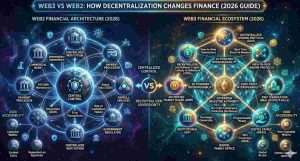
This 2026 guide explores Web3 vs Web2, explaining how decentralization vs centralization influences finance, what permissionless systems enable, the real benefits and trade‑offs, and how this evolution affects users and institutions alike.The transition from Web2 to Web3 is more than a technological upgrade, it represents a fundamental shift in how financial systems operate and who controls them. In Web2, centralized platforms and intermediaries from banks to payment processors mediate value flows, collect fees, and retain custody of user data and funds. In contrast, Web3 envisions a decentralized, blockchain‑powered environment where users retain control over data, digital identity, and value without reliance on a single intermediary.
This shift toward decentralization is the technical core of the architecture we detail in our Web3 Development Guide (2026): Building dApps, Smart Contracts & Ecosystems. Compare legacy web standards at the World Wide Web Foundation.
Web2 is the current dominant form of the internet: an interactive “read‑write” web where users create content and interact with dynamic platforms, but data control and governance remain centralized under large corporations like Google, Meta, and Amazon. Users generate content and value, but platforms collect, analyze, and monetize user data. Centralized services handle identity, payments, and access control — meaning users do not own or control their digital footprints or financial credentials.
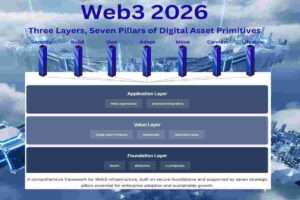
Web3 refers to the next evolutionary phase of the internet, designed on decentralized, blockchain‑based infrastructure. Instead of a centralized architecture, Web3 uses distributed consensus, smart contracts, and public ledgers to enable users to interact directly with protocols and digital assets without intermediaries.
| Feature | Web2 | Web3 |
|---|---|---|
| Control | Centralized platforms | Decentralized networks |
| Data ownership | Platform owns it | User controls it |
| Intermediaries | Required | Eliminated (often) |
| Financial access | Bank / payment processors | Permissionless, blockchain |
| Transparency | Limited | Public and auditable |
Web3 aims to shift power back to the users — giving them ownership of their data, digital assets, and online identity, and reducing dependency on centralized intermediaries.
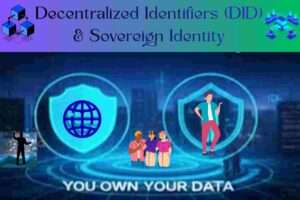
At the heart of Web3 vs Web2 is the contrast between centralization vs decentralization:
These features collectively form the backbone of permissionless finance explained — financial systems that operate without centralized gatekeepers.
Web3 improves finance by replacing centralized intermediaries with decentralized protocols, enabling sovereign ownership of assets. By utilizing smart contracts and real-time proof-of-reserve, it eliminates the need for manual approvals and reduces the “Risk of Centralized Failure” found in legacy systems. This shift ensures capital efficiency through 24/7 automated execution and provides a transparent, on-chain compliance framework for the next era of global wealth.
Web3 finance allows anyone with an internet connection to transact, lend, borrow, or invest — without requiring bank accounts or institutional approval. Decentralized finance (DeFi) protocols provide open access to financial services that were once gated behind centralized institutions.
Transactions on public blockchains are visible and traceable by design, reducing opacity in settlement and auditing processes.
By removing intermediaries, Web3 can reduce settlement times and transaction fees associated with cross‑border payments and traditional finance operations.
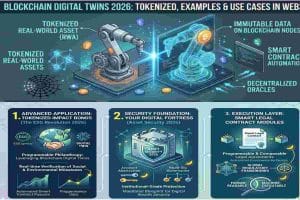
Smart contracts are self‑executing code that enforce transactional conditions without intermediaries. They automate lending, trading, and asset transfers in a secure and transparent manner.
Blockchain provides immutable record‑keeping and decentralized consensus, fundamental for permissionless finance and decentralized applications.
| Use Case | Web2 | Web3 |
|---|---|---|
| Payments | Processed by banks/payments companies | On‑chain transfers via cryptocurrencies |
| Lending | Banks & credit checks | DeFi lending platforms |
| Identity | Third‑party authentication | Blockchain‑based identity |
| Governance | Centralized decisions | DAO decision‑making |
Example: Decentralized exchanges (DEXs) allow peer‑to‑peer token trading without a central custodian, enabling users to retain control of their assets.
Web2 limitations are not just technical — they impact privacy, security, and access to financial services:
Web3’s architecture directly addresses these issues by design.
Despite advancements, Web3 still faces hurdles:
These factors explain why many real‑world applications remain hybrid, relying on both Web2 and Web3 components.

Looking beyond 2026, some technologists envision Web4 — an internet that builds on Web3 principles with enhanced AI, semantic understanding, and more advanced interoperability. This suggests future systems will further blend decentralization with intelligent automation — but the core distinction between Web2 and Web3 remains foundational.
What is the primary difference between Web2 vs Web3 finance in 2026?
Web2 finance relies on centralized custody where institutions hold your assets, while Web3 enables self-sovereign custody where you control your keys.
In 2026, a hybrid model is emerging with transparent back-end ledgers.
the obvious narrative is wrong →
Web3 vs Web2 (2026 Guide)
What went wrong with early Web3 platforms?
Many early platforms claimed decentralization but actually controlled user keys, leading to major losses during hacks.
Modern systems now use MPC wallets to balance ownership and recovery.
this doesn’t match the headlines →
Enterprise Crypto Stack Wars
How does decentralization change a bank account?
It transforms it into a programmable asset where transactions execute automatically via smart contracts without requiring bank approval.
this is where it starts getting interesting →
Web3 Development Guide
Is Web3 finance truly censorship-resistant in 2026?
Pure DeFi remains permissionless, but most institutional systems now use compliance-first models with selective privacy technologies.
look closer →
ZK Identity Architecture
What does “Read-Write-Own” actually mean?
It means users not only interact with systems but also own their assets directly on-chain, removing reliance on intermediaries.
most people still don’t see this part →
Digital Ownership in 2026
Are Web3 transaction fees still higher than Web2 banking fees?
No. With Layer-2 scaling and gas sponsorship, many Web3 transactions cost less than traditional bank transfers.
small detail, big shift →
Stablecoin Payments 2026
How does settlement speed differ between Web2 and Web3?
Web2 systems take days to finalize transactions, while Web3 offers near-instant settlement with deterministic finality.
been tracking this quietly →
Web3 Interoperability 2026
Is money safer in a Web2 bank or a Web3 wallet?
Web2 protects against user mistakes, while Web3 protects against systemic risks like inflation or bank failure.
The strongest approach combines both in a hybrid security model.
this part →
Asset Security 2026
How do Web3 systems handle identity and compliance?
They use on-chain identity solutions and zero-knowledge proofs to verify users without exposing sensitive data.
it’s subtle, but it matters →
Stablecoin Regulations & CBDC
Does Web3 eliminate the need for traditional banks?
It removes the need for centralized ledgers but not financial services, as banks evolve into gateways and advisors.
not everyone’s ready for this yet →
Neo-Banking & Sovereign Finance
What is composability in Web3 finance?
Composability allows different financial services to connect seamlessly, enabling complex strategies within a single transaction.
weird signal forming here →
RWA Tokenization 2026
What is the long-term impact of Web3 on global finance?
Web3 is shifting finance toward open, programmable, and borderless systems where ownership and control are user-centric.
before this flips →
Global Asset Decoupling 2026
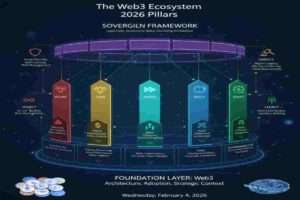
From this foundation, eight operational pillars translate sovereign ownership into execution. Together, these layers form a unified navigation system for the on-chain economy, outlining how individuals, builders, and institutions secure digital assets, establish ownership, transfer value, tokenize real-world assets, build infrastructure, enable interoperability, and preserve digital continuity over time.
The Web3 Ecosystem 2026 Pillars
Each pillar functions independently, while collectively defining the sovereign Web3 lifecycle—from asset security and ownership to long-term digital preservation.
The shift from Web2 to Web3 represents a shift from centralized control toward decentralized, permissionless systems that change how financial services are accessed, executed, and governed. While challenges remain in usability and adoption, the structural differences have already started reshaping finance, enabling new models for ownership, transparency, and inclusion.
For readers interested in these dynamics Web3 vs Web2,, exploring DeFi protocols, blockchain identity solutions, and decentralized governance models will provide a practical understanding of how this evolution unfolds.
The 2026 Web3 ecosystem is built on a foundation of On-Chain Compliance and On-Chain Sovereignty, designed to meet global standards for financial transparency. This “Controlled Disclosure” model ensures that decentralized finance operates within legal frameworks, making Web3 distinct from the “Siloed Data” vulnerabilities of Web2.
For essential regulatory context, explore the latest global financial stability standards guiding the institutional crypto landscape.
External Resource: Read the Global Financial Stability Report at IMF.org
Welcome to OwnProCrypto (Own & Pro Crypto) — a next-generation Bitcoin and blockchain education platform where the science of finance meets the power of AI-driven automation.
Our mission is simple: to equip you with the knowledge, frameworks, and tools needed to make smarter financial and business decisions in the Web3 economy.
Beyond analysis, OwnProCrypto focuses on transparency, verifiable data, and practical frameworks that investors and builders can actually use. Our goal is not hype — but clear thinking, disciplined analysis, and long-term value creation in the decentralized economy.
Our Background: Salim (Sam) is the founder and lead researcher behind OwnProCrypto, a Web3 intelligence platform focused on crypto security, digital ownership, stablecoin systems, interoperability, and institutional blockchain infrastructure.
Crypto Tools & Analysis:
Crypto Fundamental Analysis Tool | Protocol Evaluation System | DeFi Risk Analysis Tools | Crypto Portfolio Dashboard | Token Risk vs Reward Tool
Guides:
Crypto Fundamental Analysis | Blockchain Project Evaluation | Tokenomics Analysis | DeFi Protocol Analysis | Capital Efficiency
© 2026 OwnProCrypto — Built for smarter crypto decisions