
Table of Contents
Toggle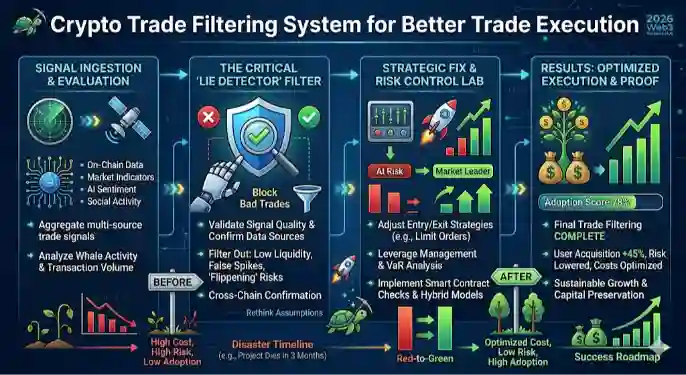
Most trading losses happen before the trade is even placed.
The problem is not execution — it is entry selection without a structured filter system.
Institutional traders reduce risk not by predicting markets, but by filtering out low-quality trades before capital is exposed.
In the volatile and highly automated crypto markets of 2026, relying solely on raw trading signals is no longer sustainable. Large institutional players and advanced trading bots are constantly manipulating liquidity, creating “bull traps” and “flash crashes” that devour unhedged capital. To survive and thrive, operators must integrate a rigorous “decision logic layer” before any order hits the exchange. This is where a Crypto Trade Filtering System becomes critical. It acts as an automated “gatekeeper,” meticulously validating every entry and exit signal against real-time market structure, depth, and risk context, ensuring that your strategies only capture authentic opportunities and block deceptive market noise.
This framework explains a simple 3-layer system used to filter bad trades before entry.
This is the Signal Layer of the Crypto Trading Intelligence & Risk Systems 2026 framework, operating within a broader institutional infrastructure ecosystem.
It includes three core pillars:
Together, these pillars form a complete institutional-grade trading intelligence model covering signal validation, system failure analysis, and pre-trade filtering. Filtering out bad trades is the primary risk-mitigation step in our Crypto Trading Intelligence & Risk Systems 2026. Learn more about the psychology of trade execution at the CFA Institute.
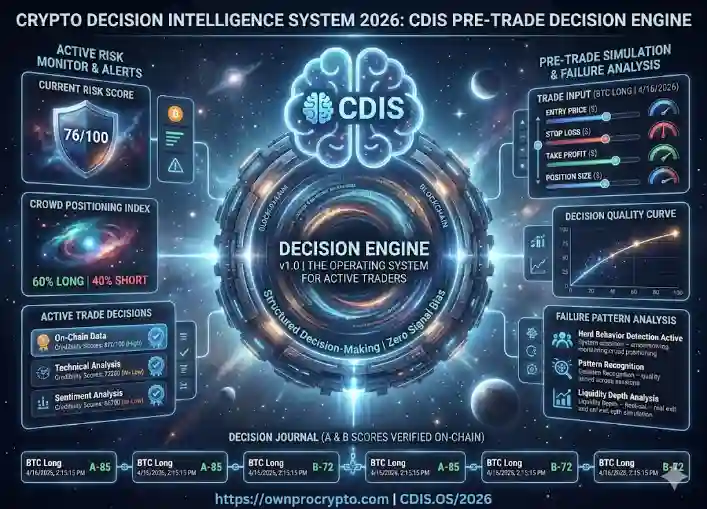
The Crypto Decision Operating System (CDIS) is designed as a complete crypto decision making system, where signal evaluation, trade filtering, and risk logic work together as one unified framework instead of disconnected tools. This article is part of the Crypto Trading Intelligence & Risk Systems 2026 cluster within the broader Institutional Infrastructure ecosystem. This cluster focuses specifically on how institutional traders evaluate signals, manage risk, and execute trades using structured frameworks instead of emotional or signal-based decision-making.
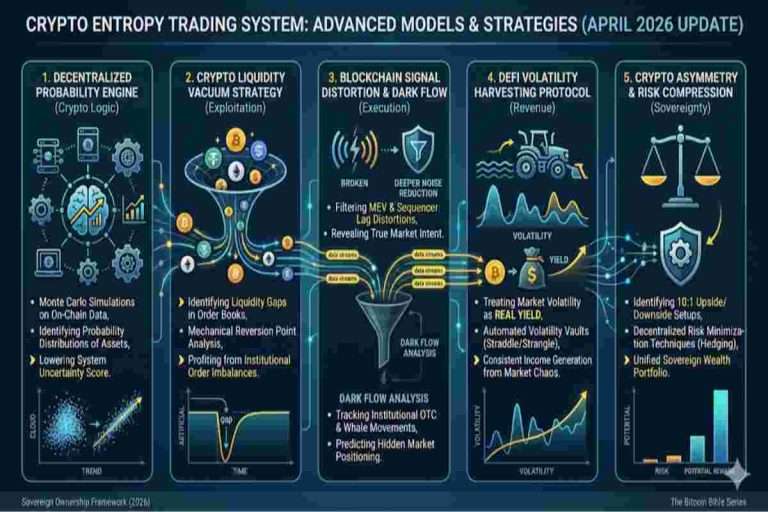
Professional traders do not ask:
They ask:
This shift alone eliminates most low-quality setups.
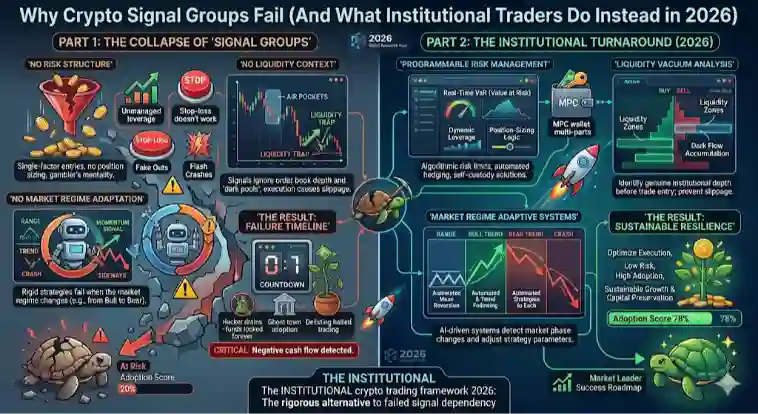
Before analyzing any setup, identify the market condition:
If market context is unclear → no trade.
Next, evaluate where price is operating:
Poor liquidity location = high probability failure.
This is the most ignored filter:
If emotional bias exists → no trade.
A trade is only valid if ALL conditions pass:
If any layer fails → the trade is discarded.

This system does not aim to increase win rate.
It aims to:
Retail traders:
Institutional traders:
Profitability in trading comes from what you do not trade, not what you trade.
What is a crypto trade filtering system?
A crypto trade filtering system is a structured decision framework used to eliminate low-quality trades before execution. crypto trade entry filter system evaluates market structure, liquidity conditions, and risk factors to ensure only high-probability setups are considered.
Why is a trade filtering system important in crypto trading?
Without a filtering system, traders are exposed to noise, emotional decisions, and low-quality setups. Filtering acts as the first layer of defense, preventing unnecessary losses before they occur.
How do professional traders filter trades?
Professional traders analyze market context, identify liquidity zones, and assess risk exposure before considering execution. professional trading framework crypto only act when multiple conditions align within a structured trading framework.
What is the best strategy for crypto trading?
There is no single best strategy, but consistently effective approaches combine a trade filtering system, strict risk management rules, and a structured execution process. The focus is on avoiding poor trades rather than chasing every opportunity.
Why do most traders overtrade?
Overtrading usually happens when traders lack a filtering system and rely on emotions such as fear of missing out or urgency. Without clear criteria, every market move appears like an opportunity.
How to avoid bad crypto trades?
Bad trades can be avoided by applying a strict entry filter. This includes validating market structure, confirming liquidity conditions, and ensuring a favorable risk-to-reward ratio before entering any position.
What is liquidity in trading?
Liquidity refers to areas where large clusters of orders or stop-losses exist. These zones often attract price movement, as they provide the volume needed for larger participants to enter or exit positions.
What is emotional bias in trading?
Emotional bias occurs when decisions are driven by fear, greed, or impatience instead of structured analysis. It is one of the primary reasons traders ignore their own rules and take low-quality trades.
What is a crypto risk management system?
A crypto risk management system is a structured approach to controlling losses, managing position size, and protecting capital. It ensures that no single trade significantly impacts overall portfolio performance.
How does a filtering system improve risk management?
A filtering system reduces the number of trades taken, which naturally lowers exposure to risk. By only allowing high-quality setups, it improves overall trade selection and helps maintain consistent risk control.
What is DSARAE in crypto risk management?
DSARAE is a structured digital asset risk assessment framework used to evaluate exposure, volatility, and systemic portfolio risk within a broader risk management system.
Learn more: https://ownprocrypto.com/digital-asset-risk-management-framework/
What is MPC wallet architecture?
MPC (Multi-Party Computation) wallet architecture distributes private key control across multiple parties, reducing single-point failure risk in crypto custody systems.
Learn more: https://ownprocrypto.com/mpc-vs-multi-sig-crypto-custody/
What is a real example of failure without a trade filtering system?
In one case, a trading system suffered significant losses after entering a position during a low-liquidity environment without proper validation. The absence of a filtering framework led to entry into a liquidity trap that could have been avoided with structured trade criteria.
A trader’s edge is not in finding more trades.
It is in consistently filtering out bad ones before capital is exposed.
Ultimately, the most profitable trades are the ones you don’t take. A robust Crypto Trade Filtering System transforms a purely predictive strategy into a resilient, risk-aware execution framework. In the professional Web3 environment of 2026, where capital preservation is prioritized over speculative spikes, this systematic approach shifts your operational profile from “At Risk” to “Sustainable Growth.” By moving from reactive signal dependency to proactive trade filtering, you can consistently achieve optimized execution, lower systemic risk, and generate verified, verifiable proof of your trading intelligence. This isn’t just a strategy for 2026; it’s the definitive framework for institutional survivability.
Welcome to OwnProCrypto (Own & Pro Crypto) — a next-generation Bitcoin and blockchain education platform where the science of finance meets the power of AI-driven automation.
Our mission is simple: to equip you with the knowledge, frameworks, and tools needed to make smarter financial and business decisions in the Web3 economy.
Beyond analysis, OwnProCrypto focuses on transparency, verifiable data, and practical frameworks that investors and builders can actually use. Our goal is not hype — but clear thinking, disciplined analysis, and long-term value creation in the decentralized economy.
Our Background: Salim (Sam) is the founder and lead researcher behind OwnProCrypto, a Web3 intelligence platform focused on crypto security, digital ownership, stablecoin systems, interoperability, and institutional blockchain infrastructure.
Crypto Tools & Analysis:
Crypto Fundamental Analysis Tool | Protocol Evaluation System | DeFi Risk Analysis Tools | Crypto Portfolio Dashboard | Token Risk vs Reward Tool
Guides:
Crypto Fundamental Analysis | Blockchain Project Evaluation | Tokenomics Analysis | DeFi Protocol Analysis | Capital Efficiency
© 2026 OwnProCrypto — Built for smarter crypto decisions