Digital asset risk management is no longer an optional layer for institutional allocators—it is now core infrastructure for sovereign capital preservation. As digital assets evolve into a permanent asset class, the absence of a unified digital asset risk management framework has created structural gaps across custody, governance, compliance, and long-term survivability. Unlike traditional finance, which operates under standardized Basel-aligned models, institutional crypto risk management remains fragmented, exposing portfolios to crypto counterparty risk management failures, governance failures, including governance dilution risk in crypto, regulatory uncertainty, and asset inaccessibility scenarios.
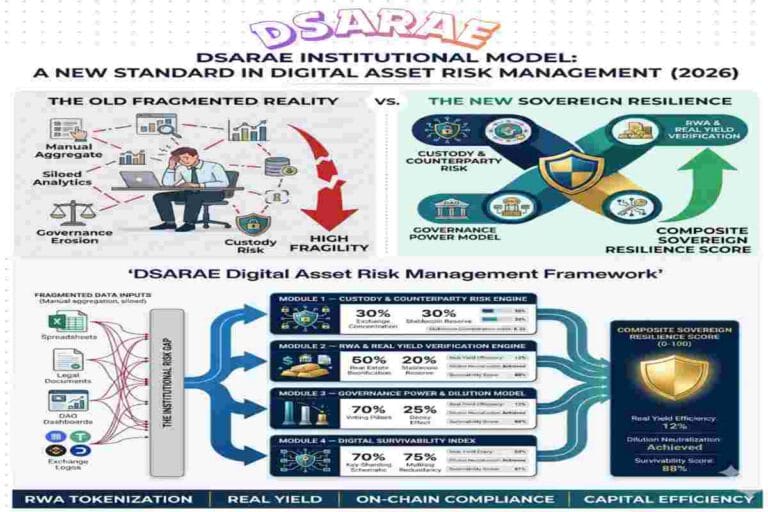
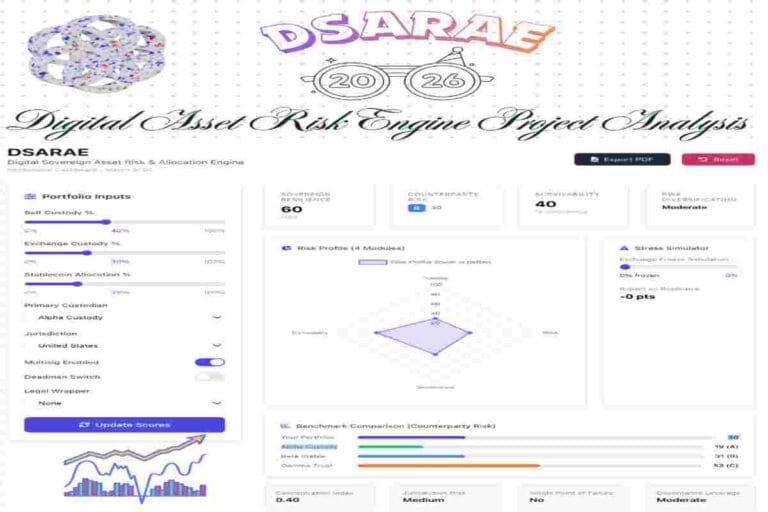
The Digital Sovereign Asset Risk & Allocation Engine (DSARAE) introduces a sovereign-grade, quantitative framework designed to transform crypto risk management into a structured institutional discipline. As an advanced digital asset allocation framework, it provides institutions with a systematic approach to managing risk alongside capital deployment. At its core, the DSARAE model calculates a Sovereign Resilience Score—a dynamic index that measures the durability, security, and long-term viability of a digital asset portfolio. This score integrates four critical dimensions: custody risk, survivability planning, governance structure, and real-world asset (RWA) diversification, providing a holistic view of portfolio resilience beyond simple price volatility.
Designed for family offices, institutional investors, hedge funds, compliance officers, and sovereign wealth managers, DSARAE bridges the gap between crypto-native infrastructure and institutional crypto risk frameworks. Through an interactive model, users can simulate real-world stress scenarios—such as exchange freezes, jurisdictional shifts, or governance failures—while dynamically adjusting portfolio parameters like self-custody allocation, multisignature governance, and legal structuring.
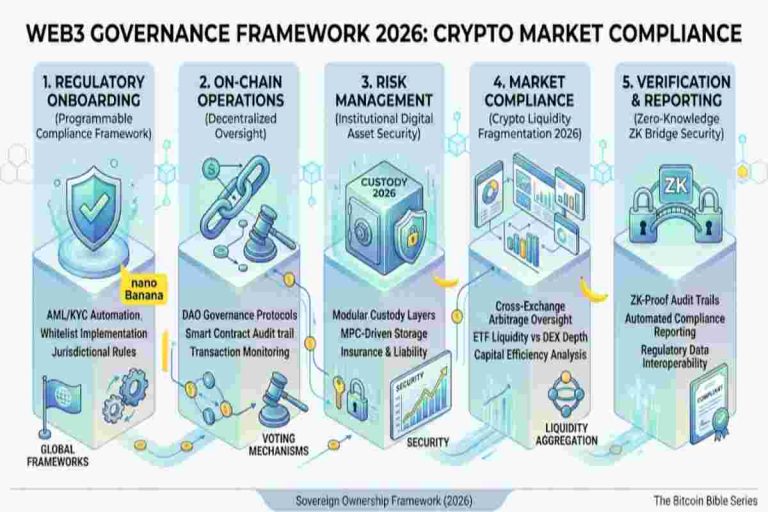
The result is not just analysis, but actionable intelligence. DSARAE enables users to identify structural weaknesses, optimize their digital asset stack, and build a clear roadmap toward higher resilience—transforming fragmented crypto exposure into a secure, compliant, and institution-ready portfolio architecture. This model provides the high-level resilience strategy required for our Web3 Governance Framework. Review the Financial Stability Board (FSB) for institutional risk benchmarks.
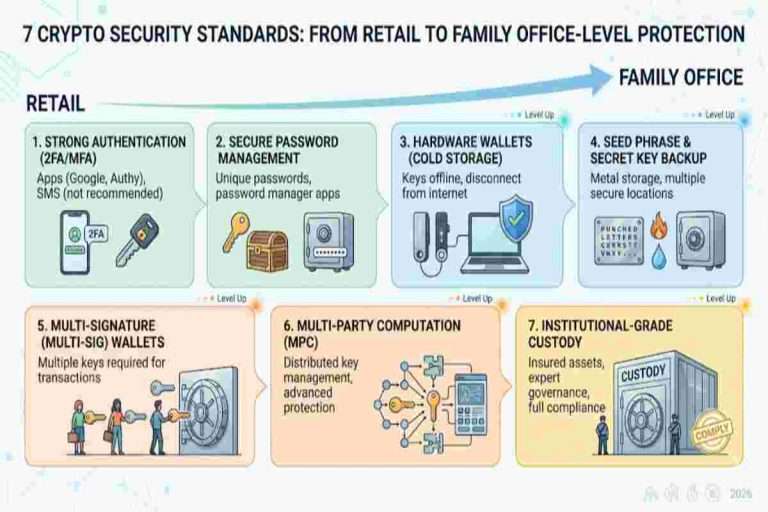
Table of Contents
ToggleIInstitutional adoption of digital assets has accelerated — yet structural risk aggregation remains incomplete. Unlike equities, fixed income, or real estate, there is no universally adopted digital asset risk scoring model.
Allocators must manually integrate:
These inputs remain siloed across custodians, analytics firms, legal advisors, and DAO dashboards.
The DSARAE Digital Asset Risk Management Framework standardizes:
The output is not volatility measurement.
It is structural fragility detection.
Institutional investors face three unresolved structural deficiencies:
Traditional finance uses credit ratings.
Digital assets rely on fragmented analytics.
DSARAE introduces weighted counterparty modeling:
This creates a standardized 0–100 Counterparty Risk Score aligned with institutional audit expectations.
DAO participation introduces political capital exposure.
Token ownership does not equal influence.
DSARAE quantifies:
Aggressive unlock schedules elevate governance dilution risk and directly impact capital efficiency.
This converts political exposure into measurable structural metrics.
Volatility is not the primary institutional threat.
Structural permanence is.
Core question:
If the principal becomes incapacitated, can the portfolio be recovered without litigation or key loss?
The DSARAE Digital Survivability Index evaluates:
No standardized digital asset survivability index existed before.
This gap is now closed.
Objective: Quantify probability of asset impairment.
Weighted Factors:
Outputs:
Lower scores indicate higher structural resilience.
Differentiates asset-backed yield from token-incentivized emissions.
Assessed Categories:
Core Metrics:
Only sustainable, asset-backed yield qualifies as real yield.
Measures political and economic leverage inside DAOs.
Key Outputs:
Institutions entering DAO governance without dilution modeling risk silent capital erosion.
Quantifies structural permanence.
Dimensions:
Outputs:
This module addresses the most under-modeled institutional risk dimension.tional risk dimension.
The Digital Asset Risk Management Framework benchmarks:
Reproducibility and audit defensibility are built into the methodology.
Unlike surface-level analytics platforms, DSARAE integrates:
Analytics report ? what happened?
A standardized framework models structural collapse before it occurs.

Emerging layer additions include:
Institutional crypto is moving toward Basel-style structural modeling.
DSARAE aligns digital assets with sovereign capital standards.

The Digital Asset Risk Management Framework is not a retail tool; it is designed for sophisticated allocators who prioritize Capital Efficiency and structural permanence over short-term speculation.
Diversified custody architecture prevented liquidity collapse during exchange freeze events.
Initial Counterparty Score: 82/100
Concentration Index: 0.75
Post-Implementation Score: 75 (from 30)
Diversification across custody layers prevented liquidity collapse during regulatory freeze events.
Initial Veto Probability: 0%
Dilution Rate: 4% quarterly
Outcome: 12% capital efficiency improvement
Shift toward asset-backed RWA governance participation stabilized influence metrics.
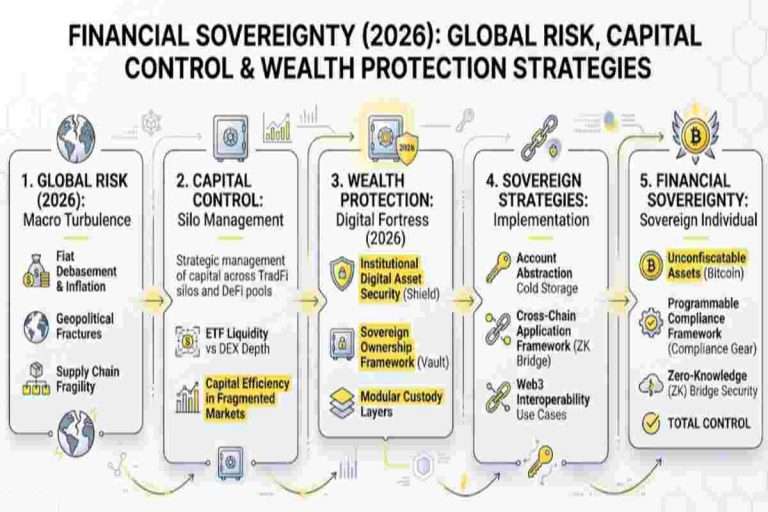
As we look toward the remainder of 2026, the shift from “speculative growth” to Structural Resilience will accelerate. The DSARAE model is evolving to include AI-driven predictive modeling for On-Chain Compliance and automated rebalancing for Real Yield optimization. Institutions that adopt this Digital Asset Risk Management Framework now will be the “Sovereign” entities of the next decade, while those relying on fragmented, legacy models will face increasing fragility. The goal of the DSARAE engine is simple: to make institutional crypto not just profitable, but permanent.
Shift toward RWA-backed governance participation stabilized political exposure.
| Metric | Pre-DSARAE | Post-DSARAE | Structural Impact |
|---|---|---|---|
| Counterparty Risk Score | 82 | 45 | Reduced custody fragility |
| Concentration Index | 0.75 | 0.32 | Lower exchange dependency |
| Governance Influence | 38 | 71 | Improved veto capacity |
| Survivability Score | 40% | 88% | Estate continuity secured |
| Real Yield Efficiency | 5% | 12% | Asset-backed yield shift |

What is a Digital Asset Risk Management Framework?
A Digital Asset Risk Management Framework is a structured methodology for identifying, quantifying, and mitigating blockchain-native risks. It evaluates custody exposure, governance dilution, smart contract vulnerabilities, and stablecoin payment system risks. Unlike traditional financial models, it measures structural survivability—not just price volatility.
Why is a Digital Asset Risk Management Framework essential for institutional investors?
Institutional capital requires more than market analytics. It provides structured oversight across Web3 governance frameworks and real-time on-chain monitoring. In 2026, digital assets demand system-level risk controls comparable to regulated financial markets.
How does digital asset risk management differ from traditional risk models?
Traditional frameworks prioritize volatility and credit risk. Digital asset models must additionally assess custodial transparency and blockchain interoperability risks. The focus shifts from market fluctuation to structural fragility.
Digital asset risk models must additionally assess:
What risks are measured within a Digital Asset Risk Management Framework?
Core risks include counterparty concentration, crypto asset security infrastructure weaknesses, and regulatory ambiguity. These risks are quantified into scoring models to evaluate systemic vulnerability.
Can a Digital Asset Risk Management Framework predict stablecoin de-pegging?
No framework can predict exact timing.
However, it identifies structural weaknesses — such as excessive allocation to a single stablecoin or opaque reserve reporting — that increase vulnerability. Learn more in our stablecoin payments architecture guide.
How is custody risk evaluated within a blockchain risk framework?
Custody risk is assessed through infrastructure design, key management, and redundancy controls. For a deeper breakdown, see the crypto asset security blueprint.
What is governance dilution and why does it matter?
Governance dilution occurs when token supply inflation or fragmented voting power reduces influence over protocol decisions. Advanced models evaluate this within a Web3 governance framework to ensure long-term control integrity.
Why is real yield prioritized over token emissions?
Frameworks prioritize yield backed by real economic activity, especially from RWA tokenization strategies, where returns are tied to productive assets rather than inflationary incentives.
How often should a Digital Asset Risk Management Framework be updated?
At minimum, quarterly. However, institutional systems adapt continuously due to evolving on-chain data and [crypto market compliance changes]Market Compliance 2026: Navigating the Institutional Mandate/).
Institutional-grade Digital Asset Risk Management Framework architecture must align with formal regulatory guidance and public enforcement standards. Structural resilience cannot be evaluated in isolation from sovereign oversight. Framework calibration should incorporate enforcement disclosures, investor protection guidance, and digital asset compliance directives published by government authorities such as the U.S. Securities and Exchange Commission (SEC) (https://www.sec.gov), the Commodity Futures Trading Commission (CFTC) (https://www.cftc.gov), and the Financial Crimes Enforcement Network (FinCEN) (https://www.fincen.gov). Integrating regulatory enforcement data, public litigation releases, and compliance bulletins into counterparty scoring models enhances audit defensibility and institutional credibility. Sovereign allocators increasingly require that digital asset survivability planning and crypto counterparty risk assessment be benchmarked against transparent government regulatory frameworks rather than relying solely on private analytics providers.
Digital assets introduce structural risks that do not exist in traditional financial markets. Custody architecture, governance mechanics, jurisdictional enforcement, smart contract design, and stablecoin dependencies all create interconnected fragilities that require disciplined oversight.
A well-designed Digital Asset Risk Management Framework transforms these uncertainties into measurable variables. Instead of reacting to volatility after disruption occurs, institutions can proactively assess concentration exposure, survivability, and structural resilience before capital is impaired.
In 2026, digital asset allocation without formalized risk architecture is no longer a competitive strategy — it is an unmanaged liability. Durable performance increasingly depends on structural integrity, transparency, and continuous monitoring.
Digital asset success is not defined by yield or price appreciation alone — it is defined by structural resilience.
Institutions that implement a disciplined risk framework gain clarity, capital efficiency, and survivability in a market where fragility compounds quickly. Those that do not remain exposed to concentration shocks, governance dilution, and systemic failures that traditional models were never designed to detect.
Welcome to OwnProCrypto (Own & Pro Crypto) — a next-generation Bitcoin and blockchain education platform where the science of finance meets the power of AI-driven automation.
Our mission is simple: to equip you with the knowledge, frameworks, and tools needed to make smarter financial and business decisions in the Web3 economy.
Beyond analysis, OwnProCrypto focuses on transparency, verifiable data, and practical frameworks that investors and builders can actually use. Our goal is not hype — but clear thinking, disciplined analysis, and long-term value creation in the decentralized economy.
Our Background: Salim (Sam) is the founder and lead researcher behind OwnProCrypto, a Web3 intelligence platform focused on crypto security, digital ownership, stablecoin systems, interoperability, and institutional blockchain infrastructure.
Crypto Tools & Analysis:
Crypto Fundamental Analysis Tool | Protocol Evaluation System | DeFi Risk Analysis Tools | Crypto Portfolio Dashboard | Token Risk vs Reward Tool
Guides:
Crypto Fundamental Analysis | Blockchain Project Evaluation | Tokenomics Analysis | DeFi Protocol Analysis | Capital Efficiency
© 2026 OwnProCrypto — Built for smarter crypto decisions