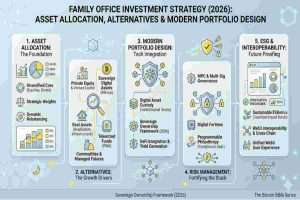
Family Office Investment Strategy defines how capital is allocated, managed, and grown across generations.
While traditional investors focus on returns, family offices operate differently — prioritizing:
In 2026, investment strategy is evolving beyond stocks and bonds into multi-asset, globally integrated portfolios, including private markets and digital assets. Modern asset allocation requires the strategic foresight found in our Legacy & Sovereignty: Securing Your Digital Life Beyond You (2026). For more on alternative investment benchmarks, visit Preqin.
Recent trends shaping strategy:
This reflects a major shift:
from passive allocation → active strategic positioning.
Family offices follow a structured investment approach rather than ad-hoc decisions.
| Step | Function |
|---|---|
| Strategy | Define goals & risk |
| Allocation | Distribute capital |
| Execution | Deploy investments |
| Monitoring | Track performance |
| Rebalancing | Adjust portfolio |
Strategy determines outcomes more than individual investments.

Asset allocation is the foundation of portfolio strategy.
| Asset Class | Role |
|---|---|
| Equities | Growth |
| Fixed Income | Stability |
| Real Estate | Income + diversification |
| Private Equity | High returns |
| Alternatives | Risk diversification |
Family offices are increasing allocation to:
alternatives + private markets
This is where family offices outperform traditional investors.
| Traditional | Modern |
|---|---|
| Public markets | Private + alternative |
| Passive investing | Active + direct |
| Static allocation | Dynamic allocation |
Strategy is becoming:
adaptive + data-driven
Family offices manage risk through:
Digital assets are emerging as a new allocation category.
Most family offices:
start with small allocations
scale with understanding
These issues highlight the need for:
structured architecture + governance
Investment strategy does not operate in isolation.
Strategy depends on:
Internal link:
Digital Family Office Architecture
Looking ahead:
Investing is becoming:
system-driven, not manager-driven
Family office investing is evolving from traditional portfolio allocation into a multi-asset, technology-driven system.
most people still don’t see this part →
Family Office Investment Strategy (2026)
What is a family office investment strategy?
It is a structured framework for managing and allocating wealth across multiple asset classes with a focus on long-term preservation and growth.
this is where it starts getting interesting →
Family Office (2026)
How do family offices allocate assets?
They diversify capital across equities, fixed income, real estate, and alternative investments to balance risk and returns.
small detail, big shift →
Global Asset Decoupling 2026
What is the role of asset allocation?
Asset allocation determines how capital is distributed, directly impacting portfolio performance and risk exposure.
look closer →
Digital Ownership in 2026
Why do family offices invest in alternative assets?
Alternatives such as private equity, hedge funds, and digital assets offer diversification and potential for higher returns.
this doesn’t match the headlines →
RWA Tokenization 2026
Are digital assets part of family office portfolios?
Yes, digital assets are becoming a small but growing allocation within diversified portfolios.
weird signal forming here →
Crypto Trends 2026
How do family offices approach crypto investments?
They typically use a cautious approach, combining institutional custody, risk controls, and long-term positioning.
this part →
Institutional Asset Security
How do family offices manage investment risk?
Risk is managed through diversification, strategic allocation, governance frameworks, and continuous monitoring.
don’t ignore this →
Family Office Governance
What makes family office strategies different from retail investing?
They prioritize long-term wealth preservation, capital protection, and intergenerational planning over short-term gains.
the obvious narrative is wrong →
Generational Wealth 2026
What challenges do family offices face in investing?
Common challenges include access to quality deals, fragmented data systems, and governance complexity.
been tracking this quietly →
Enterprise Crypto Stack
How is technology changing family office investment strategy?
Technology enables real-time analytics, automation, and more efficient portfolio management decisions.
it’s subtle, but it matters →
AI in Crypto & Markets
What role does automation play in modern portfolios?
Automation helps streamline execution, risk monitoring, and reporting across global asset classes.
this is early, not obvious →
Web4 Trends 2026
What is the future of family office investing?
The future is system-driven, combining AI, digital assets, and global diversification into a unified investment framework.
before this flips →
Digital Family Office Architecture
A strong Family Office Investment Strategy is not about chasing returns — it is about designing a system that:
This strategic layer connects foundational knowledge with advanced architecture, forming the backbone of modern wealth management.
For official guidance on digital asset risks, compliance, and investor protection, refer to global regulatory frameworks and public advisories.
this doesn’t match the headlines → U.S. SEC Cybersecurity & Digital Asset Guidance
Welcome to OwnProCrypto (Own & Pro Crypto) — a next-generation Bitcoin and blockchain education platform where the science of finance meets the power of AI-driven automation.
Our mission is simple: to equip you with the knowledge, frameworks, and tools needed to make smarter financial and business decisions in the Web3 economy.
Beyond analysis, OwnProCrypto focuses on transparency, verifiable data, and practical frameworks that investors and builders can actually use. Our goal is not hype — but clear thinking, disciplined analysis, and long-term value creation in the decentralized economy.
Our Background: Salim (Sam) is the founder and lead researcher behind OwnProCrypto, a Web3 intelligence platform focused on crypto security, digital ownership, stablecoin systems, interoperability, and institutional blockchain infrastructure.
Crypto Tools & Analysis:
Crypto Fundamental Analysis Tool | Protocol Evaluation System | DeFi Risk Analysis Tools | Crypto Portfolio Dashboard | Token Risk vs Reward Tool
Guides:
Crypto Fundamental Analysis | Blockchain Project Evaluation | Tokenomics Analysis | DeFi Protocol Analysis | Capital Efficiency
© 2026 OwnProCrypto — Built for smarter crypto decisions