
Table of Contents
ToggleUnderstanding the distinct architecture of digital assets is crucial for navigating modern Web3 infrastructure. While Bitcoin operates as a decentralized, non-sovereign store of value with a hard-capped supply, its inherent price volatility makes it a speculative asset or long-term inflation hedge rather than a predictable medium of exchange. In contrast, stablecoins are specifically engineered to maintain price parity with external references, such as fiat currencies or tokenized real-world assets.
This core difference shapes their distinct transactional use cases. Bitcoin is primarily deployed for capital preservation and sovereign digital ownership, whereas stablecoins excel in day-to-day operations, remittance corridors, and decentralized finance (DeFi) settlement layers. For institutional payments, stablecoins provide transformative benefits over both traditional banking rails and volatile cryptocurrencies: they eliminate settlement delays by enabling instant, programmable cross-border transactions, significantly lower intermediary transaction fees, and completely remove price slippage risks during transit. By combining the transaction speed and cryptographic security of blockchain technology with the pricing predictability of traditional fiat, stablecoins have become the primary utility asset for global on-chain commerce and real-time treasury management.
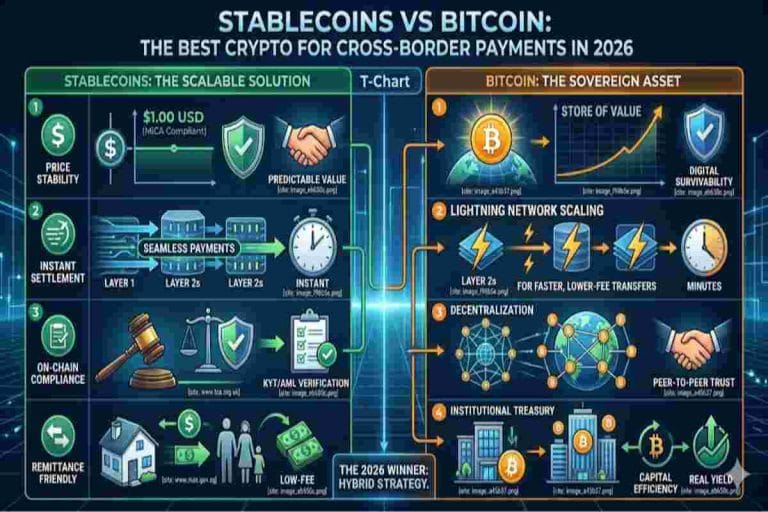
When evaluating stablecoins against Bitcoin for cross-border payments, three factors dominate the decision-making process: transaction speed, cost, and value stability.
Stablecoins typically offer:
Bitcoin, by contrast, provides:
For businesses moving large amounts of capital, stable value often outweighs decentralization, making stablecoins the preferred rail for high-frequency and operational payments. Bitcoin, however, remains indispensable when neutrality, censorship resistance, and strategic sovereignty are primary concerns.
Adopting crypto rails for cross-border payments delivers measurable improvements in cost, speed, and liquidity efficiency.
Using blockchain-based settlement can cut transaction fees by 90–99% compared with correspondent banking, particularly for low-value, high-frequency payments.
Settlements that once took days now complete in seconds, improving cash-flow predictability and operational efficiency.
On-demand liquidity models eliminate the need for pre-funded accounts, freeing capital for productive deployment across global operations.
| Metric | Traditional Rails | Stablecoins | Bitcoin Lightning |
|---|---|---|---|
| Transaction Cost (USD per $1,000) | 15–30 | 0.5–2 | 0.1–1 |
| Settlement Time | 2–7 days | Seconds–Minutes | Seconds |
| Liquidity Pre-Funding Requirement | High | Low | Low |
| Capital Locked in Transit | Trillions globally | Minimal | Minimal |
Insight: These data highlight the tangible financial and operational benefits of moving from legacy settlement systems to blockchain-based rails.
Organizations can achieve faster settlements, lower costs, and more efficient capital deployment while maintaining compliance and transparency.
Cross‑border payments remain slow, expensive, and inefficient because legacy financial systems still depend on outdated correspondent banking networks that require multiple intermediaries. This creates long settlement times, high fees, and poor transparency — all of which undermine global trade and digital commerce.
In contrast, stablecoins — blockchain‑native digital currencies pegged to fiat such as USD — offer a dramatically better model for cross‑border settlement: near‑instant settlement, ultra‑low costs, 24/7 availability, and programmable liquidity that traditional rails simply cannot match.
These structural issues make global payments costly and inefficient — especially for business‑to‑business (B2B) transactions and treasury liquidity management.
Stablecoins are digital assets on public blockchains that maintain a stable value (often 1 USD = 1 USDC/USDT). Because they settle on-chain, they avoid many legacy bottlenecks:
Example: Blockchain‑based stablecoin rails can cut settlement time from days to minutes.
Example: KPMG reported stablecoins can reduce cross‑border costs by up to 99%.
Example: Payment rails built on blockchain provide immutable tracking and faster regulatory reporting.
Bitcoin is powerful as a decentralized store of value, but it has limitations as a cross‑border settlement rail:
Stablecoins vs Bitcoin has become a central debate in the future of global finance. For readers navigating the rapidly evolving landscape of global payments, this analysis examines the core structural questions shaping cross-border settlement in 2026. It begins by exploring why cross-border settlement remains a global problem, highlighting the inefficiencies that continue to affect banks, businesses, and international transfers. The discussion then turns to how stablecoins are used for cross-border payments, followed by an examination of Bitcoin as a cross-border settlement infrastructure and its role as a neutral global rail. To provide a clear decision framework, the report presents a direct comparison of stablecoins vs Bitcoin across speed, cost, and value stability, before addressing the regulatory and operational risks surrounding crypto settlement Finally, the analysis concludes with strategic recommendations for businesses, financial institutions, and policymakers seeking the most effective settlement rail for international payments in 2026.
Choosing the right asset for payment depends on your larger goals, which we align in our Stablecoin Payments 2026 research hub.
n 2026, cross-border settlement is no longer just a back-office banking function. It has evolved into a geopolitical lever, a liquidity strategy, and a critical infrastructure layer for businesses, financial institutions, and even nation-states.
The debate between stablecoins vs Bitcoin has therefore become central to the future of global payments.
Today, businesses sending international payments still face settlement times of two to five days and fees that can exceed 6–8% for remittances. For companies operating in global supply chains, these delays and costs represent more than inconvenience—they create real friction in trade, capital movement, and liquidity management.
At the same time, blockchain-based payment infrastructure is scaling rapidly.
Stablecoins alone processed over $27.6 trillion in transactions in 2024, surpassing the combined payment volume of Visa and Mastercard. Within this ecosystem, USDT accounts for roughly 90% of stablecoin payment activity, while USDT and USDC together dominate the global stablecoin market.
This rapid growth is reshaping the landscape of cross-border settlement and raises a fundamental question.
This analysis uses the Sovereign Bridge framework to evaluate settlement infrastructure based on what actually matters for global payments: speed, cost, regulatory reality, sovereignty risk, and long-term resilience.
Rather than treating crypto payments as a single solution, it compares stablecoins and Bitcoin as competing settlement rails serving different strategic purposes.
By the end of this guide, readers will have a clear framework for choosing the right infrastructure for cross-border payments in 2026.
Traditional cross-border payments typically pass through several intermediary institutions before reaching the final recipient. Each intermediary introduces additional fees, processing delays, and reconciliation complexity.
As a result, settlement often takes multiple business days while liquidity remains tied up across different banking relationships.
Blockchain-based settlement networks operate on a fundamentally different model.
Instead of relying on correspondent banks, transactions settle directly on decentralized infrastructure, enabling near-instant value transfer across borders.
Compared with traditional SWIFT-based payment systems, crypto settlement rails offer several structural advantages:
These advantages explain why financial institutions, fintech platforms, and global enterprises are increasingly exploring blockchain-based payment rails for international transfers.

Cross-border payments often involve three to five intermediaries, each adding processing fees, FX spreads, and operational overhead. Settlements that take multiple business days constrain liquidity and delay commercial operations.
Nostro and Vostro account structures require banks to pre-fund accounts across jurisdictions, locking up trillions of dollars globally. This reduces capital efficiency and imposes higher costs on smaller institutions and emerging-market participants.
Traditional payment networks lack real-time visibility, resulting in manual reconciliation processes, investigations, and higher back-office costs.
Different regulatory frameworks across jurisdictions increase operational friction and compliance costs, further slowing settlement and adding uncertainty.
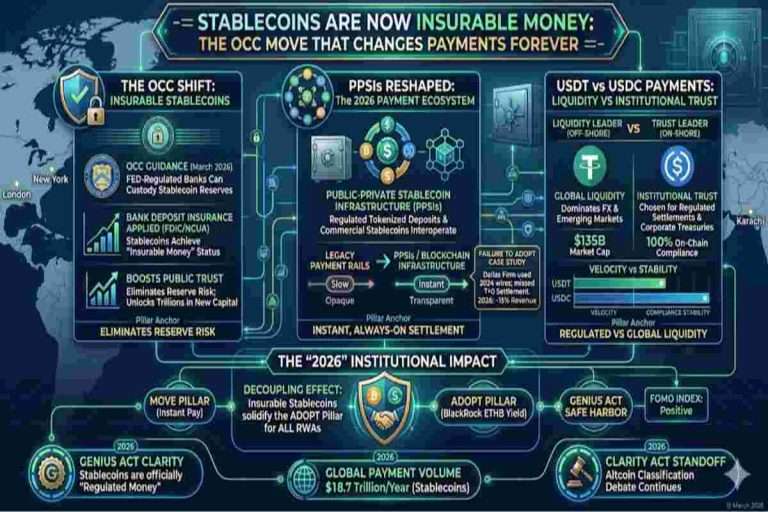
Stablecoins are digital tokens designed to maintain a stable value, typically by being pegged to fiat currencies such as the US dollar.
Because they avoid the price volatility commonly associated with cryptocurrencies like Bitcoin, stablecoins are particularly well suited for payments and settlement.
For cross-border transactions, stablecoins offer several operational advantages:
These characteristics have allowed stablecoins to evolve beyond trading instruments into practical settlement tools used for remittances, corporate treasury transfers, and cross-exchange liquidity management.
In many emerging markets—where banking infrastructure is limited or foreign currency access is restricted—stablecoins are increasingly functioning as an alternative payment rail for international commerce.
Stablecoins redefine cross-border payments by eliminating the “middleman” friction of correspondent banking. By utilizing 24/7 blockchain rails, they provide instant settlement, near-zero transaction fees, and absolute transparency. For institutional users, the primary advantage is Capital Efficiency—funds are no longer trapped in “transit” for days, allowing for real-time liquidity management and improved treasury predictability in a globalized 2026 economy.
Isolate Structural Volatility Failures: In this section, clearly contrast traditional fiat-backed options with algorithmic variants to highlight historical de-pegging risks. Explicitly detail how mechanical flaws in algorithmic mechanisms can trigger death spirals under heavy liquidation conditions. This demonstrates to search engines that you understand how risk profiles vary fundamentally within the stablecoin asset class itself, addressing the core “volatility” and “risk” search intent.
Despite decades of financial innovation, international payments still depend heavily on correspondent banking networks and SWIFT-based messaging infrastructure.
These legacy systems introduce structural inefficiencies that continue to slow global commerce:
For businesses operating across borders, these frictions translate directly into higher operational costs, delayed supply chains, and inefficient capital use.
As global trade accelerates and digital economies expand, the limitations of traditional settlement infrastructure are becoming increasingly difficult to ignore.
These challenges are a key reason why interest in blockchain-based cross-border settlement networks continues to grow.
Stablecoins are not one-size-fits-all. Understanding their structure is critical for assessing risk, speed, and regulatory compliance in cross-border payments. The main categories include:
Insight: Choosing the right stablecoin type is critical. For large cross-border remittances and corporate payments, fiat-collateralized stablecoins like USDC and USDT are generally preferred due to their liquidity, stability, and regulatory recognition.
Stablecoins have evolved far beyond speculative trading instruments to become operational settlement tools for businesses, banks, and fintech platforms.
Insight: The rapid adoption demonstrates that stablecoins are no longer niche; they are becoming a foundational layer in the global payments ecosystem, particularly in regions with limited access to traditional banking.
Financial institutions and enterprises are increasingly experimenting with stablecoin networks to streamline cross-border payments and liquidity management.
Banks, fintech platforms, and payment processors are using stablecoins for:
This growing institutional adoption reinforces the role of stablecoins as a core component of modern payment infrastructure, particularly in corridors where traditional banking is slow, costly, or limited.
By integrating stablecoins into operational workflows, enterprises gain speed, cost savings, and predictable value, creating a practical advantage over legacy settlement rails.
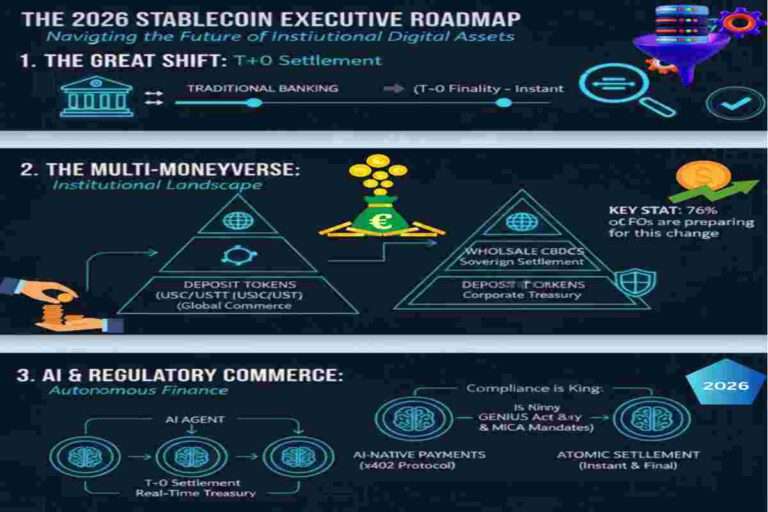
Bitcoin remains the most decentralized and censorship-resistant cryptocurrency network. Its global security, predictable issuance schedule, and neutral monetary design make it an attractive option for certain settlement scenarios, particularly where sovereignty and independence are priorities.
Layer-2 solutions, such as the Lightning Network, enable faster transactions with lower fees, allowing Bitcoin to support payment use cases more effectively than on its base layer alone.
However, Bitcoin’s price volatility can make it less predictable for businesses that require stable settlement values, and base-layer transaction costs can fluctuate with network demand.
Key advantages of Bitcoin for cross-border settlement include:
Limitations to note:
For enterprises evaluating payment rails, Bitcoin complements stablecoins: it provides a neutral, censorship-resistant settlement layer suitable for high-value or strategic transfers, while stablecoins excel in fast, low-volatility payments.
Bitcoin’s greatest strength lies in its decentralized and censorship-resistant design. Unlike fiat or centralized stablecoins, Bitcoin transactions are validated by a global network of nodes, ensuring that no single government, bank, or institution can control or reverse payments.
Key points for cross-border settlement:
Insight: For high-value transfers where sovereignty and neutrality are paramount, Bitcoin serves as a strategic base layer that complements faster, fiat-pegged stablecoin rails.
Emphasize Layer-2 Ecosystems for Speed & Fees: Focus heavily on how Bitcoin’s Lightning Network scales transaction speeds and reduces transactional overhead compared to base-layer constraints. Clearly document current transaction-per-second (TPS) capabilities and average routing fees to directly balance the speed and fee advantages of high-throughput stablecoin networks, satisfying the user’s specific intent for data-driven efficiency metrics.
While Bitcoin’s base layer is secure, it cannot match the speed and low cost required for day-to-day cross-border payments. Layer-2 solutions, like the Lightning Network, address this limitation.
Benefits include:
Insight: Layer-2 adoption allows enterprises to use Bitcoin for operational payments, combining the network’s neutrality with practical usability.
Despite its advantages, Bitcoin has constraints that can affect real-world settlement:
Insight: Many enterprises use Bitcoin in a hybrid model, pairing it with stablecoins for predictable settlement while leveraging Bitcoin for neutral, high-value transfers.
Bitcoin and stablecoins differ in network deployment:
Stablecoins: Operate across multiple blockchains (Ethereum, Solana, Polygon) and integrate with fintech platforms, exchanges, and institutional rails.
Bitcoin: Unified base-layer network ensures global coverage, but often requires Layer-2 or bridging solutions to interoperate with other blockchain networks.
Insight: For enterprises, stablecoins provide flexible interoperability, while Bitcoin offers a single, secure settlement layer. Strategic use of both ensures liquidity and reach across geographies.
Security is central to adoption in cross-border settlement:
Bitcoin: Provides irreversible, trustless settlement, backed by the largest proof-of-work network.
Stablecoins: Depend on issuer reserves and legal frameworks to guarantee redemption, making regulatory compliance critical.
Hybrid Considerations: Many enterprises use Tier-1 stablecoins with strong custody partners for speed and Bitcoin for sovereign neutrality and long-term value preservation.
Insight: Understanding the trade-off between decentralization, trust, and speed is key to selecting the right settlement rail for specific business needs.
| Settlement Method | Speed | Cost | Transparency | Liquidity Efficiency | Regulatory Complexity |
|---|---|---|---|---|---|
| SWIFT / Correspondent Banking | 2–7 days | High | Low | Low | High |
| Fiat-Collateralized Stablecoin | Seconds–Minutes | Low | High | High | Medium |
| Algorithmic Stablecoin | Seconds–Minutes | Low | Medium | Medium | Medium |
| Bitcoin Base Layer | 10–60 minutes | Medium–High | High | High | Low–Medium |
| Bitcoin Lightning Network | Seconds | Low | High | High | Low–Medium |
Insight: Blockchain-based rails drastically reduce settlement time and fees compared to traditional banking, while offering improved transparency and liquidity management.
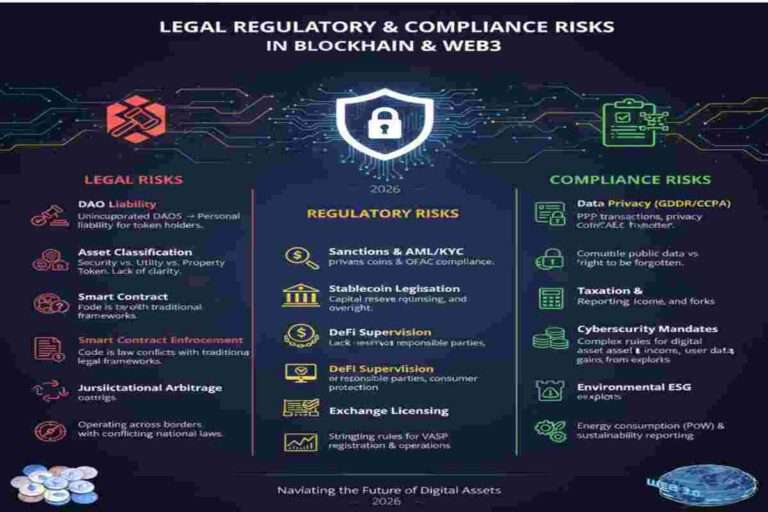
While crypto settlement rails offer clear operational advantages, they are not without risks and regulatory considerations.
Stablecoin Risks
Bitcoin Risks
Anchor the 2026 Regulatory Landscape: Directly document active, current framework updates—specifically mapping out the mature enforcement of European MiCA compliance and shifting legislative guidelines in the United States. Detailing these live compliance vectors anchors temporal authority for immediate “2026” search queries, satisfying institutional intent for current risk assessment.
Global regulatory frameworks for crypto settlement are becoming increasingly structured, but significant differences remain across regions.
Stablecoins are now regulated rather than prohibited, with a focus on:
This approach encourages institutional adoption while protecting market integrity.
The MiCA legislation provides a harmonized framework for:
This reduces fragmentation and facilitates cross-border interoperability within the EU.
Regulatory approaches vary widely:
Governments increasingly view settlement infrastructure as a strategic asset, influencing monetary policy, capital flow management, and financial stability.
Insight: Navigating this diverse regulatory landscape is essential for enterprises and financial institutions seeking to leverage stablecoins and Bitcoin for cross-border payments. Effective strategy requires balancing speed, cost, and operational efficiency with regulatory compliance and sovereign considerations.
Insight: Businesses must weigh both operational benefits and regulatory exposure. Successful adoption requires careful planning, compliance integration, and risk mitigation strategies to ensure secure, efficient cross-border settlements.
Insight: Strategic adoption of crypto rails requires balancing operational efficiency, financial stability, and policy compliance. Businesses and governments alike must consider both the opportunities and systemic risks when integrating stablecoins or Bitcoin into cross-border payments.
The adoption of crypto rails intersects directly with national monetary policy and capital controls, creating strategic implications for governments and institutions alike.
Insight: Strategic adoption of crypto rails requires balancing operational efficiency, financial stability, and policy compliance. Businesses and governments alike must consider both the opportunities and systemic risks when integrating stablecoins or Bitcoin into cross-border payments.
Financial institutions, enterprises, and digital-native businesses are increasingly integrating crypto rails into operational workflows, using both stablecoins and Bitcoin to streamline cross-border settlement.
Stablecoins for international remittances
Stablecoins are transforming international remittance in 2026 by offering a high-speed, low-cost alternative to legacy banking corridors. By leveraging On-Chain Compliance and pegged digital assets, businesses and individuals can settle cross-border payments instantly, bypassing traditional intermediary fees and settlement delays. This shift enhances Capital Efficiency and ensures that liquidity remains accessible and verifiable throughout the global transfer process.
Insight: Adoption is growing because these rails deliver measurable operational and financial advantages, while providing flexibility in a diverse regulatory landscape.
The future of international payments will likely involve multiple layers of digital settlement, combining stablecoins, Bitcoin, and emerging central bank digital currencies (CBDCs) to optimize efficiency, resilience, and regulatory compliance.
In 2026, Cross-Border Settlement via Crypto has evolved from a speculative experiment into a high-velocity institutional rail. By utilizing distributed ledgers, global entities can achieve Atomic Settlement—the simultaneous exchange of assets and payment—which removes the multi-day “float” and counterparty risks inherent in the legacy correspondent banking system. This transition to 24/7 programmable liquidity ensures Capital Efficiency by allowing treasury teams to redeploy funds instantly across different jurisdictions without waiting for traditional banking windows.
Insight: Cross-border payments are transitioning from legacy banking dependence to a multi-rail digital ecosystem, where stablecoins handle routine operational flows, Bitcoin secures strategic settlement, and CBDCs enhance interoperability.
Choosing the right settlement rails in 2026 requires a strategic, multi-layered approach that balances cost, speed, regulatory compliance, and operational needs.
Insight: Institutions that proactively design a hybrid, compliant, and flexible settlement strategy will achieve structural advantages in speed, cost, and global reach.
In 2026, the choice between Stablecoins vs Bitcoin for cross-border payments is determined by the specific need for either price certainty or asset sovereignty. Stablecoins are the primary tool for commercial settlement and remittance because they offer a peg that ensures Capital Efficiency by avoiding the volatility that can erode value during transit. Conversely, Bitcoin serves as the ultimate “Sovereign Asset” for long-term treasury allocation, providing Digital Survivability through its decentralized network. While stablecoins excel at high-velocity daily transactions, Bitcoin remains the preferred rail for censorship-resistant, large-scale value storage across borders.
Problem: A Singapore-based shipping firm faced $150,000 in monthly banking fees and consistent 4-day delays when paying suppliers in Latin America.
Objectives:
Analysis: The company relied on four correspondent banks, each adding fees and delays, creating inefficiency and liquidity constraints.
Implementation:
Challenges: Initial difficulty in locating local fiat off-ramps capable of handling large-scale conversions.
Results:
Problem:
An import-export group attempted to move $5M using a small, unproven algorithmic stablecoin to save on gas fees.
Choosing between Stablecoins vs. Bitcoin is no longer a matter of speculation—it is a matter of Settlement Finality and Liquidity Velocity. While Bitcoin offers a “Sovereign Asset” hedge against fiat debasement, Stablecoins have become the “Digital Dollar” standard for real-time B2B transactions. To move from simple transfers to high-level treasury execution, you must align your choice with your organizational risk tolerance.
For a comprehensive blueprint on how these assets integrate into a diversified institutional portfolio, explore our overarching pillar: RWA Tokenization 2026: Guide to Real-World Asset Portfolios. This guide provides the definitive structural roadmap for managing tokenized liquidity and stablecoin reserves within a secure Web3 ecosystem.
In 2026, the industry has moved beyond “T+2” settlement cycles. By leveraging Stablecoin Infrastructure, institutions can facilitate Atomic Settlement—where payment and asset delivery happen simultaneously.
Instead of enduring the 5%–7% friction costs of legacy correspondent banking, smart contracts trigger instant cross-border payouts the moment a digital twin updates its status. This architecture creates a high-trust environment for stakeholders seeking Zero-Settlement Latency and transparent On-Chain Cash Flow Analysis.
High-velocity cross-border payments demand institutional-grade protection. Before moving millions in Stablecoins vs. Bitcoin, it is critical to ensure your “Gateway” is impenetrable against Top Blockchain Mistakes.
Our comprehensive manual, Asset Security 2026: Setting Up Your Digital Fortress, provides the mandatory blueprint for MPC Custody Solutions and Multi-sig Governance. You cannot effectively manage global liquidity without first securing the entry points to your digital wealth.
The legality of a cross-border crypto payment is only as resilient as its underlying compliance code. To bridge the gap between “Code is Law” and the Compliance-First CFO’s requirements, we utilize Smart Legal Contract Modules.
These composable building blocks allow for programmable legal agreements that are simultaneously human-readable and machine-executable. By integrating these modules, businesses can automate “Compliance-by-Design,” ensuring every cross-border transaction remains harmonized with On-Chain Compliance and global AML/KYC frameworks.
Q: Why not just use Bitcoin for everything?
Bitcoin is secure and censorship-resistant, but its volatility makes it unsuitable for exact-value operational payments. Stablecoins provide predictable unit-of-account stability.
Q: Does this replace SWIFT?
Not yet. The bridge serves as a faster parallel rail, ideal for speed and sovereignty, while SWIFT remains the backbone for some traditional flows.
Q: What is the minimum amount to make a “Bridge” worth it?
Typically $5,000+. Below this threshold, fees may outweigh the savings.
Q: Is the Sovereign Bridge legal under MiCA?
Yes, if you use regulated CASPs and follow Travel Rule requirements for data sharing.
Q: How do I handle the “Last Mile” to local cash?
Partner with local liquidity providers specializing in stablecoin-to-fiat corridors for your target regions.
Q: How does this affect my tax reporting?
Every transfer is a taxable event. Use automated on-chain accounting tools to track cost basis and transfers.
Q: What is the risk of “Bridge Hacks”?
Avoid cross-chain bridges. Use native issuance or CCTP to safely burn/mint assets.
Q: Can a government “freeze” my bridge?
Centralized stablecoins like USDC can be frozen at the contract level. Bitcoin-backed rails are more censorship-resistant but carry higher volatility.
Q: What is “Probabilistic Finality” vs “Absolute Finality”?
Q: How do I secure the bridge?
Use a 3-of-5 multisig or MPC wallet. No single employee should control the keys.
The comparison between stablecoins vs Bitcoin ultimately depends on the requirements of the payment system. Businesses prioritizing stable value and efficient settlement often prefer stablecoins such as USDT or USDC. Bitcoin remains valuable for decentralized settlement and long-term value transfer. The future of cross-border settlement is not a single winner-take-all protocol — it is a strategic blend of rails, each serving a different sovereign, institutional, and commercial objective.
Stablecoins excel where speed, price stability, and regulatory alignment matter most; Bitcoin proves indispensable where neutrality, censorship resistance, and monetary independence are non-negotiable. With this understanding, the reader can now map real-world use cases to the correct settlement layer, anticipate regulatory trade-offs before they become risks, and position themselves ahead of the next phase of global payments infrastructure. What remains — and what this post equips you to evaluate — is how emerging CBDCs, hybrid settlement models, and liquidity networks will integrate into this bridge. The takeaway is power: the ability to choose settlement rails intentionally, not reactively, in a financial system being rewritten in real time.
For institutions exploring the regulatory and technical foundations of digital infrastructure, trusted research from public institutions such as the U.S. National Institute of Standards and Technology can provide valuable guidance on digital twin frameworks and industrial IoT systems: http://www.nist.gov
Welcome to OwnProCrypto (Own & Pro Crypto) — a next-generation Bitcoin and blockchain education platform where the science of finance meets the power of AI-driven automation.
Our mission is simple: to equip you with the knowledge, frameworks, and tools needed to make smarter financial and business decisions in the Web3 economy.
Beyond analysis, OwnProCrypto focuses on transparency, verifiable data, and practical frameworks that investors and builders can actually use. Our goal is not hype — but clear thinking, disciplined analysis, and long-term value creation in the decentralized economy.
Our Background: Salim (Sam) is the founder and lead researcher behind OwnProCrypto, a Web3 intelligence platform focused on crypto security, digital ownership, stablecoin systems, interoperability, and institutional blockchain infrastructure.
Crypto Tools & Analysis:
Crypto Fundamental Analysis Tool | Protocol Evaluation System | DeFi Risk Analysis Tools | Crypto Portfolio Dashboard | Token Risk vs Reward Tool
Guides:
Crypto Fundamental Analysis | Blockchain Project Evaluation | Tokenomics Analysis | DeFi Protocol Analysis | Capital Efficiency
© 2026 OwnProCrypto — Built for smarter crypto decisions