
Client → Stablecoin Conversion → Routing Engine → Blockchain Network → Freelancer Receives Payment
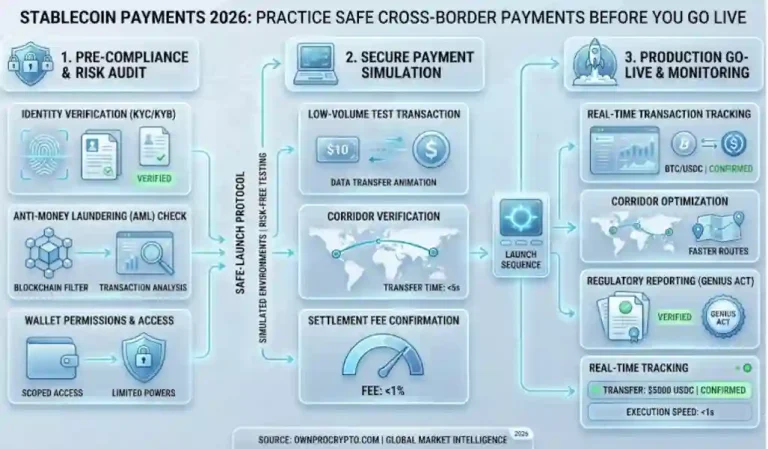
Table of Contents
ToggleA trader follows the crowd, but a Sovereign Architect follows the System Intelligence Signals. In the high-velocity market of 2026, the most critical signal for the global workforce is the move toward digital dollar efficiency. Why USDT payments for freelancers (PKW) have become the gold standard is simple: they provide the financial velocity required to bypass the “legacy tax” of traditional banking. By integrating stablecoin payments for remote workers (SKW) and exploring reliable PayPal alternatives for freelancers (SKW), you are not just getting paid—you are building a fortified Wealth Architecture that operates outside the friction of centralized gatekeepers.
Bank transfers may take days.
PayPal may not operate fully in certain regions.
Currency conversion fees slowly reduce income.
Some payments become delayed or restricted without warning.
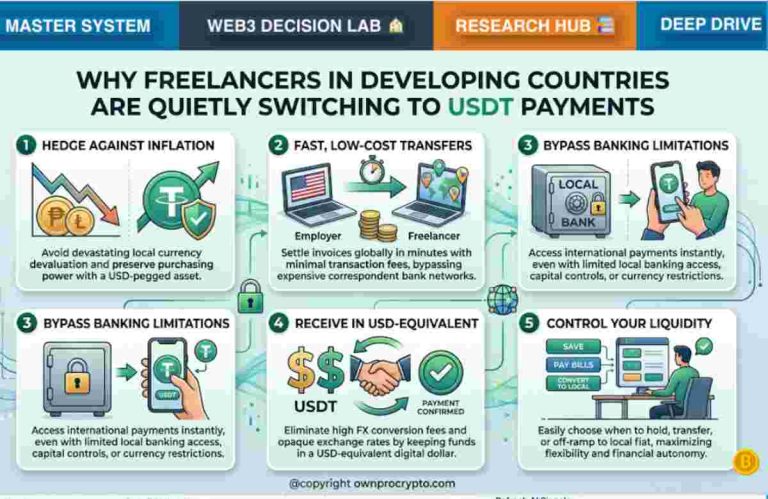
Because of this, many freelancers are shifting toward USDT payments — a stablecoin-based method that allows faster and more flexible cross-border transactions.
This trend is growing among:
The interesting part is that this movement is happening quietly — outside most mainstream financial discussions.
Client Payment → USDT Transfer → Freelancer Wallet → Local Conversion
Problem: Traditional international payment systems are slow, expensive, or unavailable for many freelancers.
Result: Faster access → Fewer restrictions → Global payment flexibility
Problem Solved: USDT allows freelancers to receive digital dollar payments globally with fewer delays and fewer banking barriers.
This stablecoin payment simulator demonstrates how cross-border payments work in real time. It shows routing decisions, blockchain selection, fees, and settlement outcomes.
It also works as a crypto payment flow simulator, helping users visualize how USDT payments move between countries.
USDT payments are digital dollar transfers made using stablecoins instead of traditional banking systems. Freelancers receive USDT directly into a crypto wallet, which can later be converted into local currency.
Stablecoin payments follow a simple flow:
Fiat Currency → USDT Conversion → Blockchain Transfer → Freelancer Wallet → Local Cashout
These payments are typically faster and more globally accessible than traditional systems.

| Feature | Bank Transfer | PayPal | USDT Payments |
|---|---|---|---|
| Processing Speed | 2–7 days | Instant to 3 days | Minutes |
| Global Accessibility | Limited in some regions | Restricted in some countries | High |
| Currency Conversion Fees | High | Medium to High | Usually lower |
| Payment Holds | Possible | Common | Rare |
| Requires Traditional Bank | Yes | Usually | No |
| Cross-Border Flexibility | Moderate | Limited | Strong |
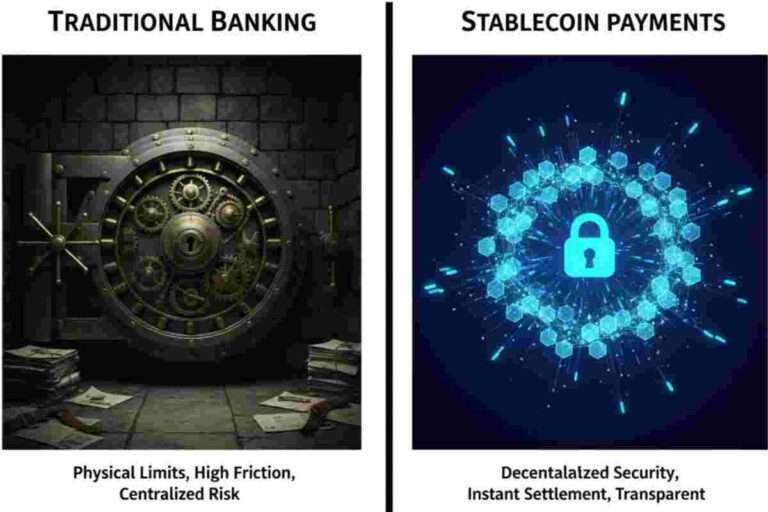
Payment Logic Flow (Problem → Impact → Result)
Problem: Traditional banking systems are not optimized for global freelance work.
Impact: Freelancers lose time and money due to delays and fees.
Result: USDT payments offer faster, more flexible cross-border income access.
Freelance Work → International Client → Banking Friction → Stablecoin Alternative
Freelancers often lose income through:
For someone working internationally every month, even small fees matter.
In some countries, freelancers also face:
Stablecoins became attractive because they function like digital dollars that move globally through blockchain networks.

Freelancers usually:
| Network | Speed | Fees | Usage |
|---|---|---|---|
| TRC20 (Tron) | Fast | Very Low | Freelance payments |
| ERC20 (Ethereum) | Moderate | High | Large transactions |
| BEP20 (BNB Chain) | Fast | Low | General transfers |
USDT payments also require awareness of risks:
| Risk | Description | Solution |
|---|---|---|
| Scams | Fake wallets or links | Use verified platforms |
| Wrong transfers | Incorrect blockchain network | Double-check details |
| Exchange risk | Centralized platform issues | Use trusted exchanges |
| Regulation | Legal uncertainty | Follow local laws |

Why USDT Became the Preferred Freelance Payment Method
USDT is designed to maintain a value close to the US dollar.
Unlike volatile cryptocurrencies, many freelancers simply use it as:
This became especially useful in countries where:
| Freelancer Problem | Why USDT Helps |
|---|---|
| Slow bank transfers | Faster settlement |
| Currency instability | Dollar-based value |
| Payment restrictions | Wallet accessibility |
| High transfer fees | Lower blockchain fees |
| Limited banking access | Peer-to-peer flexibility |
Problem: Currency instability and payment restrictions create uncertainty for freelancers.
Problem Solved: USDT provides freelancers with more stable and accessible digital payments.
Stablecoins also involve risks.
Freelancers should understand:
Unlike traditional banking, crypto transactions usually cannot be reversed.
That means freelancers must take security seriously.
| Risk | Description | How to Reduce Risk |
|---|---|---|
| Wallet scams | Fake links or phishing attacks | Use trusted wallets |
| Wrong network transfer | Funds sent incorrectly | Double-check networks |
| Exchange restrictions | Withdrawal limitations | Use reputable platforms |
| Regulation changes | Crypto laws vary globally | Follow local laws |
Receiving USDT payments usually requires:
Common methods include:
Freelancers usually share a wallet address with clients.
The client sends payment directly.
| Network | Typical Fees | Speed | Common Use |
|---|---|---|---|
| TRC20 (Tron) | Very low | Fast | Small freelance payments |
| ERC20 (Ethereum) | Higher | Moderate | Larger transfers |
| BEP20 (BNB Chain) | Low | Fast | General payments |
Payment Flow Diagram Client → Wallet Address → Blockchain Confirmation → Freelancer Receives USDT
Problem: International payments often require complicated banking infrastructure.
Problem Solved: Crypto wallets allow freelancers to receive payments directly from clients worldwide.
This is one reason some freelancers prefer stablecoins.
A remote worker delivering urgent work may not want:
Stablecoins solve one important thing:
speed of value transfer that alone changes how remote workers operate internationally.
Businesses and startups sometimes prefer stablecoin payments because:
For international remote teams, this flexibility matters.
Especially for:
Business Logic Diagram: Global Hiring → Payment Delays → Stablecoin Payments → Faster Contractor Access
Problem: Companies face friction when paying international freelancers.
Problem Solved: Stablecoins simplify global contractor payments and reduce delays.
The biggest crypto story may not be trading.
It may be: People quietly building parallel payment systems.
Freelancers care about:
That is why stablecoins continue growing quietly in remote work economies.
Remote work is expanding globally.
At the same time:
Stablecoins may continue growing because they solve real-world problems.
Especially in countries where:
| Pros | Cons |
|---|---|
| Faster payments | Learning curve |
| Lower transfer costs | Wallet security risks |
| Global accessibility | Regulation uncertainty |
| Dollar-based value | Blockchain mistakes possible |
| Fewer banking barriers | Exchange dependency |
| Fact | Detail |
|---|---|
| Stablecoin Type | Dollar-pegged cryptocurrency |
| Main Use Case | Digital international payments |
| Popular Among | Freelancers and remote workers |
| Main Benefit | Faster cross-border transfers |
| Main Concern | Security and regulations |
Most people still associate crypto with:
But for many freelancers, stablecoins are becoming something much more practical:
This shift is happening quietly because freelancers are focused on:
The future of crypto may not begin with speculation.
It may begin with ordinary people simply trying to get paid online more efficiently.
Read More: official USDT (Tether) website explaining usage and ecosystem
Group 1: Technical Infrastructure & Tools
A stablecoin payment simulator is a precision tool that maps how digital dollar transactions move across global borders using blockchain networks. It provides the Decision Intelligence needed to verify that a transaction is moving through the most efficient liquidity path before execution.
A crypto payment flow simulator visualizes the full technical lifecycle of a transaction, from converting fiat currency into stablecoins to routing payments and achieving final settlement. This “pre-flight” check is a core part of a Sovereign Architect’s risk management toolkit.
A cross-border payment demo tool is an interactive system that simulates international payments using blockchain-based stablecoins. It allows freelancers to audit the speed and transparency of the Digital Sovereign Asset architecture in a sandboxed environment.
A USDT payment calculator simulation is used to estimate network fees, real-time conversion rates, and final payout amounts for international crypto payments. This ensures Why USDT payments for freelancers remain the superior choice by eliminating the “legacy tax” of hidden bank charges.
Group 2: Freelance Strategy & Compliance
Freelancers prefer USDT payments because they offer high-velocity settlement, lower overhead costs, and a more streamlined experience for international clients. It aligns with the shift toward a Sovereign Finance model where the individual controls their own capital flow.
It depends on local regulations and the specific evolving laws within each jurisdiction. Freelancers should verify their local crypto compliance frameworks to ensure their Wealth Architecture remains resilient and legally sound.
Many freelancers prioritize the decentralized flexibility of USDT, which offers faster transfers and significantly lower fees compared to traditional centralized platforms. This move toward System Intelligence Signals allows for greater profit retention on international contracts.
Yes. Through a variety of vetted exchanges and peer-to-peer (P2P) platforms, freelancers can convert their digital assets into local fiat currency. This allows for a seamless bridge between the Sovereign Internet Stack and real-world expenses.
They operate on fundamentally different architectures. PayPal provides centralized mediation and support, while USDT offers decentralized payment flexibility and Unassailable Ownership. The choice depends on whether the user prioritizes institutional mediation or individual sovereignty.
Welcome to OwnProCrypto (Own & Pro Crypto) — a next-generation Bitcoin and blockchain education platform where the science of finance meets the power of AI-driven automation.
Our mission is simple: to equip you with the knowledge, frameworks, and tools needed to make smarter financial and business decisions in the Web3 economy.
Beyond analysis, OwnProCrypto focuses on transparency, verifiable data, and practical frameworks that investors and builders can actually use. Our goal is not hype — but clear thinking, disciplined analysis, and long-term value creation in the decentralized economy.
Our Background
Crypto Tools & Analysis:
Crypto Fundamental Analysis Tools | Protocol Evaluation System | DeFi Risk Analysis Tools | Crypto Portfolio Dashboard | Token Risk vs Reward Tool
Guides:
Crypto Fundamental Analysis | Blockchain Project Evaluation | Tokenomics Analysis | DeFi Protocol Analysis
© 2026 OwnProCrypto — Built for smarter crypto decisions