
Search by title, topic or phrase
Use our Crypto Search Engine 🔍 to find the topics and keywords you're looking for.
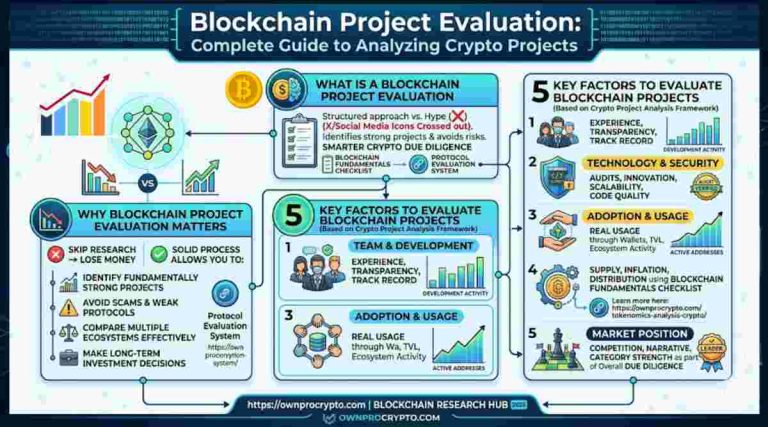
Table of Contents
ToggleMost people first encounter digital assets through a simple need—sending money, receiving payments, or exploring investment opportunities. On the surface, it looks like just another financial tool.
But underneath that surface is something far more structural. Understand the digital asset economy through 8 core layers
A complete financial architecture is quietly forming—one that redefines how value is owned, transferred, secured, governed, and preserved.
Michael discovered this unexpectedly. He only wanted to get paid by an international client without waiting days for a traditional bank transfer. What seemed like a payment inconvenience quickly became a deeper exploration into how modern digital finance actually works.
Behind every wallet, stablecoin, blockchain transaction, and decentralized application lies a system built on interconnected layers:
Ownership → Security → Decision Intelligence → Settlement → Infrastructure → Interoperability → Governance → Legacy
Each layer solves a different problem in the movement and protection of value.
This article breaks down those 8 layers to explain how the digital asset economy operates beneath the surface—and why understanding its structure is more important than tracking short-term market movements.
Because crypto is no longer just a market.
It is an evolving financial system.
| Layer | Core Function | Key Question | Example |
|---|---|---|---|
| Ownership | Asset control | Who owns the asset? | Wallet + private keys |
| Security | Asset protection | How is it secured? | Seed phrase, cold storage |
| Decision Intelligence | Action framework | Should I act? | Portfolio rules, signals |
| Settlement | Value transfer | How does money move? | Stablecoins, transfers |
| Infrastructure | System backbone | What powers it? | Blockchains, nodes |
| Interoperability | Cross-network flow | Can systems connect? | Bridges, cross-chain tools |
| Governance | Rule formation | Who decides changes? | DAO voting, protocols |
| Legacy | Wealth continuity | What happens later? | Inheritance planning |
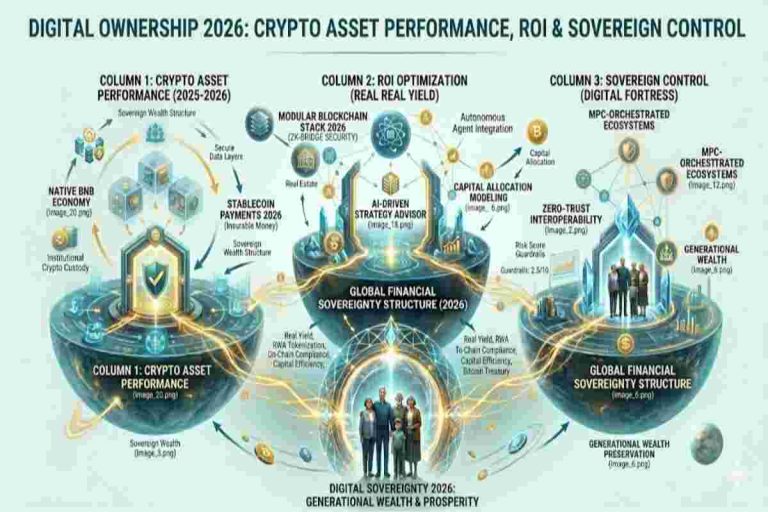
Most people assume ownership is simple—you deposit money in a bank, and it belongs to you.
In traditional finance, ownership is actually institution-mediated. Banks, brokers, and governments maintain control over records, permissions, and access.
Digital assets introduce a fundamentally different model.
Ownership is no longer granted.
Ownership is proven cryptographically.
Michael’s first interaction with crypto wasn’t an exchange or trading platform. It was a wallet containing a recovery phrase.
That phrase represented something powerful: direct control over value without requiring approval from any intermediary.
In this system, ownership is defined by one principle:
Whoever controls the private keys controls the assets.
There is no customer support reset button. No institution to reverse mistakes. No centralized authority to intervene.
This creates both empowerment and responsibility.
| Traditional Finance | Digital Assets |
|---|---|
| Bank controls access | User controls keys |
| Account can be frozen | Assets are self-custodied |
| Permission required | Permissionless access |
| Reversible transactions | Irreversible transfers |
Ownership in the digital asset economy is not based on identity or permission.
It is based on cryptographic control.

Once Michael controlled his own assets, a new reality emerged.
There was no institution protecting him anymore.
No fraud department.
No password reset system.
No reversal process.
Security became personal responsibility.
This shift is one of the most underestimated aspects of digital assets. Most losses in crypto are not caused by blockchain failures—they are caused by user-level security mistakes.
Examples include:
In this system, security is not a feature.
It is the foundation of participation.
| Risk Type | Traditional Finance | Digital Assets |
|---|---|---|
| Fraud protection | Bank-managed | User-managed |
| Account recovery | Available | Often impossible |
| Attack surface | Centralized systems | User endpoints |
| Error correction | Reversible | Irreversible |
Security is not optional in the digital asset economy.
It determines whether ownership is sustainable.
As Michael began exploring the ecosystem further, he encountered a different kind of problem.
Not scarcity of information—but overload.
Every day brought:
The issue was not access to data.
The issue was interpretation.
Without structure, information becomes noise.
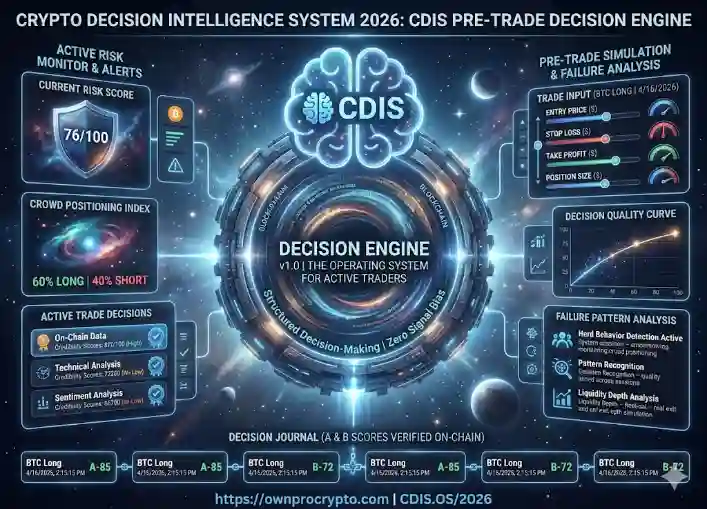
This is where decision intelligence becomes critical.
Successful participation in digital assets depends on frameworks that filter information through:
Without these filters, decisions become reactive instead of strategic.
| Factor | Unstructured Approach | Structured Approach |
|---|---|---|
| Information | Infinite noise | Filtered signals |
| Decisions | Emotional | Framework-based |
| Outcome | Inconsistent | Measurable |
| Risk | Uncontrolled | Managed |
AI • Data • Analytics • Models
│
▼
Ownership → Security → Settlement → Infrastructure
↓
Interoperability
↓
Governance
↓
Legacy
Better data does not guarantee better decisions.
Better frameworks do.
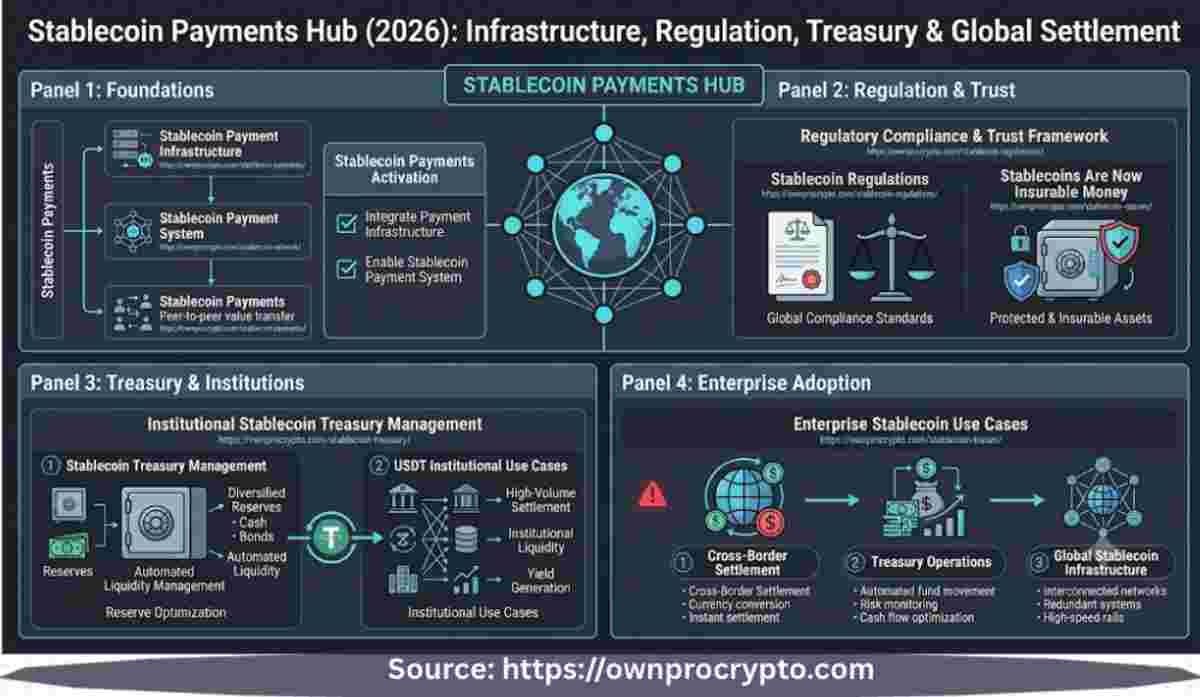
The next shift became clear when Michael received his first stablecoin payment.
Instead of waiting days for bank processing, the transaction settled within minutes.
No intermediaries.
No banking hours.
No geographic restrictions.
For the first time, value moved like digital information rather than physical paperwork.
This is one of the most important transitions in financial systems today.
Settlement is no longer constrained by traditional infrastructure cycles.
Stablecoins and blockchain networks allow near-instant global transfers, changing how businesses, freelancers, and institutions operate.
| Feature | Traditional Banking | Digital Settlement |
|---|---|---|
| Speed | 1–5 days | Minutes |
| Availability | Business hours | 24/7 |
| Geography | Restricted | Global |
| Intermediaries | Multiple | Minimal |
Settlement is no longer a delayed process.
It is an instantaneous network function.
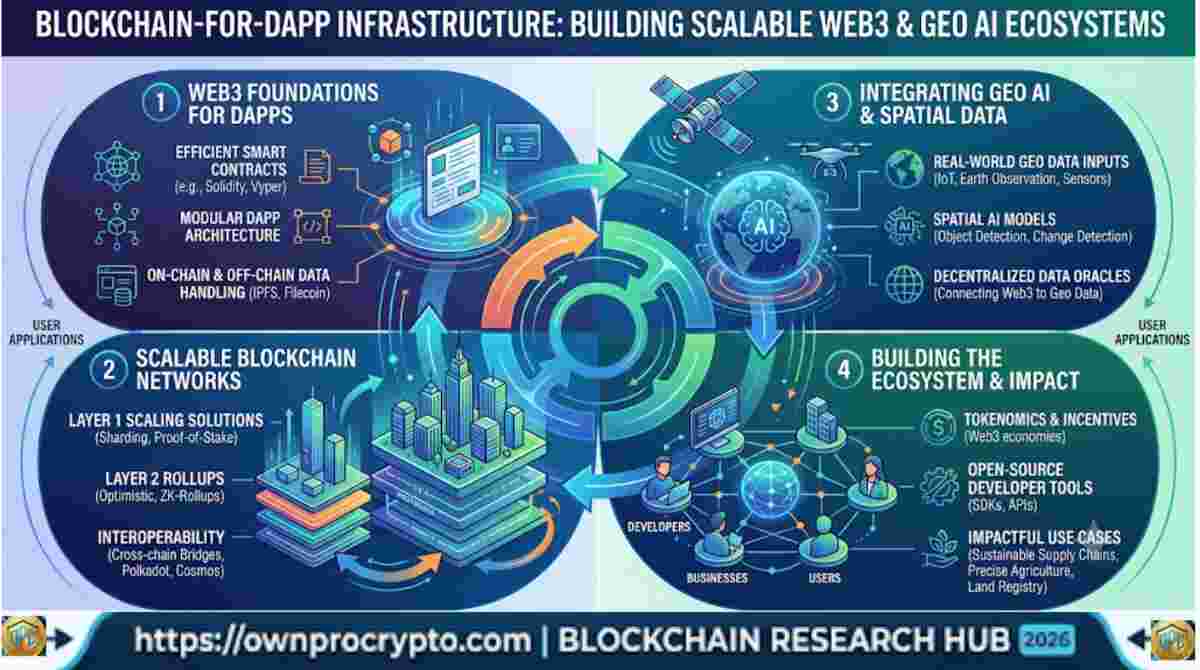
Most users interact with apps, not infrastructure.
But every wallet, exchange, payment system, or decentralized application depends on a deep technical foundation that most people never see.
This foundation is the infrastructure layer.
It includes:
Without this layer, nothing in the digital asset economy functions.
Michael realized that what looked like a simple app was actually sitting on top of multiple distributed systems working continuously in the background.
| Layer Component | Function |
|---|---|
| Blockchain | Records transactions |
| Nodes | Validate and store data |
| Validators | Secure consensus |
| Smart Contracts | Execute logic |
| APIs | Connect applications |
| Indexers | Organize blockchain data |
| Traditional System | Crypto Infrastructure |
|---|---|
| Central servers | Distributed networks |
| Single point of failure | Redundant nodes |
| Closed systems | Open protocols |
| Limited transparency | Public verification |
Infrastructure determines what is possible.
Applications only determine what is visible.
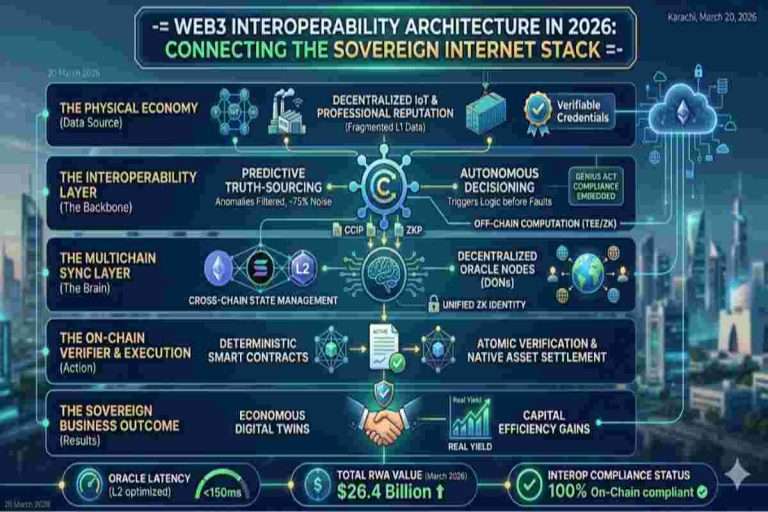
As Michael explored further, he noticed a major limitation in the ecosystem.
There was not one blockchain.
There were hundreds.
Each network operated independently, with its own rules, tokens, and liquidity systems.
This fragmentation created friction:
Interoperability emerged to solve this problem.
It allows different blockchain networks to communicate and transfer value between each other.
This is achieved through:
| Challenge | Impact | Solution |
|---|---|---|
| Fragmented liquidity | Inefficiency | Cross-chain bridges |
| Isolated ecosystems | Limited usability | Messaging protocols |
| Asset incompatibility | User friction | Wrapped tokens |
| Network silos | Poor scalability | Interoperability layers |
The future of digital assets depends on systems that can communicate—not just systems that can scale.
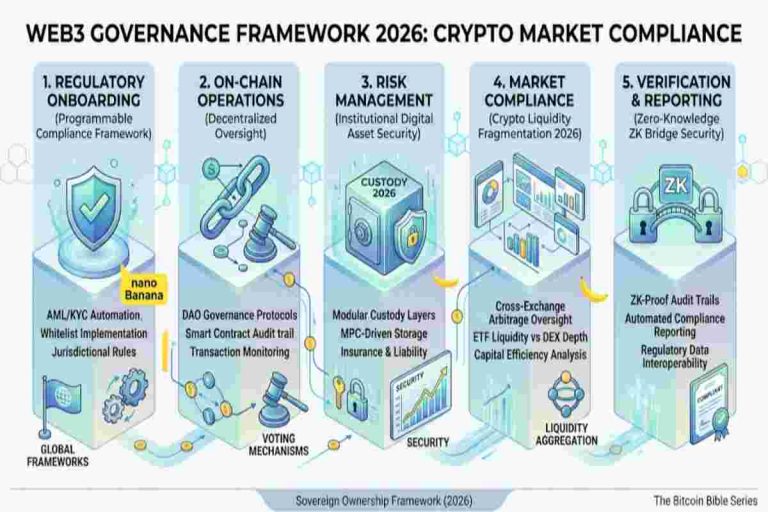
Many assume decentralization removes control.
In reality, it redistributes control.
Every blockchain system has governance mechanisms that define how rules change over time.
Governance determines:
This happens through:
Power does not disappear in decentralized systems.
It shifts into structured decision systems.
| Model | Decision Maker | Speed | Decentralization |
|---|---|---|---|
| Centralized | Company/team | Fast | Low |
| DAO-based | Token holders | Medium | High |
| Hybrid | Mixed | Balanced | Medium |
| Area | Impact |
|---|---|
| Upgrades | Protocol evolution |
| Tokenomics | Economic structure |
| Security | Network stability |
| Direction | Long-term vision |
Governance defines how systems evolve—not just how they operate today.

Most discussions in crypto focus on accumulation.
Very few focus on continuity.
Michael eventually faced a deeper question:
What happens to digital assets if the owner disappears?
Unlike traditional banking systems, crypto assets are not automatically recoverable without proper planning.
There are no default inheritance mechanisms.
No institutional safety net.
Without preparation, assets can become permanently inaccessible—even if they hold significant value.
| Factor | Traditional Finance | Digital Assets |
|---|---|---|
| Inheritance system | Built-in | Manual setup required |
| Recovery options | Legal process | Private key dependent |
| Access continuity | Managed | User-defined |
| Risk of loss | Low | High if unplanned |
| Tool | Purpose |
|---|---|
| Multi-signature wallets | Shared control |
| Recovery plans | Asset transfer planning |
| Custodial services | Institutional inheritance |
| Legal structures | Estate integration |
A financial system is incomplete if it does not survive its owner.

Michael’s journey did not begin with theory.
It began with a simple problem: receiving a payment faster.
But that small problem revealed something much larger.
The digital asset economy is not defined by trading, speculation, or short-term price movement.
It is defined by structure.
Ownership determines control.
Security determines survival.
Decision systems determine behavior.
Settlement determines speed.
Infrastructure determines capability.
Interoperability determines connectivity.
Governance determines evolution.
Legacy determines continuity.
Together, these layers form a complete financial architecture.
| Layer | Role in System |
|---|---|
| Ownership | Control of assets |
| Security | Protection of assets |
| Decision Intelligence | Behavioral framework |
| Settlement | Movement of value |
| Infrastructure | System foundation |
| Interoperability | Network connectivity |
| Governance | Rule evolution |
| Legacy | Long-term continuity |
Crypto is often misunderstood as a market.
But markets exist on top of systems.
And systems exist on top of architecture.
The digital asset economy is not just changing how money is invested.
It is changing how money is structured.
What is ownership in cryptocurrency?
Ownership in cryptocurrency means having control over digital assets through private keys stored in a wallet. Unlike traditional finance, no bank or institution controls access to the funds.
Who actually owns crypto assets?
Crypto assets are owned by whoever controls the private keys. If you control the wallet’s seed phrase, you fully control the assets without needing permission from any intermediary.
Is crypto safe if I lose my private key?
No. If you lose your private key or seed phrase, there is no way to recover your assets. This is why secure storage and backup are critical in crypto security.
What is the biggest security risk in crypto?
The biggest security risks are phishing attacks, fake wallets, malware, and compromised seed phrases rather than blockchain failures.
What is blockchain infrastructure in crypto?
Blockchain infrastructure refers to the underlying systems like nodes, validators, smart contracts, and networks that process and record crypto transactions.
How does crypto actually work behind the scenes?
Crypto works through decentralized networks where transactions are validated by nodes, recorded on a blockchain, and secured using cryptography.
Why is blockchain infrastructure important?
Without infrastructure, crypto applications like wallets and exchanges cannot function. It is the foundation layer that enables all digital asset activity.
Is every cryptocurrency built on its own blockchain?
No. Some cryptocurrencies operate on their own blockchain, while others are built on existing networks like Ethereum using smart contracts.
Crypto transactions are faster because they do not rely on traditional banking systems and instead use blockchain networks that operate 24/7 globally.
Gas fees are transaction costs paid to validators on blockchain networks (like Ethereum) for processing and securing transactions.
Fees vary based on network congestion, demand for block space, and blockchain activity levels at a given time.
Stablecoin payments are often faster and cheaper for cross-border transfers because they bypass traditional banking intermediaries.
Crypto interoperability is the ability of different blockchain networks to communicate and transfer assets between each other.
Different blockchains are designed for different purposes like speed, security, scalability, or smart contract functionality.
Crypto bridges are tools that allow assets to move between different blockchain networks.
Cross-chain bridges can be risky because they are frequent targets for hacks and rely on complex smart contract systems.
Governance in crypto refers to how decisions are made about protocol upgrades, rules, and network changes.
Decentralized networks are controlled by a combination of developers, validators, and token holders through governance systems.
Yes, crypto protocols can be updated through governance proposals, votes, or developer consensus depending on the network.
Most crypto systems are partially decentralized, meaning control is distributed but not completely removed.
If no recovery plan exists, crypto assets may become permanently inaccessible because there is no centralized recovery system.
Yes, but only if proper estate planning tools like multi-signature wallets, legal instructions, or custody solutions are used.
Crypto inheritance planning is the process of ensuring digital assets can be passed on securely to beneficiaries.
Most crypto is lost due to forgotten private keys, lost seed phrases, or lack of inheritance planning.
Loading blueprint...
Learn how digital ownership, self-custody, tokenization, and asset rights form the absolute foundation of the modern digital economy.
Searching across all layers...
DIGITAL ASSET ECONOMY
│
├── OWNERSHIP & CONTROL
│ • Self Custody
│ • Digital Ownership
│ • Asset Rights
│ • Tokenization
│
├── SECURITY & PROTECTION
│ • Risk Management
│ • Crypto Security
│ • Custody Models
│
├── DECISION INTELLIGENCE
│ • Market Intelligence
│ • Decision OS
│ • Web3 Decision Lab
│
├── PAYMENTS & SETTLEMENT
│ • Stablecoins
│ • Cross-border Rails
│ • Institutional Finance
│
├── INFRASTRUCTURE & EXECUTION LAYER
│ • Blockchain Infrastructure
│ • App Infrastructure
│ • Data & AI Systems
│ • Web3 AI Systems Hub
│
├── INTEROPERABILITY LAYER
│ • Cross-chain Bridges
│ • Messaging Systems
│ • Liquidity Routing
│ • Data Exchange Layers
│
├── GOVERNANCE & COMPLIANCE
│ • DAO Governance
│ • Protocol Rules
│ • Compliance Systems
│ • Institutional Oversight
│
└── LEGACY & WEALTH SYSTEMS
• Digital Inheritance
• Family Office Crypto
• Tokenized Wealth
• Estate Planning

Learn how digital ownership, self-custody, tokenization, and asset rights form the foundation of the modern digital economy.
Explore the security frameworks, custody models, and risk management systems used to protect digital assets.
Understand how investors, institutions, and digital asset operators use intelligence systems to make better decisions.
Discover how stablecoins, payment rails, and settlement infrastructure move value across blockchain networks.
Explore the blockchain, application, and data infrastructure powering the digital asset economy.
INFRASTRUCTURE & EXECUTION LAYER
- Blockchain Infrastructure
- dApp Infrastructure
- Web3 AI Systems HubLearn how assets, applications, and data move across chains through interoperability systems and connected infrastructure.
- Cross-chain Bridges
- Liquidity Routing
- Data Exchange LayersUnderstand how decentralized systems evolve through governance frameworks, compliance systems, and operational oversight.
- DAO Governance
- Protocol Rules
- Compliance Systems
- Institutional Oversight
Explore how digital assets, tokenized ownership, and estate planning frameworks help preserve wealth across generations.
- DAO Governance
- Protocol Rules
- Compliance Systems
- Institutional Oversight
Trading & Analysis Intelligence https://www.finra.org
Market Intelligence https://www.imf.org
Portfolio Intelligence https://www.sec.gov
Tokenization Intelligence https://www.bis.org
Security & Custody https://www.ftc.gov
Investor Education https://www.irs.gov