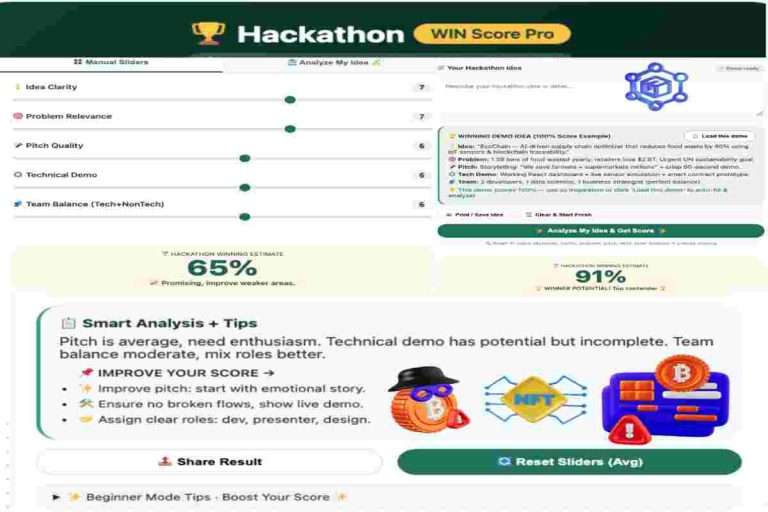
A blockchain hackathon for beginner participants might sound intimidating—especially if you don’t have a technical background. While writing smart contracts feels overwhelming, this web3 hackathon guide proves that the 2026 landscape is changing. Hackathons are no longer just for hardcore coders; they’ve evolved into collaborative spaces where diverse roles in hackathon for non technical people—from designers to researchers—matter just as much as expertise. By mastering how to win a hackathon without coding, you can turn creativity into a podium finish. Following the right blockchain hackathon tips, such as focusing on problem-solving and logic over syntax, ensures that the real question isn’t whether you can code, but how much value you bring to the table.
As the digital economy evolves, one myth still holds many people back: You need to be a coder to succeed in Web3.
That’s no longer true. In 2026, blockchain hackathons for beginners are no longer just coding competitions—they are innovation labs where ideas, clarity, and real-world thinking matter just as much as code.
If you can understand a problem, you already have something valuable to contribute.
This guide is based on current hackathon formats and real participation trends, not just theory. The WIN Score methodology is a practical application of the technical ecosystems built in our Web3 Development Guide (2026): Building dApps, Smart Contracts & Ecosystems. Track global hackathon trends at Gitcoin.
Table of Contents
ToggleA blockchain hackathon for beginners is a beginners Guide. A blockchain hackathon is a time-limited event (usually 48 hours to one week) where teams collaborate to build a prototype.
Think of it as:
a startup built under pressure.
The goal is not a finished product, but a Minimum Viable Product (MVP)—something that proves your idea works.
Most hackathons focus on areas like:
This guide is for people who feel like they don’t “fit” into Web3.
If you’ve ever thought:
“I understand the problem, but I don’t know how to build it”
Then you are exactly who this space needs.
Yes—and more importantly, they are needed.
Modern Web3 projects are becoming more complex. Developers are often focused deeply on code, which creates a gap between:
This is where non-technical contributors play a critical role.
Your perspective is not a weakness—it’s a practical advantage.
Technology alone doesn’t win hackathons—clarity does.
Non-technical participants bring:
Domain Expertise
Understanding how real-world systems like finance, property, or business actually work
User Empathy
Knowing how normal users think and where they struggle
Business Logic
Ensuring the idea creates real value—not just a technical demo
From observing how teams present and compete, one pattern becomes clear:
the best ideas are the easiest to understand.
In many cases, the difference between a winning and losing project is not the code—it’s whether people understand it.
While no hackathon guarantees results, patterns show:
In many beginner-friendly hackathons, teams with clear communication outperform more complex technical builds.
Real Problem
     ↓
Simple Idea
     ↓
Clear Explanation
     ↓
Working Demo
     ↓
Strong Pitch
     ↓
Higher Chance of Winning

You don’t need to master everything—but understanding a few key ideas helps you choose better projects.
These are not just technical ideas—they are the foundation of many strong hackathon projects.
You don’t need to write code to be valuable.
Narrative Lead
Turns complex ideas into clear, compelling stories and pitch presentations
Documentation Specialist
Creates structured whitepapers and simple explanations using research and AI tools
Product Thinker
Defines the problem, user journey, and real-world use case
Go-To-Market Strategist
Plans how the product gets its first users
These roles directly influence how judges understand—and score—your project.
| Role | What You Do | Why It Matters |
|---|---|---|
| Narrative Lead | Create pitch + story | Helps judges understand the idea |
| Product Thinker | Define problem & solution | Keeps project focused |
| Researcher | Validate idea with real data | Adds credibility |
| GTM Strategist | Plan user growth | Shows real-world potential |
These roles are often the difference between a technically correct project and a winning one.
Most hackathons evaluate projects across four areas:
Non-coders heavily influence the first three.
That means you are shaping the majority of what actually wins.
If your team clearly communicates:
the technical demo only needs to prove the idea is possible.
To win without coding, focus on what most teams ignore:
In a blockchain hackathon for beginners, clarity often matters more than complexity.
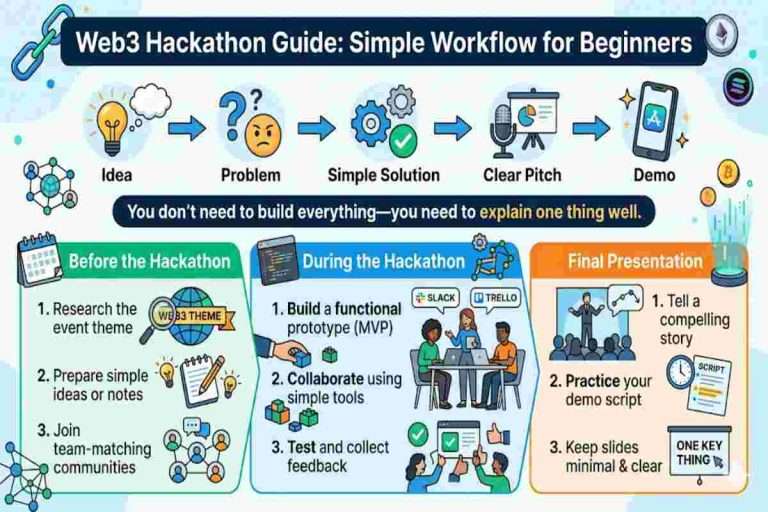
Think of your hackathon journey like this:
Idea → Problem → Simple Solution → Clear Pitch → Demo
You don’t need to build everything—you need to explain one thing well.
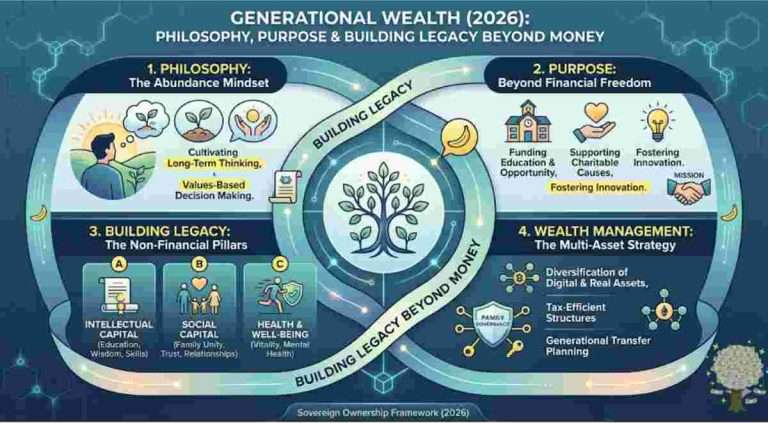
Regardless of the prize, publish your project journey on your blog immediately. This builds your “Proof of Work” for 2026 and serves as a permanent digital asset that no algorithm can take away. After the hackathon, the world will finally know your name. This single project will open the doors to your future, elevating your authority across the digital landscape. Whether you are looking to command higher rates as a Specialized Freelancer, provide high-level Strategy Consultation, or grow your influence as a Top-Tier Blogger, this “Proof of Work” is your golden ticket. You aren’t just building an app; you are building a career that scales with your experience.
| Problem | Objectives | Analysis / Situation | Implementation | Challenges | Results / Outcomes |
| A blogger didn’t win the cash prize at a 2024 event. | Turn a “loss” into a long-term financial gain. | The project was excellent, but the competition was too high. | They published a 5-part “How We Built It” series on their blog. | Dealing with the initial disappointment of not winning. | Result: Three companies found the blog and hired them for Consultation on RWA Tokenization. |
Keep It Simple
If your idea is hard to explain, it will be hard to judge
Focus on Real Problems
Real-world use cases stand out more than abstract ideas
Communicate Clearly
Judges reward clarity, not complexity
Prepare a Backup Demo
A recorded demo can save your presentation
Here are practical tips that consistently improve outcomes:
A technically advanced project is built—but:
Result: Judges don’t fully understand it → the project is ignored
A team builds a focused solution to a real problem
They:
Result: Judges understand quickly → the project stands out
Clarity beats complexity.
| Factor | Technical Teams Only | Mixed Teams (With Non-Coders) |
|---|---|---|
| Idea Clarity | Often complex | Clear and simple |
| User Focus | Low | High |
| Pitch Quality | Weak | Strong |
| Judge Understanding | Difficult | Easy |
| Winning Chances | Medium | High |

Hackathons are evolving.
We are seeing a shift toward:
The most valuable participants may not be the ones who write the most code—but the ones who can connect ideas with real-world use cases.
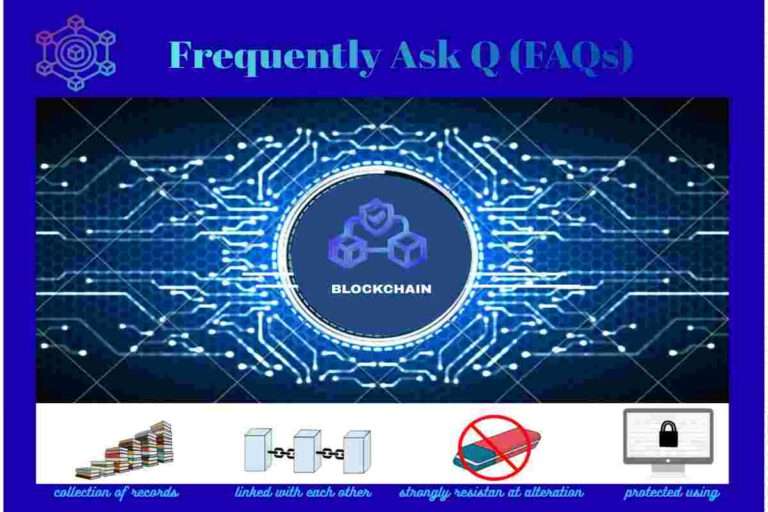
Can beginners join blockchain hackathons?
Yes. Most hackathons are open to beginners, including those without coding experience.
Do you need coding skills to win a hackathon?
No. Non-coders often contribute to strategy, research, and presentations.
What roles can non-coders play in hackathons?
Narrative Lead, Product Thinker, Documentation Specialist, and strategist roles.
How do I join a blockchain hackathon as a beginner?
Register individually and use team-matching platforms to join a team.
What is the best way to win without coding?
Focus on solving a real problem and explain it clearly.
Are hackathons worth it for beginners?
Yes. They provide learning, networking, and real opportunities.
How long do hackathons last?
Typically between 48 hours and one week.
What do judges look for?
Impact, feasibility, innovation, and execution.
Can non-coders build a career through hackathons?
Yes. Many enter Web3 through non-technical roles.
What is the biggest mistake beginners make?
Overcomplicating the idea instead of keeping it simple.

A Blockchain Hackathon for Beginners in 2026 is less about coding expertise and more about collaboration, creativity, and execution. The key takeaway is clear: you don’t need to be a developer to win—you need to bring a valuable perspective and work effectively with others. As hackathons continue to evolve, they are becoming more inclusive, opening the door for non-coders to contribute in meaningful ways and stand out. Whether you’re a strategist, designer, or simply someone with a great idea, there’s a place for you—and potentially a winning opportunity—if you’re willing to step in and participate.
Blockchain is no longer just for developers. If you can think clearly, understand problems, and explain ideas simply—you already have a place in this space.
Because the best ideas don’t just work. They are understood.
Welcome to OwnProCrypto (Own & Pro Crypto) — a next-generation Bitcoin and blockchain education platform where the science of finance meets the power of AI-driven automation.
Our mission is simple: to equip you with the knowledge, frameworks, and tools needed to make smarter financial and business decisions in the Web3 economy.
Beyond analysis, OwnProCrypto focuses on transparency, verifiable data, and practical frameworks that investors and builders can actually use. Our goal is not hype — but clear thinking, disciplined analysis, and long-term value creation in the decentralized economy.
Our Background
Crypto Tools & Analysis:
Crypto Fundamental Analysis Tools | Protocol Evaluation System | DeFi Risk Analysis Tools | Crypto Portfolio Dashboard | Token Risk vs Reward Tool
Guides:
Crypto Fundamental Analysis | Blockchain Project Evaluation | Tokenomics Analysis | DeFi Protocol Analysis
© 2026 OwnProCrypto — Built for smarter crypto decisions