
Table of Contents
ToggleModern backend developers are making the same expensive mistake repeatedly: forcing entire application stacks onto blockchains that were never designed for high-frequency software execution.
The result is predictable.
Applications become slower, transaction costs spiral upward, onboarding breaks, and user retention collapses under unnecessary complexity. Teams spend more time engineering around blockchain limitations than solving the actual product problem.
This is where most Web3 architecture discussions fail. They assume decentralization automatically improves software quality. In reality, distributed ledgers optimize for trust, immutability, and ownership — not speed, flexibility, or user experience.
Traditional cloud systems like AWS, PostgreSQL, Redis, and CDN-based architectures were built for raw throughput and low-latency execution. Blockchains were built to guarantee mathematical certainty across untrusted environments. These are fundamentally different engineering goals.
The problem begins when developers confuse them.
A social media “like” does not require global consensus validation. A collaborative document editor should not force users to sign wallet transactions for every keystroke. Uploading large media files directly on-chain is usually architectural malpractice.
At the same time, some systems genuinely benefit from decentralization. Escrow systems, immutable settlement layers, decentralized identity, governance execution, and censorship-resistant ownership models are difficult to replicate safely with centralized infrastructure.
The real challenge is not choosing blockchain or centralized infrastructure.
The real challenge is understanding exactly where each belongs.
That is the purpose of this guide.
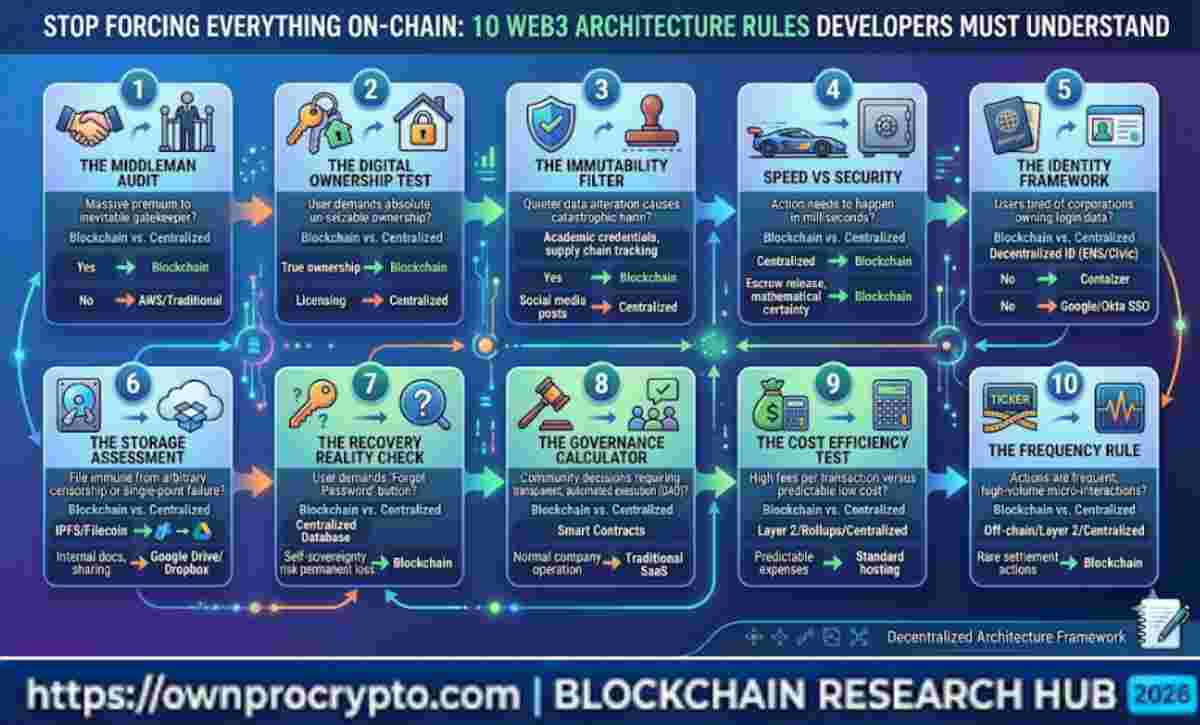
These 10 Web3 architecture rules are designed as practical engineering shortcuts for backend developers, startup founders, SaaS architects, and infrastructure teams trying to balance decentralized trust with real-world scalability.
The goal is simple:
Use blockchains where trust matters.
Use centralized systems where speed matters.
And stop sacrificing product quality for unnecessary decentralization.
The idea of a fully decentralized application sounds attractive in theory.
No middlemen. No centralized control. No platform dependency.
But software engineering operates under hard performance realities.
Every blockchain transaction introduces:
Centralized databases do not have this problem because they rely on unified infrastructure controlled by a single operator.
This is why traditional applications can process:
while decentralized applications struggle under congestion during peak activity.
| Application Feature | Best Infrastructure |
|---|---|
| Likes & comments | Centralized DB |
| Chat messages | Redis/PostgreSQL |
| Video uploads | CDN + Cloud |
| Real-time editing | WebSockets |
| Analytics | Cloud servers |
| Search indexing | ElasticSearch |
The issue is not that blockchains are “bad.”
The issue is that developers often misuse them as generic databases instead of treating them as specialized trust layers.
That distinction changes everything.
| Action | On-Chain Cost Problem |
|---|---|
| Text edits | Excessive |
| Likes | Unsustainable |
| Video upload | Impossible |
| NFT mint | Acceptable |
| Financial settlement | Worth it |
| Problem | Outcome |
|---|---|
| Every like/comment required wallet signature | Massive UX friction |
| On-chain storage for social activity | Unsustainable gas costs |
| Real-time feeds on blockchain | Multi-second latency |
| Forced wallet onboarding | 80%+ user abandonment |
The project eventually migrated:
off-chain into centralized infrastructure while keeping:
on-chain.
The easiest way to understand Web3 architecture is this:
Traditional servers are optimized for speed.
Blockchains are optimized for trust.
That single principle explains nearly every infrastructure decision modern developers should make.
| Infrastructure Type | Primary Strength | Weakness |
|---|---|---|
| Centralized Servers | Speed and scalability | Requires trust in operator |
| Blockchain Networks | Trust and immutability | Slower execution and higher cost |
This means:
| Feature | Blockchain | Traditional Server |
|---|---|---|
| Speed | Slow | Fast |
| Trust | Mathematical | Organizational |
| Cost | Higher | Lower |
| Ownership | User-controlled | Platform-controlled |
| Recovery | Difficult | Easy |
| Scalability | Limited | High |
| Transparency | Public | Private |
| Immutability | Strong | Weak |
Developers who understand this early avoid years of architectural mistakes.
we break down the definitive boundaries between on-chain settlement and off-chain execution. By mastering these ten architectural boundaries, you will learn how to design highly composable systems that natively support RWA Tokenization, preserve Real Yield mechanics, and enforce rigorous On-Chain Compliance without breaking your user experience.
The first question every backend engineer should ask is:
“Does this system actually need to remove a trusted intermediary?”
If the answer is no, blockchain infrastructure may introduce more complexity than value.
Good blockchain candidates:
Poor blockchain candidates:
If users are not suffering from:
then traditional infrastructure is usually the better engineering decision.
Rule of thumb:
If AWS solves the problem efficiently, forcing decentralization may only damage performance.
This is one of the most misunderstood areas in Web3 engineering.
Many products claim “ownership” while users still rely entirely on centralized platform permission.
True digital ownership means:
Examples where blockchain ownership matters:
Examples where centralized systems are sufficient:
| Use Case | Why Blockchain Helps |
|---|---|
| Escrow | Trustless settlement |
| NFTs | Ownership verification |
| DAO voting | Transparent governance |
| Stablecoins | Permissionless transfer |
| Identity proofs | Tamper resistance |
| Supply chains | Immutable records |
If ownership is not core to the product, decentralized infrastructure may add friction without meaningful user benefit.
Frontend
↓
Backend API
↓
PostgreSQL + Redis
↓
Blockchain Settlement Layer
↓
IPFS/Filecoin Storage
Developers should ask:
“What happens if this data is silently changed?”
If silent modification creates catastrophic trust failure, blockchain validation becomes useful.
Examples:
Examples that usually do NOT require immutability:
Not every database record deserves permanent global consensus.
Treat immutability like cryptographic insurance:
valuable for critical records, dangerous when overused.
User Action
↓
Fast Off-Chain Execution
↓
Critical Data Hash
↓
Blockchain Verification
Every architecture decision is a trade-off between:
This is where many startup teams fail.
Users expect:
But public blockchains cannot currently deliver cloud-level throughput at cloud-level costs.
That means:
A good hybrid architecture separates:
instead of forcing all operations into a single blockchain environment.
This is the foundation of scalable Web3 engineering.
| Component | Infrastructure |
|---|---|
| UI State | Centralized |
| Transactions | Blockchain |
| Media | Cloud/IPFS |
| Notifications | Centralized |
| Ownership Proof | Blockchain |
| Search | Centralized |
| Infrastructure Layer | Solution |
|---|---|
| NFT ownership | Ethereum |
| Metadata | IPFS |
| Search engine | ElasticSearch |
| User profiles | PostgreSQL |
| Images | CDN |
| Trading settlement | Smart contracts |
This hybrid architecture reduced:
while maintaining verifiable digital ownership.
Authentication is one of the biggest friction points in decentralized applications.
Most mainstream users still expect:
But pure wallet-based authentication introduces:
Developers should decide whether users truly require self-sovereign identity or simply convenient authentication.
Use decentralized identity systems when:
Use centralized identity systems when:
Hybrid authentication is often the best solution.
The best Web3 architecture often supports both traditional login systems and wallet authentication simultaneously.
| Authentication Need | Best Solution |
|---|---|
| Mainstream SaaS onboarding | Google OAuth |
| Enterprise login | Okta/Auth0 |
| DAO participation | WalletConnect |
| Web3 identity portability | ENS |
| Anonymous access | Wallet-only auth |
The best Web3 architecture often supports both traditional login systems and wallet authentication simultaneously.
Blockchains are extremely inefficient for storing large files.
Every byte written directly on-chain increases:
This makes direct on-chain storage impractical for:
Instead, developers should separate:
A common architecture pattern is:
This preserves verification without destroying scalability.
| Data Type | Recommended Storage |
| Images | CDN/S3 |
| NFTs metadata | IPFS |
| Large video files | Cloud storage |
| Verification records | Blockchain |
| Application logs | PostgreSQL |
| Immutable proofs | On-chain hash |
The blockchain should verify the file — not become the file.
One of the harshest realities in Web3 engineering is that users lose credentials constantly.
Most users expect:
Pure self-custody systems eliminate intermediaries but also eliminate recovery safety nets.
Developers must decide:
Does the product prioritize sovereignty or convenience?
If users are non-technical, forcing irreversible wallet management can severely damage retention.
This is why many successful hybrid platforms:
| User Expectation | Recommended Architecture |
| Forgot password recovery | Centralized auth |
| Full self-sovereignty | Wallet custody |
| Enterprise support | Hybrid |
| Mainstream onboarding | OAuth + wallet optional |
| Anonymous access | Wallet-only |
The best user experience is often invisible hybrid infrastructure.
Not every application requires decentralized governance.
Many startups create tokens and DAOs long before governance complexity actually exists.
This introduces:
Developers should ask:
“Does the product truly require transparent community execution?”
Blockchain governance makes sense when:
Traditional governance works better when:
| Governance Need | Recommended System |
| DAO treasury | Smart contracts |
| Startup operations | Traditional management |
| Community protocol upgrades | On-chain voting |
| Internal business strategy | Centralized execution |
| Token distribution | Smart contracts |
Decentralization should solve governance problems — not create unnecessary bureaucracy.
Every decentralized action carries infrastructure cost.
Many developers underestimate:
If decentralization increases costs dramatically without increasing user value, the architecture is inefficient.
This is especially dangerous for:
Developers should calculate:
“Does decentralization improve the product enough to justify the operational burden?”
| Application Action | Blockchain Suitability |
| Financial settlement | High |
| NFT ownership | High |
| Chat messages | Low |
| Real-time gaming input | Low |
| Escrow contracts | High |
| Analytics tracking | Very low |
A blockchain should increase trust efficiency — not operational inefficiency.
High-frequency interactions should almost never execute directly on-chain.
This is one of the most important principles in scalable Web3 engineering.
Actions like:
generate massive throughput requirements that distributed consensus systems are not optimized to handle efficiently.
Instead, developers should:
This hybrid execution model dramatically improves:
| Interaction Type | Recommended Layer |
| Likes/comments | Off-chain |
| Messaging | Off-chain |
| Escrow settlement | On-chain |
| NFT transfers | On-chain |
| Real-time gameplay | Off-chain |
| Ownership verification | On-chain |
The future of scalable Web3 infrastructure is not fully decentralized execution.
It is intelligent separation between:
That separation is what modern backend architecture actually requires.
| Requirement | Recommended System |
|---|---|
| Millisecond response | Centralized |
| Financial settlement | Blockchain |
| Social interactions | Off-chain |
| Asset ownership | On-chain |
| Real-time gaming | Hybrid |
| Escrow release | On-chain |
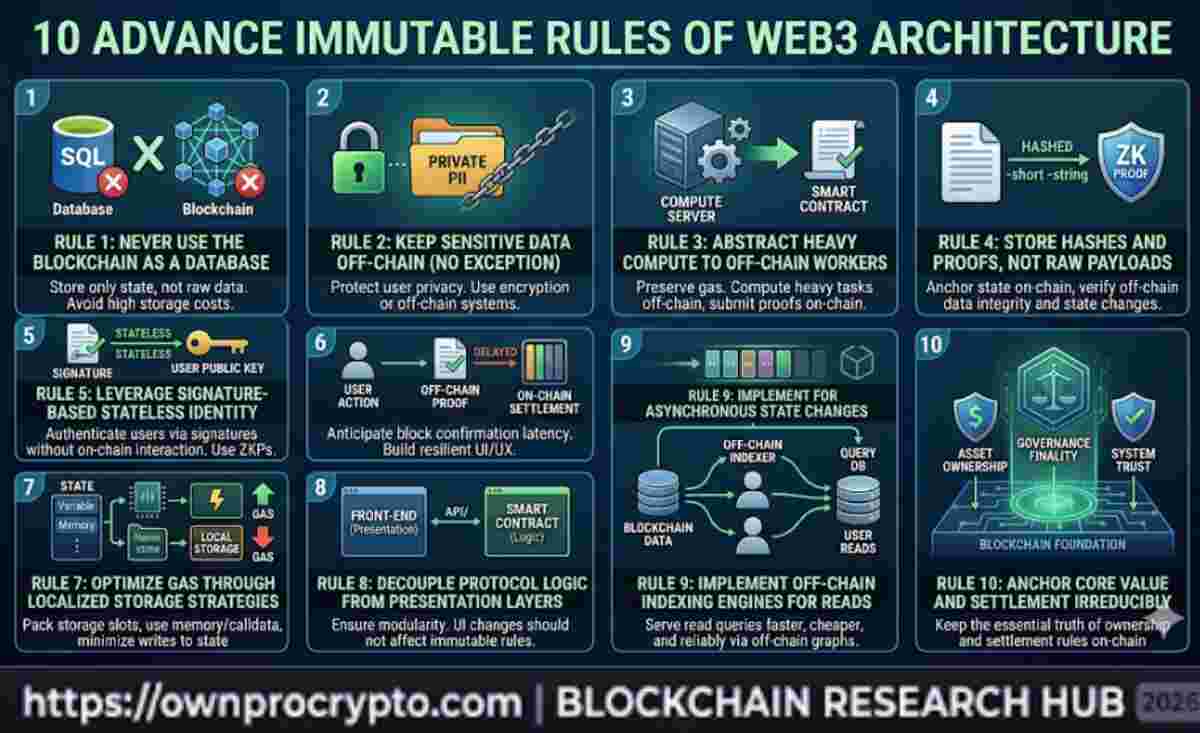
Decoupling core infrastructure guarantees from expensive storage layers is the defining trait of an enterprise-grade developer. Yet, too many engineering teams cripple their application’s performance, spike gas overheads, and destroy user experience by treating distributed ledgers like traditional relational databases.10 Advance Immutable Rules of Web3 Architecture Developers Must Understand, we establish the immutable boundaries between state settlement and off-chain execution. By mastering these ten production rules, you will learn how to build composable systems. To see how these system design frameworks directly integrate with our full development ecosystem, be sure to check our Next master cluster post.
| Layer | Recommended Tool |
|---|---|
| Frontend | Next.js |
| Backend | Node.js |
| Database | PostgreSQL |
| Cache | Redis |
| Blockchain | Ethereum/Solana |
| File Storage | IPFS |
| Indexer | The Graph |
| Auth | WalletConnect + OAuth |
As blockchain adoption grows across identity, payments, governance, storage, and ownership systems, the teams that survive long-term will not be the ones forcing everything on-chain. They will be the teams designing practical systems that combine trust, usability, scalability, and performance intelligently.
The future of Web3 architecture is not fully decentralized execution. It is intelligent infrastructure separation. Modern backend developers are realizing that forcing every application layer onto blockchain networks creates unnecessary latency, rising operational costs, poor onboarding experiences, and severe scalability bottlenecks. The strongest decentralized application architecture in 2026 is built around hybrid execution models where centralized systems handle speed while blockchain networks handle trust, ownership, verification, and settlement. This shift is already visible across the industry. Leading infrastructure projects now combine cloud scalability with decentralized security instead of attempting to replace traditional backend systems entirely.
Developers who understand the difference between on-chain vs off-chain architecture gain a major advantage when building scalable products that users can actually adopt. The core principle remains simple: Use centralized infrastructure for execution speed. Use blockchain infrastructure for mathematical trust. That balance is what separates sustainable Web3 engineering from expensive architectural experimentation. For developers researching modern blockchain infrastructure standards, Ethereum’s official developer documentation remains one of the best technical resources for understanding smart contracts, scaling layers, decentralized identity systems, and hybrid Web3 infrastructure design: https://ethereum.org/en/developers/
Understanding the principles behind Web3 architecture is only the first step. Once developers know when blockchain should be used and when traditional infrastructure is the better choice, the next challenge is implementation. Our companion guide, Web3 Architecture Guide: On-Chain vs Off-Chain Engineering & Hybrid Systems, takes a deeper technical dive into hybrid infrastructure, scalability design, storage frameworks, authentication models, and real-world engineering case studies that show how modern decentralized applications are actually built.
A blockchain is a decentralized digital ledger that records transactions across multiple computers instead of relying on a single centralized server. It is designed to provide transparency, immutability, and mathematical trust without requiring a middleman. Blockchain networks like Bitcoin and Ethereum are commonly used for digital payments, smart contracts, ownership verification, and decentralized applications.
Traditional blockchain architecture attempts to place most application logic directly on-chain, including storage, execution, and validation. Hybrid blockchain architecture separates responsibilities between centralized infrastructure and decentralized networks.
In a hybrid blockchain architecture:
This approach improves Web3 scalability while maintaining decentralization where it actually matters.
Most Web3 apps fail because developers force too many application features directly onto blockchain infrastructure. This creates:
The best Web3 applications follow on-chain vs off-chain architecture rules carefully instead of treating blockchains like general-purpose databases.
The 10 Web3 architecture rules help developers decide when blockchain infrastructure is necessary and when centralized systems are more efficient.
These rules include:
Together, these frameworks create scalable decentralized application architecture without sacrificing performance.
On-chain systems execute directly on a blockchain network and benefit from:
Off-chain systems execute outside the blockchain using traditional infrastructure like cloud servers and databases. They provide:
Modern Web3 architecture usually combines both approaches through hybrid blockchain infrastructure.
Decentralized application architecture refers to software systems that combine blockchain networks, smart contracts, decentralized storage, and traditional backend infrastructure to create trust-minimized applications.
A decentralized application architecture may include:
Most scalable decentralized apps today use hybrid Web3 infrastructure rather than fully on-chain execution.
Web3 scalability is difficult because blockchain networks require distributed consensus across many nodes before updating state. This creates:
Traditional cloud servers process requests much faster because they operate on centralized infrastructure without requiring global consensus validation.
This is why many developers move high-frequency interactions off-chain.
Developers should use blockchain when applications require:
Traditional servers are usually better for:
The best Web3 architecture balances both systems intelligently.
Not everything should be on-chain because blockchains optimize for trust, not speed. Writing all application data directly to a blockchain increases:
High-frequency interactions like comments, likes, notifications, and UI state updates are usually better handled through centralized infrastructure while blockchain handles settlement and ownership layers.
Hybrid Web3 infrastructure combines:
This architecture allows developers to maintain:
Hybrid infrastructure is becoming the dominant model for scalable Web3 engineering in 2026.
Welcome to OwnProCrypto (Own & Pro Crypto) — a next-generation Bitcoin and blockchain education platform where the science of finance meets the power of AI-driven automation.
Our mission is simple: to equip you with the knowledge, frameworks, and tools needed to make smarter financial and business decisions in the Web3 economy.
Beyond analysis, OwnProCrypto focuses on transparency, verifiable data, and practical frameworks that investors and builders can actually use. Our goal is not hype — but clear thinking, disciplined analysis, and long-term value creation in the decentralized economy.
Our Background: Salim (Sam) is the founder and lead researcher behind OwnProCrypto, a Web3 intelligence platform focused on crypto security, digital ownership, stablecoin systems, interoperability, and institutional blockchain infrastructure.
Crypto Tools & Analysis:
Crypto Fundamental Analysis Tool | Protocol Evaluation System | DeFi Risk Analysis Tools | Crypto Portfolio Dashboard | Token Risk vs Reward Tool
Guides:
Crypto Fundamental Analysis | Blockchain Project Evaluation | Tokenomics Analysis | DeFi Protocol Analysis | Capital Efficiency
© 2026 OwnProCrypto — Built for smarter crypto decisions