infographic of site logo for contact us

OwnProCrypto.com

Use our Crypto Search Engine 🔍 to find the topics and keywords you're looking for.

AI Crypto Portfolio Tracker: Track, Analyze & Optimize Your Portfolio

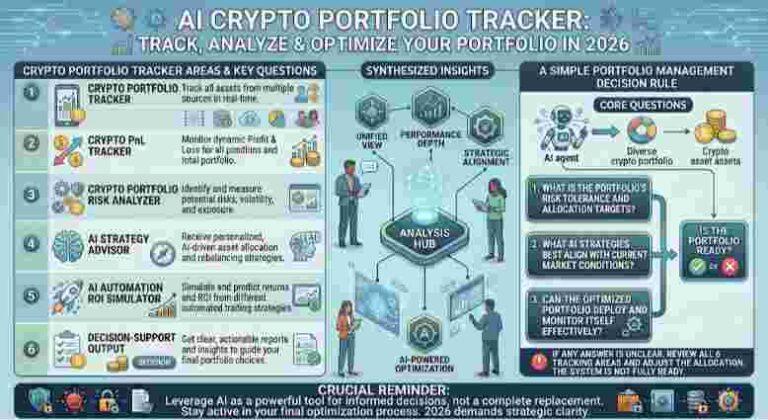
Infographic of AI Crypto Portfolio Tracker 2026
AI Crypto Portfolio Tracker

Managing a crypto portfolio is no longer just a matter of knowing whether the portfolio is up or down.

An AI crypto portfolio tracker combines the basic functions of a crypto portfolio tracker with additional analysis. Instead of simply displaying balances, holdings, allocation, and performance, an AI-enabled system can help interpret portfolio data, identify concentration, examine risk, and explore hypothetical scenarios.

A traditional crypto portfolio tracker is primarily designed to answer: “What do I own, and how is it performing?” An AI crypto portfolio tracker can go further by helping users ask: “What does my portfolio data mean, what risks should I examine, and what scenarios should I compare?”

As portfolios become more diversified across assets, chains, strategies and trading positions, investors need to understand what they own, how it is performing, where the risk is concentrated, and whether a different strategy could produce a better outcome under the same assumptions.

That is where an AI Crypto Portfolio Tracker can become more useful than a basic balance dashboard.

A conventional tracker may show holdings, prices and profit or loss. An AI-enabled portfolio tool can go further by combining portfolio tracking, PnL analysis, risk analysis, strategy evaluation and scenario modeling into one decision-support workflow.

This guide explains how an AI crypto portfolio tracker works, what the different analysis layers mean, how to use the OwnProCrypto portfolio tool, and where AI analysis should—and should not—be trusted.

Table of Contents

Quick Answer

An AI Crypto Portfolio Tracker is a portfolio analysis system that combines cryptocurrency holdings data with automated calculations and AI-assisted interpretation.

Instead of looking only at portfolio value, the system can help answer five different questions:

QuestionAnalysis layerWhat it tells you
What do I own?Portfolio trackingHoldings, allocation, value and exposure
How am I performing?PnL analysisGains, losses, ROI and performance
How much risk am I taking?Risk analysisConcentration, volatility and portfolio weaknesses
Is my strategy working?Strategy analysisPotential strengths, weaknesses and scenario outcomes
What could happen under another approach?SimulationHypothetical outcomes under stated assumptions

The important distinction is that an AI portfolio tracker should be treated as a decision-support system, not a guaranteed prediction engine.

Modern portfolio tools increasingly combine tracking, PnL, allocation and risk analytics, while newer AI-oriented tools add natural-language analysis and portfolio recommendations.

AI Crypto Portfolio Tracker

An AI crypto portfolio tracker combines the basic functions of a crypto portfolio tracker with additional analysis. Instead of simply displaying balances, holdings, allocation, and performance, an AI-enabled system can help interpret portfolio data, identify concentration, examine risk, and explore hypothetical scenarios.

A traditional crypto portfolio tracker is primarily designed to answer: “What do I own, and how is it performing?” An AI crypto portfolio tracker can go further by helping users ask: “What does my portfolio data mean, what risks should I examine, and what scenarios should I compare?”

What Is an AI Crypto Portfolio Tracker?

An AI crypto portfolio tracker combines traditional portfolio accounting with automated analysis and AI-assisted interpretation.

A conventional tracker answers:

“What is my portfolio worth?”

A more advanced system can also ask:

“Why does the portfolio look this way?”

“Where is the risk concentrated?”

“How much of the result comes from a particular asset?”

“What would happen under another strategy?”

This creates a progression:

Track → Measure → Analyze → Compare → Decide


Portfolio tracking

Portfolio tracking establishes the basic state of the portfolio.

Depending on the tool and available inputs, this can include:

  • Asset names and quantities.
  • Purchase prices.
  • Current prices.
  • Portfolio value.
  • Asset allocation.
  • Cash or stablecoin exposure.
  • Individual position weights.
  • Portfolio-level exposure.

Without accurate portfolio data, every later analysis becomes less reliable.


PnL analysis

PnL means profit and loss.

A crypto PnL analysis can distinguish between the amount originally invested and the current or estimated value of the position.

A simplified unrealized PnL calculation is:

Unrealized PnL = Current Position Value − Cost Basis

For example, if an investor purchased $10,000 worth of an asset and its current estimated value is $13,000:

Estimated PnL = $13,000 − $10,000 = $3,000

Real-world PnL can become more complicated when there are multiple purchases, sales, fees, transfers, staking rewards or different cost-basis methods.

That is why users should always understand what inputs and accounting assumptions a particular tracker uses.


Risk analysis

Portfolio value alone does not reveal portfolio risk.

A portfolio can be profitable while being highly concentrated in one asset or market theme.

Risk analysis can examine factors such as:

  • Asset concentration.
  • Sector concentration.
  • Stablecoin exposure.
  • Volatility.
  • Drawdown.
  • Correlation.
  • Position sizing.
  • Liquidity assumptions.

Professional portfolio analysis therefore asks not only how much was earned, but how much risk was required to produce that result.


Strategy analysis

Strategy analysis moves beyond describing the portfolio and begins examining the decisions behind it.

Examples include:

  • Buy-and-hold versus active trading.
  • Concentrated versus diversified allocation.
  • Periodic rebalancing.
  • DCA versus lump-sum entry.
  • Different cash allocations.
  • Different risk assumptions.
  • Different execution approaches.

The purpose is not to prove that one strategy will win.

The purpose is to understand how different assumptions could change the outcome.

What Does a 5-in-1 AI Crypto Portfolio Tool Do?

The OwnProCrypto AI Crypto Portfolio Tool is designed around five complementary functions rather than a single portfolio number.

5-IN-1 AI CRYPTO PORTFOLIO TOOL

Portfolio Data

↓

1. AI Crypto Portfolio Tracker

↓

2. Crypto PnL Tracker

↓

3. Portfolio Risk Analyzer

↓

4. AI Strategy Advisor

↓

5. AI Automation ROI Simulator

↓

Decision-Support Output

The advantage of this architecture is that the user can move from measurement to interpretation without treating every metric as an isolated number.


AI Crypto Portfolio Tracker

The first layer establishes the portfolio itself.

It helps organize information such as:

  • Assets.
  • Quantities.
  • Estimated values.
  • Portfolio weights.
  • Allocation.
  • Performance.

This creates the baseline for every other analysis.


Crypto PnL Tracker

The PnL component focuses on portfolio performance.

It can help users understand:

  • Estimated gains.
  • Estimated losses.
  • Return on investment.
  • Position-level performance.
  • Portfolio-level performance.
  • Potential effects of costs where those inputs are included.

A useful PnL analysis should make the calculation assumptions visible rather than presenting an unexplained number.


Portfolio Risk Analyzer

The risk analyzer examines whether the portfolio’s apparent performance is accompanied by significant concentration or other structural risks.

For example:

Portfolio conditionPossible interpretation
One asset dominates the portfolioHigh concentration risk
Several holdings belong to one sectorTheme or sector concentration
Highly correlated assets dominateDiversification may be weaker than it appears
Large stablecoin allocationLower market exposure but potentially lower upside participation
High-volatility assets dominateGreater potential drawdown and portfolio instability

AI Strategy Advisor

The strategy advisor uses the available portfolio information and assumptions to help interpret possible strategic choices.

It may help identify:

  • Concentration issues.
  • Allocation weaknesses.
  • Potential diversification considerations.
  • Strategy trade-offs.
  • Questions the investor should investigate.

An AI strategy recommendation should not be interpreted as a guaranteed buy, sell or hold signal.

The better use of AI is to make the investor’s decision process more structured.


AI Automation ROI Simulator

The automation ROI simulator introduces a different question:

“Would automating part of the portfolio or trading process potentially justify its cost and risk?”

A scenario simulator can compare assumptions such as:

  • Manual execution time.
  • Estimated automation costs.
  • Trading frequency.
  • Potential efficiency gains.
  • Estimated transaction costs.
  • Hypothetical strategy outcomes.

These are scenario calculations, not guarantees of future trading profitability.

Use the AI Crypto Portfolio Tool

The workflow is designed to be simple: provide the relevant portfolio or scenario information, select the required assumptions, and review the generated analysis.

The basic workflow is:

Input → Analyze → Interpret → Compare → Decide

Users should provide accurate information whenever they want the analysis to represent an existing portfolio.

For hypothetical scenarios, clearly label the assumptions so the resulting numbers are not confused with actual portfolio performance.

Infographic of 5 in 1 AI Crypto Portfolio Tool 2026
AI Crypto Portfolio Tool

How the AI Crypto Portfolio Tool Works

Step 1: Enter Your Portfolio Information

Enter the assets, amounts, prices, or other information requested by the tool.

Use accurate information when you want the calculations to represent an existing portfolio.

Depending on the analysis, useful inputs can include:

  • Asset.
  • Quantity.
  • Entry price.
  • Current price.
  • Portfolio value.
  • Fees or costs where applicable.
  • Strategy assumptions.
  • Risk assumptions.

Do not enter private keys, seed phrases, passwords or sensitive account credentials into an analysis tool.


Step 2: Set Your Analysis Parameters

Depending on the analysis you want to perform, provide the relevant investment, risk, transaction or strategy assumptions.

Different questions require different assumptions.

AnalysisUseful assumptions
PnLCost basis, current price and applicable costs
RiskAllocation, concentration and volatility assumptions
StrategyAllocation or execution assumptions
ROI simulationCosts, expected efficiency and scenario parameters

Step 3: Run the Analysis

Submit the information to generate the portfolio analysis.

The tool processes the supplied inputs and presents the resulting estimates and indicators.

The output is only as meaningful as the data and assumptions supplied to the system.


Step 4: Review the Results

Review the estimated portfolio value, PnL, ROI, risk information and other available results.

Look at the complete portfolio rather than focusing on a single number.

For example, a portfolio showing a strong estimated return may also show:

  • High concentration.
  • High volatility.
  • Large drawdown potential.
  • Significant dependence on one asset.

Step 5: Compare Possible Strategies

Use the analysis to compare scenarios and identify potential strengths, weaknesses and risks.

The output should be treated as decision-support information rather than a guaranteed trading signal.

DECISION-SUPPORT LOOP

Current Portfolio

↓

Measure Performance

↓

Identify Risk

↓

Generate Alternative Scenario

↓

Compare Outcomes

↓

Review Assumptions

↓

Make Your Own Decision

Understanding Your Results

The numbers generated by a portfolio tool are most useful when they are interpreted together.

A high estimated return, for example, may also involve substantially higher risk.


Estimated Results

Estimated results represent the outcome produced from the assumptions entered into the tool.

They should not be interpreted as a prediction of future market performance.

If the underlying assumption changes, the estimated result can change as well.


Net Result

The net result helps users understand the overall outcome after the relevant gains, losses, costs or assumptions included in the calculation.

When comparing strategies, always check what costs and assumptions are included in the result.


Missed Opportunities

A missed-opportunity analysis can illustrate how a different hypothetical decision might have changed an outcome.

For example, a scenario might compare holding an asset with selling it earlier under a particular historical price path.

This should be viewed as scenario analysis, not evidence that a different trade would necessarily have succeeded in real market conditions.


Asset Breakdown and Risk

The asset breakdown helps users understand how individual holdings contribute to the overall portfolio.

Concentration in one asset, sector, blockchain ecosystem or market segment can create risks that may not be obvious when looking only at total portfolio value.

A useful portfolio review therefore moves from:

Total Value → Asset Allocation → Concentration → Performance → Risk → Strategy


Strategy Recommendation

An AI strategy recommendation should be interpreted as an analytical opinion generated from the supplied information and assumptions.

It can help surface:

  • Potential concentration issues.
  • Possible diversification considerations.
  • Trade-offs between risk and return.
  • Questions that deserve further investigation.
  • Alternative scenarios worth testing.

It should not be treated as a prediction or an instruction to execute a trade.

AI vs Human Trading Analysis

The most useful comparison between AI and human decision-making is not simply “which one wins?”

The better question is:

Which parts of portfolio analysis are well suited to automation, and which still require human judgment?

TaskAI / automationHuman judgment
Calculating PnLExcellent for repetitive calculationsVerifies assumptions and data quality
Portfolio allocationFast and systematicDetermines acceptable allocation
Risk screeningCan identify patterns and concentrationDetermines whether the risk is acceptable
Scenario analysisCan process many assumptionsChooses relevant scenarios
Market interpretationCan summarize large information setsEvaluates context and uncertainty
Trading decisionCan generate an analytical recommendationRemains responsible for the final decision

AI is particularly powerful at repetitive analysis, structured comparisons and processing large amounts of portfolio information.

Humans remain responsible for defining objectives, understanding constraints and deciding whether a recommendation is appropriate.

Even current AI portfolio products explicitly warn that AI output can be incomplete or incorrect and should be verified against actual portfolio data. 

Portfolio Risk and Strategy

A portfolio should not be judged solely by its return.

Consider two hypothetical portfolios:

MetricPortfolio APortfolio B
Estimated return+30%+24%
Largest position65%30%
Sector concentrationHighModerate
Estimated volatilityHighModerate
Drawdown exposureHigherLower

Portfolio A has the higher estimated return.

But that does not automatically make it the better portfolio.

The appropriate choice depends on the investor’s:

  • Risk tolerance.
  • Time horizon.
  • Liquidity requirements.
  • Investment objectives.
  • Ability to withstand drawdowns.

This is why AI portfolio analysis should present trade-offs rather than pretending that one metric determines the correct decision.

Who Should Use This Tool?

Beginners

Beginners can use an AI crypto portfolio tracker to understand basic concepts such as portfolio value, allocation, PnL and concentration.

The visual structure can make complex portfolio information easier to understand than manually maintaining spreadsheets.

However, beginners should be particularly careful not to confuse an AI recommendation with professional investment advice.


Active investors

Active investors can use portfolio analysis to monitor multiple positions, compare performance and evaluate strategy assumptions.

The biggest advantage is often reducing the amount of repetitive calculation required before making a decision.


Researchers

Researchers can use scenario analysis to examine how different allocations or assumptions affect portfolio outcomes.

This can be useful for hypothesis testing, historical analysis and strategy comparison.


Portfolio managers

Portfolio managers can use automated portfolio analysis as an additional analytical layer for allocation review, risk monitoring and scenario analysis.

For professional use, however, the underlying data quality, methodology, auditability and assumptions should be independently verified.


Limitations and Risk Considerations

An AI crypto portfolio tool is powerful, but it is not infallible.

Garbage in, garbage out

Incorrect quantities, prices or cost-basis information can produce incorrect results.


AI can make analytical mistakes

AI systems can misinterpret inputs, overlook context or produce incorrect explanations.


Historical scenarios are not forecasts

A strategy that worked under historical assumptions does not necessarily work in the future.


Market conditions change

Crypto markets can experience extreme volatility, liquidity changes, regulatory changes and structural shifts.


Risk metrics are model-dependent

Different models can produce different estimates depending on the selected time period, methodology and assumptions.


PnL may depend on accounting methodology

Realized and unrealized PnL can differ depending on transaction history, cost-basis methodology, fees, transfers and other factors.


AI cannot know your complete financial situation

A portfolio tool generally does not know your complete income, liabilities, tax situation, liquidity needs, personal risk tolerance or other assets unless you explicitly provide that information.


Automation adds its own risk

Automating a trading strategy can introduce execution, API, connectivity, security and model risks.

For these reasons, portfolio analysis should support judgment rather than replace it.

How to Use AI Portfolio Analysis Responsibly

  1. Verify the input data. Make sure quantities, prices and cost assumptions are accurate.
  2. Understand the methodology. Know what the tool is calculating and what it excludes.
  3. Separate facts from estimates. A calculated historical result is different from a future prediction.
  4. Look at the entire portfolio. Do not judge the portfolio from one asset or one metric.
  5. Test alternative assumptions. See how sensitive the result is to different scenarios.
  6. Review risk alongside return. A higher return estimate can come with substantially higher risk.
  7. Keep sensitive credentials private. Never provide seed phrases, private keys, passwords or withdrawal-capable credentials to an analysis tool.
  8. Make the final decision yourself. AI output should remain decision-support information.
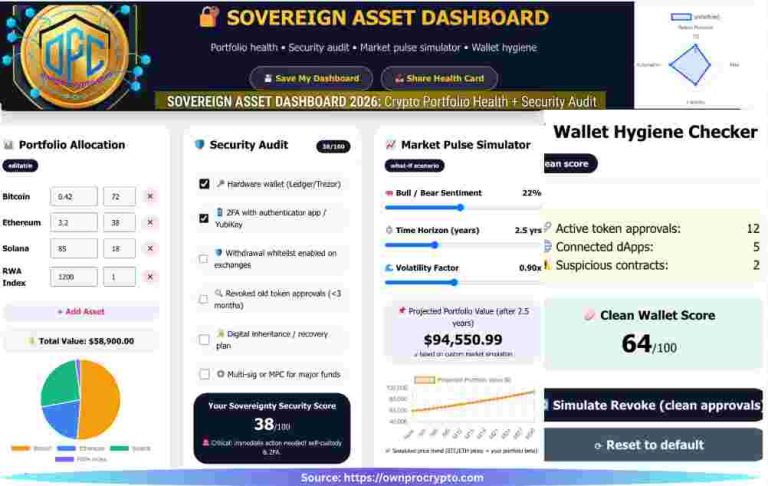
Infographic of Crypto Portfolio Tracker 2026: Security Audit, Risk Management & Wallet Health Dashboard
Crypto Portfolio Tracker 2026

AI Crypto Portfolio Tracker vs Traditional Portfolio Tracker

CapabilityTraditional trackerAI Crypto Portfolio Tracker
Portfolio valueYesYes
Asset allocationUsuallyYes
PnL trackingUsuallyYes
Risk analysisVariesIntegrated analysis
Strategy interpretationLimitedAI-assisted
Scenario comparisonLimitedCore use case
Natural-language analysisRarePossible
Automation ROI simulationRareSpecialized function

The important difference is not that AI magically produces better returns.

The difference is that AI can add an interpretation and scenario layer on top of conventional portfolio calculations.

This infographic of Crypto Asset Explorer Dashboard
Tab here to See your entire net worth through a professional lens.

What Makes an AI Crypto Portfolio Tracker Useful?

A useful portfolio tool should reduce complexity without hiding important assumptions.

Five qualities matter particularly:

QualityWhy it matters
AccuracyPortfolio calculations depend on reliable inputs
TransparencyUsers should understand what the numbers mean
ContextMetrics need interpretation within the portfolio
Scenario analysisUsers can compare alternatives rather than relying on one outcome
Risk awarenessReturn should always be considered alongside risk

This is also where OwnProCrypto’s tool architecture is intended to be different from a basic tracker.

The objective is not simply:

“Here is your portfolio value.”

The objective is:

Here is what your portfolio contains, how it has performed under the supplied assumptions, where risk appears concentrated, and what alternative scenarios are worth examining.

AI Crypto Portfolio Analysis Workflow

PORTFOLIO INTELLIGENCE LOOP

1. TRACK

↓

2. CALCULATE PnL

↓

3. ANALYZE RISK

↓

4. ANALYZE STRATEGY

↓

5. SIMULATE ALTERNATIVES

↓

6. REVIEW ASSUMPTIONS

↓

7. HUMAN DECISION

This workflow matters because portfolio optimization is not a single calculation.

It is a process of continuously connecting data, performance, risk and decision-making.

This Image shows Conclusion of Post
Conclusion

Conclusion about AI Crypto Portfolio Tracker

An AI Crypto Portfolio Tracker should be more than a digital replacement for a spreadsheet.

The real value comes from connecting several layers of portfolio intelligence:

Track → Measure → Analyze → Compare → Decide.

Portfolio tracking tells you what you own.

PnL analysis tells you how the portfolio has performed under the selected assumptions.

Risk analysis tells you where the portfolio may be vulnerable.

Strategy analysis helps you examine alternative approaches.

Simulation helps you understand what could happen under different assumptions.

And AI can help connect those pieces into a more understandable decision-support workflow.

But the most important principle remains simple:

AI should improve the quality of your decision process—not remove human responsibility from the decision.

A strong crypto portfolio is not necessarily the portfolio with the highest estimated return.

It is the portfolio whose risk, objectives, assumptions and strategy the investor actually understands.

Related Crypto Decision Tools

An AI portfolio tracker becomes more useful when it sits inside a broader decision-support ecosystem.

For further reading on this topic, visit the official NIST Post-Quantum Cryptography Project for comprehensive standards and technical guidance.

Image used for FAQs Frequently Asked Questions and their Answer about How to Build Your Brand and Mission showing & solving Complex Business Problems
FAQs Frequently Asked Questions

AI Crypto Portfolio Tool FAQs

General Questions

What is an AI crypto portfolio tool?

An AI crypto portfolio tool combines portfolio tracking, financial calculations, risk analysis and AI-assisted interpretation to help users understand their cryptocurrency holdings and compare potential strategies.


How does an AI crypto portfolio tool work?

The user provides portfolio or scenario information, selects relevant assumptions, runs the analysis and reviews the resulting portfolio, PnL, risk or strategy information. The output depends on the quality and completeness of the supplied data.


What can an AI crypto portfolio tool analyze?

Depending on the tool, it can analyze portfolio allocation, estimated value, PnL, ROI, concentration, risk factors, strategy scenarios and hypothetical automation outcomes.


Is an AI crypto portfolio tool useful for beginners?

Yes. It can help beginners understand portfolio value, allocation, PnL and basic risk concepts. Beginners should nevertheless treat AI-generated recommendations as decision-support information rather than guaranteed investment advice.


Portfolio Questions

Can an AI crypto portfolio tool track multiple assets?

Yes. Portfolio tools can be designed to analyze multiple assets and calculate their individual and combined contribution to portfolio value, allocation and performance.


Can I use an AI crypto portfolio tool without connecting my wallet?

Yes. A portfolio tool can analyze manually entered holdings or scenario data without requiring direct wallet connectivity. Manual analysis can also reduce the need to provide account credentials or permissions to an external system.


Can AI analyze crypto portfolio risk?

Yes. AI can assist with interpreting portfolio concentration, allocation, volatility and other supplied risk indicators. The quality of the analysis depends on the underlying data and methodology.


Can an AI tool help with crypto portfolio allocation?

Yes. AI can compare allocations and identify potential concentration or diversification issues. Any allocation recommendation should be evaluated against the investor’s objectives, risk tolerance and time horizon.


PnL and ROI Questions

What is a crypto PnL tracker?

A crypto PnL tracker calculates estimated profit and loss from cryptocurrency positions by comparing relevant cost-basis information with current or selected valuation data.


How does a crypto PnL calculator account for fees?

That depends on the calculator. Some systems allow trading or transaction fees to be included in the calculation, while simpler tools may exclude them. Users should check the methodology before relying on a PnL figure.


How is crypto portfolio ROI calculated?

A simplified ROI calculation is estimated gain or loss divided by the relevant initial investment, multiplied by 100. More sophisticated portfolio calculations may require cash-flow, timing and cost-basis adjustments.


Can AI calculate crypto trading returns?

AI can help calculate or interpret trading returns when accurate transaction and pricing information is available. The resulting calculation is only as reliable as the data, accounting method and assumptions used.


AI Trading Questions

Can AI predict crypto prices?

AI can generate forecasts or scenarios, but it cannot reliably guarantee future cryptocurrency prices. Crypto markets are affected by changing liquidity, sentiment, macroeconomic conditions, regulation, technology and unpredictable events.


Can AI trading outperform human traders?

There is no universal answer. AI can process data quickly and apply rules consistently, while humans can provide contextual judgment. Whether an automated strategy outperforms depends on the strategy, data, execution, costs, market conditions and risk controls.


Is AI crypto trading safe?

AI crypto trading carries financial, technical, market and cybersecurity risks. Automated systems can execute mistakes at scale, and API or software failures can create additional exposure. Strong permissions, risk limits and monitoring are essential.


Should I let AI trade crypto automatically?

Not simply because an AI system produces a recommendation. Before considering automation, users should understand the strategy, execution permissions, risk limits, costs, failure modes and security model. Analysis and execution should be treated as separate decisions.


Tool-Specific Questions

Does this AI crypto portfolio tool connect to my wallet?

The analysis workflow can be based on the portfolio or scenario information supplied to the tool. Users should not provide seed phrases, private keys, passwords or other sensitive credentials to an analysis interface.


Does the tool execute real trades?

The portfolio analysis workflow described in this article is designed for analysis and decision support. A calculation or recommendation should not be assumed to execute a real trade unless an explicitly documented trading integration is provided.


Are the AI portfolio results guaranteed?

No. Portfolio results are estimates based on supplied information and assumptions. They are not guarantees of future returns, trading performance or investment outcomes.


What does the AI strategy recommendation mean?

An AI strategy recommendation is an analytical interpretation of the portfolio data and assumptions provided to the system. It can highlight potential strengths, weaknesses, risks or alternative scenarios, but the user remains responsible for evaluating whether the recommendation is appropriate.


How does the AI vs human execution simulator work?

An AI versus human execution simulator can compare hypothetical outcomes using assumptions about execution speed, costs, strategy rules, frequency and other parameters. It should be treated as scenario analysis rather than proof that one approach will outperform in live markets.

Looking for another topic? Search the OwnProCrypto research archive.
RESEARCH

Found this research useful?

Share it with someone who may find it useful.

DISCUSSION

Join the Discussion

Share your perspective, question, or additional insight.

Join the Research Discussion

Your contribution should remain relevant, constructive, and research-focused.

← Best Institutional Digital Asset Management Platforms (2026): Enterprise Asset Management & Accounting Tools Compared
Portfolio Allocation Strategy: How to Balance Real Estate, Gold & Crypto →
🛠 Explore Tools ▼
📚 Explore Crypto Research Select a research category