
Table of Contents
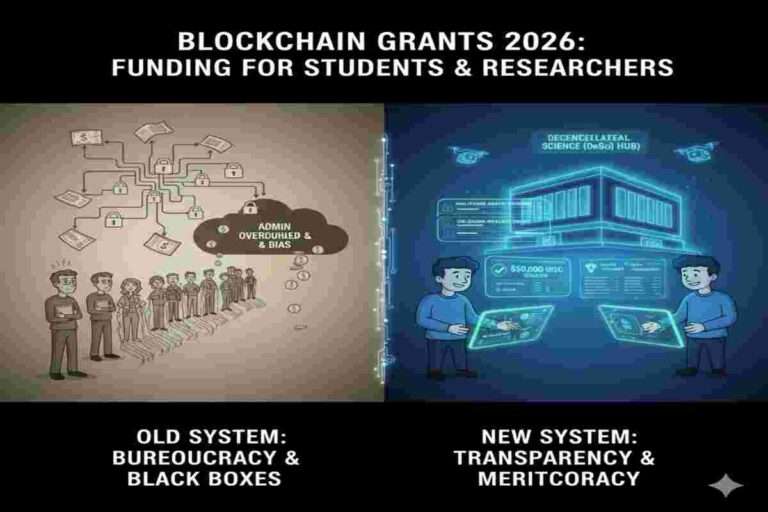
ToggleThe transition to Blockchain Grants 2026: Funding for Students & Researchers addresses the critical pain point of centralized academic gatekeeping by offering the unique solution of Capital Efficiency through Decentralized Science (DeSci). For decades, academic funding followed a familiar pattern: lengthy applications, institutional gatekeepers, and grant cycles that could take more than a year. In 2026, that model is being challenged by blockchain ecosystems, Decentralized Science (DeSci), quadratic funding, milestone-based grants, and global stablecoin payments.
For students, researchers, developers, and academic innovators, blockchain grants represent more than an alternative funding source. They represent a new funding infrastructure where ideas can receive support based on merit, transparency, community impact, and measurable outcomes rather than institutional prestige alone.
Whether you are a Master’s student seeking funding for a thesis, a PhD researcher building a proof of concept, an open-source developer, or an academic exploring decentralized systems, understanding the blockchain grant landscape could dramatically expand your funding opportunities.
Traditional research funding remains highly competitive.
Many applicants spend months preparing proposals only to face:
Blockchain ecosystems approach funding differently.
Many Web3 foundations view grants as ecosystem investments rather than traditional research sponsorships. Their goal is to accelerate innovation, adoption, education, and infrastructure growth.
As a result, grant programs often provide:
For researchers and students, this creates entirely new pathways to fund meaningful work.
Decentralized Science, commonly known as DeSci, has become one of the most important developments within Web3.
DeSci aims to improve how research is funded, published, reviewed, owned, and commercialized.
Instead of relying exclusively on:
DeSci platforms enable communities, DAOs, foundations, and token holders to collectively fund research initiatives.
The model offers several advantages:
Researchers can often receive funding within weeks instead of waiting a year or longer.
Talent is no longer limited by geography.
A researcher in Kenya, Pakistan, Brazil, India, Indonesia, or Argentina can access the same grant opportunities as applicants from traditional research hubs.
Blockchain records provide publicly verifiable funding activity, helping reduce opacity in grant distribution.
Projects often receive support through community voting mechanisms that reward practical impact.
Most blockchain grant programs follow a similar structure.
Applicants submit:
Grant committees evaluate:
Funding is frequently divided into milestones.
Rather than receiving the entire grant upfront, researchers unlock funds as progress is demonstrated.
Payments are commonly issued through:
This allows global distribution without traditional banking friction.
Many grant programs require:
Transparency is often a core requirement.

Researchers seeking larger grants often move beyond standard applications.
Many successful applicants build relationships before applying.
Participating in:
can significantly improve proposal quality.
Maintaining transparent progress records through:
demonstrates credibility.
Foundations fund projects that advance their ecosystems.
Applications should clearly explain:
Strong milestone design reduces perceived risk.
Reviewers prefer:
Stablecoin budgeting helps reduce currency volatility risks during long research timelines.
Several ecosystems remain highly active in grant distribution.
Often focused on:
Common funding areas include:
Typically support:
Funding categories often include:
Particularly attractive for:
Supports:
One of the most accessible opportunities for:
A PhD student in Kenya wanted to build a blockchain-based land registry for local farmers.
Traditional NGOs rejected the proposal because it was considered too technical and outside their existing funding frameworks.
Secure $20,000 to develop a working proof of concept.
Several blockchain foundations actively fund real-world asset and public infrastructure initiatives.
The project aligned directly with ecosystem goals.
The student applied for an ecosystem grant with:
The proposal underwent a rigorous technical review process.
Funding was approved within approximately one month.
The registry eventually supported hundreds of local farmers and helped secure additional research opportunities.
Many grant committees prioritize practical implementation over theoretical concepts.
Researchers who demonstrate clear execution pathways often outperform applicants who focus exclusively on academic theory.
Blockchain grants are no longer a niche funding source.
They are becoming a legitimate parallel funding infrastructure for students, researchers, academics, and open-source builders worldwide.
The most successful applicants are not necessarily those with the strongest credentials.
They are often the individuals who can clearly answer four questions:
In 2026, the opportunity is larger than funding alone.
Blockchain grants are helping reshape how innovation, research, and public knowledge are financed—creating new pathways for talent to thrive regardless of geography, institution, or traditional gatekeepers.
Study secure digital system design and infrastructure standards 👉 https://www.nist.gov
No.
Many grant programs support:
Technical skills help, but they are not always required.
Common reasons include:
No.
Many successful proposals focus on:
Grant sizes vary widely.
Programs may offer:
The most active funding ecosystems often include:
Always verify that grant rounds are currently active before applying.
Welcome to OwnProCrypto (Own & Pro Crypto) — a next-generation Bitcoin and blockchain education platform where the science of finance meets the power of AI-driven automation.
Our mission is simple: to equip you with the knowledge, frameworks, and tools needed to make smarter financial and business decisions in the Web3 economy.
Beyond analysis, OwnProCrypto focuses on transparency, verifiable data, and practical frameworks that investors and builders can actually use. Our goal is not hype — but clear thinking, disciplined analysis, and long-term value creation in the decentralized economy.
Our Background: Salim (Sam) is the founder and lead researcher behind OwnProCrypto, a Web3 intelligence platform focused on crypto security, digital ownership, stablecoin systems, interoperability, and institutional blockchain infrastructure.
Crypto Tools & Analysis:
Crypto Fundamental Analysis Tool | Protocol Evaluation System | DeFi Risk Analysis Tools | Crypto Portfolio Dashboard | Token Risk vs Reward Tool
Guides:
Crypto Fundamental Analysis | Blockchain Project Evaluation | Tokenomics Analysis | DeFi Protocol Analysis | Capital Efficiency
© 2026 OwnProCrypto — Built for smarter crypto decisions