
Table of Contents
ToggleCrypto staking taxes became significantly more important in 2026 as exchanges expanded IRS reporting and investors started receiving new digital asset tax forms. Many taxpayers now receive Form 1099-MISC for staking rewards while also receiving Form 1099-DA for crypto sales and dispositions. The confusion is that these forms report different things.
The IRS position is straightforward: staking rewards are generally taxable as ordinary income when the taxpayer gains dominion and control over the tokens. The challenge for investors, CPAs, and crypto businesses is determining where the income belongs on the tax return and how to avoid mismatches with IRS reporting systems.
👨🏻🎨 Problem: Investors are receiving multiple crypto tax forms without understanding what each form reports.
★ˎˊ˗Problem Solved: This guide explains how staking rewards are taxed, how 1099-DA differs from 1099-MISC, and how most taxpayers report staking income in 2026.

The IRS currently treats staking rewards as ordinary income at the fair market value (FMV) of the tokens when the taxpayer gains control over them under Revenue Ruling 2023-14.
That means:
This applies whether staking occurs:
Even if no tax form is issued, the income is still reportable.
👨🏻🎨 Problem: Many crypto users think taxes only apply when tokens are sold.
★ˎˊ˗Problem Solved: Staking rewards are usually taxable at receipt, even before disposition.
Starting in 2025–2026, many exchanges and brokers began implementing Form 1099-DA for digital asset reporting. However, 1099-DA primarily focuses on crypto sales, exchanges, and other dispositions.
Most staking rewards are still commonly reported on:
In many cases:
This creates confusion because taxpayers may receive both forms from the same platform.
Common exchange scenarios include:
Taxpayers should reconcile wallet activity, exchange statements, and on-chain records rather than relying only on IRS forms.
👨🏻🎨 Problem: Users assume 1099-DA includes staking rewards automatically.
★ˎˊ˗Problem Solved: 1099-DA generally focuses on dispositions, while staking rewards are usually reported separately.
The most common reporting method for passive crypto staking is reporting rewards as ordinary income on Schedule 1 (Additional Income).
However, reporting depends on the nature of the activity.
| Staking Activity | Common Tax Treatment |
|---|---|
| Passive exchange staking | Schedule 1 Other Income |
| Active validator business | Schedule C |
| Partnership staking operation | Form 1065 + K-1 |
| S-Corp validator operation | Form 1120S + K-1 |
| Institutional staking entity | Depends on structure |
Some practitioners discuss Schedule E treatment in limited situations involving property-use analogies, but this is far less common than Schedule 1 reporting and is not directly endorsed by IRS staking guidance.
For most retail crypto investors:
👨🏻🎨 Problem: Crypto investors do not know whether staking belongs on Schedule 1, C, or E.
★ˎˊ˗Problem Solved: Most passive staking is commonly reported on Schedule 1, while active operations may require business treatment.
Many taxpayers incorrectly import staking rewards into tax software and leave them categorized as uncategorized miscellaneous income.
This can create:
Another common mistake is confusing withholding boxes and income boxes on Form 1099-MISC.
Taxpayers should ensure:
Crypto tax software often imports transactions incorrectly, especially for:
Manual reconciliation is frequently necessary.
👨🏻🎨 Problem: Imported crypto tax forms are often categorized incorrectly by software.
★ˎˊ˗Problem Solved: Always verify that staking income flows to the correct tax schedule and basis records are maintained.
Entity structure matters more in 2026 because staking income can create operational, accounting, and self-employment tax considerations.
| Entity Type | Typical Filing | General Treatment |
|---|---|---|
| Single-Member LLC | Form 1040 | Pass-through income |
| Partnership LLC | Form 1065 | Pass-through via K-1 |
| S-Corp | Form 1120S | Pass-through with salary rules |
| C-Corp | Form 1120 | Corporate taxation |
Simple structure for solo investors and validators. Self-employment tax exposure depends on whether staking activity rises to a trade or business level.
Often used for pooled staking or family office structures. Income passes through to members via K-1 allocations.
Sometimes used by active validator operators seeking operational payroll structures and potential SE tax planning. Requires reasonable compensation compliance.
Typically used for treasury management or long-term retained earnings strategies. Subject to corporate taxation rules.
No entity structure eliminates the requirement to recognize staking rewards as ordinary income at FMV upon receipt.
👨🏻🎨 Problem: Crypto investors assume an LLC automatically reduces staking taxes.
★ˎˊ˗Problem Solved: Entity structure changes reporting mechanics, but staking rewards generally remain taxable ordinary income.
One of the biggest crypto tax mistakes is failing to track basis after receiving staking rewards.
Example:
If the tokens later sell for:
Without basis tracking, investors risk paying tax twice on the same tokens.
This becomes even more complicated with:
Institutional investors increasingly use specialized crypto accounting software to reconcile wallet-level basis records.
👨🏻🎨 Problem: Many investors pay tax twice because staking basis is not tracked correctly.
★ˎˊ˗Problem Solved: The FMV recognized as income becomes the basis for future gain or loss calculations.
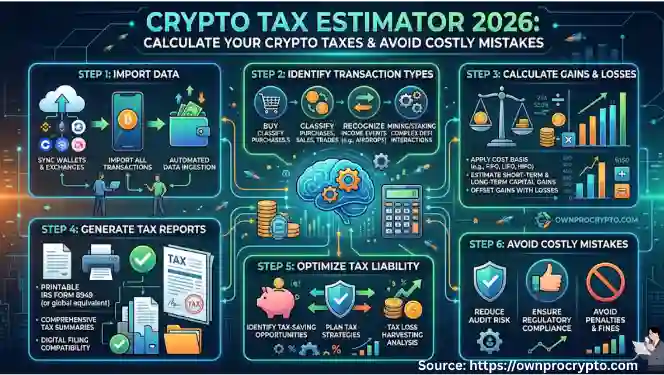
Before filing crypto taxes in 2026, investors and businesses should:
As IRS crypto reporting expands, documentation quality is becoming just as important as the tax return itself.
👨🏻🎨 Problem: Crypto tax reporting is becoming more complex as IRS enforcement expands.
★ˎˊ˗Problem Solved: Consistent reporting, accurate reconciliation, and basis tracking reduce audit and mismatch risk.
The biggest misconception in crypto taxes is that staking rewards are only taxable when sold. Current IRS guidance generally treats rewards as ordinary income when received, while future price movements create separate capital gains or losses.
In 2026, the real challenge is not whether staking is taxable. The challenge is:
For most investors, accurate reporting and consistency matter more than aggressive classification strategies. Read More: >>
👨🏻🎨 Problem: Many Investors are overwhelmed by changing crypto tax rules and IRS forms.
★ˎˊ˗Problem Solved: Understanding how staking income is recognized and reported helps avoid costly filing mistakes and future IRS disputes.
Welcome to OwnProCrypto (Own & Pro Crypto) — a next-generation Bitcoin and blockchain education platform where the science of finance meets the power of AI-driven automation.
Our mission is simple: to equip you with the knowledge, frameworks, and tools needed to make smarter financial and business decisions in the Web3 economy.
Beyond analysis, OwnProCrypto focuses on transparency, verifiable data, and practical frameworks that investors and builders can actually use. Our goal is not hype — but clear thinking, disciplined analysis, and long-term value creation in the decentralized economy.
Our Background
Crypto Tools & Analysis:
Crypto Fundamental Analysis Tools | Protocol Evaluation System | DeFi Risk Analysis Tools | Crypto Portfolio Dashboard | Token Risk vs Reward Tool
Guides:
Crypto Fundamental Analysis | Blockchain Project Evaluation | Tokenomics Analysis | DeFi Protocol Analysis
© 2026 OwnProCrypto — Built for smarter crypto decisions