
Search by title, topic or phrase
Use our Crypto Search Engine 🔍 to find the topics and keywords you're looking for.
Understanding crypto staking taxes in 2026 requires accurate reward-income reporting, digital asset transaction reconciliation, and cost-basis tracking. Taxpayers may encounter Form 1099-MISC for certain staking-related payments and Form 1099-DA for reportable digital asset dispositions.
These forms serve different purposes. Correct reporting requires determining when staking rewards become taxable, establishing their fair market value and cost basis, and reporting subsequent sales or exchanges separately. Information-return requirements do not determine whether income is taxable.
Scope & Core Reporting Objectives
This guide provides a practical federal tax compliance framework for individual investors, validator operators, and businesses evaluating crypto staking activity.
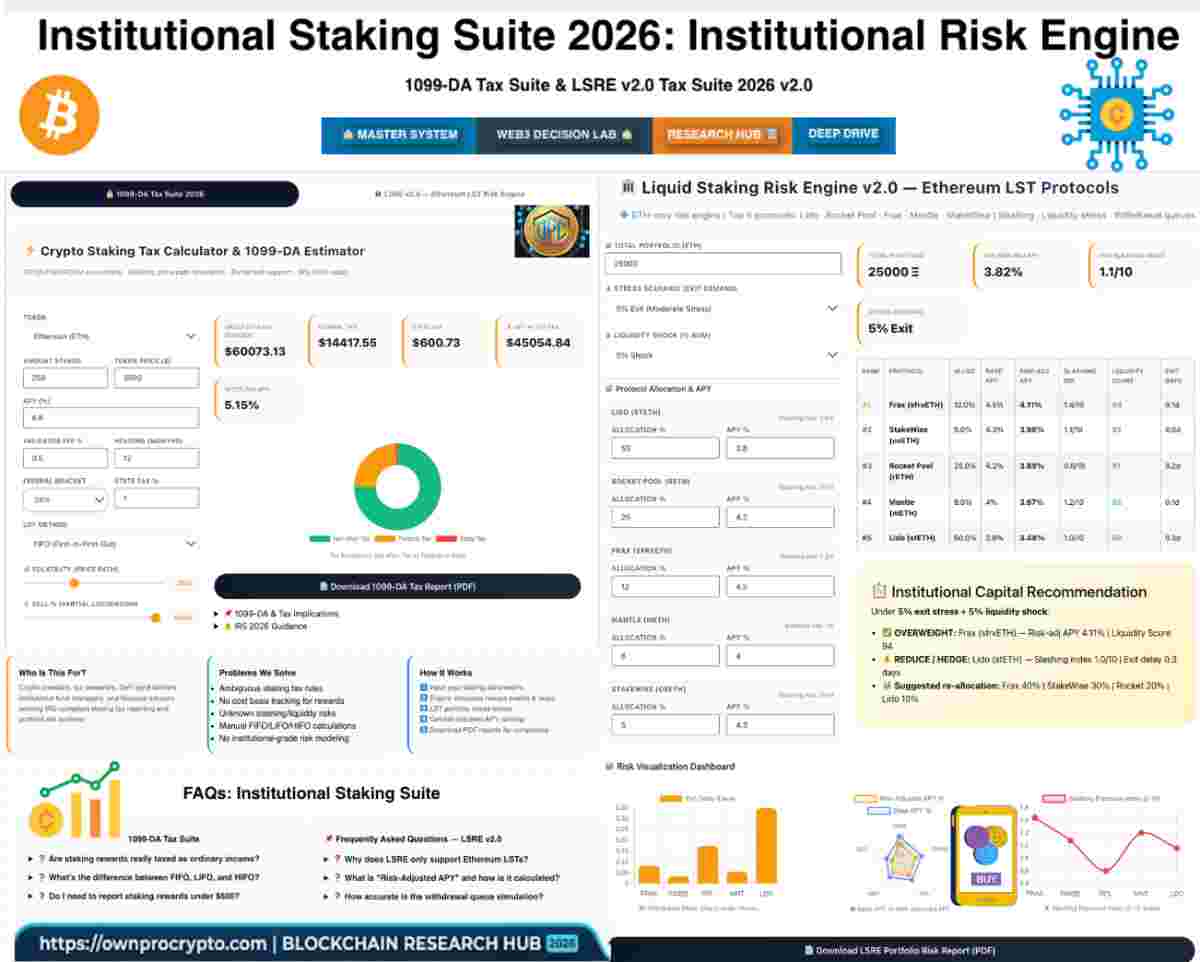
Table of Contents
ToggleIRS Revenue Ruling 2023-14 addresses native cryptocurrency rewards received by a cash-method taxpayer who stakes cryptocurrency on a proof-of-stake blockchain. Under the ruling, the taxpayer includes the fair market value of the rewards in gross income when the taxpayer gains dominion and control over them. Applying this principle to other staking arrangements requires consideration of their specific facts.
A protocol lock, unstaking period, or exchange restriction does not automatically establish a universal tax-recognition date. Analyze whether the taxpayer has actually obtained dominion and control, considering the contractual terms, available rights, transfer restrictions, and relevant facts. Do not assume that every locked reward is taxable immediately or that every locked reward is automatically deferred.
Different arrangements may require different transaction-level analyses. The technical label alone does not determine the tax treatment.
Primary authority: IRS Revenue Ruling 2023-14. Complex arrangements may require advice from a qualified tax professional.

A taxpayer may receive multiple information returns from the same digital asset platform because different forms report different types of activity. Reconcile each document against transaction history instead of treating the forms as interchangeable or adding their totals together without review.
| Information Return | Primary Reporting Focus | Tax Treatment | Typical Tax Return Destination |
|---|---|---|---|
| Form 1099-DA | Reportable digital asset dispositions effected through a broker | Potential capital gain or loss; classification depends on the transaction | Generally Form 8949 and Schedule D for capital transactions |
| Form 1099-MISC | Certain miscellaneous payments, including reportable other-income payments | Depends on the nature of the payment | Applicable Form 1040 schedule or other appropriate reporting destination |
| Exchange or Protocol Statement | Reward credits, staking activity, fees, transfers, and transaction details | Requires transaction-by-transaction tax analysis | Determined by the underlying activity and applicable tax rules |
Important Reporting Note
Form 1099-DA generally reports proceeds from reportable broker dispositions; it does not automatically report every staking reward. Form 1099-MISC may report certain other-income payments but does not, by itself, establish the complete tax treatment of every reward. Reconcile both forms against wallet records, exchange ledgers, acquisition dates, proceeds, and cost basis to avoid omissions or duplicate reporting.
For the applicable reporting rules, see the IRS Form 1099-DA guidance.
The appropriate reporting destination depends on the character of the income, the taxpayer’s activities, and the applicable federal tax rules. Do not classify staking rewards solely by whether they came from an exchange, a validator, or a staking pool.
| Staking Activity | Potential Tax Classification | Potential Reporting Destination | Self-Employment Tax |
|---|---|---|---|
| Investment-Related Staking | Other ordinary income, where applicable | Schedule 1 or another applicable reporting destination, based on the facts and current instructions | Not automatically subject to self-employment tax |
| Staking Conducted as a Trade or Business | Potential business income | Schedule C when the activity qualifies as a sole-proprietor business | May apply if the income constitutes net earnings from self-employment |
| Partnership or Multi-Member LLC | Pass-through income, subject to applicable classification rules | Generally Form 1065 and Schedule K-1 for a partnership-taxed entity | Depends on the income character and partner status |
| S Corporation | Corporate income and applicable shareholder items | Generally Form 1120-S and Schedule K-1 | Officer wages and distributions are subject to distinct rules |
| C Corporation | Corporate taxable income | Generally Form 1120 | Corporate payroll and compensation rules apply where relevant |
Important: The examples above are general classifications, not automatic elections. Business status, deductible expenses, self-employment tax, entity classification, and the precise reporting line must be determined from the facts and the instructions applicable to the tax year being filed.
Accurate cost-basis records help prevent the same economic value from being incorrectly treated as taxable income a second time. The amount included in income and the tax basis used for later dispositions should be reconciled with the transaction history and applicable basis rules.
Assume $1,000 of staking rewards is properly included in ordinary income when received, and that amount establishes the tokens’ basis. If you later sell those tokens for $1,400, the illustrative gain is $400: $1,400 proceeds minus $1,000 basis. If the original basis is omitted, a calculation may incorrectly show a $1,400 gain. Actual results depend on the applicable recognition, basis, and disposition rules.
Keep transaction-level records, valuation sources, exchange statements, wallet addresses, and any calculations used to establish income and basis. Obtain professional advice for complex DeFi, restaking, and liquidity-provider transactions.
Entity structure can affect liability management, accounting, expense deductions, reporting obligations, and the taxation of staking operations. Forming an LLC or corporation does not, by itself, remove the requirement to recognize taxable income under applicable federal rules.
A domestic single-member LLC is generally disregarded for federal income tax purposes unless it elects corporate treatment. Reporting depends on the owner’s activity and the applicable classification rules; Schedule C is not automatic for every staking investment.
A multi-member LLC commonly defaults to partnership classification. Income, deductions, and other tax items are reported and allocated under applicable partnership rules, with Schedule K-1 reporting where required.
An eligible entity that elects S corporation status generally files Form 1120-S. Compensation for shareholder-employees and distributions must be handled under the applicable payroll and tax rules.
A C corporation generally reports its taxable income on Form 1120. Corporate-level tax, compensation, distributions, and any subsequent shareholder-level tax should be evaluated separately.
Receiving a liquid staking token, depositing collateral, claiming rewards, or restaking assets may involve different tax questions. Do not assume that every token conversion is taxable or that every protocol deposit is tax-free. Review the legal and economic substance of each transaction and retain supporting records.
Before preparing your federal income tax return, complete these reconciliation steps to help ensure that staking rewards, broker information returns, and digital asset dispositions are reported consistently.
Information-return thresholds affect payer reporting obligations, not necessarily the taxpayer’s duty to report taxable income. Confirm the rules for the relevant payment date and tax year.
→ Access the Staking Tax Estimator & GuideAnswers to common questions about staking reward income, digital asset reporting forms, cost basis, and tax return schedules.
Not simply because the tokens are sold after their value was included in income. Where reward value is recognized as ordinary income and establishes the appropriate basis, a later taxable sale generally produces a gain or loss based on the difference between the amount realized and adjusted basis. Accurate basis records help prevent the same value from being taxed twice.
IRS Revenue Ruling 2023-14 addresses native proof-of-stake rewards received by a cash-method taxpayer. Under the ruling, rewards are included in gross income when the taxpayer gains dominion and control, measured using their fair market value at that time. Other arrangements may require additional analysis.
Form 1099-DA is used for reportable digital asset proceeds from broker transactions. It is not a universal form for all staking rewards. A platform may issue other tax statements or an applicable Form 1099-MISC for certain payments. Reconcile the actual documents with your wallet and exchange records.
Schedule 1 may be relevant for certain other-income items, while Schedule C is generally used for income and expenses from a sole-proprietor trade or business. Staking activity does not automatically qualify for either treatment in every case. Determine the activity’s tax character and business status before selecting a reporting destination or assessing self-employment tax.
The absence of Form 1099-MISC does not automatically make staking rewards non-taxable. For payments made after December 31, 2025, the general federal reporting threshold for Box 3 other-income payments is $2,000, subject to applicable rules and exceptions. The reporting threshold for an information return is distinct from the taxpayer’s obligation to report taxable income.
The relevant question is when the taxpayer obtains dominion and control over the rewards under the applicable facts. A lock or withdrawal restriction may be relevant, but it does not establish a universal rule that all rewards are taxable immediately or only upon unlocking. Review the protocol mechanics, contractual rights, and practical ability to control the tokens.
Not necessarily. The tax treatment depends on the transaction’s legal and economic substance, the rights represented by the receipt token, and applicable federal tax guidance. Retain records of the deposited assets, tokens received, quantities, dates, fees, and any subsequent dispositions.
Explore related technical and compliance guides across our digital asset taxation research cluster.
Digital Asset Taxation: Crypto Tax Rules & Compliance Guide (2026)
Read Master Pillar Guide →Crypto Tax-Loss Harvesting 2026: Wash Sale Rules & Tax Strategies
Explore Harvesting Guide →Crypto Tax Residency 2026: Rules for Crypto Nomads & Global Investors
Explore Residency Guide →NFT Tax Guide 2026: NFT Taxes, Gaming Rewards & Taxable Events
Explore NFT Tax Guide →Best Crypto Tax Software (2026): Compare Top Platforms
Compare Software Platforms →