
Search by title, topic or phrase
Use our Crypto Search Engine 🔍 to find the topics and keywords you're looking for.
Crypto tax-loss harvesting allows investors to sell digital assets at a loss to offset capital gains and reduce overall tax liabilities. As trading expands across decentralized finance (DeFi), Layer-2 protocols, and multi-wallet systems, implementing a tax-efficient portfolio strategy requires careful attention to cost-basis calculations and local tax regulations.
Executing this strategy effectively depends on understanding country-specific wash-sale rules, correctly tracking cross-chain disposals, and maintaining complete, verifiable transaction records.
Table of Contents
ToggleThis guide provides an educational framework for evaluating tax-loss harvesting opportunities, navigating statutory restrictions, and managing multi-chain recordkeeping:

Crypto tax-loss harvesting involves realizing a loss on a qualifying digital-asset disposal and determining whether that loss can reduce taxable capital gains under the rules of the relevant jurisdiction. A decline in market value alone generally does not establish a realized capital loss. The tax result depends on the nature of the transaction, the asset’s adjusted cost basis, allowable expenses, and any applicable loss-restriction rules.
An unrealized loss occurs when an asset’s market value falls below its relevant tax basis while you continue to hold it. A realized loss may arise when a taxable disposal occurs, such as selling an asset for fiat currency or exchanging it for another token. The disposal must be evaluated under the applicable local tax rules before the loss is claimed.
A capital gain or loss is generally calculated by comparing the disposal proceeds with the allowable tax basis and expenses under local law. Acquisition costs and transaction fees may affect the calculation, but their treatment varies by jurisdiction. Asset identification and cost-allocation rules also differ: do not assume FIFO, LIFO, or specific identification is permitted in every country or for every type of holding.
Digital-asset reporting can become complex when transactions span centralized exchanges, self-custody wallets, decentralized finance (DeFi) protocols, and multiple blockchain networks.
Maintain acquisition dates, quantities, transaction values, fees, wallet or account details, and disposal records. Apply the identification and basis-allocation method required or permitted in your jurisdiction. For U.S. digital-asset reporting, consult the IRS digital-assets guidance and the applicable basis-identification requirements.
Tax-loss harvesting restrictions differ by jurisdiction. Some systems restrict losses when the same or substantially similar property is reacquired; others use asset-matching rules or broader anti-avoidance provisions. A 30-day period should not be treated as a universal international rule.
IRC Section 1091 contains wash-sale rules for covered stock and securities. Whether a particular digital asset falls within those provisions depends on its legal characteristics and applicable law. Do not assume every cryptocurrency is covered—or that every digital asset is automatically exempt. General tax doctrines may also be relevant. See the IRS digital-assets guidance.
The Income Tax Act’s superficial-loss rules may deny a loss where the taxpayer or an affiliated person acquires the same or identical property during the relevant 30-day period and the property remains owned by the taxpayer or an affiliated person at the end of that period. The statutory conditions and exceptions must be checked before claiming the loss. See the Canada Revenue Agency.
For individuals subject to Capital Gains Tax, cryptoasset disposals generally use a statutory matching order involving same-day acquisitions, qualifying acquisitions within the following 30 days, and the Section 104 pool. These are matching rules, not simply a blanket prohibition on repurchasing an asset. Review the HMRC cryptoasset pooling guidance.
Australia’s tax treatment depends on the nature of the disposal and the taxpayer’s circumstances. Part IVA may apply to a scheme entered into for the dominant purpose of obtaining a tax benefit. A genuine disposal at a loss is not automatically disallowed merely because it has tax consequences; the specific facts and applicable provisions matter. Consult the Australian Taxation Office for current guidance.
Before realizing a loss, identify your tax residence, the legal classification of the asset, the applicable tax year, and any rules governing reacquisitions or tax-avoidance arrangements. The summaries below are educational and do not replace current legislation or official guidance.
| Jurisdiction | Relevant Framework | Timing or Test | Potential Impact |
|---|---|---|---|
| United States | IRC Section 1091 and other applicable tax principles | Wash-sale timing applies to covered stock or securities; asset classification matters | A loss may be disallowed under applicable rules; do not assume all crypto assets receive identical treatment |
| Canada | Income Tax Act superficial-loss rules | Generally examines acquisitions in the 30 days before and after the disposition, plus ownership at the end of the period | A superficial loss may be denied; the resulting basis treatment depends on the circumstances and statutory rules |
| United Kingdom | Capital Gains Tax same-day, 30-day and Section 104 matching rules | Statutory order matches qualifying acquisitions to disposals | Changes the allowable cost attributed to a disposal and may alter the calculated gain or loss |
| Australia | Capital Gains Tax provisions and Part IVA where applicable | Fact-specific legal and purpose analysis; no universal crypto wash-sale waiting period | A loss or arrangement may be challenged where the relevant statutory requirements are satisfied |

Accurate crypto tax reporting requires distinguishing a transfer of existing holdings from a transaction that changes ownership or disposes of one asset in exchange for another. A bridge transaction, token wrap, or smart-contract interaction should be classified based on its actual mechanics and the applicable tax rules—not solely on the name of the protocol.
Moving the same asset between wallets that you beneficially own is generally not, by itself, a disposal for capital gains purposes in many jurisdictions. A bridge that preserves beneficial ownership may also be treated as a transfer, but the result depends on the mechanism and local law.
Swapping one token for another can constitute a disposal even when no fiat currency is received. Wrapping, unwrapping, migrations, liquidity-pool transactions, and other smart-contract operations require transaction-specific analysis. A fee paid in cryptocurrency may itself have tax consequences. For example, HMRC explains the treatment of fees paid in tokens under UK Capital Gains Tax rules.
The following simplified example assumes that Asset A’s sale is a qualifying taxable disposal, the full $50,000 basis is allowable, the $40,000 represents net disposal proceeds, and the $15,000 represents eligible gains under the same tax regime. It excludes other adjustments and loss limitations.
| Transaction Event | Calculation Basis | Illustrative Amount (USD) |
|---|---|---|
| Asset A adjusted cost basis | Assumed allowable acquisition cost and adjustments | $50,000 |
| Asset A net disposal proceeds | Assumed proceeds after applicable selling expenses | $40,000 |
| Realized capital loss | Net proceeds minus adjusted basis | −$10,000 |
| Other eligible realized capital gains | Assumed qualifying gains in the same tax period | +$15,000 |
| Illustrative net capital gain | $15,000 gains minus $10,000 loss | $5,000 |
The $5,000 result is an illustrative net amount before other applicable adjustments. It is not necessarily the final taxable gain or tax liability. Capital loss limitations, holding-period rules, carryforward provisions, asset classifications, and local tax treatment may change the outcome.
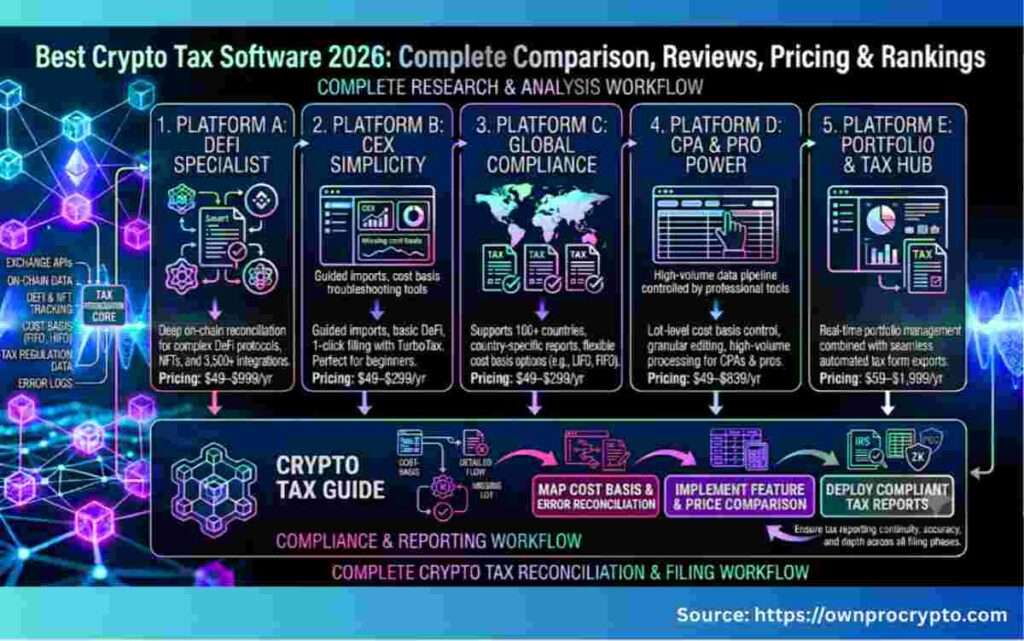
Crypto tax software can help aggregate exchange records, import supported blockchain transactions, calculate gains and losses, and identify incomplete records. However, automated classifications and tax calculations should be reviewed, particularly for DeFi activity, wrapped assets, cross-chain transactions, and jurisdiction-specific restrictions.
| Operational Task | Manual Spreadsheet Tracking | Automated Software with Manual Audit |
|---|---|---|
| Data collection | Requires manual imports, entry, and reconciliation. | May import supported exchange and blockchain data; unsupported sources still require attention. |
| Cross-chain linkage | Transfer matching depends on manual review and complete transaction details. | May suggest matching transfers, but incorrect or incomplete matches need verification. |
| DeFi transactions | Complex activity may require substantial manual classification. | May identify or categorize known transaction types; unusual contract interactions need review. |
| Cost-basis calculations | Requires a consistent method and careful record maintenance. | Can apply supported calculation methods, subject to correct data, settings, and jurisdictional rules. |
| Loss restrictions | Requires separate review of applicable legal rules. | Jurisdiction-specific features may help, but software output should not replace legal verification. |
Use this workflow to identify potential opportunities, confirm their tax treatment, and preserve a complete audit trail.
Reconcile holdings and identify positions with unrealized losses across exchanges, wallets, and supported protocols.
Verify residency, asset classification, cost-basis rules, loss restrictions, and relevant anti-avoidance provisions.
Estimate the potential tax result and account for fees, market risk, execution costs, and the possibility that a loss is restricted.
Retain transaction confirmations, timestamps, valuations, fees, transaction hashes, and relevant wallet or account records.
Apply jurisdiction-specific acquisition-matching periods and loss-restriction rules. Do not assume a universal waiting period applies to crypto.
Update tax records, investigate exceptions, retain supporting evidence, and obtain qualified tax advice where treatment is uncertain.

Because tax-loss harvesting rules depend entirely on legal tax jurisdiction, establishing your tax residency status is the essential first step before executing portfolio adjustments.
Our Crypto Tax Residency & Compliance Framework Guide helps investors analyze jurisdictional obligations, evaluate cross-border tax considerations, and prepare structured records prior to annual reporting deadlines.

A repeatable reconciliation process helps identify incomplete transaction histories, missing cost basis, and reporting exceptions before filing. Track the following operational indicators throughout the tax year. The targets below are suggested internal controls, not statutory requirements.
Percentage of known exchanges, wallets, and relevant protocols included in the reconciliation process.
Target number of unexplained transfers remaining before final review.
Target number of taxable disposals with unresolved cost-basis or acquisition-history issues.
Target proportion of material transactions supported by available statements, transaction hashes, valuations, or equivalent records.
Calculate coverage percentages using a consistent denominator and document exceptions. A zero-exception target is an internal objective, not a guarantee that every transaction has been classified correctly.
| Operational Risk | Potential Reporting Impact | Recommended Corrective Action |
|---|---|---|
| Unreviewed Reacquisitions | Loss may be restricted or matched differently under applicable rules. | Maintain a transaction timeline and review jurisdiction-specific acquisition-matching and anti-avoidance provisions. |
| Unlinked Bridge Transactions | Missing acquisition history can result in incorrect gains, losses, or basis calculations. | Match originating and receiving transactions using wallet ownership, transaction hashes, quantities, dates, and fees. |
| Incomplete Exchange Records | Omitted exchange, DEX, or self-custody activity can make the tax calculation incomplete. | Reconcile exchange exports against on-chain records and available account statements. |
| Incorrect Fee Classification | Misclassified fees can affect allowable expenses, basis, proceeds, or separate disposal calculations. | Record the fee asset, quantity, transaction date, market value where needed, and treatment under local rules. |
| Missing Acquisition Basis | Unsubstantiated or incorrect basis may distort reported gains and losses. | Trace acquisition records, document reasonable valuation evidence, and resolve exceptions before filing. |
| Unverified Software Output | Automated classifications may misstate the tax result for unusual transactions. | Review material transactions, document assumptions, and obtain professional advice on uncertain treatment. |
Use reconciliation metrics to direct attention to missing information and unresolved issues. They are operational controls, not substitutes for the applicable tax rules, supporting evidence, or professional review.
Educational answers about realizing crypto losses, acquisition-matching rules, cost-basis records, and tax reporting. Your actual treatment depends on your jurisdiction and circumstances.
Crypto tax-loss harvesting is the process of disposing of a digital asset at a loss and determining whether that loss can offset eligible capital gains under the applicable tax rules. An unrealized decline in market value generally does not create a realized capital loss. Transaction classification, allowable basis, expenses, and loss-restriction rules must be considered before claiming a deduction.
IRC Section 1091 applies to covered stock and securities. Whether a particular digital asset falls within that statutory rule depends on its legal characteristics and applicable law. It is not appropriate to assume that every cryptocurrency is covered or that every digital asset is automatically exempt. Other tax principles may also be relevant.
Review the IRS digital-assets guidance and seek qualified tax advice for transactions involving tokenized securities or uncertain asset classifications.
Canada’s superficial-loss rules may deny a capital loss when the taxpayer or an affiliated person acquires the same or identical property during the relevant 30-day period and the property is still owned by the taxpayer or an affiliated person at the end of that period. The statutory requirements, exceptions, and any resulting adjusted-cost-base treatment must be assessed before claiming the loss.
Consult the Canada Revenue Agency and the applicable provisions of the Income Tax Act.
For individuals subject to UK Capital Gains Tax, cryptoasset disposals generally follow a statutory matching order: qualifying acquisitions on the same day, qualifying acquisitions during the following 30 days, and then the relevant Section 104 pool. These rules determine which acquisition costs are matched to a disposal; they are not simply a blanket ban on buying the asset again.
See HMRC’s cryptoasset pooling guidance for the detailed rules and examples.
A transfer of the same asset between wallets you beneficially own is generally not, by itself, a capital gains disposal in many jurisdictions. However, a bridge, token migration, wrap, or other smart-contract operation may involve additional transactions that require separate analysis. Fees paid in cryptocurrency can also have tax consequences. Keep both the sending and receiving transaction records and check the local rules.
The answer depends on the country and the type of income. In the United States, a taxpayer’s net capital loss generally offsets capital gains first. If capital losses exceed capital gains, individuals can generally deduct up to $3,000 of the excess against other income per year, or $1,500 if married filing separately, subject to applicable rules. Unused net capital losses may generally be carried forward.
Do not assume a capital loss can offset staking rewards, wages, business income, or other ordinary income without checking the applicable rules. See the IRS guidance on capital gains and losses.
No. The United States, Canada, the United Kingdom, Australia, and other jurisdictions apply different tax classifications, acquisition-matching rules, anti-avoidance provisions, and loss-offset limits. Establish the relevant tax residence and tax year before deciding whether a loss can be claimed or how a subsequent acquisition will be treated.
Retain acquisition dates and quantities, transaction values, cost-basis records, disposal proceeds, fee details, exchange statements, wallet addresses, transaction hashes, and evidence supporting the classification of transfers and other complex activity. Keep records of the calculation method used and any material assumptions or professional advice. Follow the record-retention period applicable to your jurisdiction.
For U.S. reporting, start with the IRS digital-assets guidance and the relevant rules for basis identification and reporting.
Explore related technical and compliance guides across our research cluster:
Digital Asset Taxation: Crypto Tax Rules & Compliance Guide (2026)
Read Master Pillar Guide →Crypto Staking Tax Guide: 1099-DA Rules & Tax Estimator (2026)
Explore Staking Guide →Crypto Tax Residency 2026: Rules for Crypto Nomads & Global Investors
Explore Residency Guide →NFT Tax Guide 2026: NFT Taxes, Gaming Rewards & Taxable Events
Explore NFT Tax Guide →Best Crypto Tax Software (2026): Compare Top Platforms
Compare Software Platforms →This Rea-World Templates provides a structured framework for tax-efficient crypto portfolio management.
Purpose
Master register of taxable crypto holdings.
| Asset ID | Asset | Quantity | Cost Basis ($) | Market Value ($) | Unrealized P/L ($) |
|---|---|---|---|---|---|
| TAX001 | Bitcoin | 5.0 | 250,000 | 220,000 | -30,000 |
| TAX002 | Ethereum | 100 | 300,000 | 260,000 | -40,000 |
| TAX003 | Solana | 2,000 | 240,000 | 275,000 | +35,000 |
| TAX004 | Chainlink | 5,000 | 90,000 | 75,000 | -15,000 |
| TAX005 | Avalanche | 3,000 | 120,000 | 105,000 | -15,000 |
Purpose
Track completed taxable events.
| Trade ID | Asset | Sale Date | Gain/Loss ($) | Tax Category | Status |
|---|---|---|---|---|---|
| RL001 | Bitcoin | 05-Feb-2026 | -10,000 | Capital Loss | Closed |
| RL002 | Ethereum | 20-Mar-2026 | +15,000 | Capital Gain | Closed |
| RL003 | Solana | 18-Apr-2026 | +8,500 | Capital Gain | Closed |
| RL004 | Chainlink | 12-May-2026 | -5,000 | Capital Loss | Closed |
| RL005 | Avalanche | 01-Jun-2026 | -7,000 | Capital Loss | Closed |
Purpose
Identify unrealized losses available for harvesting.
| Asset | Unrealized Loss ($) | Holding Period | Harvest Opportunity | Priority | Status |
|---|---|---|---|---|---|
| Bitcoin | 30,000 | Long-Term | High | High | Open |
| Ethereum | 40,000 | Long-Term | High | High | Open |
| Chainlink | 15,000 | Short-Term | Medium | Medium | Open |
| Avalanche | 15,000 | Short-Term | Medium | Medium | Open |
| Polygon | 8,000 | Long-Term | Low | Low | Open |
Purpose
Track transactions that may trigger wash sale concerns.
| Asset | Sale Date | Repurchase Date | Days Between | Wash Sale Risk | Status |
|---|---|---|---|---|---|
| Bitcoin | 01-Jan-2026 | 15-Jan-2026 | 14 | High | Review |
| Ethereum | 05-Feb-2026 | 10-Mar-2026 | 33 | Low | Clear |
| Solana | 10-Mar-2026 | 20-Mar-2026 | 10 | High | Review |
| Chainlink | 01-Apr-2026 | 05-May-2026 | 34 | Low | Clear |
| Avalanche | 01-May-2026 | 18-May-2026 | 17 | Medium | Review |
Purpose
Evaluate tax impact under different accounting methods.
| Asset | FIFO Gain/Loss | LIFO Gain/Loss | HIFO Gain/Loss | Recommended Method |
|---|---|---|---|---|
| Bitcoin | -8,000 | -12,000 | -15,000 | HIFO |
| Ethereum | +12,000 | +8,000 | +5,000 | HIFO |
| Solana | +9,000 | +7,500 | +6,500 | HIFO |
| Chainlink | -4,000 | -6,000 | -7,000 | HIFO |
| Avalanche | -5,000 | -6,500 | -8,000 | HIFO |
Purpose
Match losses against gains.
| Category | Amount ($) |
|---|---|
| Total Capital Gains | 250,000 |
| Total Capital Losses | 120,000 |
| Net Taxable Gain | 130,000 |
| Estimated Tax Saved | 36,000 |
| Remaining Loss Carryforward | 25,000 |
Purpose
Monitor holding period tax implications.
| Asset | Purchase Date | Holding Period | Tax Classification | Tax Rate Impact |
|---|---|---|---|---|
| Bitcoin | Jan-2024 | 2 Years | Long-Term | Lower |
| Ethereum | Feb-2024 | 22 Months | Long-Term | Lower |
| Solana | Jul-2025 | 11 Months | Short-Term | Higher |
| Chainlink | Aug-2025 | 10 Months | Short-Term | Higher |
| Avalanche | Sep-2025 | 9 Months | Short-Term | Higher |
Purpose
Compare tax treatment across regions.
| Jurisdiction | Capital Gains Tax | Loss Harvesting Allowed | Wash Sale Rule | Compliance Complexity |
|---|---|---|---|---|
| USA | Yes | Yes | Depends on law changes | High |
| UK | Yes | Yes | Anti-avoidance rules | Medium |
| Singapore | Generally No CGT | Limited relevance | N/A | Low |
| UAE | Generally Favorable | Limited relevance | N/A | Low |
| Switzerland | Varies by circumstances | Varies | Limited | Medium |
Purpose
Monitor taxable DeFi activities.
| Protocol Activity | Transaction Count | Taxable Event | Estimated Tax Impact |
|---|---|---|---|
| Staking Rewards | 120 | Yes | Medium |
| Liquidity Mining | 80 | Yes | High |
| Yield Farming | 60 | Yes | High |
| Lending Interest | 45 | Yes | Medium |
| Governance Rewards | 30 | Yes | Low |
Purpose
Track non-fungible and digital asset gains/losses.
| Asset | Purchase Value ($) | Sale Value ($) | Gain/Loss ($) | Tax Status |
|---|---|---|---|---|
| NFT Alpha | 15,000 | 9,000 | -6,000 | Loss |
| NFT Beta | 8,000 | 12,000 | +4,000 | Gain |
| Gaming Asset | 4,500 | 2,500 | -2,000 | Loss |
| Metaverse Land | 20,000 | 25,000 | +5,000 | Gain |
| Collectible Token | 6,000 | 3,000 | -3,000 | Loss |
Purpose
Maintain documentation and compliance.
| Requirement | Status | Last Review | Owner |
|---|---|---|---|
| Trade Records | Complete | Monthly | Tax Team |
| Wallet Records | Complete | Monthly | Operations |
| Exchange Statements | Complete | Quarterly | Finance |
| Cost Basis Reports | Complete | Monthly | Accounting |
| Tax Filings | Complete | Annual | Tax Advisor |
Purpose
Prepare for tax year close.
| Planning Area | Current Status | Target Outcome | Priority |
|---|---|---|---|
| Loss Harvesting | 80% Complete | Maximize Offsets | High |
| Gain Management | Active | Reduce Liability | High |
| Carryforward Review | Complete | Preserve Losses | Medium |
| DeFi Reporting | In Progress | Full Compliance | High |
| NFT Reporting | Complete | Full Compliance | Medium |
Purpose
Model different harvesting strategies.
| Scenario | Harvested Losses ($) | Tax Saved ($) | Net Benefit ($) |
|---|---|---|---|
| Conservative | 25,000 | 7,500 | 7,500 |
| Moderate | 50,000 | 15,000 | 15,000 |
| Aggressive | 100,000 | 30,000 | 30,000 |
| Maximum Harvest | 150,000 | 45,000 | 45,000 |
| Institutional | 500,000 | 150,000 | 150,000 |
Purpose
Coordinate investment and tax decisions.
| Asset | Current Weight | Target Weight | Tax Impact | Action |
|---|---|---|---|---|
| Bitcoin | 40% | 35% | Positive | Harvest |
| Ethereum | 25% | 25% | Neutral | Hold |
| Solana | 15% | 20% | Neutral | Increase |
| Stablecoins | 10% | 15% | None | Increase |
| Altcoins | 10% | 5% | Positive | Reduce |
Purpose
Measure overall tax optimization maturity.
| Category | Current Score | Target Score | Gap |
|---|---|---|---|
| Record Keeping | 95 | 100 | 5 |
| Harvesting Strategy | 88 | 98 | 10 |
| Cost Basis Management | 92 | 98 | 6 |
| DeFi Reporting | 85 | 98 | 13 |
| Audit Readiness | 94 | 99 | 5 |