infographic of site logo for contact us

OwnProCrypto.com

Use our Crypto Search Engine 🔍 to find the topics and keywords you're looking for.

Crypto in UAE · Dubai Regulation & Market Update

Crypto in UAE (Dubai): Regulations, Adoption & Latest Updates in 2026

2026RegulationDubaiUAE Crypto MarketVARAVirtual Assets

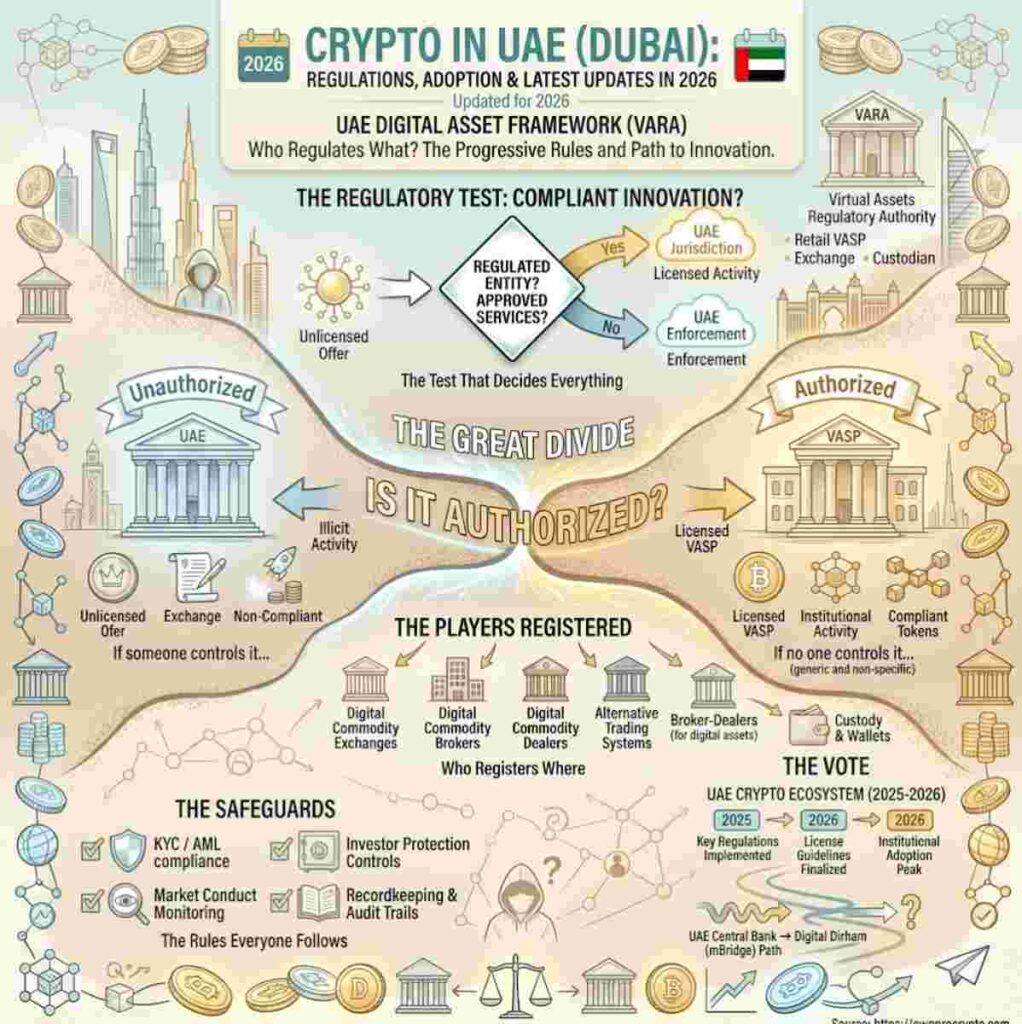
Is crypto legal in Dubai? Yes, but crypto activity in Dubai operates within a regulated virtual-asset framework rather than an unrestricted market. Dubai’s Virtual Assets Regulatory Authority (VARA) regulates virtual-asset activities across Dubai’s mainland and free zones, excluding the Dubai International Financial Centre (DIFC), which has its own regulatory framework.

Short answer:

Dubai has become one of the world’s more structured virtual-asset markets. In 2026, the focus is moving beyond simply attracting crypto businesses toward stronger licensing, anti-money-laundering controls, the UAE Virtual Assets Travel Rule, investor protection, reserve-asset oversight, and controlled tokenization. The UAE should therefore be understood as a multi-layer regulatory environment, not as one single crypto jurisdiction.
UAE Framework
→
Dubai
→
VARA
→
Licensed VASPs
→
Regulated Activities
Infographic of Crypto in UAE (Dubai): Regulations, Adoption & Latest Updates in 2026
Crypto in UAE (Dubai)
COrient & Navigate · UAE Crypto Landscape

What Is the Crypto Market Like in the UAE in 2026?

The UAE crypto market is increasingly defined by regulated infrastructure, institutional participation, tokenization and compliance rather than retail speculation alone.

Recent blockchain activity data also shows that the UAE is a significant crypto economy within the Middle East and North Africa. Chainalysis estimated that the UAE received more than $56 billion in cryptocurrency value during its 2024–2025 reporting window, representing approximately 33% year-over-year growth. The same analysis found particularly strong growth in institutional and large-transfer activity, while smaller retail and merchant-service categories also expanded. This matters because the UAE’s crypto story is no longer simply about individual investors buying Bitcoin. The market increasingly includes exchanges, brokers, custodians, investment firms, payment infrastructure, tokenized assets and institutional digital-asset activity.
01 $56B+ in crypto value receivedChainalysis estimated that the UAE received more than $56 billion in cryptocurrency value during its 2024–2025 reporting period.
02 33% year-over-year growthThe UAE’s crypto economy grew approximately 33% compared with the previous reporting period in Chainalysis’s regional analysis.
03 Institutional activity is importantChainalysis reported strong growth in institutional transactions and transfers, indicating that UAE crypto activity extends beyond retail trading.
04 Retail and merchant activity is also developingSmall retail transactions and merchant-service activity recorded substantial growth, suggesting broader use alongside institutional participation.
UAE Crypto Market Structure in 2026
Regulatory Infrastructure
↓
Licensed Exchanges, Brokers & Custodians
↓
Trading, Investment & Digital-Asset Services
↓
Stablecoins, Payments & Tokenization
↓
Institutional & Consumer Adoption

Want to explore the UAE crypto market by topic?

The country page provides the UAE-specific context. Use the specialist resources below when you need the deeper technical, security or asset-specific analysis. Explore Crypto Asset Security →

Who Regulates Crypto in UAE and the DUBAI?

There is no single authority responsible for every digital-asset activity throughout the UAE. The applicable regulator depends on the emirate, financial free zone, activity and type of virtual asset or financial service involved.

For Dubai outside the DIFC, VARA is the central virtual-asset regulator. VARA states that it regulates and oversees the provision, use and exchange of virtual assets in and from Dubai and is the sole authority for virtual assets across Dubai’s mainland and free zones, except within the DIFC.

The DIFC is therefore a separate regulatory environment. Businesses and readers should not assume that a VARA licence automatically covers activity inside the DIFC, or that a company operating elsewhere in Dubai is automatically authorized to conduct every type of financial or virtual-asset activity.

UAE Digital-Asset Regulatory Map
United Arab Emirates
↓
Federal Financial & Regulatory Frameworks
↓
Dubai Mainland & Free Zones → VARA
↔
DIFC → DFSA Framework
01 Dubai outside DIFCVARA regulates virtual-asset activities across Dubai’s mainland and free zones outside the DIFC.
02 DIFC is separateThe Dubai International Financial Centre operates under its own financial-services regulatory environment, so VARA and DIFC rules should not be treated as interchangeable.
03 Federal rules still matterVirtual-asset businesses can also be affected by UAE-wide requirements, including financial-crime controls, tax rules and other federal obligations.
04 The activity determines the ruleLicensing, custody, exchange, brokerage, advisory, issuance and other activities can carry different regulatory requirements.

Need the detailed UAE regulatory framework?

This article gives the jurisdiction map. The specialist regulation guide should handle the deeper licensing, rulebook and compliance analysis.

Explore Crypto Market Compliance →

What Are the Latest Crypto Regulation Updates in Dubai?

Dubai’s virtual-asset framework is becoming more detailed in 2026, with VARA focusing on financial-crime controls, transaction transparency, investor protection, market infrastructure and virtual-asset issuance.

The most important developments are not a single new “crypto law,” but a series of regulatory updates that strengthen how licensed virtual-asset businesses operate. VARA introduced requirements for UAE Virtual Assets Travel Rule implementation in February 2026 and issued requirements for VASPs relating to UAE anti-money-laundering, counter-terrorism financing and proliferation-financing obligations in March. VARA subsequently published AML/CFT business-risk assessment guidance in June 2026. Its regulatory framework also received substantial updates during the year, including new guidance covering virtual-asset issuance and amendments to exchange-services rules.
FEB 2026 Virtual Assets Travel RuleVARA published implementation requirements for the UAE Virtual Assets Travel Rule, strengthening information-sharing requirements around qualifying virtual-asset transfers.
MAR 2026 AML/CFT/CPF requirementsVARA issued implementation requirements for UAE anti-money-laundering, counter-terrorism-financing and proliferation-financing obligations applicable to VASPs.
APR 2026 Virtual-asset issuance guidanceVARA published detailed guidance and illustrative examples relating to its Virtual Asset Issuance Rulebook, including Category 1 and Category 2 issuance scenarios.
JUN 2026 AML/CFT risk assessmentVARA published business-risk assessment guidance to help regulated VASPs identify, assess and manage financial-crime risks.
How Dubai’s 2026 Regulatory Direction Is Evolving
Licensing & Market Entry
↓
AML / CFT / CPF Controls
↓
Travel Rule & Transaction Transparency
↓
Issuance, Exchange & Market Infrastructure
↓
Supervised & More Mature Virtual-Asset Market
These developments indicate a shift from establishing the basic regulatory perimeter toward operational supervision. For businesses, this means licensing is only one part of compliance. For consumers, the practical implication is that using a regulated provider and checking the provider’s actual authorization becomes increasingly important.

Want the full regulatory picture?

Our specialist compliance resource covers the broader crypto-market compliance framework without repeating that material throughout this country guide. Explore Crypto Market Compliance →

How Many Crypto Companies Are Regulated in Dubai?

VARA maintains a public register showing virtual-asset service providers that are fully licensed or hold an In-Principle Approval (IPA). The register is one of the most useful tools for checking whether a provider has actually reached the licensing stage required to conduct regulated virtual-asset activity.

As of October 2026, VARA’s public register displayed 57 results. However, this number should not be described as “57 licensed crypto companies,” because the register includes both fully licensed VASPs and entities holding an In-Principle Approval. That distinction matters. VARA explicitly states that an IPA is a conditional stage in the licensing process and that an entity holding an IPA cannot begin virtual-asset activities or service clients until it receives its full VASP licence.
VARA Licensing Status
Application
↓
In-Principle Approval (IPA)
↓
Final Requirements Completed
↓
Full VASP Licence
↓
Authorized Activity / Client Service
57 Public-register resultsVARA’s current public register displayed 57 results in October 2026 across its licensed and in-principle-approval categories.
FULL Licence means authorized activityA full VASP licence identifies an entity that has completed VARA’s licensing process for the relevant regulated activity.
IPA Not permission to operateAn In-Principle Approval is conditional and does not allow the holder to conduct virtual-asset activities or serve clients before obtaining its full licence.
CHECK Verify the specific activityA provider may be licensed for particular activities such as exchange, broker-dealer, custody, advisory, management and investment or issuance. A licence should not be interpreted as universal authorization.

Looking for a crypto provider in Dubai?

Do not rely only on a company’s website or marketing claims. Check the provider’s status and licensed activities against VARA’s public register before assuming it is authorized for a particular service. Check the VARA Public Register →
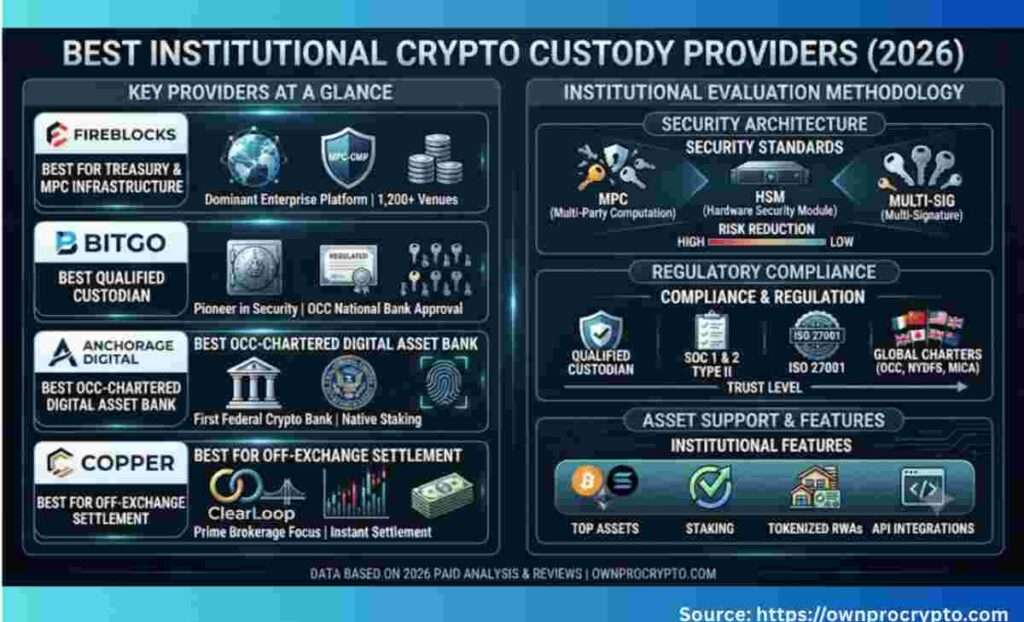
Infographic of Institutional Crypto Infrastructure Governance & Legacy Integraion 2026
Institutional Crypto Infrastructure Governance & Legacy Integraion

Dubai Crypto Regulation vs DIFC: What Is the Difference?

Dubai is not a single regulatory zone for digital assets. The most important distinction is between Dubai’s mainland and non-DIFC free zones, which fall under VARA for virtual assets, and the DIFC, which operates under the Dubai Financial Services Authority (DFSA).

Area Dubai Mainland / Non-DIFC Free Zones DIFC
Primary virtual-asset regulator VARA DFSA
Regulatory environment Dedicated Dubai virtual-asset framework DIFC financial-services framework
Geographic scope Dubai mainland and free zones outside DIFC Dubai International Financial Centre
Key consideration Check VARA licence and authorized activity Check DFSA authorization and applicable DIFC rules
For consumers and businesses, the practical lesson is simple: do not assume that a company operating in Dubai is automatically regulated by VARA. The legal location, business activity and financial service being offered determine which framework applies. This distinction is also important for searchers comparing Dubai’s broader crypto ecosystem with the UAE’s other financial centres. A company may have a presence in the UAE while operating under a different regulatory framework depending on where its relevant activity is conducted.
01 Dubai outside DIFC → VARAVARA states that it is the sole authority regulating virtual assets across Dubai’s mainland and free zones, except the DIFC.
02 DIFC → DFSAThe DIFC has its own financial-services regulatory regime, so its digital-asset rules should be assessed separately.
03 Licence ≠ every activityEven within the correct jurisdiction, authorization is activity-specific. Exchange, custody, brokerage, advisory and investment services can have different requirements.

How Widely Is Crypto Used in the UAE?

Crypto adoption in the UAE extends beyond individual trading. The market increasingly includes institutional investors, professional service providers, payment businesses, exchanges, custodians and companies exploring blockchain-based financial infrastructure.

Regional blockchain data places the UAE among the most active cryptocurrency markets in the Middle East and North Africa. Chainalysis reported more than $56 billion in cryptocurrency value received by the UAE during its 2024–2025 measurement period, with approximately 33% year-over-year growth. The composition of activity is particularly important. Institutional and large-value transfers account for a significant part of the UAE’s crypto economy, while retail-sized transactions and merchant-service activity are also developing. This suggests that crypto adoption in the UAE is becoming a combination of investment, financial infrastructure and commercial use, rather than a single retail trading phenomenon.
$56B+ Crypto value receivedChainalysis estimated that UAE addresses received more than $56 billion in cryptocurrency value during its latest regional measurement period.
33% Year-over-year growthThe UAE’s measured crypto activity increased by approximately 33% compared with the previous reporting period.
INSTITUTIONAL Large transfers matterInstitutional and large-value transfers represent an important part of the UAE market, reinforcing Dubai’s role as a financial and digital-asset hub.
RETAIL Consumer activity continuesRetail-sized transactions and merchant-service activity are also part of the country’s expanding crypto ecosystem.
UAE Crypto Adoption Layers
Retail Users & Investors
↓
Merchants & Payment Use Cases
↓
Exchanges, Brokers & Custodians
↓
Institutional Capital & Financial Services
↓
Tokenization & Digital Financial Infrastructure
infographic of Best Institutional Crypto Custody provider and Reviews
Best Institutional Crypto Custody provider and Reviews

Why Is Institutional Crypto Activity Growing in the UAE?

The UAE’s institutional crypto story is closely connected to its broader financial-services strategy: regulated market access, custody, investment products, tokenization and digital-asset infrastructure.

Institutional participation matters because it changes the nature of the market. Large financial institutions and professional investors generally require regulated counterparties, custody arrangements, compliance controls and clearly defined products before allocating significant capital to digital assets. Dubai’s regulatory infrastructure is designed around this more formal market structure. VARA’s framework covers activities including broker-dealer services, custody, exchange services, lending and borrowing, management and investment, transfer and settlement, and advisory activities. This creates distinct regulatory categories rather than treating every crypto business as the same type of company. The result is an ecosystem in which institutional crypto activity can develop through regulated intermediaries and defined financial activities, rather than relying exclusively on offshore exchanges or informal markets.

01 Custody infrastructure Institutional investors need controlled custody and asset-management arrangements rather than simply holding assets through an ordinary retail account. Explore Asset Security →
02 Regulated market accessBroker-dealer and exchange frameworks create defined routes for professional and institutional participation in virtual-asset markets.
03 Investment managementDubai’s regulatory framework includes management and investment activities, supporting a broader professional-services ecosystem around digital assets.
04 Tokenized financial assets Tokenization connects crypto infrastructure with traditional financial assets, creating another pathway for institutional blockchain adoption. Explore RWA Tokenization →

Why does custody matter for institutional crypto?

Institutional adoption depends heavily on how digital assets are secured, controlled and transferred. Explore the specialist security pillar for the deeper custody and asset-control framework. Explore Crypto Asset Security →
Infographic of Crypto Trends 2026 shows How Bear Market Innovation Is Forging the Next Big Breakthrough
Crypto Trends 2026

Are Crypto Payments and Merchant Adoption Growing in the UAE?

Crypto payments are part of the UAE’s digital-asset ecosystem, but the more important development is the growth of regulated payment infrastructure and digital settlement use cases.

Merchant adoption should not be measured only by whether a shop displays a “Bitcoin accepted” sign. In a regulated financial centre, payment activity can involve digital-asset service providers, payment processors, stablecoins, settlement infrastructure and conversion between digital assets and conventional currency. This is why stablecoins deserve a separate treatment from general cryptocurrency payments. Stablecoins can be used for settlement and transfers without exposing merchants or counterparties to the same price volatility associated with assets such as Bitcoin.

01 Retail paymentsConsumers may encounter crypto-payment options through merchants and payment providers, but availability depends on the provider and applicable regulatory permissions.
02 Merchant settlementBusinesses can use payment infrastructure to receive or settle digital-asset transactions without necessarily becoming crypto trading businesses themselves.
03 Stablecoin settlement Stablecoins can provide a different payment and settlement model from volatile cryptocurrencies, making them particularly relevant to commercial use cases. Explore Stablecoin Payments →
04 Cross-border transfersThe UAE’s position as an international financial and business hub makes cross-border digital-asset settlement an important area to monitor.
From Digital Asset to Merchant Settlement
Customer / Business
↓
Digital Asset or Stablecoin
↓
Licensed Payment / Virtual-Asset Provider
↓
Conversion / Settlement Infrastructure
↓
Merchant or Business Settlement
The important distinction is that crypto adoption does not automatically mean unrestricted crypto payments. A payment use case can involve several regulated activities, and the legal treatment depends on the asset, provider, transaction structure and jurisdiction.

Want the complete stablecoin payment framework?

This country page only explains why stablecoins matter to UAE adoption. The specialist pillar covers payment architecture, settlement models and the broader stablecoin ecosystem. Explore Stablecoin Payments →
Infographic Image of Real-World Crypto Adoption 2026
Real-World Crypto Adoption 2026

What Is Driving Crypto Adoption in the UAE?

The UAE’s crypto adoption story can be understood through four connected forces: investment, regulated financial infrastructure, commercial settlement and tokenization.

01 Investment & wealth managementCrypto and digital assets have become part of the broader investment conversation among retail, professional and institutional market participants.
02 Regulated infrastructureLicensing, custody, brokerage and exchange infrastructure makes it easier for professional participants to interact with digital assets within defined regulatory boundaries.
03 Payments & settlementDigital assets and stablecoins can support payment, transfer and settlement use cases, particularly where cross-border movement of value is important.
04 Tokenization Tokenized real-world assets connect blockchain infrastructure with conventional financial and physical assets, creating a broader institutional use case. Explore RWA Tokenization →

Where should you explore next?

Use this UAE pillar for the country-level picture. Move into the specialist clusters when you need the detailed mechanics of security, stablecoins or tokenized assets. Explore RWA Tokenization →
Infographic of Crypto Tax Estimator & Compliance Checker 2026
Crypto Tax Estimator

How Is Crypto Taxed in the UAE?

Does the UAE tax crypto? There is no separate federal “crypto capital gains tax” simply because an individual holds or sells cryptocurrency. However, crypto activity can still have tax consequences when it forms part of a business, and virtual-asset transactions can fall within UAE VAT rules depending on the nature of the activity.

The key distinction is between personal investment activity and business activity. UAE Corporate Tax applies to businesses and certain natural persons conducting a business or business activity. The Federal Tax Authority states that a natural person is generally within Corporate Tax when business or business-activity revenue exceeds AED 1 million in a calendar year. Salary, private investment income and real-estate investment income are excluded from that business-activity calculation. That means the popular statement “crypto is tax-free in Dubai” is too broad. A person holding digital assets as a private investment is not automatically treated in the same way as a UAE business conducting crypto trading, brokerage, advisory, custody or other commercial activities.
01 No standalone crypto capital-gains taxThe UAE does not impose a separate federal crypto capital-gains tax merely because an individual realizes a gain on a personal crypto investment.
02 Business activity can create Corporate Tax obligationsCrypto-related business activity can fall within UAE Corporate Tax rules when the relevant business and registration conditions are met.
AED 1M Natural-person business thresholdThe FTA states that natural persons conducting a business or business activity are subject to Corporate Tax when total business turnover exceeds AED 1 million in a calendar year.
VAT Virtual assets also interact with VAT rulesThe FTA has specifically addressed virtual assets under UAE VAT legislation, so “no crypto capital-gains tax” does not mean every crypto-related transaction is outside the tax system.

Need the detailed crypto-tax analysis?

This country guide explains the UAE-specific tax position. Use the dedicated tax resource for detailed treatment of trading, business activity, accounting, reporting and transaction scenarios. Explore Crypto Taxes →

When Can Crypto Activity Become Subject to UAE Corporate Tax?

The important question is not simply whether someone owns cryptocurrency. It is whether the activity constitutes a business or business activity under UAE Corporate Tax rules.

The Federal Tax Authority describes business as an economic activity conducted by a person, and its current guidance states that natural persons are subject to Corporate Tax when they conduct business or business activity in the UAE and their total turnover from those activities exceeds AED 1 million during the calendar year. For a crypto company, the analysis is different from that of a private investor. A UAE-incorporated company carrying on crypto-related business can fall within the Corporate Tax regime regardless of whether its revenue comes from trading, services, technology, brokerage, advisory or another commercial activity, subject to the specific rules and exemptions applicable to that entity.
UAE Crypto Tax Decision Path
Crypto Activity
↓
Private Investment?
↓
Generally Different From Conducting a Business
↔
Business / Commercial Activity?
↓
Check Corporate Tax & VAT Obligations
01 Individual investorPrivate investment income is treated differently from carrying on a business. The facts and nature of the activity matter.
02 Professional crypto businessA company or individual operating a commercial crypto business needs to assess UAE Corporate Tax, registration and accounting obligations.
03 Revenue matters for natural personsThe FTA’s current guidance uses AED 1 million of annual business turnover as the threshold for a natural person to come within Corporate Tax.
04 Accounting becomes importantBusinesses need records that allow crypto-related income, expenses, assets and transactions to be properly identified and supported.

Running a crypto business in the UAE?

Tax treatment should be assessed alongside licensing, accounting and compliance requirements. Do not treat the individual-investor rules as a substitute for business tax advice. Explore UAE Crypto Tax Guidance →

Does VAT Apply to Crypto in UAE?

VAT treatment is more technical than the simple question “Is crypto taxable?” The Federal Tax Authority has specifically incorporated virtual assets into the UAE VAT framework and has issued public clarifications on their treatment.

The FTA’s updated VAT framework defines virtual assets to include digital representations of value that can be digitally traded or converted and can be used for investment purposes. The definition covers cryptocurrencies such as Bitcoin and Ethereum while excluding digital representations of fiat currency and financial securities.

In 2026, the FTA also published a directive dealing specifically with the method of converting the value of digital currencies into UAE dirhams for VAT purposes. This is a useful indication of how the UAE tax system is becoming more operationally specific around digital-currency transactions.

The practical VAT result depends on the nature of the supply and the activity involved. Therefore, businesses should not assume that every transfer, trade or crypto transaction receives identical VAT treatment.

01 Virtual assets are recognized in VAT rulesThe FTA’s VAT framework specifically defines virtual assets for UAE VAT purposes.
02 Bitcoin and Ethereum are includedThe FTA clarification identifies cryptocurrencies such as Bitcoin and Ethereum as examples of virtual assets within the relevant definition.
03 Fiat representations are excludedDigital representations of fiat currencies and financial securities are expressly excluded from the virtual-asset definition used for this VAT purpose.
2026 Digital-currency valuation guidanceThe FTA published a 2026 directive covering how digital-currency values are converted into UAE dirhams for VAT purposes.

Need the detailed VAT treatment?

VAT treatment can depend on the transaction and business model. Use the dedicated tax cluster for the detailed rules rather than treating this country overview as individual tax advice.
Explore Crypto Tax Guidance →

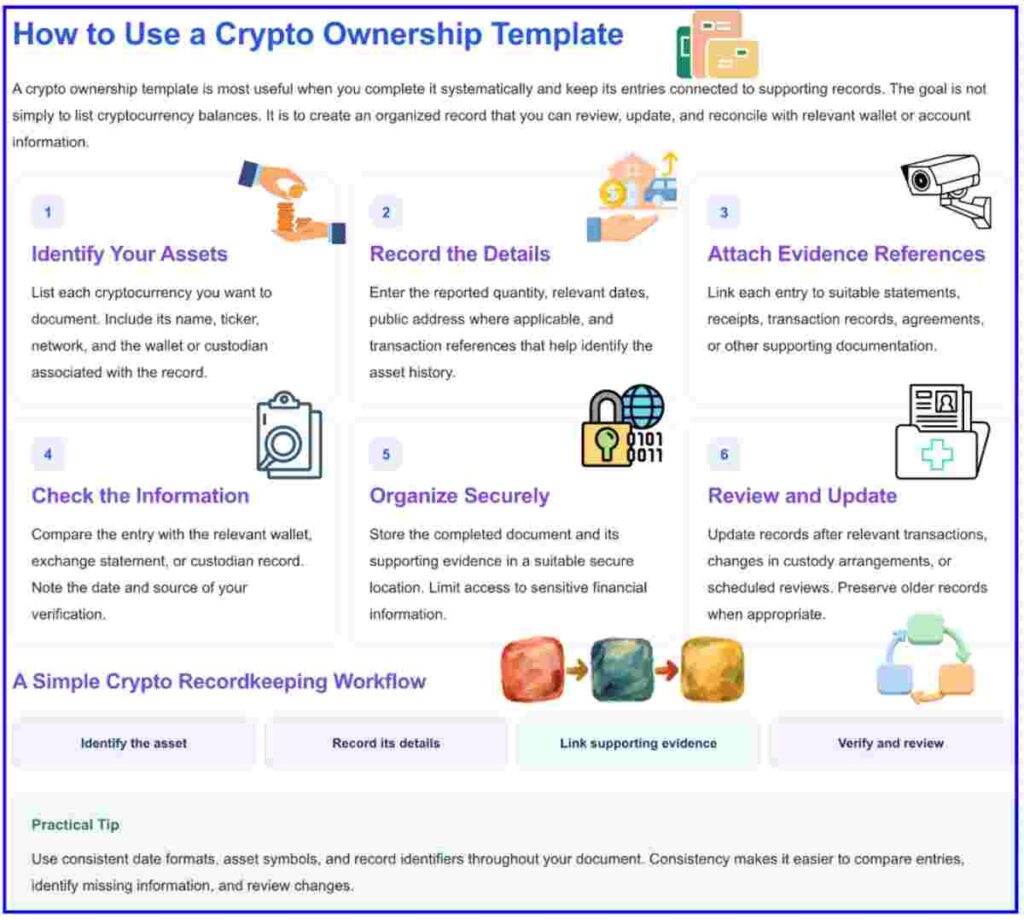
Infographic of Crypto Ownership Templates
Crypto Ownership Templates

What Financial Records Should UAE Crypto Users and Businesses Keep?

Even where a particular personal crypto gain is not subject to UAE Corporate Tax, good transaction records remain important—especially when activity becomes frequent, commercial or business-related.

Crypto businesses should be able to distinguish transactions, counterparties, asset types, fees, transfers, revenue and expenses. The need for accurate records becomes particularly important where a business interacts with multiple wallets, exchanges, custodians or payment providers.

For businesses subject to UAE tax obligations, records should support the figures reported in accounting and tax filings. The FTA’s wider tax framework also contains specific record-keeping and accounting requirements, making transaction documentation an important part of financial compliance.

01 Track every transactionMaintain records of purchases, sales, transfers, fees and other material crypto-related transactions.
02 Separate personal and business activityMixing personal wallets and business transactions can make accounting, tax analysis and compliance substantially harder.
03 Document valuationKeep evidence supporting the value assigned to digital assets and transactions, particularly where UAE dirham conversion is required.
04 Retain supporting evidenceExchange statements, invoices, wallet records, custody records and other transaction evidence can help substantiate accounting and tax positions.

Tax-free does not mean record-free

The UAE’s crypto environment is comparatively attractive, but businesses still need to understand tax registration, accounting, VAT and Corporate Tax obligations where applicable.

Explore the Complete Crypto Tax Guide →

Is Crypto Tax-Free in Dubai?

Is crypto tax-free in Dubai? For an individual holding cryptocurrency as a personal investment, Dubai does not impose a separate personal capital-gains tax on crypto profits. However, saying that “all crypto is tax-free in Dubai” is too broad because business activity can fall within UAE Corporate Tax and crypto transactions can also have VAT implications.

The simple answer:

Personal crypto investment gains are generally not subject to a separate UAE personal capital-gains tax. But the treatment can change when crypto activity becomes a business, and UAE VAT and Corporate Tax rules can apply depending on the transaction and activity.

Is Crypto Tax-Free in Dubai?
Personal Crypto Investment
↓
No Separate Personal Capital-Gains Tax
↓
But What Is the Activity?
↙     ↘
Private Investment
Business / Commercial Activity
01 Individual investorSomeone holding crypto as a personal investment is not subject to a separate UAE personal capital-gains tax simply because the crypto appreciates and is later sold.
02 Crypto businessA person or company conducting crypto-related business may fall within UAE Corporate Tax rules depending on the applicable conditions.
03 VAT is separateThe absence of a personal capital-gains tax does not mean crypto-related supplies and business transactions are automatically outside UAE VAT rules.
04 Facts matterThe nature, frequency, purpose and commercial character of the activity can affect how UAE tax rules apply.

When Is Crypto Effectively Tax-Free for an Individual?

For a private individual investing their own money in cryptocurrency, the UAE’s tax environment is considerably different from jurisdictions that impose personal capital-gains tax. The UAE does not impose a separate federal personal income tax or a standalone personal crypto capital-gains tax.

That does not mean every person who trades large volumes of cryptocurrency can automatically classify the activity as personal investment. Where activity amounts to carrying on a business or business activity, the UAE Corporate Tax framework needs to be considered.

SituationGeneral UAE tax positionWhat to check
Personal crypto investmentNo separate personal crypto capital-gains taxWhether activity remains personal investment
Crypto businessCorporate Tax may applyBusiness status, turnover and applicable tax rules
Crypto-related suppliesVAT may be relevantNature of the supply and applicable VAT treatment
Crypto companyPotential Corporate Tax obligationsEntity structure, taxable income and exemptions

Want the complete UAE crypto-tax rules?

This section answers the “tax-free Dubai” question. For detailed Corporate Tax, VAT, business and transaction scenarios, use the specialist tax guide.

Explore Crypto Taxes →

What Does “Tax-Free Crypto in Dubai” Actually Mean?

“Tax-free crypto” is useful shorthand for the UAE’s lack of a personal income tax and separate personal capital-gains tax, but it should not be interpreted as a blanket exemption covering every crypto-related activity.

For an individual investor, the distinction is relatively straightforward: buying and holding crypto as a personal investment is fundamentally different from operating a commercial crypto business.

The distinction becomes even more important for founders, professional traders, brokers, advisors, exchanges, custodians and other businesses. These activities can involve licensing, Corporate Tax, VAT, accounting, AML/CFT and other regulatory obligations at the same time.

PERSONAL Investment is not automatically a businessPrivate investment activity should not automatically be treated as commercial crypto trading merely because an individual realizes a gain.
BUSINESS Commercial activity is differentOperating a crypto-related business can create tax and regulatory obligations that do not apply in the same way to a private investor.
VAT Tax systems are separateCorporate Tax and VAT are separate parts of the UAE tax framework and should not be collapsed into the phrase “crypto tax.”
COMPLIANCE Tax is only one obligationA tax-efficient environment does not remove licensing, AML/CFT, accounting, consumer-protection or other regulatory responsibilities.

For the latest crypto regulations in Dubai, visit the official VARA website for regulatory updates and virtual asset guidance.

Frequently Asked Questions About Crypto in UAE

These questions provide concise UAE-specific answers and guide readers to the specialist resources covering wallets, payments, stablecoins, tokenization, taxes, exchanges, security and regulatory compliance.

01
Can I buy and hold cryptocurrency in the UAE?
Yes. Cryptocurrency ownership and investment are part of the UAE’s broader digital-asset ecosystem, but users should distinguish personal investment from regulated commercial activity.
Explore Crypto Wallets →
02
Are crypto wallets legal in Dubai?
Wallet use is different from operating a regulated custody or virtual-asset service. The regulatory requirements depend on the activity, provider and custody arrangement.
Explore Crypto Wallets →
03
Are stablecoins used for payments in the UAE?
Stablecoins are increasingly relevant to digital payments, transfers and settlement, particularly as the UAE develops regulated digital-asset infrastructure.
Explore Stablecoin Payments →
04
Can businesses use crypto for payments in Dubai?
Crypto and stablecoin payment models can involve several regulated activities, so businesses need to consider the asset, payment structure and service provider involved.
Explore Stablecoin Payments →
05
What is crypto tokenization in the UAE?
Tokenization connects blockchain infrastructure with real-world and financial assets and is an increasingly important part of the UAE digital-asset ecosystem.
Explore RWA Tokenization →
06
Are crypto exchanges legal in Dubai?
Exchange services can be regulated in Dubai, but users should verify whether a provider is actually authorized for the specific virtual-asset activity it offers.
Explore Crypto Exchanges →
07
Is crypto tax-free in Dubai?
There is no separate UAE personal capital-gains tax simply because an individual realizes a gain on a personal crypto investment, but business activity and VAT can create different obligations.
Explore Crypto Taxes →
08
How can I verify whether a crypto company is licensed in Dubai?
Check the relevant regulatory register and confirm the provider’s actual authorization and permitted activities rather than relying only on its website or marketing claims.
Explore Crypto Compliance →

Explore the UAE Crypto Ecosystem

Use this UAE guide for the country-level picture, then move into the specialist pillars when you need deeper information about wallets, payments, stablecoins, tokenization, exchanges, taxes or security.

Explore the Web3 Ecosystem →

Looking for another topic? Search the OwnProCrypto research archive.
Comments
💬 What’s Your Take? Leave a Comment Below 0
← Crypto Ownership Template: Free Digital Asset Record← Back
🔍 Search → Token • DeFi • NFT & more
🛠 Explore Tools ▼
📚 Explore Crypto Research Select a research category