
Search by title, topic or phrase
Use our Crypto Search Engine 🔍 to find the topics and keywords you're looking for.
Best crypto tax software is an automated reporting platform designed to calculate cryptocurrency taxes by importing transaction data from exchanges, wallets, and blockchain networks. Unlike traditional portfolio trackers, crypto tax platforms are built to identify taxable events, calculate cost basis, categorize income, and create compliance reports.
Navigating the rapidly evolving digital asset regulatory landscape requires reliable automation, making the selection of the best crypto tax software one of the most important decisions for cryptocurrency investors, traders, and Web3 businesses. Entering the 2026 tax season, crypto tax platforms have moved beyond simple capital gains calculations, accommodating expanded broker reporting standards like IRS Form 1099-DA.
This guide provides an editorial comparison for selecting and utilizing leading crypto tax platforms in 2026:
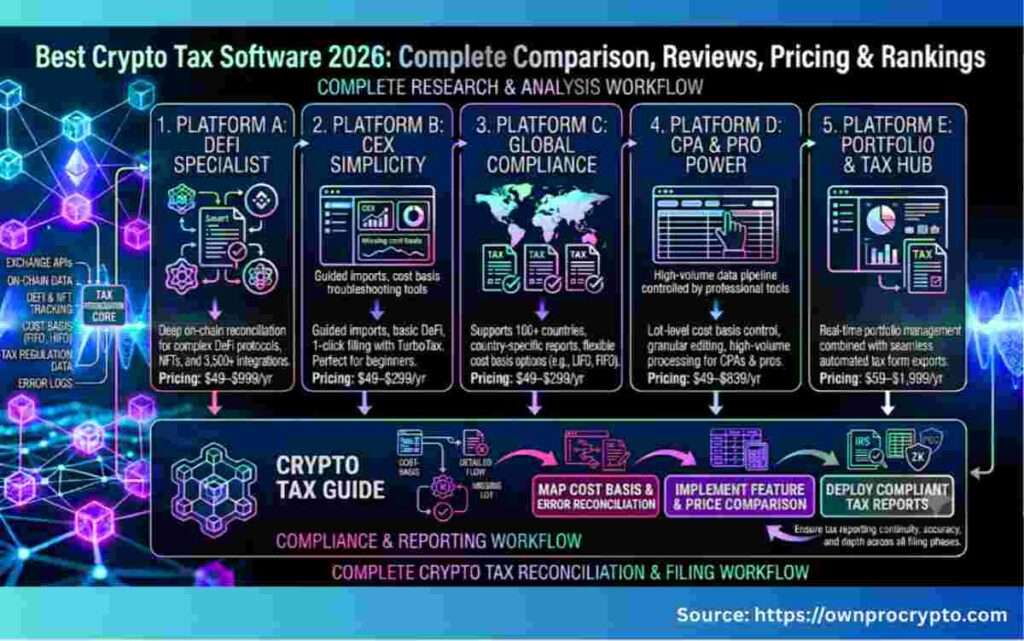
Table of Contents
ToggleRankings reflect editorial judgment based on publicly available information as of October 2026. No provider paid for placement.
| Ranking | Software | Best For | Editorial Rationale |
|---|---|---|---|
| 1 | Summ | DeFi users & complex portfolios | Published DeFi protocol coverage (2,300+) and on-chain reconciliation features |
| 2 | Koinly | International investors | Multi-country tax report support and broad exchange compatibility |
| 3 | CoinTracker | US investors | TurboTax integration and US-focused reporting workflow |
| 4 | CoinTracking | Professional traders | Historical ledger depth and manual editing controls |
| 5 | CoinLedger | Beginners | Simplified onboarding and accessible entry pricing |
| Software | Best For | Published Price Range (Annual) | Exchange Support | DeFi Support | Key Strength |
|---|---|---|---|---|---|
| Summ | Active traders & DeFi | $49–$499 | 150+ | Very Strong | On-chain reconciliation |
| Koinly | Global compliance | $49–$199+ | 400+ | Strong | International tax rules |
| CoinTracker | US investors | $59–$599 | 300+ | Moderate | TurboTax integration |
| CoinTracking | Advanced users | $49–$899 | 900+ | Strong | Historical ledger control |
| CoinLedger | Beginners | $49–$199 | 500+ | Limited | Easy onboarding |
Pricing verified October 2026. Plans scale based on transaction volume, transaction tiers, and features.
Automated tax platforms streamline multi-chain portfolio tracking through a three-step processing pipeline:
Platforms connect through exchange read-only APIs, public wallet addresses, CSV uploads, and blockchain explorers to compile complete transaction histories.
Software identifies buys, sells, swaps, transfers, staking rewards, mining income, NFTs, and DeFi activity. Classification may be imperfect; users should review flagged items.
The system calculates capital gains, losses, cost basis, and holding periods, generating tax-ready forms (such as Form 8949) and TurboTax exports.

Increased reporting visibility means investors should maintain accurate records. For U.S. taxpayers, brokers report gross proceeds for transactions on or after January 1, 2025, while basis reporting applies to covered digital assets acquired on or after January 1, 2026.
| Challenge | Software Solution | What 1099-DA Does Not Solve |
|---|---|---|
| Missing transaction history | Automated wallet scanning | Brokers only report what they custody; self-custody wallets produce no form. |
| Duplicate transfers | Smart transfer matching | Transfers between your own wallets are not taxable but may appear as disposals if mismatched. |
| Multi-chain complexity | Blockchain reconciliation | DeFi and non-custodial activity are not covered by current broker rules. |
| Incorrect cost basis | Automated accounting methods | Basis reporting applies only to covered assets; assets acquired before 2026 may be noncovered. |
| Manual spreadsheet errors | Automated reporting | A 1099-DA may report proceeds that differ from your actual taxable gain. |
Final broker regulations explicitly exclude decentralized or non-custodial brokers that do not take possession of digital assets. DeFi broker reporting is delayed, with penalty relief applying to sales effected during calendar year 2027. For the 2026 tax year, on-chain DeFi activity remains self-reported, making software reconciliation essential for complex portfolios.

| Editorial Pros | Editorial Cons |
|---|---|
| Strong published DeFi protocol coverage | Higher tiers expensive for high-volume traders |
| Advanced error detection features | Steeper learning curve for beginners |
| Editorial Pros | Editorial Cons |
|---|---|
| Broad international tax support | Advanced customization may cost more |
| Robust transfer matching engine | Less granular manual control than CoinTracking |
| Editorial Pros | Editorial Cons |
|---|---|
| Beginner-friendly dashboard | Limited advanced DeFi controls |
| Seamless TurboTax workflow | Higher tiers scale quickly |
| Editorial Pros | Editorial Cons |
|---|---|
| Maximum manual transaction control | Complex interface with steep learning curve |
| Deep historical ledger depth | Overkill for casual investors |
| Editorial Pros | Editorial Cons |
|---|---|
| Very easy onboarding & setup | Limited advanced DeFi tooling |
| Accessible entry pricing | Less granular customization |
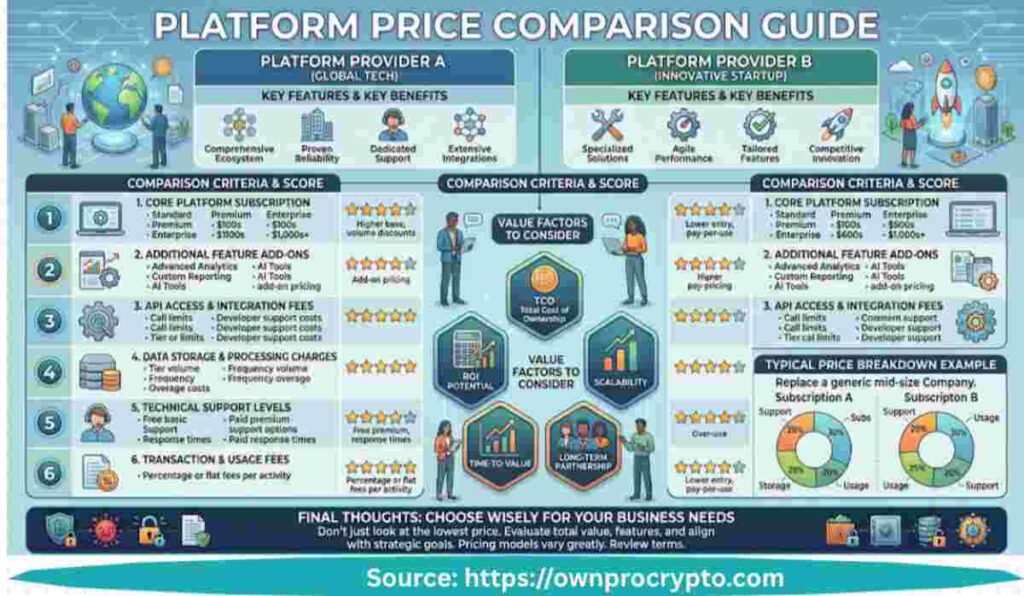
| Feature | Summ | Koinly | CoinTracker | CoinTracking | CoinLedger |
|---|---|---|---|---|---|
| Price Range (Annual) | $49–$499 | $49–$199+ | $59–$599 | $49–$899 | $49–$199 |
| Free Preview | Yes | Yes (up to 10k tx) | Limited | Limited trial | Yes |
| Exchange Support | 150+ | 400+ | 300+ | 900+ | 500+ |
| DeFi Support | Very Strong | Strong | Moderate | Strong | Limited |
| NFT Support | Strong | Good | Moderate | Good | Basic |
| 1099-DA Reconciliation | Yes | Yes | Yes | Yes | Yes |
| Manual Editing | Strong | Moderate | Basic | Excellent | Basic |
| TurboTax Export | Yes | Yes | Yes | Yes | Yes |
Professional platforms use encryption, read-only exchange APIs, and two-factor authentication. Crypto tax software never requires private keys or seed phrases. When selecting a platform, evaluate your annual transaction volume, exchange spread, DeFi engagement, and jurisdiction.
Common questions regarding software features, pricing, imports, and tax season preparation.
Educational disclaimer: This FAQ provides general educational information, not individualized legal or tax advice. Verify rules with official tax authorities before filing.
Explore related technical and compliance guides across our research cluster:
Digital Asset Taxation: Crypto Tax Rules & Compliance Guide (2026)
Crypto Tax-Loss Harvesting 2026: Wash Sale Rules & Strategies
Crypto Staking Tax Guide: 1099-DA Rules & Estimator (2026)
NFT Tax Guide 2026: Rules, Reporting & Compliance
Crypto Tax Residency 2026: Rules for Nomads & Investors
Explore related technical and compliance guides across our research cluster:
Pillar Master Guide
Digital Asset Taxation: Crypto Tax Rules & Compliance Guide (2026)
Tax-Loss Harvesting
Crypto Tax-Loss Harvesting 2026: Wash Sale Rules & Strategies
Global Tax Residency
Crypto Tax Residency 2026: Rules for Nomads & Investors
Managing cryptocurrency taxes becomes much easier with standardized templates that organize transactions, calculate gains and losses, and prepare records for tax filing. Whether you’re a casual investor, an active DeFi user, an NFT creator, a crypto miner, or a CPA handling multiple clients, these ready-to-use templates help maintain accurate documentation, simplify tax calculations, and improve compliance. Each template includes practical sample data, can be customized for your portfolio, and serves as a starting point for creating audit-ready records throughout the tax year.
| Template | Best For | What It’s Used For |
| Crypto Transaction Ledger | All Investors |
Record every cryptocurrency purchase, sale, transfer, swap, and fee in one place. Serves as the foundation for calculating gains, losses, and maintaining complete transaction history.
|
| Capital Gains Calculator | Individual Taxpayers |
Calculate realized capital gains and losses using your preferred accounting method (FIFO, LIFO, HIFO, or Specific Identification) while tracking holding periods for tax purposes.
|
| DeFi Yield Tracker | DeFi Users |
Monitor income from staking, liquidity pools, lending, borrowing, yield farming, and other DeFi protocols to accurately report taxable rewards and earnings.
|
| NFT Sales & Royalties Tracker | NFT Traders & Creators |
Track NFT purchases, sales, minting costs, marketplace fees, creator royalties, and realized profits for collectors, creators, and traders.
|
| Staking Rewards Log | Validators & Stakers |
Record staking rewards, validator payouts, reward dates, fair market value at receipt, and wallet information for accurate income reporting.
|
| Mining Income Tracker | Miners |
Log mining rewards, operational expenses such as electricity, equipment costs, and calculate net mining income for business or individual tax reporting.
|
| CPA Client Import Sheet | Accountants & Tax Firms |
Standardize client crypto data into a single worksheet, making it easier for accountants to import transactions, reconcile wallets, and prepare tax returns efficiently.
|
| Tax-Loss Harvesting Planner | Active Traders |
Identify unrealized losses, estimate potential tax savings, and plan harvesting opportunities while documenting repurchase strategies and compliance considerations.
|
| Crypto Cost Basis Worksheet | Investors |
Maintain detailed cost basis records for every crypto asset, helping ensure accurate gain/loss calculations when assets are sold, swapped, or spent.
|
| IRS 1099-DA Reconciliation Template | US Tax Filers |
Compare exchange-issued 1099-DA reports with your own transaction records to identify discrepancies, missing transactions, and reconciliation issues before filing your tax return.
|
| Date | Asset | Buy/Sell | Quantity | Price (USD) | Exchange | Fee | Wallet |
|---|---|---|---|---|---|---|---|
| 2026-01-10 | BTC | Buy | 0.15 | 97,500 | Coinbase | 15 | Ledger |
| 2026-01-18 | ETH | Buy | 2.00 | 3,200 | Kraken | 8 | MetaMask |
| 2026-02-05 | SOL | Sell | 25 | 182 | Binance | 4 | Phantom |
| 2026-02-16 | LINK | Buy | 100 | 21 | Coinbase | 3 | Ledger |
| 2026-03-02 | BTC | Sell | 0.05 | 103,800 | Kraken | 10 | Ledger |
| Asset | Purchase Date | Sale Date | Cost Basis | Sale Price | Gain/Loss | Holding Period |
|---|---|---|---|---|---|---|
| BTC | Jan 10 | Mar 15 | $8,000 | $9,200 | +$1,200 | Short |
| ETH | Jan 02 | Aug 10 | $4,600 | $5,800 | +$1,200 | Long |
| SOL | Feb 15 | Apr 02 | $2,800 | $2,150 | -$650 | Short |
| AVAX | Mar 01 | Sep 10 | $1,400 | $1,950 | +$550 | Long |
| LINK | Jan 18 | Jan 30 | $900 | $820 | -$80 | Short |
| Protocol | Network | Deposit | Rewards | Token | APY | Taxable Income |
|---|---|---|---|---|---|---|
| Aave | Ethereum | $5,000 | $180 | ETH | 4.1% | $180 |
| Pendle | Arbitrum | $2,500 | $145 | PENDLE | 8.4% | $145 |
| Morpho | Base | $8,000 | $275 | USDC | 5.2% | $275 |
| Compound | Ethereum | $3,000 | $95 | COMP | 3.8% | $95 |
| Spark | Ethereum | $7,500 | $330 | DAI | 4.9% | $330 |
| Collection | Purchase | Sale | Marketplace | Profit | Royalties |
|---|---|---|---|---|---|
| Pudgy Penguins | $850 | $1,600 | OpenSea | $750 | $40 |
| Azuki | $2,300 | $2,050 | Blur | -$250 | $0 |
| CloneX | $1,750 | $2,420 | OpenSea | $670 | $60 |
| Doodles | $980 | $1,180 | Magic Eden | $200 | $20 |
| Otherdeed | $1,450 | $1,900 | Blur | $450 | $35 |
| Date | Asset | Validator | Rewards | FMV | Wallet |
|---|---|---|---|---|---|
| Jan 1 | ETH | Lido | 0.021 | $68 | MetaMask |
| Jan 15 | SOL | Marinade | 0.80 | $148 | Phantom |
| Feb 1 | ATOM | Cosmostation | 1.90 | $22 | Keplr |
| Feb 14 | ADA | Yoroi | 12 | $9 | Yoroi |
| Mar 1 | DOT | Polkawallet | 1.20 | $8 | Ledger |
| Date | Coin | Quantity | FMV | Electricity | Net Income | Wallet |
|---|---|---|---|---|---|---|
| Jan 3 | BTC | 0.0025 | $240 | $70 | $170 | Ledger |
| Jan 8 | LTC | 1.2 | $138 | $40 | $98 | Ledger |
| Jan 20 | KAS | 650 | $92 | $28 | $64 | Kaspa Wallet |
| Feb 2 | BTC | 0.0027 | $255 | $72 | $183 | Ledger |
| Feb 15 | ETC | 6 | $144 | $48 | $96 | MetaMask |
| Client | Wallet | Exchange | Transactions | Tax Year | Status |
|---|---|---|---|---|---|
| John D. | Ledger | Coinbase | 520 | 2026 | Complete |
| Sarah M. | MetaMask | Kraken | 2,100 | 2026 | Review |
| Alex P. | Trezor | Binance | 850 | 2026 | Complete |
| Emma R. | Ledger | Gemini | 240 | 2026 | Pending |
| Michael K. | Phantom | Coinbase | 1,420 | 2026 | In Progress |
| Asset | Unrealized Loss | Sell Date | Repurchase Date | Estimated Savings | Status |
|---|---|---|---|---|---|
| ETH | $850 | Nov 10 | Nov 12 | $204 | Planned |
| SOL | $620 | Dec 02 | Dec 05 | $149 | Complete |
| LINK | $180 | Nov 28 | Nov 30 | $43 | Planned |
| AVAX | $430 | Dec 12 | Dec 14 | $103 | Pending |
| UNI | $295 | Dec 18 | Dec 20 | $71 | Planned |
| Asset | Quantity | Avg Cost | Current Price | Unrealized Gain | Method |
|---|---|---|---|---|---|
| BTC | 0.55 | $84,200 | $102,400 | $10,010 | FIFO |
| ETH | 8 | $2,850 | $3,350 | $4,000 | FIFO |
| SOL | 150 | $132 | $185 | $7,950 | HIFO |
| LINK | 500 | $17 | $22 | $2,500 | FIFO |
| AVAX | 90 | $28 | $36 | $720 | LIFO |
| Exchange | 1099-DA | Internal Records | Difference | Status | Notes |
|---|---|---|---|---|---|
| Coinbase | $18,250 | $18,250 | $0 | Match | — |
| Kraken | $9,540 | $9,615 | -$75 | Review | Missing fee |
| Gemini | $5,820 | $5,820 | $0 | Match | — |
| Binance.US | $7,140 | $7,098 | $42 | Review | Deposit timing |
| Robinhood | $3,460 | $3,460 | $0 | Match | — |