
Search by title, topic or phrase
Use our Crypto Search Engine 🔍 to find the topics and keywords you're looking for.
Modern DAO governance extends far beyond simple token voting. Leading protocols now combine delegated voting, treasury management, compliance controls, reputation systems, security frameworks, and measurable governance metrics to create resilient organizations that can operate across jurisdictions and adapt to changing market conditions.
Unlike traditional organizations, where decisions typically flow through executives or board members, DAOs distribute governance among their communities using smart contracts and on-chain voting. Every proposal, vote, treasury allocation, and protocol upgrade can be recorded on a blockchain, creating a transparent decision-making process that anyone can audit.
This guide explains how DAO governance works, explores the architecture behind successful decentralized organizations, compares modern voting models, discusses governance risks, and highlights the best practices shaping the future of collective ownership.
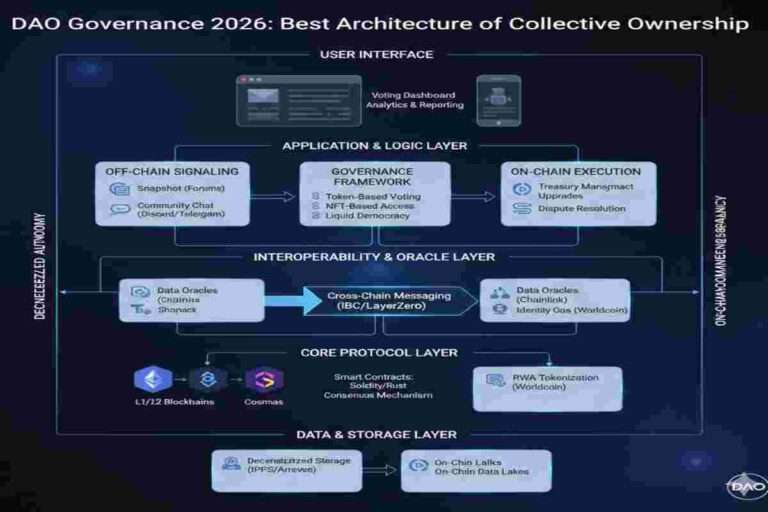
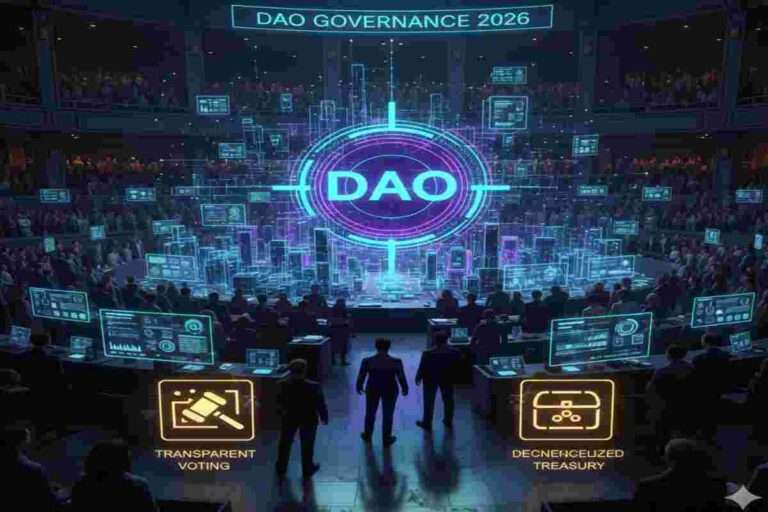
Table of Contents
ToggleDAO governance is the framework that enables members of a decentralized autonomous organization to propose ideas, vote on decisions, manage shared resources, and oversee the long-term direction of a protocol or community. Instead of relying on centralized executives or boards of directors, governance rules are encoded into smart contracts that automatically execute approved decisions.
A governance proposal might involve:
Once a proposal reaches the required voting threshold, the corresponding smart contract can execute the approved action automatically or after a predefined timelock period.
This approach reduces reliance on trusted intermediaries while improving transparency and accountability across the organization.
As blockchain ecosystems expand, governance becomes more than a voting mechanism—it becomes the operating system that coordinates people, capital, and technology.
Effective governance helps organizations:
Without effective governance, even technically advanced protocols can suffer from slow decision-making, voter apathy, treasury mismanagement, or governance attacks that undermine community trust.
Early DAOs relied almost entirely on token-weighted voting, where voting power was proportional to the number of governance tokens a participant owned. While this approach was simple to implement, it often concentrated influence among large token holders, venture capital firms, or founding teams.
Over time, decentralized organizations recognized that governance required more than counting votes. Modern DAOs now separate governance into specialized layers that distribute responsibilities across proposals, treasury management, execution, security, compliance, and community coordination.
This architectural approach improves resilience because each layer performs a distinct role while remaining connected through transparent governance processes.
Today, leading decentralized organizations increasingly treat governance as critical infrastructure rather than a community feature.
Although governance models vary across protocols, most follow a similar lifecycle from proposal creation to on-chain execution.
Each stage helps reduce operational risk while ensuring that governance decisions remain transparent and verifiable.
Successful DAOs separate governance responsibilities into multiple interconnected layers. This modular design improves security, scalability, and accountability while allowing organizations to evolve without disrupting their core governance processes.
These layers operate together to create an organization that is both decentralized and operationally resilient.
Rather than functioning independently, each governance layer contributes to the organization’s overall stability and long-term sustainability.
Modern governance systems typically include several interconnected components that support secure and efficient operations.
Together, these components create a governance framework capable of supporting both community-driven innovation and institutional-scale operations.
One of the biggest shifts in recent years is the growing recognition that governance is not simply a feature—it is infrastructure.
As decentralized finance, tokenized assets, decentralized identity, and institutional blockchain adoption continue to expand, governance increasingly serves as the coordination layer that connects technical systems with human decision-making.
Rather than asking, “Who owns the protocol?” organizations are increasingly asking:
Answering these questions effectively is becoming one of the defining challenges of modern Web3.
Voting is the foundation of DAO governance, but not all voting systems are designed to solve the same problem. Some prioritize simplicity, others encourage broader participation, while more advanced models aim to balance efficiency, expertise, and decentralization.
As DAOs have matured, many have adopted hybrid governance models that combine multiple voting mechanisms instead of relying on a single approach. This allows communities to tailor governance based on proposal type, treasury impact, and organizational complexity.
Modern governance increasingly blends these approaches to reduce concentration of power while maintaining operational efficiency.
Rather than treating every proposal equally, mature DAOs often apply different governance processes depending on the level of risk involved.

One of the biggest misconceptions in Web3 is that having thousands of token holders automatically means a protocol is decentralized.
In reality, decentralization depends on how governance power is distributed—not simply how many wallets exist.
Large token holders, founding teams, delegated representatives, or centralized custodians can significantly influence governance outcomes even when ownership appears widely distributed.
This is why governance quality is increasingly measured using objective metrics.
The Nakamoto Coefficient estimates the minimum number of independent participants required to gain enough influence to control a blockchain or governance system.
Higher values generally indicate a broader distribution of power, while lower values suggest governance may depend on only a few participants.
| Nakamoto Coefficient | Governance Interpretation |
|---|---|
| 1–3 | Highly centralized governance |
| 4–10 | Moderate decentralization |
| 11–30 | Strong decentralization |
| 30+ | Highly distributed governance |
The exact threshold varies between protocols, but institutions increasingly monitor this metric when evaluating governance resilience.
Modern governance considers several additional factors beyond token ownership:
These elements collectively determine whether governance remains resilient over time.
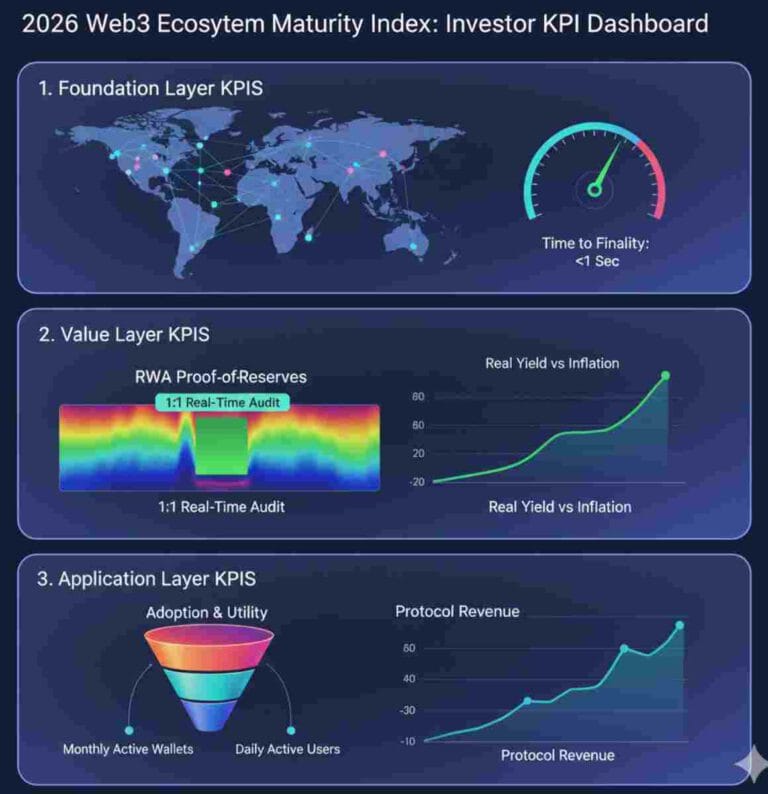
Healthy governance is measurable.
Rather than relying on subjective opinions, leading DAOs monitor operational indicators that reveal how effectively the organization functions.
| KPI | Measures | Why It Matters |
|---|---|---|
| Voter Participation Rate | Percentage of eligible voting power that participates | Indicates community engagement |
| Proposal Approval Rate | Percentage of proposals accepted | Reveals governance efficiency |
| Proposal Execution Rate | Percentage of approved proposals successfully implemented | Measures operational effectiveness |
| Delegation Depth | Distribution of delegated voting power | Reflects governance expertise |
| Treasury Runway | Financial sustainability | Indicates long-term resilience |
| Average Voting Duration | Time required to finalize governance decisions | Measures governance efficiency |
| Nakamoto Coefficient | Distribution of governance influence | Indicates decentralization |
Governance should not be judged by how many proposals are submitted, but by whether the community can consistently make informed decisions and execute them effectively.
DAO Governance Health

Participation        █████████░ 82%

Execution            ████████░░ 78%

Treasury Stability   ██████████ 95%

Delegate Diversity   ███████░░░ 71%

Transparency         ██████████ 97%

Security             █████████░ 89%
Although every DAO defines success differently, tracking consistent governance metrics helps communities identify weaknesses before they become critical issues.
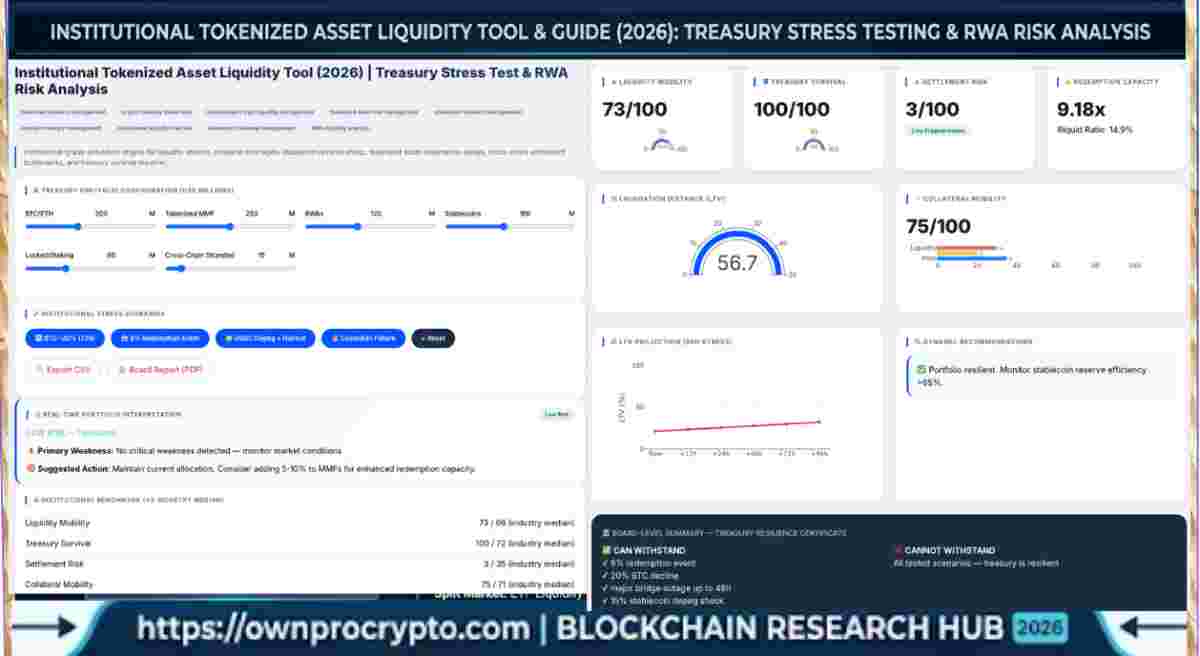
The treasury is often the largest and most valuable asset controlled by a DAO. It funds ecosystem development, security audits, grants, partnerships, liquidity incentives, and protocol growth.
Poor treasury governance can threaten the long-term sustainability of an otherwise successful protocol.
A mature DAO treasury typically manages core operational assets through structured allocation layers:
Rather than simply storing assets, treasury management has become an active financial discipline focused on preserving capital while supporting ecosystem growth.
This structured process improves transparency and reduces the likelihood of unauthorized fund movements.
Many leading DAOs now publish periodic treasury reports to help members understand how community funds are managed.
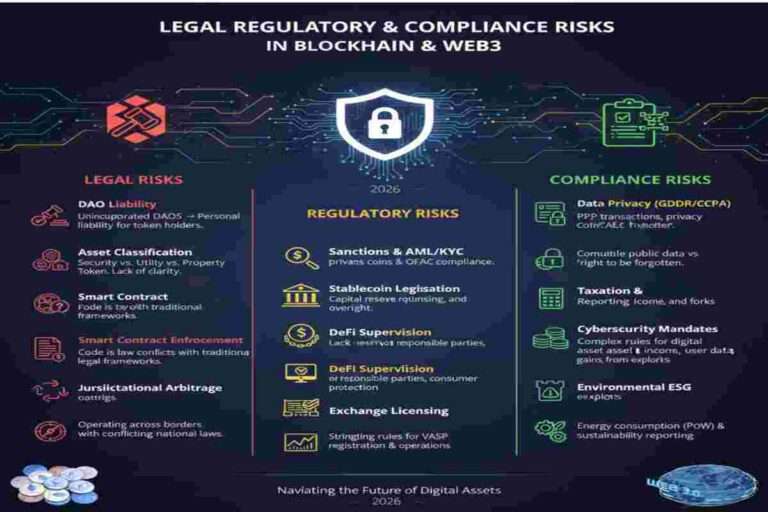
As institutional participation increases, governance frameworks are evolving to incorporate compliance requirements without abandoning decentralization.
Modern DAO governance may include:
These measures can help DAOs interact with traditional financial systems while preserving community-led governance.
It’s important to note that legal recognition of DAOs varies by jurisdiction. Some regions have introduced legal frameworks for DAO-related entities, while others continue to regulate activities through existing corporate, securities, or partnership laws. Organizations should evaluate applicable regulations before adopting governance structures or launching regulated products.
Institutional participants increasingly evaluate governance before allocating capital.
Beyond technology, they assess whether a protocol demonstrates:
| Evaluation Area | Institutional Question |
|---|---|
| Governance | Can decisions be audited? |
| Treasury | Is capital managed responsibly? |
| Security | Are governance contracts independently audited? |
| Participation | Is voting sufficiently decentralized? |
| Compliance | Can governance satisfy applicable regulatory obligations? |
| Transparency | Are proposals and treasury activities publicly accessible? |
Governance has become one of the strongest indicators of long-term protocol maturity.
Even well-designed DAOs face governance challenges as their communities grow and their treasuries become more valuable. Poor governance rarely results from a single failure—instead, it usually develops through a combination of weak participation, unclear accountability, technical limitations, and inefficient decision-making.
Understanding these challenges allows organizations to design governance systems that remain resilient as protocols evolve.
| Challenge | Description | Potential Impact |
|---|---|---|
| Low Voter Participation | A small percentage of token holders actively vote. | Decisions may not reflect the broader community. |
| Whale Dominance | Large token holders can disproportionately influence proposals. | Governance becomes centralized. |
| Proposal Fatigue | Too many proposals reduce engagement. | Important decisions receive limited attention. |
| Governance Attacks | Coordinated actors manipulate voting outcomes. | Protocol security and trust decline. |
| Treasury Mismanagement | Poor capital allocation or uncontrolled spending. | Reduced financial sustainability. |
| Slow Decision-Making | Complex governance processes delay execution. | Innovation and protocol upgrades slow down. |
| Regulatory Uncertainty | Changing legal requirements create governance challenges. | Increased compliance risk. |
No governance model eliminates every risk, but thoughtful governance architecture significantly reduces their likelihood and impact.
Healthy DAOs continuously monitor governance quality rather than reacting only after problems occur.
Some common warning signs include:
Identifying these trends early allows communities to improve governance before trust begins to erode.
| Governance Failure | Primary Cause | Recommended Solution |
|---|---|---|
| Low Participation | Limited incentives | Delegate voting and improve community education. |
| Whale Control | Concentrated token ownership | Introduce delegated, quadratic, or hybrid voting. |
| Proposal Spam | Low proposal requirements | Require proposal thresholds and structured review. |
| Treasury Losses | Weak financial oversight | Adopt treasury policies, audits, and risk frameworks. |
| Governance Deadlock | Excessive voting thresholds | Balance participation with practical decision-making. |
| Smart Contract Risks | Inadequate testing | Perform independent audits and phased deployments. |
| Compliance Gaps | Undefined governance responsibilities | Establish governance policies and legal review where appropriate. |
Strong governance focuses on preventing problems through clear processes rather than relying solely on emergency interventions.
Not all DAOs operate with the same level of governance sophistication. As organizations grow, their governance typically evolves through several stages of maturity.
Understanding these stages helps communities identify strengths, prioritize improvements, and prepare for long-term sustainability.
Governance maturity is not determined by protocol size alone. It reflects how effectively an organization manages decision-making, accountability, security, and long-term resilience.
As governance matures, organizations typically become more transparent, measurable, and resilient.

Successful governance is rarely the result of a single innovation. Instead, it emerges from consistent operational discipline, transparent decision-making, and continuous improvement.
The following practices are widely recognized across mature DAO ecosystems.
Voting determines what should happen, while smart contracts determine how approved decisions are executed. Separating these responsibilities reduces operational risk and improves accountability.
Communities should clearly define:
Standardized governance processes improve participation and reduce confusion.
Track measurable indicators such as:
Governance should evolve using data rather than assumptions.
Treasury governance should include:
Strong treasury governance strengthens community confidence.
Healthy governance rewards meaningful contributions rather than short-term speculation.
Many DAOs encourage participation through:
Sustainable governance depends on active, informed participants.
Studying established DAO ecosystems provides practical insight into how governance models operate at scale.
Rather than following a single approach, leading protocols tailor governance to their communities, technical requirements, and long-term objectives.
| Protocol | Governance Focus | Notable Characteristics |
|---|---|---|
| MakerDAO | Treasury and risk management | Specialized governance processes supporting decentralized stablecoin operations. |
| Uniswap | Protocol governance | Community proposals, delegated voting, and treasury funding for ecosystem growth. |
| Aave | Risk-managed lending | Governance balances protocol upgrades with financial risk management. |
| Optimism | Ecosystem funding | Governance combines community participation with public goods funding. |
| Arbitrum | Layer-2 ecosystem development | Treasury governance supports protocol growth through structured proposal processes. |
Although governance structures differ, successful DAOs generally share several characteristics:
| Feature | DAO Governance | Traditional Corporate Governance |
|---|---|---|
| Decision Making | Community voting | Board of directors |
| Transparency | Public blockchain records | Internal corporate records |
| Voting | On-chain governance | Shareholder meetings |
| Treasury | Smart contract controlled | Bank accounts and finance departments |
| Execution | Automated through smart contracts | Manual operational processes |
| Participation | Global and permissionless (subject to protocol rules) | Typically limited to shareholders and executives |
| Auditability | Public and verifiable | Often periodic and internal |
Both models aim to coordinate organizations effectively, but DAOs emphasize transparency and programmable execution while traditional organizations rely on established legal and managerial structures.
DAO governance continues to evolve alongside advances in decentralized identity, zero-knowledge technologies, modular blockchain infrastructure, artificial intelligence, and tokenized real-world assets.
Future governance systems are likely to become more adaptive, data-driven, and interoperable, enabling decentralized organizations to coordinate increasingly complex economic and social activities while maintaining transparency and community participation.
| OwnProCrypto resource | Primary purpose / search intent | How it differs from this dApps & DAOs guide |
|---|---|---|
| dApps & DAOs 2026 | Core conceptual guide explaining what dApps and DAOs are, their differences, and how they can work together. | This is the relationship and definition resource. It is not a dedicated infrastructure, governance, security, or investment guide. |
| Blockchain for DApp Infrastructure | Explains the technical infrastructure required to build and operate decentralized applications, including blockchain networks, smart contracts, storage, indexing, oracles, wallets, RPC infrastructure, and related architecture. | Infrastructure intent. It explains how the technology stack behind dApps works rather than defining the broader dApp–DAO relationship. |
| DAO Governance | Explains DAO governance architecture, proposals, voting models, delegation, treasury management, governance participation, and governance best practices. | Governance intent. This DAOs page introduces the DAO concept; the governance resource goes deeper into how DAO decision-making works. |
| DAO Governance Risk Analysis Tool | Provides a specialized framework for examining governance attack surfaces, voting concentration, quorum, proposal thresholds, timelocks, privileged control, and related governance risks. | Risk-assessment intent. It is a diagnostic resource rather than a general explanation of dApps and DAOs. |
| Web3 Ecosystem Explained | Provides the broader Web3 ecosystem and architecture context, including blockchain infrastructure, dApps, DeFi, DAO coordination, identity, RWA, liquidity, and institutional participation. | Web3 ecosystem intent. It places dApps and DAOs inside the larger Web3 system; this page focuses specifically on the relationship between dApps and DAOs. |
| Chain Abstraction 2026 | Explains how chain abstraction reduces blockchain complexity across wallets, networks, liquidity, execution, and user intents. | User-experience and interoperability intent. It addresses blockchain complexity rather than the fundamental meaning and relationship of dApps and DAOs. |
| Web3 AI Build Guide 2026 | Explores AI agents, autonomous workflows, and the technical intersection between AI systems and Web3 applications. | AI + Web3 intent. AI-powered dApps and autonomous agents are treated as an emerging application area rather than the primary subject of this guide. |
For additional research and technical references, explore:
DAO governance has evolved far beyond its origins as a simple on-chain voting mechanism. Today, it serves as the operational framework that enables decentralized communities to coordinate people, capital, and technology with transparency and accountability.
As blockchain ecosystems continue to expand, governance will play an increasingly important role in supporting protocol upgrades, treasury management, ecosystem funding, and long-term sustainability. Modern DAOs are adopting layered governance architectures, measurable performance metrics, and structured decision-making processes that improve resilience while preserving community participation.
At the same time, governance continues to adapt to emerging technologies such as decentralized identity, artificial intelligence, zero-knowledge proofs, and cross-chain interoperability. These innovations are expected to make governance systems more secure, efficient, and responsive without losing the transparency that defines decentralized organizations.
Whether you are an investor, developer, contributor, researcher, or business leader, understanding DAO governance provides valuable insight into how digital organizations coordinate decisions at global scale. As Web3 matures, governance is becoming more than a technical feature—it is emerging as one of the core foundations of the decentralized digital economy.
| Topic | Summary |
|---|---|
| DAO Governance | Enables decentralized decision-making through transparent community participation and smart contracts. |
| Governance Architecture | Separates responsibilities across governance, execution, treasury, compliance, and coordination layers. |
| Voting Models | Modern DAOs increasingly combine token, delegated, reputation-based, and hybrid voting mechanisms. |
| Treasury Management | Focuses on sustainable capital allocation, risk management, and long-term ecosystem growth. |
| Governance Metrics | Participation, execution, decentralization, and treasury health provide measurable indicators of governance quality. |
| Future Direction | Governance continues to evolve alongside decentralized identity, interoperability, automation, and institutional adoption. |
Something readers can use immediately.
| ✔ Checklist | Status |
|---|---|
| Governance documentation published | ☐ |
| Treasury policies established | ☐ |
| Smart contracts independently audited | ☐ |
| Delegation system implemented | ☐ |
| Governance KPIs monitored | ☐ |
| Emergency response process documented | ☐ |
| Treasury transparency reports published | ☐ |
| Community education resources available | ☐ |
| Governance risks reviewed regularly | ☐ |
| Long-term roadmap publicly maintained | ☐ |
It’s simple, practical, and highly shareable. It also reinforces the article’s educational value and gives readers something actionable to take away.
Expand your understanding of decentralized infrastructure with these related guides:
What is DAO governance and how does Off-Chain Signalling work?
DAO governance is the process through which community members of a Decentralized Autonomous Organization propose, discuss, vote on, and execute decisions. Before committing gas on-chain, DAOs use Off-Chain Signalling on a dedicated Voting Platform to gauge general Community Sentiment and measure preliminary approval among DAO Voters.
How does the full Proposal Lifecycle progress from discussion to execution?
The Proposal Lifecycle begins with off-chain community temp checks, moves through Proposal Voting, and concludes with on-chain execution. This structured pathway ensures that proposals undergo rigorous technical vetting before final execution through smart contracts.
What is the purpose of governance tokens for Community Members?
Governance tokens give Community Members the voting power needed to participate in protocol updates, treasury grants, and policy changes. Token ownership allows participants to act as active DAO Voters or delegate their voting rights to trusted representatives.
What roles do OpenZeppelin Governor and specialized Voting Tools play?
OpenZeppelin Governor provides standard, battle-tested smart contract modules for on-chain voting logic. Modern protocols pair these contracts with specialized Voting Tools and analytics dashboards to streamline vote submission, delegate tracking, and voter verification.
How do DeGov AI, DeGov Square, and Orbs Guardians enhance protocol integrity?
Emerging platforms like DeGov AI automatically audit proposal descriptions for threat patterns, while DeGov Square aggregates cross-chain governance analytics. Meanwhile, Orbs Guardians operate as decentralized monitoring networks that verify voting conditions and protect against hostile takeovers.
How do governance requirements differ for Collector DAOs and Legal DAOs?
Collector DAOs focus on capital pooling and rapid asset acquisitions, requiring agile voting models. In contrast, Legal DAOs bind smart contract decisions to real-world legal entities, requiring strict identity verification, compliance guardrails, and formal voter registration.
How do Voting Period, Voting Steps, and Votes Cast determine proposal success?
During the designated Voting Period, participants execute specific Voting Steps to register their official Votes Cast on-chain. The system continually tallies these votes to verify whether the proposal meets approval ratios before the deadline expires.
What is the difference between Quorum Threshold, Quorum Approval, and overall DAO Quorum?
The Quorum Threshold defines the minimum total participation required for a vote to be valid. Achieving a baseline DAO Quorum ensures that a minority cannot pass contentious decisions, while final Quorum Approval verifies that the required proportion of affirmative votes has been achieved.
How do DAOs manage treasuries and protect against voter errors?
DAO treasuries are governed through community proposals. Protocols enforce mandatory review windows and execution timelocks so that Community Members and security councils can detect potential errors or malicious payloads before on-chain execution occurs.
What is the Nakamoto Coefficient and how does it measure governance performance?
The Nakamoto Coefficient calculates the minimum number of independent entities required to control 51% of voting power. Combined with delegation depth and execution rates, it helps communities evaluate governance resilience and decentralization over time.
What is the future outlook for legal recognition and DAO adoption?
As regulatory frameworks evolve worldwide, enterprise adoption of DAO governance is expanding across decentralized finance, capital allocation, and supply chain management. Future frameworks will increasingly combine artificial intelligence, automated risk analytics, and verifiable governance infrastructure to balance regulatory compliance with community autonomy.