infographic of site logo for contact us

OwnProCrypto.com

Use our Crypto Search Engine 🔍 to find the topics and keywords you're looking for.

dApps & DAOs · OwnProCrypto
Web3 Foundation • dApps & DAOs

dApps & DAOs 2026: How They Work Together in Web3

Decentralized applications (dApps) are the applications and protocols people interact with on blockchain networks, while decentralized autonomous organizations (DAOs) provide a way for communities, token holders, contributors, or other participants to coordinate decisions and resources. They are related but not interchangeable: a dApp provides functionality, while a DAO can provide the coordination and governance layer that helps a decentralized protocol or community evolve.

⚡ First Answer

dApps and DAOs solve different parts of decentralized systems. A dApp lets users interact with blockchain-based functionality such as trading, lending, gaming, identity, assets, or other programmable services. A DAO provides a coordination structure through which participants can make proposals, vote, manage resources, or influence how a protocol or community develops.

The important relationship is therefore: dApps are primarily the application or protocol interface; DAOs are primarily a coordination and governance mechanism. Some systems use both, some use one without the other, and the presence of a DAO does not automatically make an application fully decentralized.
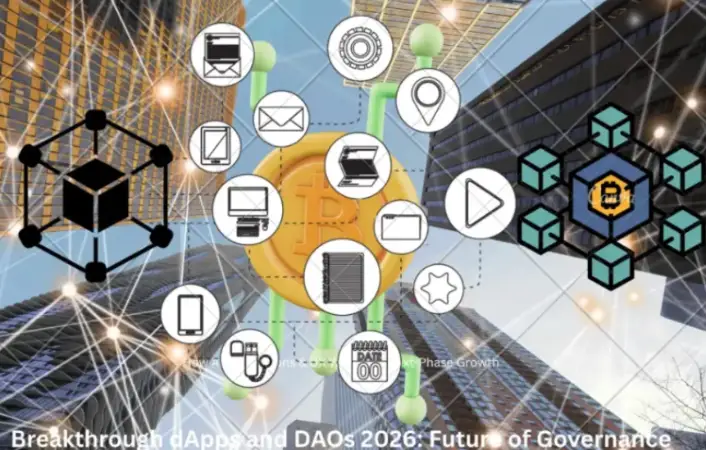
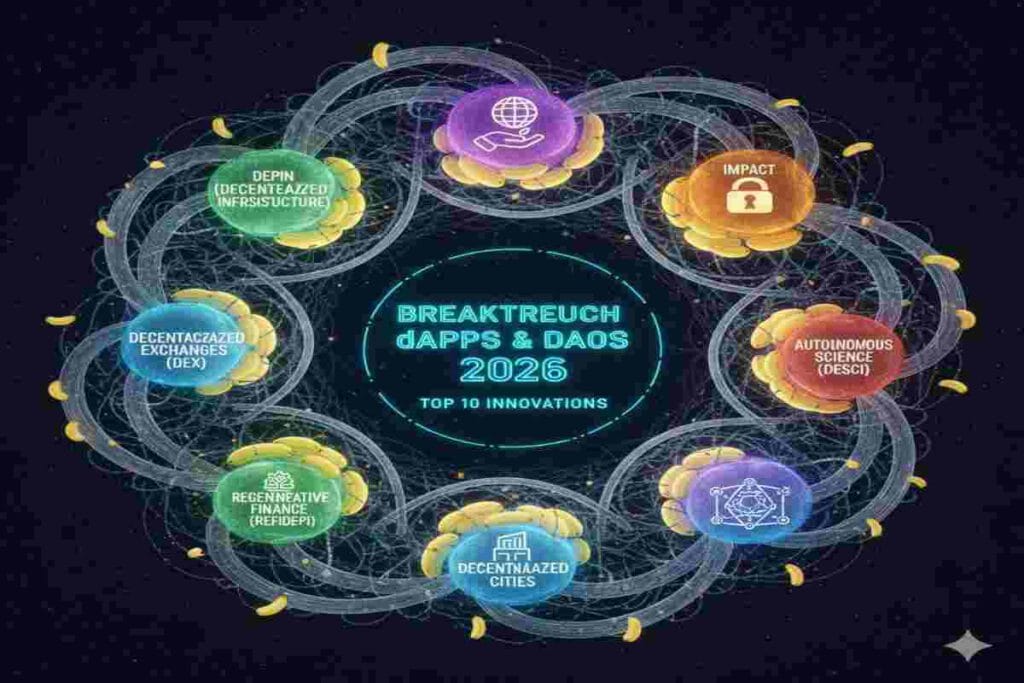
Diagram showing Breakthrough dApps & DAOs 2026: Future of Governance
Breakthrough dApps & DAOs

Table of Contents

What Are dApps and DAOs?

What is a dApp?

A decentralized application, commonly called a dApp, is an application or protocol that uses blockchain networks and smart contracts for some of its core functionality. Instead of depending entirely on a centralized server and database, parts of its logic, ownership, transactions, or state can be executed or recorded through decentralized infrastructure.

Typical dApp components

ComponentPrimary role
BlockchainProvides settlement, state and transaction verification.
Smart contractsExecute programmable rules and application logic.
WalletProvides identity, authorization and transaction signing.
FrontendProvides the interface through which users interact with the system.
Data / indexing infrastructureMakes blockchain information usable by applications and users.

For a deeper technical explanation, see OwnProCrypto’s Blockchain for DApp Infrastructure guide.

What is a DAO?

A decentralized autonomous organization, or DAO, is a coordination structure that uses blockchain-based rules and governance mechanisms to allow participants to make collective decisions or manage shared resources.

Typical DAO functions

DAO functionWhat it coordinates
ProposalsIdeas or actions submitted for collective consideration.
VotingDecision-making among eligible participants.
Treasury managementAllocation and control of shared resources.
DelegationAllows participants to assign voting authority to delegates.
Execution controlsDetermines how approved decisions become operational actions.

For the deeper governance layer, see OwnProCrypto’s DAO Governance guide.

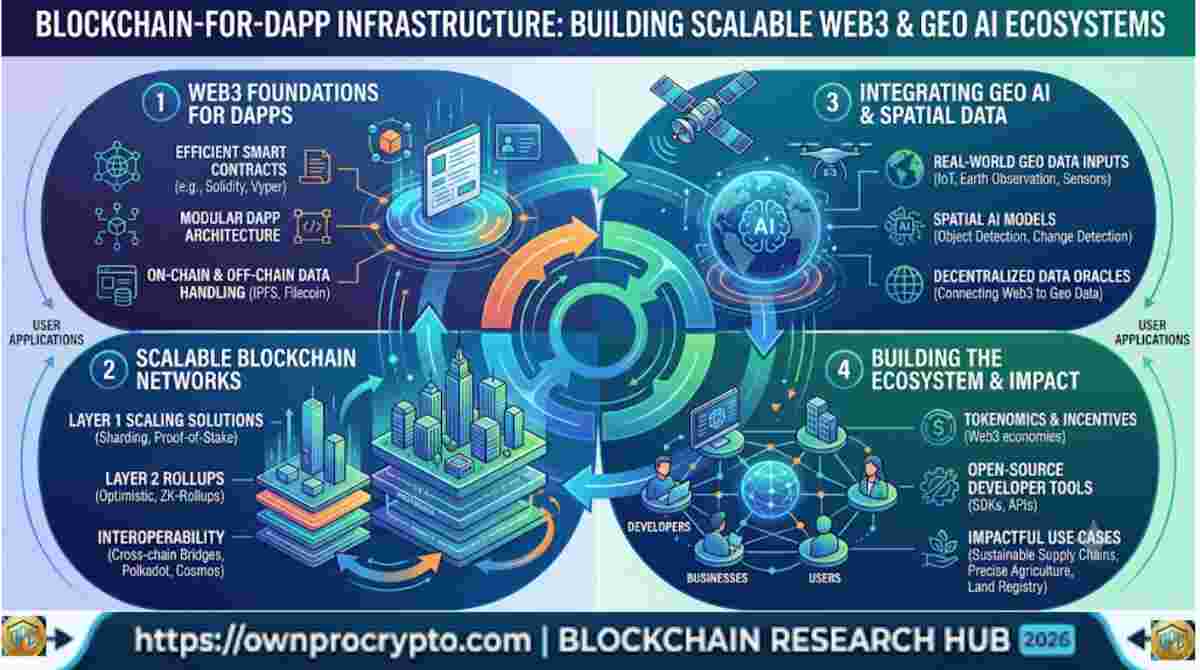
Infographic of Blockchain for dApps and DAOs 2026
dApps and DAOs 2026

How dApps and DAOs Work Together

A dApp and a DAO can operate as two different layers of the same decentralized ecosystem. The application gives users something to do; the governance system can give participants a mechanism for influencing how the protocol, treasury, parameters, or community develops.

dApp + DAO Relationship
Users Interact with the application or protocol
↓
dApp / Protocol Provides blockchain-based functionality
↕
DAO / Governance Coordinates decisions and shared resources
The dApp answers “What can users do?” while the DAO can help answer “How does the decentralized system decide what happens next?”

The relationship is complementary, not automatic

A protocol can have a dApp without operating through a DAO. A DAO can exist without controlling a single consumer-facing dApp. A mature ecosystem may combine both, with the dApp providing functionality and the DAO coordinating selected decisions around the protocol or community.

dApp layer User interaction, application functionality, transactions and protocol services.
DAO layer Governance, coordination, proposals, voting, treasury decisions and selected protocol changes.
Infographic of Daap vs Dao Explaining Decentralized Finance (DeFi): Banking Without Banks. The Key Differences
dApp vs DAO — showing The Key Differences How.

dApps vs DAOs: Key Differences

The easiest way to understand the distinction is to separate application functionality from organizational coordination.

DimensiondAppDAO
Primary purposeProvide an application, protocol or blockchain-based service.Coordinate people, decisions, resources or protocol governance.
Main participantsUsers, traders, borrowers, players, creators or other application users.Members, token holders, delegates, contributors or other governance participants.
Core technologySmart contracts, blockchain networks, wallets and application interfaces.Governance contracts, voting systems, proposals, treasury controls and execution mechanisms.
Main questionWhat can users do?How are collective decisions made?
Can it exist alone?Yes.Yes.
Can they be combined?Yes. A protocol can use DAO governance.Yes. A DAO can govern or coordinate around a protocol.
Simple mental model A dApp is primarily the application layer. A DAO is primarily the coordination and governance layer. They can operate independently or become connected parts of the same decentralized system.
Image shows How to Connect a Web3 Wallet to dApps in 2026
How to Connect a Web3 Wallet begnet to dApps

How a dApp Connects Users to Web3

The user-facing side of decentralization

Most people encounter Web3 through applications rather than through blockchain infrastructure itself. A dApp turns blockchain capabilities into a usable experience: swapping assets, interacting with lending protocols, managing digital assets, playing games, creating assets, accessing identity systems, or performing other programmable actions.

Typical interaction flow

StageUser / system action
1. InterfaceThe user opens the dApp interface.
2. WalletThe user connects or authorizes an account.
3. IntentThe user requests an action such as swap, lend, mint or vote.
4. Smart contractApplication rules are executed through blockchain infrastructure.
5. SettlementThe blockchain records and verifies the resulting state or transaction.

This page should not duplicate the infrastructure deep dive. For the technical architecture, continue to Blockchain for DApp Infrastructure.

Infographic of DAO Governance 2026- Web3 ecosystem structured
How a DAO Coordinates People, Rules and Resources

How a DAO Coordinates People, Rules and Resources

A DAO addresses a different problem from a dApp. Instead of primarily delivering an application experience, it creates a framework for collective coordination. Governance may cover protocol parameters, treasury decisions, upgrades, grants, incentives, community initiatives or other defined areas of authority.

DAO coordination model

Layer Question Example
Participation Who can participate? Token holders, delegates, contributors or members.
Proposal What can be proposed? Parameter changes, treasury actions or protocol upgrades.
Decision How is a decision reached? Voting, delegation, reputation or hybrid mechanisms.
Execution How does an approved decision take effect? Smart-contract execution, multisig action or other defined controls.

For detailed governance models, voting structures and governance architecture, use DAO Governance Explained.

Infographic of Blockchain for DApp Infrastructure in 2026
When a dApp Needs a DAO — and When It Does Not

When a dApp Needs a DAO — and When It Does Not

A common mistake is treating “dApp” and “DAO” as if they are required components of every Web3 project. They are not. The appropriate structure depends on what needs to be decentralized and who needs authority over future decisions.

Project structure When it may make sense Primary coordination need
dApp without DAO The application can operate with defined development or administrative control. Application delivery and protocol operation.
DAO without a consumer dApp A community or organization primarily needs collective coordination. Governance, treasury or contributor coordination.
dApp + DAO A protocol wants community or stakeholder participation in defined decisions. Application functionality plus decentralized coordination.
Hybrid governance Some decisions require governance while others remain with specialized operators. Distributed authority with defined operational controls.
Important distinction A DAO does not automatically make every component of a dApp decentralized. Governance authority, smart-contract upgrade rights, frontend hosting, treasury control and other administrative permissions may remain distributed differently.
Infographic of DAO Governance 2026- Web3 ecosystem structured
Where dApps and DAOs Fit in the Web3 Ecosystem

Where dApps and DAOs Fit in the Web3 Ecosystem

dApps and DAOs sit above the underlying blockchain infrastructure but serve different functions within the broader Web3 system. The dApp is generally closer to the user and application layer, while DAO mechanisms can operate across the governance and coordination layer.

Web3 layer Primary role Relationship to dApps / DAOs
Blockchain networks Settlement and decentralized state. Provide the base environment on which applications and governance systems operate.
Smart contracts Programmable execution. Implement application logic and governance rules.
dApps User-facing functionality. Turn blockchain capabilities into usable applications and protocols.
DAOs Coordination and governance. Coordinate defined decisions, resources or protocol evolution.
Infrastructure Data, indexing, wallets, storage, RPC and connectivity. Supports application and governance operations.

OwnProCrypto’s broader Web3 map

The broader Web3 Ecosystem Explained resource provides the larger architecture. This dApps & DAOs page should remain narrower: it explains the relationship between applications and decentralized organizations rather than attempting to replace the ecosystem hub.

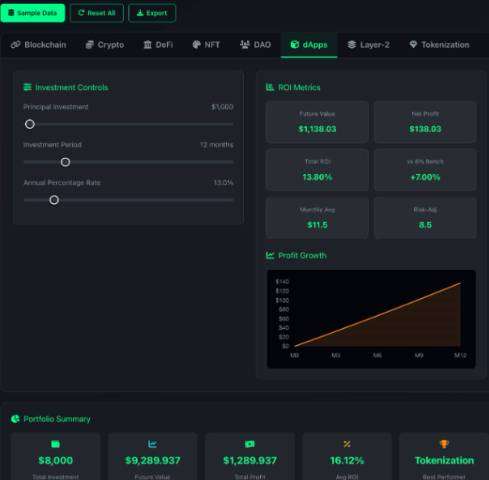
The Diagram of Image showing dApps and DAOs Calculator
dApps and DAOs: The Foundation of Modern Decentralized Governance

Interactive Resource: Web3 Empire Calculator

The Web3 Empire Calculator is a separate interactive tool for exploring hypothetical growth and ROI scenarios across several Web3 categories, including DAO & dApps, Blockchain, Crypto, DeFi, NFTs, Tokenization, and broader Web trends. On this page, it serves as a supporting exploration tool rather than a definition or valuation model for dApps and DAOs. If you want to understand what dApps and DAOs are and how they relate, continue with this guide. If you want to explore hypothetical financial scenarios across different Web3 categories, the calculator provides an interactive way to adjust assumptions such as principal, time period, and growth rate. Important: calculator outputs are mathematical scenarios based on user-selected assumptions and should not be interpreted as predictions, guaranteed returns, or investment advice.

dApps & DAOs in 2026: Where They Fit in Web3

dApps and DAOs serve different functions within the Web3 ecosystem, but they can work together as complementary layers. A decentralized application provides functionality that users interact with, while a DAO can provide mechanisms for community coordination and decision-making.
Web3 layer Primary role Relationship to dApps / DAOs
Blockchain networks Execution, settlement and decentralized state. Provide the underlying environment in which applications and governance systems operate.
Smart contracts Programmable rules and execution. Implement application logic and, where applicable, governance mechanisms.
dApps Application functionality. Give users practical ways to interact with decentralized protocols and services.
DAOs Coordination and governance. Provide mechanisms for eligible participants to make defined collective decisions.
Users and communities Interaction and participation. Use dApps and may participate in DAO governance where applicable.

dApps as the application layer

dApps are the part of the decentralized ecosystem that users directly interact with. They can provide services such as decentralized trading, lending, marketplaces, gaming, identity, and other blockchain-based applications. Although a dApp may look similar to a conventional web application, its underlying functionality can rely on smart contracts and blockchain networks rather than a single centralized backend.

DAOs as the coordination layer

DAOs can provide a structured way for communities or stakeholders to coordinate decisions around a protocol, treasury, organization, or other decentralized initiative. The specific governance model varies between projects. Some use token-based voting, while others may incorporate delegation, reputation, multisignature controls, or other mechanisms.

When dApps and DAOs work together

A project can combine a dApp with a DAO when decentralized application functionality and community coordination need to operate within the same ecosystem.
Stage What happens
1. User interaction The user interacts with the dApp or protocol.
2. Smart-contract execution Smart contracts process the relevant application activity.
3. Governance Where applicable, DAO participants make eligible protocol or organizational decisions.
4. Protocol change An approved decision may affect selected parameters, resources, upgrades, or rules.
5. dApp evolution The application or protocol can evolve according to the applicable governance and technical mechanisms.

The important distinction

A dApp does not automatically require a DAO, and a DAO does not necessarily operate a user-facing dApp. They can operate independently or work together when their functions align with the needs of the project and its community.
Remember dApps = application functionality · DAOs = coordination & governance. Both can exist alone, but together they can create a more resilient and participatory Web3 ecosystem.
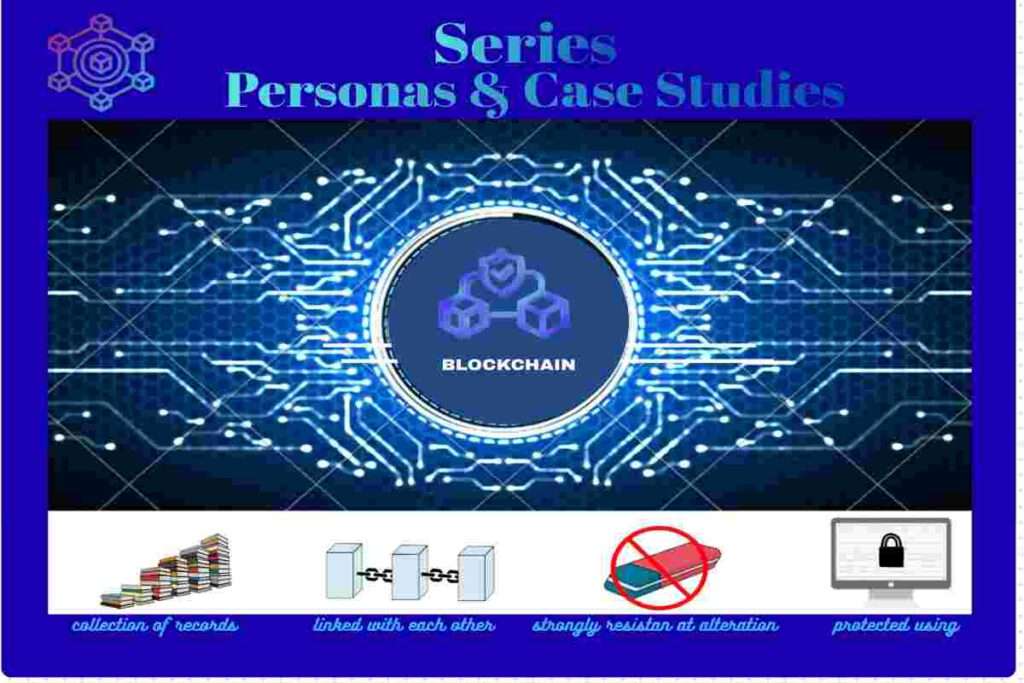
This infographic of Real-life Personas & Case Studies of Blockchain in 2026
dApps & DAOs: Real-World Examples

dApps & DAOs: Real-World Examples

Real-world projects demonstrate that dApps and DAOs do not follow a single architecture. Some focus primarily on application functionality, some emphasize decentralized governance, and others combine both within the same ecosystem.

Uniswap: dApp and Protocol Governance

Uniswap illustrates how users can interact with a decentralized exchange protocol while governance mechanisms can be used to participate in selected protocol decisions.

The example shows the distinction between the application layer, where users access decentralized exchange functionality, and the governance layer, where eligible participants can influence certain protocol decisions.

Aave: dApp and DAO Ecosystem

Aave demonstrates a closer relationship between decentralized financial applications and community-based governance. Users interact with the protocol’s lending and borrowing functionality, while governance mechanisms can be used to coordinate aspects of the protocol’s development and operation.

This illustrates how application functionality and decentralized coordination can coexist within one broader ecosystem.

Aragon: DAO Infrastructure

Aragon represents another side of the relationship. Rather than being primarily an end-user dApp such as a decentralized exchange, it provides infrastructure and tooling for organizations interested in creating and managing decentralized governance systems.

This demonstrates that DAOs can also exist as organizational systems supported by specialized infrastructure rather than simply serving as governance for one consumer-facing application.

Key takeaway dApps and DAOs can be connected, but they are not interchangeable concepts.

Do All dApps Need a DAO?

No. A decentralized application can operate without a DAO, just as a DAO can exist without operating a conventional user-facing dApp.

Whether a project needs both depends on what it is trying to decentralize. An application may focus on decentralized service delivery while retaining a different form of development or administrative structure. A DAO, meanwhile, may exist primarily to coordinate people, resources, proposals, or decisions.

dApp Without a DAO

The application provides decentralized functionality, but governance may use a different organizational structure.

DAO Without a dApp

The organization coordinates members, resources, proposals, or decisions without operating a conventional consumer-facing application.

dApp + DAO

The application provides decentralized functionality while the DAO provides mechanisms for community or stakeholder coordination.

Important Treating every dApp as a DAO-governed application creates an inaccurate picture of Web3 architecture. The two concepts should be evaluated separately before considering how they might work together.
Infographic of Daap vs Dao Explaining Decentralized Finance (DeFi): Banking Without Banks. The Key Differences
dApp vs DAO — showing The Key Differences How.

dApps vs DAOs: The Key Differences

dApps and DAOs are often discussed together because they can operate within the same Web3 ecosystem. Their primary purposes, however, are different.

Aspect dApps DAOs
Primary purpose Provide decentralized application or protocol functionality. Coordinate people, resources, proposals, or decisions.
Main participants Users and application participants. Members, contributors, delegates, token holders, or other eligible stakeholders.
Core technology Smart contracts, blockchain networks, wallets, and related infrastructure. Governance mechanisms, smart contracts, voting systems, and coordination infrastructure.
Primary activity Using a decentralized service or interacting with a protocol. Proposing, deciding, coordinating, or managing resources.
Main question “What can users do?” “How are decisions made?”
Typical output Application activity or protocol transactions. Governance decisions, proposals, resource allocation, or organizational actions.
In simple terms A dApp provides decentralized functionality, while a DAO can provide decentralized coordination and decision-making. Some projects combine the two, but neither concept automatically requires the other.

Common Misconceptions About dApps & DAOs

Every dApp Is Controlled by a DAO

Not necessarily. A dApp can provide decentralized functionality without being governed by a DAO.

Every DAO Has Its Own dApp

Not necessarily. A DAO can exist primarily as a coordination or governance structure without operating a conventional user-facing application.

A DAO Automatically Means Complete Decentralization

A DAO’s actual level of decentralization depends on its governance design, participation structure, voting power distribution, execution controls, and other mechanisms.

dApps Are Just Websites on a Blockchain

A dApp may have a familiar web interface, but its architecture can involve smart contracts, blockchain networks, wallets, decentralized storage, indexing services, oracles, and other infrastructure.

DAOs Are Simply Companies Without CEOs

A DAO should be understood through its specific governance and coordination mechanisms rather than treated as a direct one-to-one replacement for a traditional company.

Benefits and Limitations of Combining dApps & DAOs

Combining a dApp with a DAO can connect application functionality with community-based coordination, but the combination does not automatically produce a better system. The result depends on how the technical and governance layers are designed.

User Participation

Users can interact directly with decentralized applications while eligible participants may also contribute to governance or protocol decisions.

Community Coordination

A DAO can provide defined mechanisms for stakeholders to propose, discuss, and decide on selected changes or resource allocations.

Transparent Rules

Where rules and governance actions are represented on-chain, participants can inspect relevant transactions and contract activity.

Programmable Execution

Some governance systems can connect approved decisions to smart-contract execution, reducing the need for a separate centralized execution layer.

What the Combination Does Not Guarantee

Using both a dApp and a DAO does not automatically guarantee decentralization, security, efficiency, fairness, or broad participation. Those characteristics depend on the underlying application architecture and governance design.

The Relationship Between dApps, DAOs & Users

The relationship becomes easier to understand when the different roles are viewed as connected layers rather than as competing technologies.

Users Interact with applications, services, assets, and protocols.
↓
dApps Provide the application or protocol functionality users interact with.
↓
Smart Contracts Execute programmable rules according to their design.
↓
Blockchain Infrastructure Provides decentralized execution, settlement, and data availability.
↕
DAO Governance Where applicable, governance mechanisms can influence selected protocol parameters, resources, upgrades, or rules.
Key point: dApps focus primarily on functionality, while DAOs can provide mechanisms for coordination and decision-making.

When the two are connected, users can interact with a decentralized application while a defined governance system can help determine how parts of the underlying protocol evolve.

dApps & DAOs in 2026: What Is Changing?

In 2026, dApps and DAOs are increasingly being shaped by improvements across blockchain infrastructure, user experience, automation, interoperability, and governance. These developments are changing how decentralized applications are used and how decentralized organizations coordinate.

Account and Chain Abstraction

Newer approaches are reducing some of the wallet, network-switching, and transaction complexity that can make decentralized applications difficult for mainstream users.

AI Agents and Automation

AI-powered agents are creating new possibilities for automated interactions with decentralized protocols, while also introducing new questions around permissions, execution, and governance.

Cross-Chain Applications

Interoperability infrastructure is enabling applications and users to interact across multiple blockchain environments rather than relying on a single network.

Real-World Assets

Tokenized real-world assets are expanding the range of assets and financial activity that decentralized applications and governance systems can interact with.

More Sophisticated Governance

DAO governance continues to evolve beyond simple token voting toward delegation, reputation mechanisms, specialized execution systems, and other approaches to coordination.

Bottom line These developments are relevant to the relationship between dApps and DAOs, but they represent supporting technologies and trends rather than replacing the fundamental distinction: dApps provide functionality, while DAOs can provide decentralized coordination.

Frequently Asked Questions About dApps & DAOs

What is a dApp?

A dApp, or decentralized application, is an application or protocol that uses blockchain networks and typically smart contracts to provide functionality without relying entirely on a single centralized system.

What is a DAO?

A DAO, or decentralized autonomous organization, is an organizational structure that uses defined governance and coordination mechanisms to enable participants to make collective decisions and manage shared resources or protocols.

What is the difference between a dApp and a DAO?

A dApp primarily provides application or protocol functionality, while a DAO primarily provides mechanisms for coordination and decision-making. They can operate independently or together.

Can a dApp exist without a DAO?

Yes. A dApp does not inherently require a DAO. Its development, administration, or governance can use other organizational structures.

Can a DAO exist without a dApp?

Yes. A DAO can coordinate people, resources, proposals, or decisions without operating a conventional consumer-facing dApp.

How do dApps and DAOs work together?

A dApp can provide decentralized functionality while a DAO can provide mechanisms for eligible participants to coordinate and make selected decisions about the protocol or organization.

Are dApps and DAOs the same thing?

No. They serve different primary purposes. A dApp is primarily an application or protocol, while a DAO is primarily a coordination and governance structure.

Does every dApp need a DAO?

No. Whether a DAO is appropriate depends on the project’s governance and organizational requirements.

Why are dApps and DAOs important to Web3?

dApps provide decentralized services and applications, while DAOs can provide mechanisms for decentralized coordination. Together, they can connect user-facing functionality with community-based governance.

OwnProCrypto dApps & DAOs Resources Library

This dApps & DAOs guide explains the relationship between decentralized applications and decentralized organizations. The related OwnProCrypto resources below cover different questions within the same Web3 topic cluster. They are intentionally separated by purpose: this page explains what dApps and DAOs are, how they differ, and how they work together, while the specialist resources below focus on infrastructure, governance, risk, architecture, interoperability, and emerging applications.

OwnProCrypto resource Primary purpose / search intent How it differs from this dApps & DAOs guide
dApps & DAOs 2026 Core conceptual guide explaining what dApps and DAOs are, their differences, and how they can work together. This is the relationship and definition resource. It is not a dedicated infrastructure, governance, security, or investment guide.
Blockchain for DApp Infrastructure Explains the technical infrastructure required to build and operate decentralized applications, including blockchain networks, smart contracts, storage, indexing, oracles, wallets, RPC infrastructure, and related architecture. Infrastructure intent. It explains how the technology stack behind dApps works rather than defining the broader dApp–DAO relationship.
DAO Governance Explained Explains DAO governance architecture, proposals, voting models, delegation, treasury management, governance participation, and governance best practices. Governance intent. This dApps & DAOs page introduces the DAO concept; the governance resource goes deeper into how DAO decision-making works.
DAO Governance Risk Analysis Tool Provides a specialized framework for examining governance attack surfaces, voting concentration, quorum, proposal thresholds, timelocks, privileged control, and related governance risks. Risk-assessment intent. It is a diagnostic resource rather than a general explanation of dApps and DAOs.
Web3 Ecosystem Explained Provides the broader Web3 ecosystem and architecture context, including blockchain infrastructure, dApps, DeFi, DAO coordination, identity, RWA, liquidity, and institutional participation. Web3 ecosystem intent. It places dApps and DAOs inside the larger Web3 system; this page focuses specifically on the relationship between dApps and DAOs.
Chain Abstraction 2026 Explains how chain abstraction reduces blockchain complexity across wallets, networks, liquidity, execution, and user intents. User-experience and interoperability intent. It addresses blockchain complexity rather than the fundamental meaning and relationship of dApps and DAOs.
Web3 AI Build Guide 2026 Explores AI agents, autonomous workflows, and the technical intersection between AI systems and Web3 applications. AI + Web3 intent. AI-powered dApps and autonomous agents are treated as an emerging application area rather than the primary subject of this guide.

Why these resources are separate

These pages may contain related terminology such as dApps, DAOs, smart contracts, governance, blockchain infrastructure, and Web3 architecture, but their purposes are different. The dApps & DAOs guide answers the foundational relationship question. The specialist resources answer narrower questions that require deeper treatment.

This structure allows readers to start with the concept they need and move directly to the appropriate specialist resource without repeating the same explanation across multiple pages.

Choose the resource by your question

External reference resources

For additional primary or ecosystem-level references, readers can also consult Ethereum’s technical introduction to dApps, which explains the application and smart-contract architecture of decentralized applications, and Ethereum’s DAO guide, which explains DAO structures, membership, governance, and coordination. The Ethereum DAO applications directory provides another useful external reference for exploring DAO-related tools and governance applications.

Topic cluster note This page is the relationship hub for the dApps & DAOs cluster. Each linked resource owns a distinct intent — start here, then branch to the specialist page that matches your question.

Conclusion: Understanding the Relationship Between dApps & DAOs

dApps and DAOs are closely related parts of the Web3 ecosystem, but they are not the same thing. A dApp primarily provides decentralized application or protocol functionality, while a DAO can provide mechanisms for decentralized coordination and decision-making.

They can operate independently, but they can also work together. In a combined model, users interact with the dApp while a DAO may coordinate selected decisions about the underlying protocol, resources, upgrades, or rules.

dAppsDecentralized functionality
+
DAOsDecentralized coordination
=
Web3 EcosystemApplications connected with community-driven coordination where appropriate

The key is not whether a project uses both technologies, but whether each layer has a clear purpose. Understanding that distinction makes it easier to evaluate how decentralized applications, organizations, protocols, and users fit together across Web3.

Final thought dApps and DAOs are complementary tools. Use them where they make sense — not because they are trendy, but because they solve specific problems of functionality and coordination.
dApps & DAOs Topic Cluster Map
This Guide dApps & DAOs — the relationship hub
How to use this map: Start here to understand the relationship. Then follow the colored box that matches your question — each resource owns a distinct intent.

dApps & DAOs: The Web3 Foundation

dApps provide the user-facing functionality that makes blockchain technology practical, while DAOs offer a flexible coordination framework for communities and stakeholders. Understanding their distinct roles—and how they can complement each other—is essential for navigating the decentralized web.

OwnProCrypto · Deep dives into Web3, blockchain and decentralized organizations.

Looking for another topic? Search the OwnProCrypto research archive.
Comments
💬 What’s Your Take? Leave a Comment Below 0
← Crypto Incident Response: What to Do After a Wallet Hack, Scam or Security Breach
Crypto Loss Response: What to Do After a Crypto Loss →
🛠 Explore Tools ▼
📚 Explore Crypto Research Select a research category