
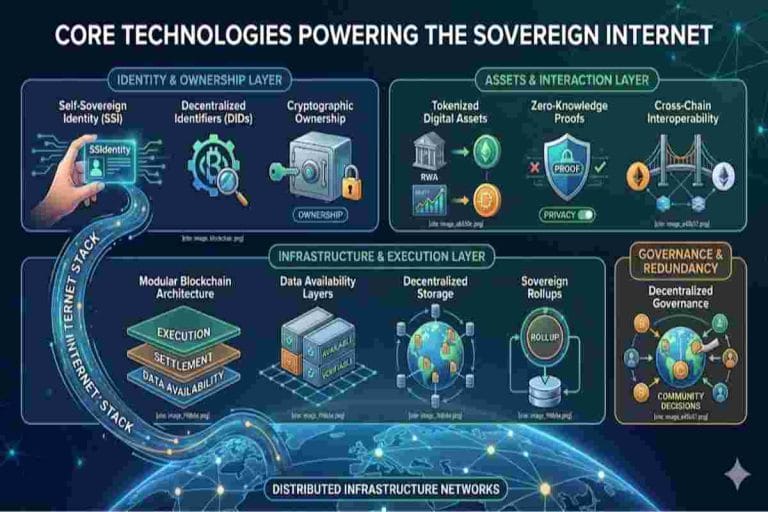
Modular Blockchain Architecture in 2026 represents the protocol layer of the Web3 Archetecture, connecting identity systems, interoperability frameworks, and value networks into a unified architecture. By leveraging layered blockchain infrastructure, composable blockchain modules, and multi-chain protocol architecture, enterprises and developers can build scalable, interoperable, and resilient Web3 applications. This evolution transforms blockchain from a single-utility tool into a coordinated, multi-functional infrastructure, ensuring that Web3 protocol interoperability serves as the backbone for global finance. In this new paradigm, the focus shifts from individual chain performance to the collective power of a synchronized, modular digital world, where assets and data operate seamlessly across the Sovereign Internet Stack.
To see how these layers fit into a professional roadmap, refer to our Web3 Development Guide (2026) for a full architectural deep dive.
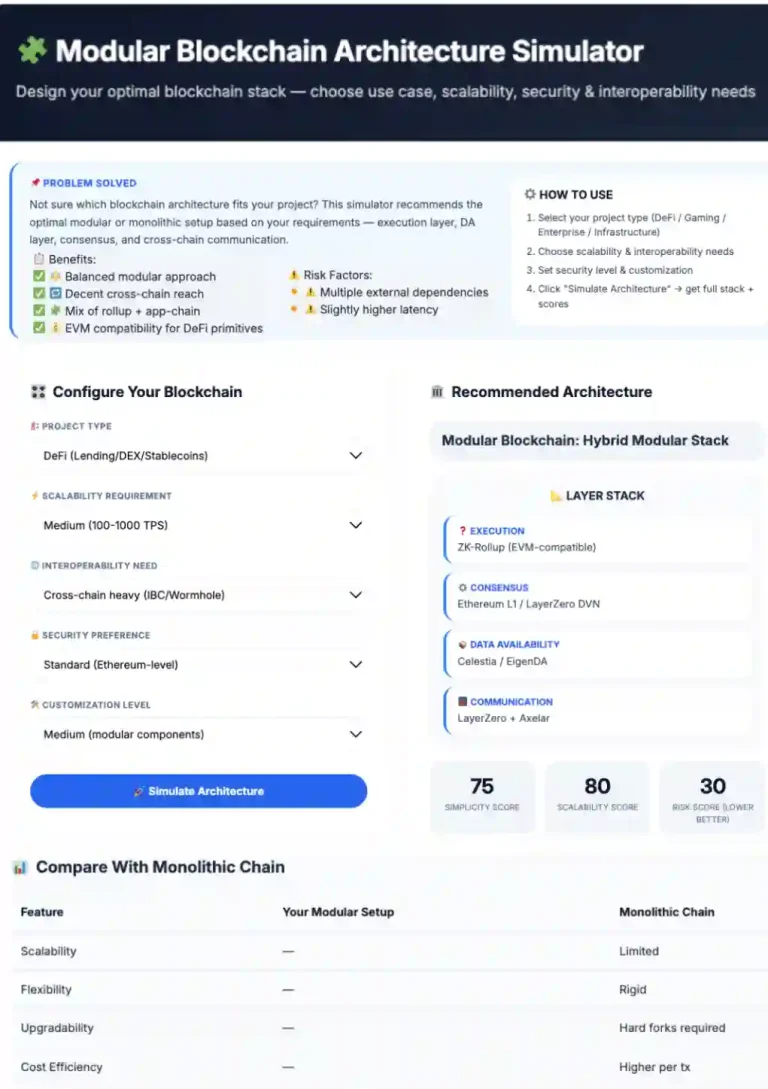
Table of Contents
ToggleModular Blockchain Architecture in 2026 represents the protocol layer of the Web3 Ecosystem, connecting identity systems, interoperability frameworks, and value networks into a unified architecture. By leveraging layered blockchain infrastructure, composable blockchain modules, and multi-chain protocol architecture, enterprises and developers can build scalable, interoperable, and resilient Web3 applications that operate seamlessly across the Sovereign Internet Stack.
The protocol layer is no longer just a set of rules for a single chain — it is the structural backbone that ensures modularity, composability, and multi-chain communication.
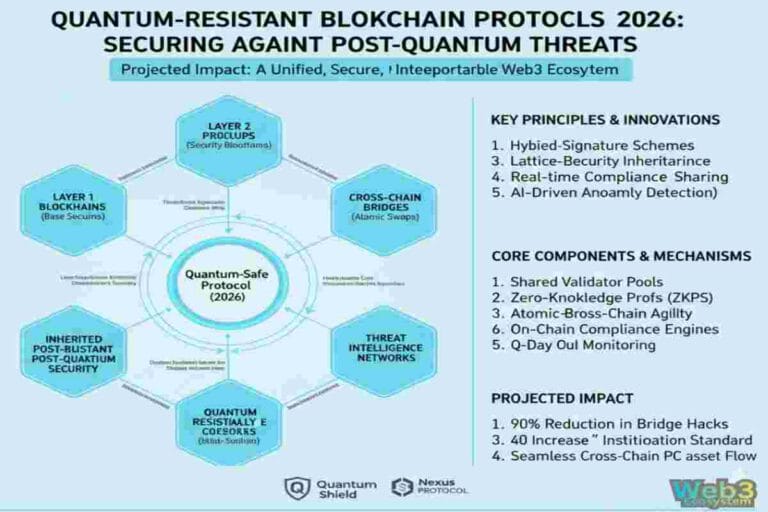
The Web3 protocol layer standardizes interactions across chains and applications. Its purpose is to:
A well-architected modular blockchain system reduces redundancy, improves scalability, and ensures that every component from the identity layer to the value layer works cohesively.
Composable blockchain modules allow enterprises to plug in specific capabilities (consensus, execution, messaging) into their protocol stack without redesigning the entire blockchain.
Key benefits:
| Component | Function | Example |
|---|---|---|
| Consensus Layer | Validates transactions | PoS, Tendermint, HotStuff |
| Execution Layer | Runs smart contracts | EVM, WASM, Solidity |
| Communication Layer | Handles cross-chain messaging | IBC, CCIP, LayerZero |
| Governance Layer | Manages protocol upgrades | On-chain voting, DAO governance |
| Security Layer | Validator incentives & protection | Slashing, staking, insurance modules |
| Feature | Monolithic Blockchain | Modular Blockchain Architecture |
|---|---|---|
| Scalability | Limited | High, composable |
| Flexibility | Low | High, plug-and-play modules |
| Interoperability | Poor | Native cross-chain support |
| Upgradeability | Hard | Easy, modular upgrades |
| Enterprise Adoption | Moderate | High |

The protocol layer is the bridge between identity, interoperability, and value networks.
These integrations ensure that modular blockchain architecture supports multi-chain composability and Sovereign Internet interoperability.
Enterprises adopting modular blockchain architectures should focus on:
This approach allows organizations to operate securely and efficiently across a multi-chain ecosystem while maintaining modular flexibility.
Even with modular designs, risks include:
A robust architecture requires careful selection of consensus, messaging, and execution modules to mitigate these risks.
The next generation of modular blockchain architectures will focus on:
By 2030, the protocol layer will be invisible to end-users but critical for enterprise-grade scalability, security, and multi-chain operations.
| Metric | 2024 | 2026 (Est.) | Growth |
|---|---|---|---|
| Modular blockchain deployments | 50 | 320+ | 6.4x |
| Multi-chain protocols in production | 8 | 28 | 3.5x |
| Cross-chain transaction throughput | 15M/month | 120M/month | 8x |
| Enterprise adoption | Moderate | Scaling rapidly | High |
Modular Blockchain Architecture in 2026 establishes the protocol layer that connects identity, interoperability, and value layers in the Web3 ecosystem. It is the structural foundation of multi-chain composability, enabling secure, scalable, and interoperable applications across the Sovereign Internet Stack.
By mastering the protocol layer, enterprises and developers gain architectural control, reduced friction, and future-proof scalability—turning modular blockchain systems into the backbone of the Web3 Ecosystem.
Modular Blockchain Architecture is essential to the Web3 stack, complementing our previous posts on ZK Identity Architecture in 2026 and Web3 Interoperability Architecture in 2026. Together, these layers form the Sovereign Internet Stack: Architecture of the Web3 Ecosystem.
For external references and technical standards: Ethereum Foundation → advancing composable protocol design
Welcome to OwnProCrypto (Own & Pro Crypto) — a next-generation Bitcoin and blockchain education platform where the science of finance meets the power of AI-driven automation.
Our mission is simple: to equip you with the knowledge, frameworks, and tools needed to make smarter financial and business decisions in the Web3 economy.
Beyond analysis, OwnProCrypto focuses on transparency, verifiable data, and practical frameworks that investors and builders can actually use. Our goal is not hype — but clear thinking, disciplined analysis, and long-term value creation in the decentralized economy.
Our Background: Salim (Sam) is the founder and lead researcher behind OwnProCrypto, a Web3 intelligence platform focused on crypto security, digital ownership, stablecoin systems, interoperability, and institutional blockchain infrastructure.
Crypto Tools & Analysis:
Crypto Fundamental Analysis Tool | Protocol Evaluation System | DeFi Risk Analysis Tools | Crypto Portfolio Dashboard | Token Risk vs Reward Tool
Guides:
Crypto Fundamental Analysis | Blockchain Project Evaluation | Tokenomics Analysis | DeFi Protocol Analysis | Capital Efficiency
© 2026 OwnProCrypto — Built for smarter crypto decisions