
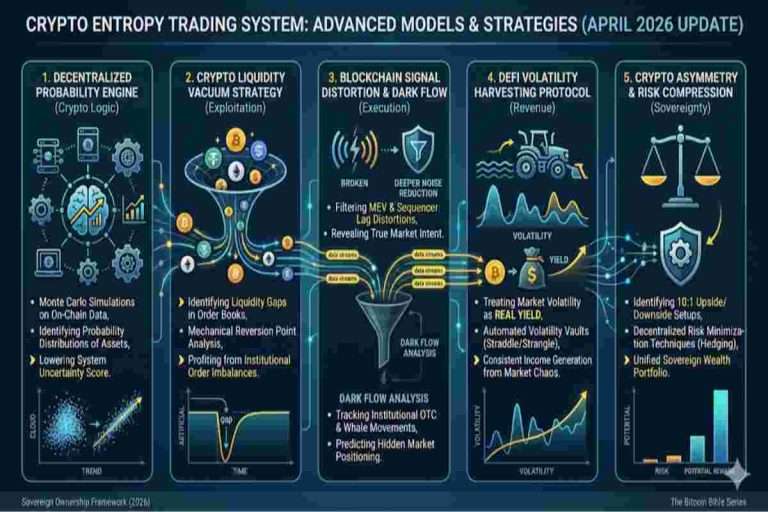
In April 2026, the crypto trading landscape has evolved with AI-driven agents, DeFi liquidity dynamics, and real-time market entropy tracking. The crypto entropy trading system has become an essential framework for institutional allocators, family offices, and sophisticated traders aiming to quantify uncertainty, identify high-probability trades, and exploit hidden liquidity flows. With the rise of decentralized probability engines, dark flow monitoring, and DeFi volatility harvesting protocols, understanding market entropy is no longer optional—it is core to capital efficiency and real yield generation.
This guide refreshes the core mechanics of entropy-based trading, combining probability modeling, liquidity vacuum strategies, blockchain signal distortion analysis, and risk compression techniques into a single, actionable framework for 2026.
Deep Dive: Digital Legacy 2026: Family Office Architecture for Generational Sovereignty

Table of Contents
ToggleEntropy in crypto trading measures disorder and randomness in price movements, quantifying uncertainty before trends emerge. Unlike conventional trading models, which assume linear patterns, entropy models capture hidden information decay, network delays, and on-chain irregularities. By doing so, traders can anticipate regime changes in markets before volatility spikes.
In 2026, entropy-based systems monitor DeFi liquidity vacuums, MEV-induced signal distortion, and dark flow activity. Traders can detect when markets shift from “ordered accumulation” to “disordered distribution,” allowing for pre-emptive entry or exit strategies.
Table: Entropy Signals vs Traditional Indicators
| Signal Type | Traditional Model | Entropy-Based Model | Benefit |
|---|---|---|---|
| Price Trend | Lagging | Real-time probabilistic | Early detection |
| Volume Shock | Observable | Probability weighted | Avoid false triggers |
| Liquidity Gap | Missed | Entropy identified | Exploit vacuums |
| Dark Flow | Not visible | Trackable | Anticipate whale activity |
Deep Dive: Artificial Intelligence Crypto in 2025: MEV, AI Agents & the Invisible Engines Powering the Market
A decentralized probability engine crypto framework uses off-chain computation powered by AI agents to run millions of simulations against real-time DEX and AMM data. Instead of predicting exact prices, it predicts probability distributions of liquidity settlements, optimizing both risk and execution efficiency.
Deep Dive:
The crypto liquidity vacuum strategy detects sudden gaps in order books or AMM pools, usually created by large institutional trades. These “vacuum zones” indicate potential mechanical reversion points.
Entries are triggered when vacuum thresholds exceed the standard deviation of historical liquidity, while exits align with restoration points.
Comparison Table: Vacuum Strategy vs Market Observation
| Metric | Retail Observation | Entropy-Based Vacuum |
|---|---|---|
| Reaction Speed | Slow | Real-time |
| Accuracy | Medium | High |
| Risk Mitigation | Low | Optimized |
Deep Dive: “AMM pools” → Web3 Development Guide (2026)
Market signals are distorted by MEV bots, sequencer delays, and cross-chain latency. This “noise” hides institutional intentions.
By filtering out distortions, traders can execute with higher precision and compliance, improving both risk-adjusted returns and on-chain strategy adherence.
Deep Dive: “MEV” → Artificial Intelligence Crypto: MEV & AI Agents
Dark flow tracks off-chain movements of large capital through private OTC desks and liquidity bridges.
AI-enabled monitoring of stablecoin issuance and cross-chain bridging reveals early positioning of institutional actors, giving traders a predictive edge.
Deep Dive: Blockchain Interoperability 2026: AI Agents & Universal Connectivity
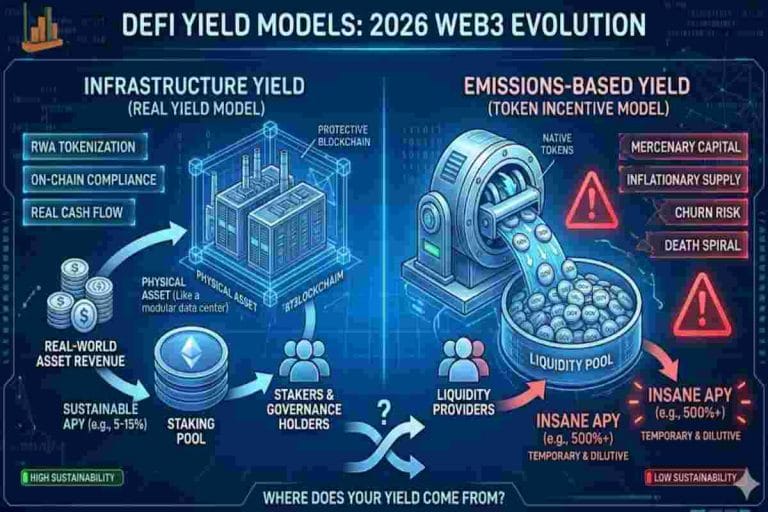
High volatility is converted into real yield through options vaults and automated straddle/strangle strategies.
Protocols trigger harvests when entropy spikes, turning periods of market chaos into predictable income streams.
Deep Drive: “options vaults” → RWA as DeFi Collateral: Unlocking $100B in Liquidity

Focuses on setups with capped downside but unlimited potential upside, often combined with RWA tokenization insights.
Early detection of undervalued assets or unrecognized DeFi opportunities allows institutional-level alpha capture.
Deep Drive: “DeFi opportunities” → Web3 Development Guide (2026)
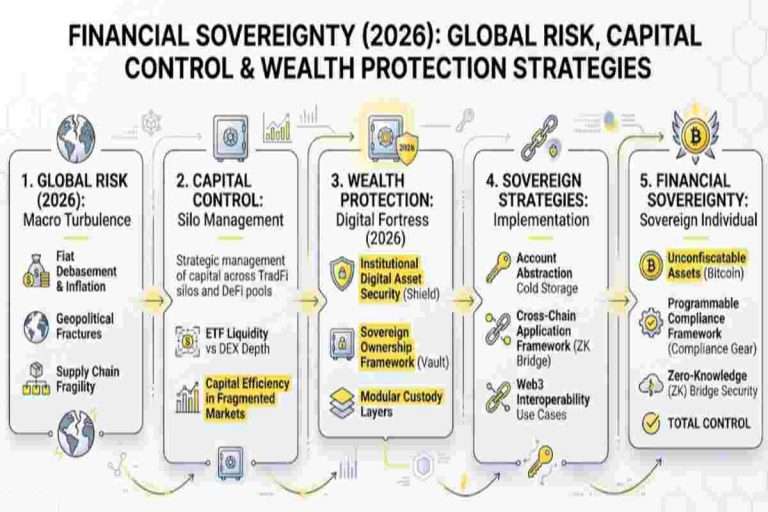
Cross-protocol hedges, paired with entropy-driven analytics, reduce exposure while maintaining upside.
By integrating account abstraction and decentralized risk compression, portfolios achieve resilience, survivability, and compliance.
Deep Drive: “cross-protocol hedges” → AI-Powered Multichain Oracles
An integrated approach uses:
This creates a modular system ready for AI agent deployment, institutional audit, and family office oversight.
| Problem | Objectives | Analysis / Situation | Implementation | Challenges | Results / Outcomes |
| Institutional “Slippage” during 2025 Market Re-balancing. | Capture 5% alpha on a $50M portfolio during a liquidity crunch. | Identified a Crypto Liquidity Vacuum following a major CEX outage where order books were thin. | Deployed a Decentralized Probability Engine to buy the “Air Pockets” at a 4% discount to fair value. | High gas fees on Ethereum L1 during the spike in network activity. | Achieved a 6.2% net gain in 48 hours; confirmed the Crypto Asymmetry Trading Model works in low-depth markets. |
| Problem | Objectives | Analysis / Situation | Implementation | Challenges | Results / Outcomes |
| Protocol-level insolvency due to Blockchain Signal Distortion. | Hedge a stablecoin-yielding position against a de-pegging event. | A DeFi Volatility Harvesting Protocol failed to recognize a “Dark Flow” exit by a major VC firm. | Attempted to use Decentralized Risk Compression through a single-chain hedge. | Signal Distortion hid the “Whale” exit until the liquidity was already gone. | Total Loss: $1.2M lost in 12 minutes. Rooted in Failure: Over-reliance on single-chain data and failure to monitor cross-chain dark pools. |
The 2026 crypto entropy trading system is no longer theoretical. By combining probability engines, liquidity vacuum strategies, signal distortion filtering, dark flow monitoring, and decentralized risk compression, traders can maximize alpha, real yield, and capital efficiency while mitigating systemic and counterparty risks.
Deep Drive “real yield” → RWA as DeFi Collateral: Unlocking $100B in Liquidity
For official guidance on digital asset regulations and compliance, refer to the U.S. Securities and Exchange Commission (SEC) website: https://www.sec.gov
Can a retail trader use a Crypto Entropy Trading System?
Yes, but retail traders require specialized “Agentic” tools. While institutions deploy the full DSARAE framework, retail users can apply the Crypto Asymmetry Trading Model, focusing on high-reward setups—typically 10:1 reward-to-risk—in emerging DeFi pools.
Is the Volatility Harvesting Protocol safe during a market crash?
No protocol is entirely risk-free, but volatility harvesting is generally safer than “long-only” strategies. By selling volatility, you earn premiums while the market moves. However, in high-entropy scenarios, rapid moves can push insurance costs above realized yield.
How do I identify a “Liquidity Vacuum”?
A liquidity vacuum occurs when prices shift sharply on very low volume, creating an “informational vacuum” with minimal value transfer.
What is market entropy in crypto trading?
Cryptocurrency market entropy quantifies uncertainty in price movements, helping traders filter low-confidence setups and anticipate regime changes before volatility spikes.
How do decentralized probability engines help?
They estimate probability distributions of liquidity settlements instead of exact prices, enabling high-confidence trade selection and optimized execution.
What role does blockchain signal distortion play?
Market signals can be distorted by MEV bots, sequencer delays, and cross-chain latency. Filtering these distortions enhances trade decision-making and reduces exposure to hidden market noise.
How does the system track dark flow?
Dark flow analysis monitors off-chain or hidden capital movements through private OTC desks or bridging activity, giving traders early predictive insights into large-scale positioning.
How does DeFi volatility harvesting generate yield?
By converting high volatility into real yield using options vaults or automated straddle/strangle strategies, traders can monetize market chaos with controlled risk.
What is the Crypto Asymmetry Trading Model?
It focuses on setups with high upside and limited downside, allowing early detection of undervalued assets or overlooked DeFi opportunities—ideal for both institutional and retail frameworks.
How does decentralized risk compression work?
Cross-protocol hedges combined with entropy-driven analytics reduce exposure while maintaining upside potential, creating resilient, survivable portfolios optimized for regulatory and market stress.
Additional Considerations:
Welcome to OwnProCrypto (Own & Pro Crypto) — a next-generation Bitcoin and blockchain education platform where the science of finance meets the power of AI-driven automation.
Our mission is simple: to equip you with the knowledge, frameworks, and tools needed to make smarter financial and business decisions in the Web3 economy.
Beyond analysis, OwnProCrypto focuses on transparency, verifiable data, and practical frameworks that investors and builders can actually use. Our goal is not hype — but clear thinking, disciplined analysis, and long-term value creation in the decentralized economy.
Our Background: Salim (Sam) is the founder and lead researcher behind OwnProCrypto, a Web3 intelligence platform focused on crypto security, digital ownership, stablecoin systems, interoperability, and institutional blockchain infrastructure.
Crypto Tools & Analysis:
Crypto Fundamental Analysis Tool | Protocol Evaluation System | DeFi Risk Analysis Tools | Crypto Portfolio Dashboard | Token Risk vs Reward Tool
Guides:
Crypto Fundamental Analysis | Blockchain Project Evaluation | Tokenomics Analysis | DeFi Protocol Analysis | Capital Efficiency
© 2026 OwnProCrypto — Built for smarter crypto decisions