
Search by title, topic or phrase
Use our Crypto Search Engine 🔍 to find the topics and keywords you're looking for.
Quick Answer: A Crypto Currency Converter Guide estimates the value of digital assets, such as Bitcoin (BTC) and Ethereum (ETH), in fiat currencies like USD or EUR, or in other cryptocurrencies, using current exchange rates. To estimate your conversion amount, select a currency pair, enter the quantity, and review any applicable trading fees, exchange spreads, and price fluctuations that could affect the final amount.
Converting digital assets into traditional money—or calculating how much cryptocurrency you can buy with fiat currency—is useful for traders, investors, and everyday crypto users. This Crypto Currency Converter Guide explains how to check conversion rates, estimate portfolio values, and compare currency pairs before making a transaction.
In this guide, you’ll learn how crypto-to-fiat exchange rates work, how to calculate conversions, which fees to consider, and how to use the OwnProCrypto converter to estimate values and make more informed decisions.

Table of Contents
ToggleA cryptocurrency converter is a tool that estimates the value of a specified amount of cryptocurrency in another currency. Depending on the currencies supported, it can convert digital assets into fiat money, convert fiat money into cryptocurrency, or calculate the equivalent value between two cryptocurrencies.
For example, you can use a crypto converter to estimate the US dollar value of 0.5 Bitcoin (BTC), determine how much Bitcoin corresponds to $1,000, or compare the value of Ethereum (ETH) with Bitcoin.
The calculation generally uses an exchange rate expressed as the value of one unit of the source currency in the destination currency.
Suppose a converter uses an illustrative rate of:
1 BTC = $60,000 USD
If you enter 0.25 BTC, the estimated equivalent is $15,000 USD before any applicable fees or other adjustments.
A converter can be useful when checking portfolio values, planning a potential purchase, comparing currency values, or understanding how a change in market price affects the value of your holdings.
It is important to distinguish between a conversion estimate and a completed transaction. A calculator may display an indicative value without buying, selling, transferring, or exchanging any funds. The exact amount available in an actual transaction can depend on the provider’s price, trading fees, spread, liquidity, and execution conditions.
The terms are often used interchangeably.
A crypto converter typically emphasizes exchanging the displayed value of one currency for another. A crypto calculator can describe a broader range of calculations, including conversion estimates, portfolio valuations, investment returns, and trading costs.
For example:
The most useful tool depends on what you want to calculate. If your goal is to determine the equivalent value of one currency in another, a cryptocurrency converter is generally the appropriate starting point.
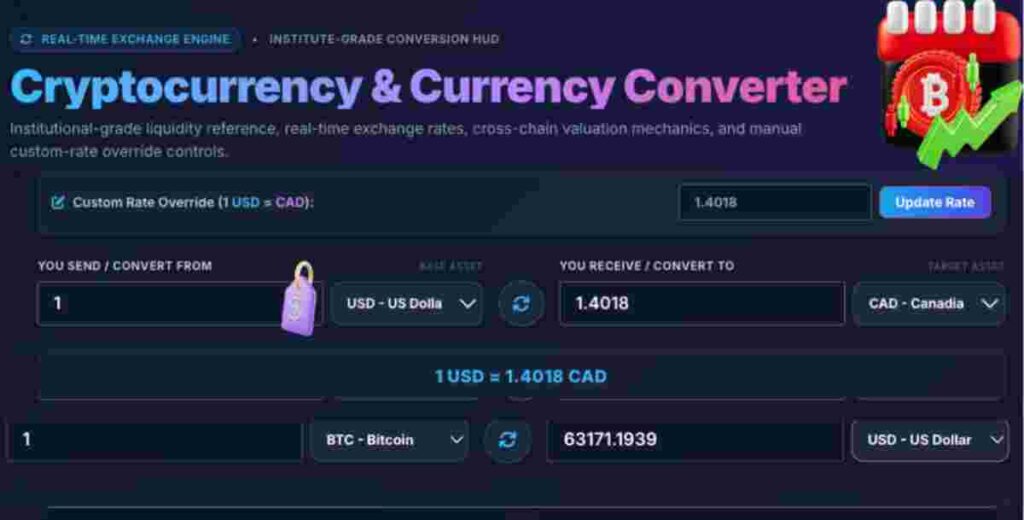
The OwnProCrypto converter is the tool to use when you want to calculate an estimated value between supported currencies. The following instructions describe the standard workflow for a currency converter; confirm that each step matches the published tool before using this section as a product-specific tutorial.
Navigate to the OwnProCrypto converter page.
Before entering an amount, check that the tool has loaded correctly and that the currency-selection controls are available.
If the converter displays information about its pricing source or last update, review it so you understand the basis of the result.
Choose the currency you want to convert from.
For example, select BTC if you want to calculate the fiat equivalent of Bitcoin. If you are starting with traditional money, choose the relevant fiat currency, such as USD or EUR.
Always verify the currency symbol and ticker. Similar names or symbols can refer to different assets.
Enter the amount you want to convert.
You might enter 0.1 BTC, 1 BTC, or a fiat amount such as $500, depending on the conversion you are performing.
Use a valid numerical amount and check the decimal separator. Some interfaces use a period for decimal values, while others may follow regional formatting conventions.
Choose the currency in which you want to see the result.
For example, if you selected BTC as the source, you might choose USD as the destination. For a crypto-to-crypto calculation, choose another supported cryptocurrency.
The source and destination selections determine the direction of the conversion.
Review the displayed amount and verify that it corresponds to your intended currency pair.
For a more informed interpretation, check the displayed exchange rate and any available information about price sources, timestamps, or calculation assumptions.
If the result is being used to plan a transaction, remember that the estimate may exclude costs or differ from the price offered by a trading platform.
If the interface offers a reverse or swap control, you can use it to switch the source and destination currencies.
For example, reversing BTC-to-USD changes the direction to USD-to-BTC.
The reciprocal conversion should be consistent with the same underlying rate before rounding and other adjustments. However, if the tool uses different buy and sell rates, or updates its data between calculations, the displayed results may not be exact mathematical inverses.
A displayed conversion estimate should not be treated as a guaranteed transaction price unless the provider explicitly offers an executable quote with stated terms.
If you plan to buy or sell cryptocurrency, check the relevant platform’s final order preview, applicable fees, and expected net amount before confirming the transaction.
The OwnProCrypto converter can help you understand the estimated value. The final transaction terms depend on the service through which the transaction is executed.
For consistent results, follow a few simple habits:
If the displayed rate seems unusual, check the currency pair and reference price before assuming the converter is incorrect.
Manual conversion is useful when you know the exchange rate and only need to perform a simple calculation. An online calculator can be more convenient when you want to test multiple amounts, switch currency pairs, or check a rate that changes frequently.
A calculator may also reduce arithmetic mistakes and help you compare values without repeatedly applying formulas.
However, an online tool is not automatically more accurate than a manual calculation. Its accuracy depends on the underlying data, update process, and implementation of the conversion formula.
The best approach is to use a reliable calculator for convenience while understanding how its rate and result are produced.
A converter and an exchange serve different purposes.
A converter estimates the value of one currency in another. A cryptocurrency exchange provides a marketplace or transaction service through which users may be able to buy, sell, or trade supported assets.
| Capability | Crypto converter | Cryptocurrency exchange |
|---|---|---|
| Estimate currency values | Yes, if the pair is supported | Often |
| Execute trades | Not necessarily | Yes, where trading is supported |
| Display order books | Usually not required | Often available |
| Apply trading fees | Depends on the tool’s function | Usually governed by the platform’s fee structure |
| Guarantee an indicative estimate | No | A submitted order may execute at a different price |
| Require an account | Depends on the tool | Often required for trading |
Use a converter when you want to estimate an amount or understand a currency pair. Use a suitable trading platform when you intend to execute a transaction, after reviewing its terms and availability in your jurisdiction.
The currencies available depend on the converter and its underlying price data. Most cryptocurrency conversion tools focus on three main types of conversion.
This conversion estimates the value of a digital asset in a traditional currency.
Common examples include:
These calculations help users understand the fiat value of their cryptocurrency holdings.
For example, someone holding 0.1 BTC may want to estimate its value in dollars before deciding whether to sell, hold, or compare prices across platforms.
The displayed value is an estimate unless the tool provides a firm, executable transaction quote.
The reverse conversion estimates how much cryptocurrency corresponds to a specified amount of traditional money.
Examples include:
Suppose Bitcoin is priced at an illustrative $60,000 and you enter $1,500 into a USD-to-BTC calculator.
The estimated amount is:
$1,500 ÷ $60,000 = 0.025 BTC
This calculation does not automatically purchase Bitcoin. It shows the approximate amount corresponding to the assumed exchange rate before applicable costs.
A converter may also compare one digital asset with another.
Examples include:
These conversions are useful when comparing the relative value of digital assets or estimating the amount of one cryptocurrency equivalent to another.
The conversion may be calculated using a direct trading pair or by deriving a cross-rate from another market, depending on the tool’s methodology.
Some cryptocurrency converters also support traditional currency pairs, such as USD to EUR or EUR to GBP.
These conversions use fiat exchange rates rather than relying exclusively on cryptocurrency prices.
A tool that supports both fiat and cryptocurrency conversions can be convenient when comparing the value of a digital asset across different national currencies.
Before using a converter, check which currencies and trading pairs it actually supports. A currency’s inclusion in a general list does not necessarily mean that every possible pair is available.
A crypto currency converter can simplify calculations that would otherwise require looking up an exchange rate and applying the correct formula manually.
Its usefulness extends beyond checking the price of Bitcoin.
If you own Bitcoin, Ethereum, or another supported digital asset, a converter can help you estimate its value in a fiat currency.
For instance, if you hold 0.4 ETH and the assumed price is $3,000 per ETH, the estimated value is:
0.4 × $3,000 = $1,200
The result changes when the underlying price changes. A conversion tool makes it easier to recalculate the value without repeating the arithmetic yourself.
Before buying cryptocurrency, you may want to know how much of an asset corresponds to your available budget.
A fiat-to-crypto conversion helps you estimate the quantity before you review the actual quote and transaction costs on your chosen platform.
This can make it easier to compare different purchase amounts and understand fractional cryptocurrency quantities.
Cryptocurrency converters can help compare assets that trade at very different nominal prices.
For example, one Bitcoin may be worth thousands of dollars while one unit of another cryptocurrency may be worth considerably less. Comparing a fixed dollar amount or a fixed portfolio value provides more meaningful information than looking at the unit prices alone.
A lower unit price does not automatically mean that an asset is cheaper relative to its potential value or that it is a better investment.
Cryptocurrency prices can fluctuate significantly. Recalculating the value of a holding at different hypothetical prices helps illustrate how market movements affect its fiat equivalent.
A converter is particularly useful for answering questions such as:
Remember that an estimated conversion is not a forecast of future prices.
Manual conversions are straightforward when the rate is known, but errors can occur when you use the wrong exchange-rate direction, misplace a decimal point, or round too early.
A reliable calculator can reduce these arithmetic mistakes. However, it cannot compensate for an outdated price feed, an unsupported currency pair, or an incorrect input.
The result is only as useful as the rate and calculation method behind it.
A traditional currency converter calculates the equivalent value of one fiat currency in another. A cryptocurrency converter performs a similar calculation but may also handle digital assets whose market prices can change continuously.
The underlying arithmetic is similar, but the markets and practical considerations differ.
| Feature | Cryptocurrency converter | Traditional currency converter |
|---|---|---|
| Common currencies | BTC, ETH, and other supported crypto assets | USD, EUR, GBP, and other fiat currencies |
| Price drivers | Crypto market supply and demand, liquidity, sentiment, and broader market conditions | Interest rates, economic conditions, monetary policy, and currency-market supply and demand |
| Price behavior | Can experience substantial short-term volatility | Also fluctuates, but behavior depends on the currency pair and market conditions |
| Data sources | Crypto exchanges, market-data providers, or other supported pricing sources | Banks, financial data providers, currency markets, or other reference sources |
| Transaction costs | May include trading fees, spreads, network fees, and other charges | May include provider spreads, bank fees, or transfer charges |
| Typical uses | Portfolio valuation, crypto conversion estimates, and transaction planning | Travel, international payments, remittances, and currency comparisons |
Not every converter uses the same source or pricing methodology. A reference-rate tool may display a different figure from a bank, exchange, or payment provider even when all are calculating the same currency pair.
Cryptocurrencies trade on markets with different levels of liquidity, and their prices can respond rapidly to changes in buying and selling activity.
A major news event, a large order, changing market sentiment, or differences between exchanges can influence the displayed price.
Fiat exchange rates can change too, but cryptocurrency markets often experience sharper short-term movements. This makes it especially important to understand when a crypto conversion rate was updated and whether it is an indicative price or a transaction quote.
Converting cryptocurrency to fiat currency means calculating the equivalent value of a digital asset in a traditional currency, such as USD or EUR.
The basic process is simple: identify the amount of cryptocurrency, find the applicable exchange rate, and multiply the amount by that rate.
Choose the digital asset you want to value, such as Bitcoin (BTC) or Ethereum (ETH).
Make sure you select the correct asset and ticker symbol. Some tokens have similar names, and selecting the wrong asset can produce a misleading result.
Select the currency in which you want to see the value, such as US dollars (USD), euros (EUR), or British pounds (GBP).
The destination currency matters because the displayed value depends on the relevant exchange rate.
Enter the amount you want to convert.
You can use a whole-number amount, such as 1 BTC, or a fractional amount, such as 0.015 BTC. Bitcoin is divisible into smaller units, so you do not need to own an entire Bitcoin to calculate its value.
Multiply the cryptocurrency amount by the fiat value of one unit of that cryptocurrency.
The formula is:
Fiat value = Cryptocurrency amount × Crypto-to-fiat exchange rate
For example, assume the rate used by the converter is:
1 BTC = $60,000
To calculate the value of 0.15 BTC:
0.15 × $60,000 = $9,000
The estimated value is $9,000 before transaction costs or differences between the reference rate and an executable quote.
Check the displayed amount, currency symbols, exchange-rate direction, and any available timestamp or pricing information.
If you are using the result to plan a sale, remember that the amount received may differ from the estimate. A platform may apply a spread or trading fee, and the market price can move before your order executes.
Assume the following illustrative inputs:
Calculation:
0.08 × $62,500 = $5,000
The estimated fiat equivalent is $5,000.
If the actual selling price is lower than the reference rate, or the transaction incurs fees, the net proceeds may be less than $5,000.
This is why a converter is useful for estimating value, while an exchange’s order preview or trade confirmation is more relevant when determining the amount available from an actual sale.
Fiat-to-crypto conversion works in the opposite direction. Instead of multiplying a cryptocurrency amount by its fiat price, you divide the fiat amount by the price of one unit of the cryptocurrency.
This calculation helps estimate how much cryptocurrency corresponds to a specific budget.
Choose the currency you want to start with, such as USD or EUR.
Enter the amount you want to evaluate. For example, you might use $500, $1,000, or $2,500.
The purpose is to calculate the approximate cryptocurrency equivalent, not to assume that a purchase has already taken place.
Choose the destination asset, such as BTC or ETH.
Check the ticker symbol carefully to ensure that you are calculating the intended asset.
Use the following formula:
Cryptocurrency amount = Fiat amount ÷ Price per cryptocurrency unit
Suppose Bitcoin is priced at an illustrative $50,000 per BTC and you want to calculate the equivalent of $1,000.
$1,000 ÷ $50,000 = 0.02 BTC
The estimated amount is 0.02 BTC before applicable costs.
A calculator may show the quantity corresponding to the reference price without accounting for trading fees, spreads, or other costs.
If you are planning an actual purchase, review the provider’s quote and the net quantity you would receive.
Some platforms charge fees separately, while others incorporate some costs into their quoted exchange rate. The precise treatment depends on the provider.
Assume:
Calculation:
$2,000 ÷ $80,000 = 0.025 BTC
At the assumed price, $2,000 corresponds to 0.025 BTC.
If the price changes to $85,000 per BTC, the same $2,000 corresponds to approximately 0.023529 BTC before costs.
This illustrates an important principle: when the price per unit rises, a fixed amount of fiat currency corresponds to a smaller quantity of cryptocurrency, all else being equal.
No. A conversion calculator estimates the equivalent amount of cryptocurrency. A purchase involves a transaction with a platform or another party.
An actual purchase may require identity verification, account funding, and compliance with the provider’s rules and applicable laws. It can also involve fees, spreads, minimum purchase amounts, and other restrictions.
Use a converter to understand the estimated value. Use the relevant provider’s transaction interface to review the actual terms of a purchase.
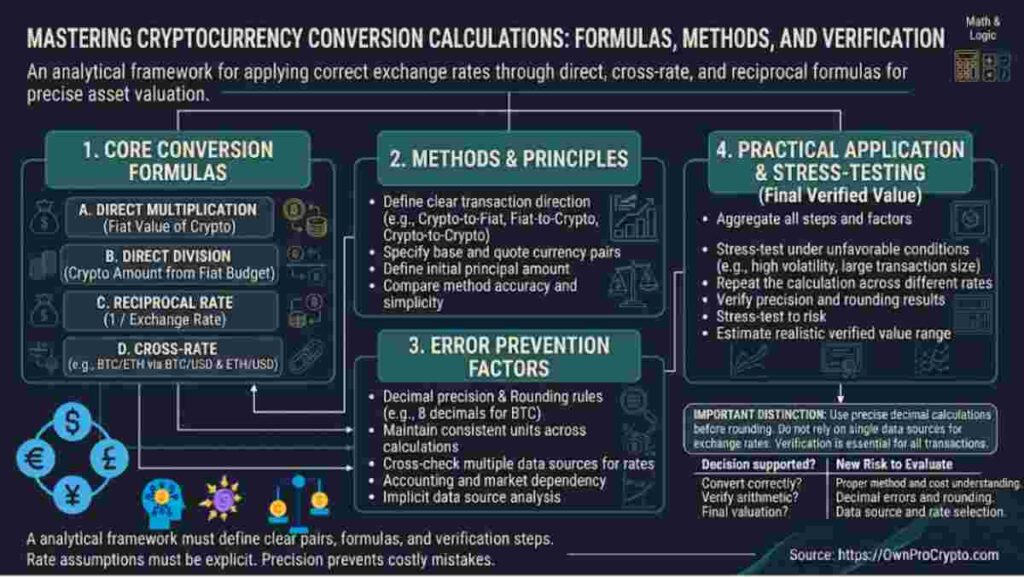
o convert one currency into another, multiply or divide by the appropriate exchange rate, depending on how the rate is quoted. For example, converting cryptocurrency into fiat currency generally involves multiplying the cryptocurrency amount by its fiat price, while converting fiat currency into cryptocurrency involves dividing the fiat amount by the cryptocurrency price.
Always check the currency pair and rate direction before calculating. For detailed formulas, reciprocal exchange rates, cross-rate calculations, and worked examples, read our guide to cryptocurrency conversion formulas and calculations.
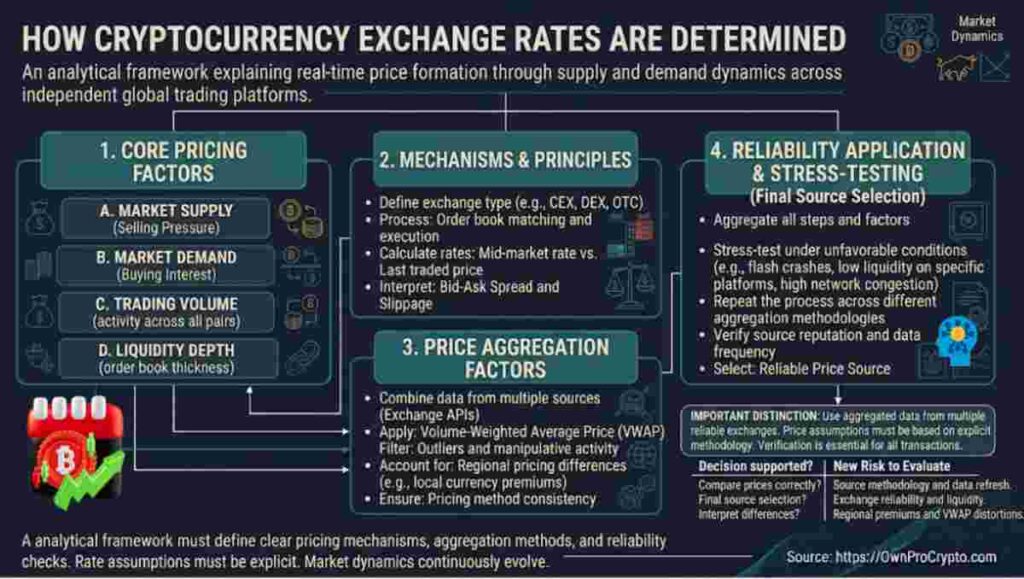
A cryptocurrency converter uses an exchange rate to estimate the value of one currency in another. The result depends on the selected currency pair, the amount entered, and the rate available from the provider. For example, converting Bitcoin to USD requires the Bitcoin-to-dollar rate, while converting USD to Bitcoin uses the corresponding rate in the reverse direction.
Cryptocurrency prices can vary between platforms because of differences in market liquidity, trading activity, data sources, and rate-update frequency. As a result, two converters may display slightly different estimates for the same currency pair.
When using a converter, check which rate is being used and when it was last updated. For a deeper explanation of market prices, mid-market rates, VWAP, and cross-exchange price differences, see our guide to [how cryptocurrency market prices and exchange rates are determined].
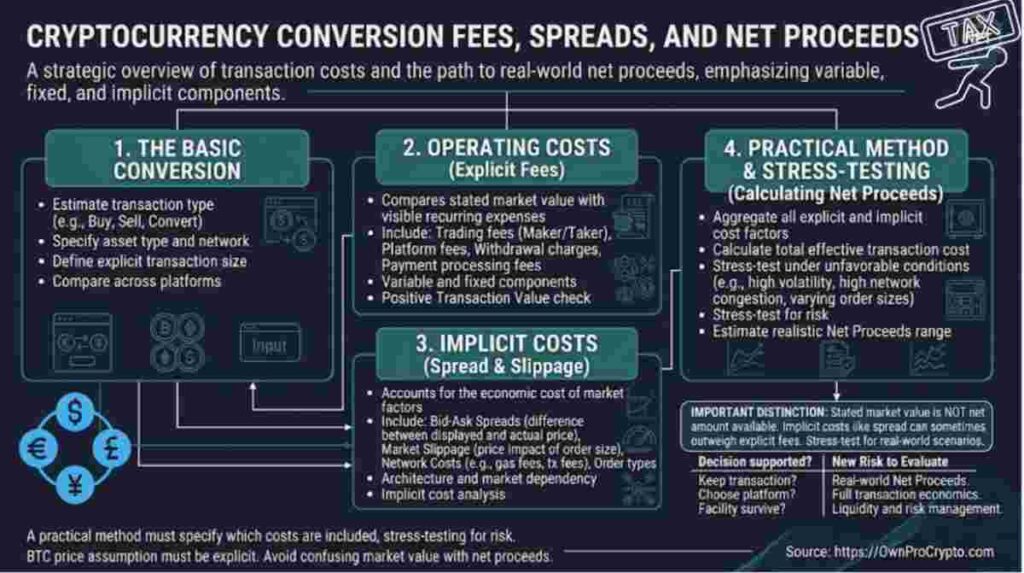
The exchange rate determines the estimated value of a currency conversion, but it does not always represent the final amount you will receive in a transaction. Depending on the provider and transaction method, additional costs may include trading fees, bid-ask spreads, conversion margins, withdrawal charges, and blockchain network fees.
Before completing a transaction, review the quoted rate, any applicable fees, and the estimated amount after costs. Comparing the total cost rather than the headline exchange rate can help you make a more informed decision.
For a detailed explanation of cryptocurrency trading fees, spreads, slippage, and net proceeds, read our guide to [cryptocurrency conversion costs and fees].
Worked examples show how conversion formulas operate in different directions. The following examples use hypothetical exchange rates for educational purposes, not live market prices.
Actual results depend on the applicable rate, the time of calculation, the pricing source, and any transaction costs.
Suppose you want to estimate the US dollar value of 0.25 BTC.
Assume the reference price is:
1 BTC = $60,000
Step 1: Identify the amount of Bitcoin.
0.25 BTC
Step 2: Identify the BTC/USD rate.
$60,000 per BTC
Step 3: Multiply the amount by the rate.
0.25 × $60,000 = $15,000
Result: At the assumed rate, 0.25 BTC corresponds to $15,000 before applicable costs.
If Bitcoin’s price changes, the estimated dollar value changes as well. If you intend to sell the Bitcoin, the amount actually received may differ because of execution prices, fees, and other costs.
Suppose you want to calculate the euro value of 0.1 BTC.
Assume the reference rate is:
1 BTC = €55,000
The calculation is:
0.1 × €55,000 = €5,500
Result: At the assumed rate, 0.1 BTC corresponds to €5,500 before applicable costs.
The EUR value of Bitcoin depends on the relevant BTC/EUR rate. It should not be assumed that a USD price can be converted into EUR using a fixed relationship, because the USD/EUR exchange rate also changes.
Suppose you have $1,500 and want to estimate how much Bitcoin corresponds to that amount.
Assume:
1 BTC = $60,000
The formula is:
BTC amount = USD amount ÷ BTC price in USD
Substituting the values:
$1,500 ÷ $60,000 = 0.025 BTC
Result: $1,500 corresponds to 0.025 BTC at the assumed rate, before applicable costs.
If you intend to purchase Bitcoin, the actual quantity received may be lower after fees or if the executed price differs from the reference price.
Suppose you want to estimate how much Bitcoin corresponds to €2,000.
Assume:
1 BTC = €50,000
The calculation is:
€2,000 ÷ €50,000 = 0.04 BTC
Result: At the assumed rate, €2,000 corresponds to 0.04 BTC before applicable costs.
The important point is to use the BTC price expressed in euros. If you begin with a USD price instead, you must first account for the USD/EUR exchange rate.
Crypto-to-crypto conversion follows the same general principle.
Suppose the assumed reference prices are:
To calculate the implied ETH-to-BTC rate, divide the ETH price by the BTC price:
$3,000 ÷ $60,000 = 0.05 BTC per ETH
If you have 4 ETH, the estimated equivalent is:
4 × 0.05 = 0.2 BTC
Result: At the assumed reference prices, 4 ETH corresponds to 0.2 BTC before applicable costs.
This is an implied cross-rate. A direct ETH/BTC market may quote a different executable price because of differences in market conditions, liquidity, timing, and trading costs.
The examples illustrate three core principles.
First, converting from cryptocurrency to fiat generally involves multiplying the cryptocurrency amount by the fiat price per unit.
Second, converting from fiat to cryptocurrency generally involves dividing the fiat amount by the cryptocurrency price expressed in that fiat currency.
Third, converting between two cryptocurrencies requires an exchange rate for the relevant pair, whether quoted directly or derived from compatible reference prices.
The formulas are straightforward, but choosing the correct exchange rate is essential. The result also needs to be interpreted in light of the source, timestamp, rounding method, and any transaction costs.
To get a reliable conversion estimate, select the correct source and destination currencies, check that the exchange rate is current, and make sure the rate matches the direction of your conversion. Use sufficient decimal precision during calculations and round only the final displayed result when possible.
Remember that a converter provides an estimate based on the rate and information available to it. Transaction fees, spreads, market movements, and provider-specific limits may affect the amount ultimately received. Review these details before making a transaction, and avoid treating an estimated conversion value as a guaranteed execution price.
For additional guidance, explore our resources on [cryptocurrency exchange rates], [conversion fees and net proceeds], and [cryptocurrency calculation methods].
Even a simple conversion can produce a misleading result when the wrong inputs or assumptions are used.
Some cryptocurrencies have similar names or ticker symbols. Selecting the wrong asset or fiat currency can lead to an incorrect result.
Always verify the full asset name and symbol before using a displayed amount.
Calculating that $1,000 corresponds to a certain amount of BTC does not mean you have purchased that Bitcoin.
A calculator provides an estimate unless it explicitly forms part of a transaction service. Buying, selling, and transferring assets involve additional steps and conditions.
The displayed market value may not equal the net amount you receive.
Trading fees, provider spreads, withdrawal charges, and network fees can affect the final result. Review the relevant transaction terms rather than assuming that the calculator’s displayed value is the amount you will receive.
Different converters can use different price sources, market observations, and calculation methods.
Compare their methodologies and timestamps before concluding that one result is incorrect.
A price that was accurate earlier may no longer represent current market conditions.
For time-sensitive calculations, check the last-updated information where available and recalculate before relying on the estimate.
Crypto-to-fiat values can change because of movements in the cryptocurrency market, the fiat currency market, or both.
For example, the EUR value of Bitcoin can change even if you are also monitoring its USD price, because the USD/EUR rate can move independently.
Rounding intermediate values can create small differences between your manual calculation and a converter’s result.
Retain adequate precision during the calculation and round the final output consistently.
Some exchanges and payment providers impose minimum or maximum transaction amounts, withdrawal limits, or account-specific restrictions.
A converter may calculate an amount that a particular service cannot execute under its current terms.
Before proceeding, check the limits and requirements of the provider you intend to use.
A cryptocurrency converter makes it easier to understand the value of digital assets in fiat currencies and to compare one cryptocurrency with another. By applying an exchange rate to a specified amount, it can simplify calculations that would otherwise require manual arithmetic.
However, a useful conversion involves more than the final number. The selected currency pair, pricing source, update time, calculation direction, rounding method, and potential transaction costs all affect how the result should be interpreted.
Understanding these factors helps you distinguish an indicative conversion from an executable trade and compare results more meaningfully across different tools and platforms.
The OwnProCrypto converter can serve as a practical starting point for estimating currency values, provided its supported currencies, pricing methodology, and displayed results are clearly explained. Check the rate and assumptions behind the calculation, and review the relevant provider’s terms before making an actual transaction.
The goal is not simply to obtain a number. It is to understand what that number represents and how to use it appropriately.
How to Convert Cryptocurrency to Fiat Currency
A cryptocurrency converter is an online tool that calculates the equivalent value of one cryptocurrency or fiat currency in another supported currency. It helps users estimate cryptocurrency values in traditional currencies, calculate potential crypto amounts, and compare currency values.
A cryptocurrency converter helps users check the fiat value of digital assets, estimate how much cryptocurrency corresponds to a specific amount of money, compare exchange rates, and calculate equivalent values across supported currency pairs.
Many online cryptocurrency converters offer basic conversion calculations for free. Availability of additional features may vary by provider, so check the tool’s terms and functionality for any limitations.
The terms are often used interchangeably. A coin converter generally calculates the value of supported digital coins, while a crypto converter may also support tokens, stablecoins, and fiat currencies.
Yes. A combined crypto and currency converter can support cryptocurrency-to-fiat, fiat-to-cryptocurrency, cryptocurrency-to-cryptocurrency, and fiat-to-fiat conversions, depending on the available currency pairs.
Not necessarily. Some online converters allow users to calculate currency values without registering, while others may require an account for additional features or services.
Select Bitcoin (BTC) as the source currency, enter the amount, and choose US dollars (USD) as the destination currency. The converter uses the available BTC-to-USD exchange rate to calculate the estimated dollar value.
Select Ethereum (ETH) as the source currency and euros (EUR) as the destination. Enter the amount of ETH and review the estimated euro value using the available exchange rate, provided the currency pair is supported.
Yes, provided the converter supports the selected cryptocurrency and destination currency. Choose the asset and fiat currency, enter the amount, and review the estimated equivalent value.
Multiply the amount of cryptocurrency by its price in the target fiat currency. For example, if a cryptocurrency is priced at $2,000 per coin, 0.5 coins would have an estimated value of $1,000 before any applicable fees or spreads.
Yes. Bitcoin can be divided into smaller units, so you can calculate the value of amounts such as 0.1 BTC, 0.01 BTC, or smaller fractions, depending on the converter’s supported input and display precision.
Not necessarily. The displayed value is an estimate based on the applicable rate. The final amount may differ because of execution prices, spreads, trading fees, liquidity, and other transaction costs.
No. A converter calculates an equivalent value but does not affect market prices or execute a transaction. Cryptocurrency prices change in response to market activity independently of the calculation.
The estimated amount depends on the BTC-to-USD exchange rate. Divide $100 by the applicable Bitcoin price to calculate the estimated BTC quantity before fees. For example, at a hypothetical BTC price of $50,000, $100 would equal 0.002 BTC before applicable costs.
Select US dollars (USD) as the source currency and Bitcoin (BTC) as the destination asset. Enter the dollar amount to calculate the estimated Bitcoin equivalent using the available conversion rate.
Yes, if the converter supports the selected fiat currency and cryptocurrency pair. Choose your source currency, select the destination cryptocurrency, enter the amount, and review the estimated result.
Select your fiat currency as the source and Ethereum (ETH) as the destination. Enter the amount you want to convert. The estimated ETH quantity depends on the applicable ETH price and exchange rate.
No. A converter estimates the equivalent value of a currency amount in cryptocurrency. Buying cryptocurrency requires an actual transaction through a supported exchange, broker, or other service, where execution prices and applicable fees may affect the final amount.
Yes. A fiat currency converter can calculate equivalent values between supported national currencies, such as USD to PKR, USD to INR, EUR to USD, or GBP to INR. Select the source and destination currencies, enter the amount, and review the result.
Different providers may use different exchange-rate sources, pricing times, spreads, and fees. A converter may display a reference or mid-market rate, while a bank or payment service may apply its own buying or selling rate.
Yes. A converter can help estimate the currency equivalent before making an international payment. However, the final amount received may differ because of the provider’s exchange rate, transaction charges, and intermediary fees.
A cryptocurrency conversion calculator applies the exchange rate for a selected currency pair to the amount entered. For a straightforward conversion, the estimated target amount is calculated by multiplying the source amount by the applicable rate, provided the rate is quoted in the correct direction.
That depends on the provider and its pricing sources. Some converters refresh frequently, while others update at scheduled intervals or use delayed data. Check the available rate information and update timestamp when accuracy is important.
Cryptocurrency prices fluctuate with market supply and demand, trading activity, and liquidity. Conversion estimates may also change because of differences in pricing sources, rate-update frequency, and provider-specific spreads or charges.
No. Results may differ because of the price sources, exchange coverage, update frequency, market liquidity, and rounding precision used by each provider. Check the rate information and calculation assumptions when comparing results.
A cryptocurrency price expresses the value of a digital asset in a particular currency, such as the price of BTC in USD. A conversion rate is used to translate an amount from one currency or asset into another.
Not necessarily. Some converters calculate an estimated value using the exchange rate alone, while others may include certain charges. Review the tool’s disclosures to understand what the displayed result includes before making a transaction.
No. A converter calculates the estimated equivalent value of one currency in another, while a cryptocurrency exchange facilitates buying, selling, or trading digital assets. Some platforms provide both functions, but a conversion estimate does not automatically execute a trade.
Select the source cryptocurrency or fiat currency, choose the destination currency, and enter the amount you want to convert. Review the calculated result and any available exchange-rate information. You can reverse the currency pair when you want to estimate the conversion in the opposite direction.
No. A calculated conversion is an estimate, not a guarantee of an executable trade or payment amount. The final result may depend on the execution price, liquidity, fees, spreads, and timing of the transaction.
Yes. A currency converter helps beginners understand the relationship between cryptocurrency amounts and traditional currency values without performing every calculation manually. Users should still review the applicable rate and any transaction costs before making financial decisions.
The accuracy of a conversion estimate depends on the underlying pricing data, its update frequency, and the calculation method used. When evaluating a converter, review its stated data sources, rate methodology, and any available timestamps or pricing disclosures.
Calculations utilize volume-weighted spot pricing standardizing with CoinGecko Institutional Data Feeds and foreign exchange benchmarks aligned with the Bank for International Settlements (BIS).
Vertical flow diagram detailing content relationships, topic, and interactive tool integration.
Houses the primary converter utility, core valuation formulas, and overarching domain guidance.