
Search by title, topic or phrase
Use our Crypto Search Engine 🔍 to find the topics and keywords you're looking for.
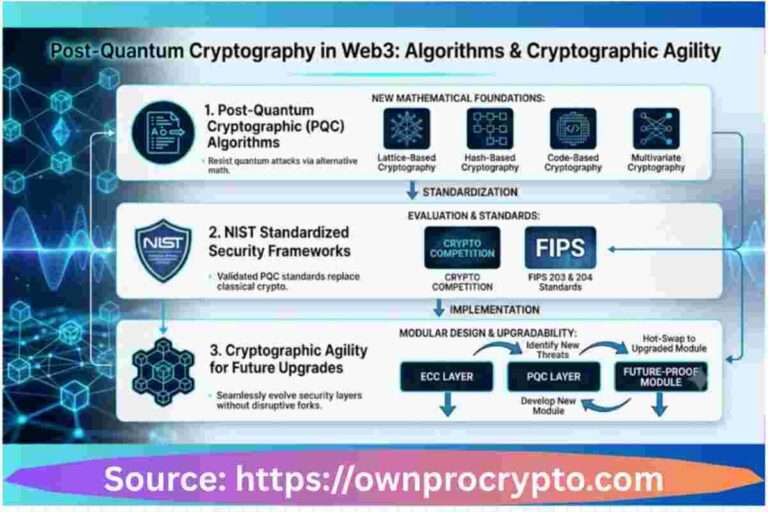
Table of Contents
ToggleBlockchain technology was built on a simple but powerful idea: digital ownership without centralized control.
From Bitcoin wallets to decentralized finance protocols, Web3 networks depend on cryptography to prove who owns assets, who can authorize transactions, and which participants are allowed to secure the network.
For more than a decade, blockchain infrastructure has relied on classical cryptographic algorithms such as Elliptic Curve Cryptography (ECC), ECDSA, and Ed25519. These systems are extremely efficient against today’s computers, but they were never designed for the computational capabilities of future quantum machines.
Post-quantum cryptography (PQC) represents the next security evolution for Web3. Instead of relying on mathematical problems vulnerable to quantum algorithms, PQC uses alternative cryptographic foundations designed to remain secure against both classical and quantum computing attacks.
The transition to quantum-resistant blockchain systems depends on understanding three core concepts:
Together, these technologies form the foundation of the next generation of blockchain security.

Modern blockchain networks use asymmetric cryptography.
A user generates:
The relationship looks simple:
Private Key
     ↓
Digital Signature
     ↓
Public Blockchain Verification
The security assumption is that calculating a private key from a public key is computationally impossible.
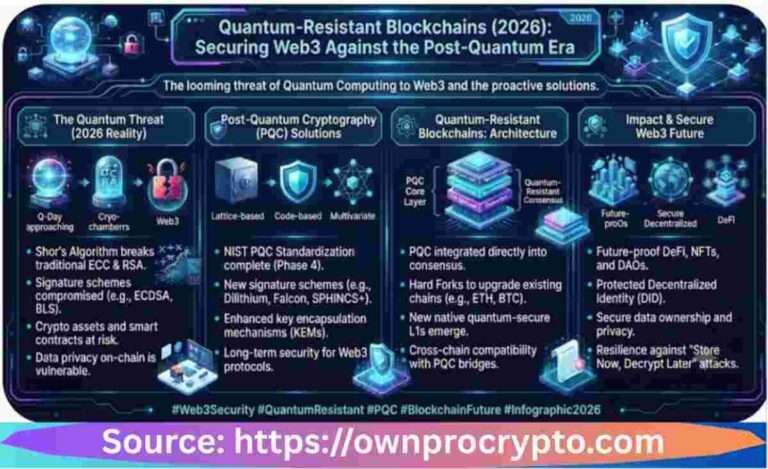
However, quantum computers introduce new algorithms capable of solving certain mathematical problems much faster than classical computers.
Most major blockchain networks rely on mathematical problems called:
These problems protect:
| Blockchain Function | Current Algorithm | Quantum Risk |
|---|---|---|
| Transaction signatures | ECDSA | Vulnerable to Shor’s algorithm |
| Wallet ownership | ECC | Private key recovery risk |
| Authentication systems | RSA/ECC | Quantum compromise risk |
| Validator identity | Classical signatures | Impersonation risk |
The challenge is not that blockchain technology is insecure.
The challenge is that the mathematical foundation underneath current blockchain security must evolve.
Post-quantum cryptography refers to cryptographic algorithms designed to resist attacks from quantum computers while continuing to operate on traditional computing systems.
Unlike quantum cryptography, PQC does not require quantum hardware.
It is a software-based cryptographic upgrade.
The goal of PQC is to replace vulnerable systems such as:
with quantum-resistant alternatives.
| Category | Classical Cryptography | Post-Quantum Cryptography |
| Security Foundation | Elliptic curves and factoring | Lattices, hashes, codes |
| Quantum Resistance | No | Designed for quantum resistance |
| Hardware Requirement | Classical computers | Classical computers |
| Blockchain Application | Current wallets and validators | Future quantum-safe infrastructure |
Post-quantum cryptography is not based on one single technology.
Several mathematical approaches are being researched and standardized.
| Cryptographic Family | Security Foundation | Main Web3 Applications |
| Lattice-Based Cryptography | Learning With Errors (LWE) problems | Wallets, signatures, validators |
| Hash-Based Cryptography | Cryptographic hash functions | Long-term signing |
| Code-Based Cryptography | Error-correcting codes | Secure communication |
| Multivariate Cryptography | Polynomial equations | Specialized authentication |
The most important family for blockchain migration today is lattice-based cryptography.
Lattice-based cryptography has become the leading approach for blockchain applications because it provides a strong balance between:
These algorithms rely on mathematical problems involving high-dimensional lattice structures.
A simplified explanation:
Classical Cryptography

Elliptic Curve Problem
          ↓
Quantum Computers Can Solve

Lattice Cryptography
High-Dimensional Mathematical Structure
          ↓
No Known Efficient Quantum Solution
Major lattice-based standards include:
ML-KEM (Module-Lattice Key Encapsulation Mechanism) is designed to securely establish shared encryption keys.
It replaces vulnerable key exchange systems used in:
| Standard | Purpose | Web3 Application |
| ML-KEM-512 | Lightweight security | Low-resource systems |
| ML-KEM-768 | Balanced security | Enterprise blockchain infrastructure |
| ML-KEM-1024 | High security | Critical systems |
ML-DSA (Module-Lattice Digital Signature Algorithm) is designed to replace signature systems such as ECDSA.
It enables:
| Feature | ECDSA | ML-DSA |
| Quantum Resistance | No | Yes |
| Mathematical Foundation | Elliptic curves | Lattice problems |
| Signature Size | Small | Larger |
| Future Web3 Role | Legacy compatibility | Quantum-safe replacement |
The National Institute of Standards and Technology (NIST) has become a major authority in defining practical post-quantum cryptographic standards.
The key standards influencing blockchain security are:
| Standard | Algorithm | Purpose |
| FIPS 203 | ML-KEM | Key encapsulation |
| FIPS 204 | ML-DSA | Digital signatures |
| FIPS 205 | SLH-DSA | Hash-based signatures |
These standards provide a foundation for organizations designing quantum-resistant digital infrastructure.
Replacing blockchain cryptography is not a one-time event.
Future algorithms may continue evolving as research advances.
This makes cryptographic agility essential.
Cryptographic agility means a blockchain can replace its security algorithms without rebuilding the entire network.
Traditional design:
Blockchain Logic
       ↓
Fixed Cryptographic Algorithm
Future-ready design:
Blockchain Logic
       ↓
Cryptographic Layer
       ↓ ┌────────┬─────────┐
 ML-DSA   Future PQC
A cryptographically agile blockchain can:
Without cryptographic agility, blockchain networks may face:
With cryptographic agility, protocols can gradually upgrade security while maintaining ecosystem compatibility.
Post-quantum cryptography is not replacing blockchain technology.
It is upgrading the mathematical foundation that allows blockchain networks to function securely.
The future of Web3 depends on systems that combine:
Protocols that adopt PQC early will be better prepared for the next era of computing.
The transition toward quantum-resistant blockchain infrastructure depends heavily on standardized cryptographic algorithms.
For years, blockchain systems have optimized around classical algorithms such as ECDSA and Ed25519 because they provide small keys, fast signatures, and efficient transaction processing.
Post-quantum cryptography introduces a different engineering balance.
The new algorithms provide quantum resistance, but they require blockchain developers to rethink:
The goal is not simply replacing one algorithm with another.
The goal is building blockchain systems that can survive future cryptographic challenges.
FIPS 203 defines ML-KEM (Module-Lattice Key Encapsulation Mechanism), previously known as Kyber.
Unlike digital signatures, ML-KEM is designed for secure key establishment.
It allows two parties to create a shared secret key across an untrusted communication channel.
Blockchain applications include:
| Algorithm | Security Level | Public Key Size | Ciphertext Size | Typical Use |
|---|---|---|---|---|
| ML-KEM-512 | Level 1 | 800 bytes | 768 bytes | Lightweight environments |
| ML-KEM-768 | Level 3 | 1,184 bytes | 1,088 bytes | Recommended enterprise deployment |
| ML-KEM-1024 | Level 5 | 1,568 bytes | 1,568 bytes | High-security environments |
ML-KEM is important because many blockchain systems require secure communication between:
FIPS 204 defines ML-DSA (Module-Lattice Digital Signature Algorithm), previously known as Dilithium.
Digital signatures are the most important cryptographic component in blockchain because they authorize state changes.
ML-DSA is designed to replace vulnerable systems such as:
Blockchain applications include:
| Algorithm | Security Level | Public Key Size | Signature Size |
| ML-DSA-44 | Level 2 | 1,312 bytes | 2,420 bytes |
| ML-DSA-65 | Level 3 | 1,952 bytes | 3,309 bytes |
| ML-DSA-87 | Level 5 | 2,592 bytes | 4,627 bytes |
For most blockchain applications, ML-DSA-65 provides a practical balance between security and performance.
FIPS 205 defines SLH-DSA, a stateless hash-based digital signature system based on SPHINCS+.
Hash-based cryptography has one major advantage:
Its security relies on well-understood hash functions rather than complex mathematical structures.
This makes it highly attractive for:
However, hash-based signatures usually create larger signatures and slower execution compared with lattice-based approaches.
| Feature | SLH-DSA |
| Security Foundation | Hash functions |
| Quantum Resistance | Strong |
| Signature Size | Large |
| Best Use Case | Long-term trust systems |
Moving to quantum-resistant cryptography introduces measurable engineering challenges.
| Algorithm | Public Key Size | Signature Size | Quantum Resistant | Blockchain Impact |
| ECDSA | 33 bytes | 64 bytes | No | Current standard |
| Ed25519 | 32 bytes | 64 bytes | No | Current high-performance use |
| ML-DSA-65 | 1,952 bytes | 3,309 bytes | Yes | Higher bandwidth requirements |
| SLH-DSA | Varies | Large | Yes | Best for long-term security |
The main challenge is not security.
The challenge is scaling.
Blockchain throughput depends heavily on transaction size.
A traditional transaction:
Transaction
+
64-byte Signature
=
Small Data Payload
A post-quantum transaction:
Transaction
+
3,309-byte ML-DSA Signature
=
Larger Blockchain Payload
Larger signatures can affect:
Developers are exploring multiple solutions to reduce the impact of larger cryptographic data.
Multiple signatures can potentially be combined to reduce repeated data overhead.
Protocols can optimize how signatures and public keys are stored.
Rollups can handle larger cryptographic operations away from the main chain.
Specialized processors can improve PQC signing and verification performance.
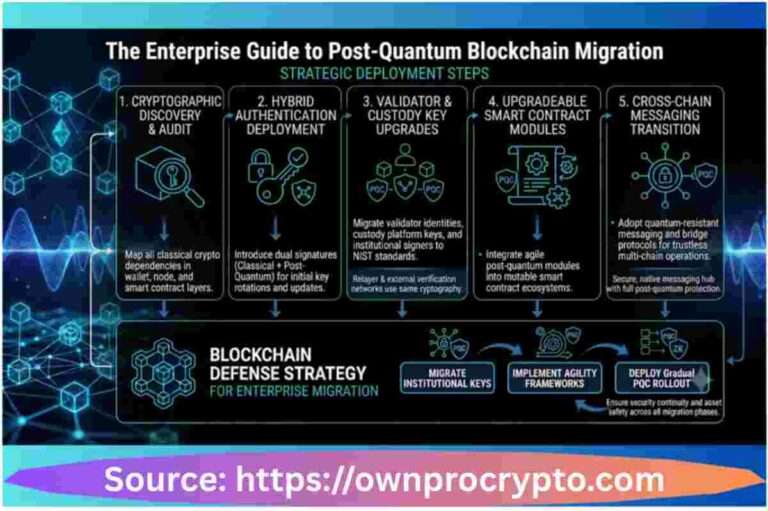
Most blockchain networks will not immediately switch from classical cryptography to pure post-quantum systems.
The industry is moving toward hybrid cryptographic models.
A hybrid transaction requires both:
Example:
User Transaction
        ↓
ECDSA Signature
+
ML-DSA Signature
        ↓

Dual Verification
        ↓
Blockchain Approval
This approach provides:
New cryptographic algorithms require years of real-world testing.
Hybrid systems reduce migration risk because security does not depend on only one algorithm.
If one system fails, the second verification layer continues protecting the network.
A future-ready blockchain should never permanently hardcode one cryptographic method.
Instead, developers should create flexible security layers.
Recommended architecture:
| Design Principle | Implementation |
| Modular verification | Separate crypto logic from application logic |
| Algorithm identifiers | Allow multiple signature types |
| Flexible key storage | Support larger PQC keys |
| Upgradeable contracts | Enable future security improvements |
| Multi-algorithm support | Prevent single algorithm dependency |
Before deploying a blockchain protocol, teams should evaluate:
| Area | Question |
| Wallets | Can users migrate to PQC addresses? |
| Smart contracts | Are signatures hardcoded? |
| Validators | Can node keys be replaced? |
| Bridges | Are verification systems upgradeable? |
| Storage | Can larger keys be handled? |
| Governance | Can security upgrades be approved? |
The move toward post-quantum cryptography is not a single upgrade.
It is a long-term transition toward flexible security infrastructure.
The strongest blockchain systems of the future will combine:
Quantum computing changes the security environment, but blockchain networks can adapt by upgrading the mathematics that protects digital ownership.
What exactly is Post-Quantum Cryptography (PQC)?
PQC refers to Post-Quantum Cryptography algorithms mostly public-key algorithms that are thought to be secure against a cryptanalytic attack by a quantum computer. While current standards like RSA and ECC are vulnerable to Shor’s algorithm, PQC focuses on mathematical problems (such as lattice-based, code-based, or multivariate problems) that remain computationally hard even for powerful quantum machines.
Why are our current Web3 encryption standards at risk?
Web3 relies heavily on Elliptic Curve Cryptography (ECC) for digital signatures and wallet addresses. A sufficiently large, fault-tolerant quantum computer could theoretically derive a private key from a public key almost instantaneously, effectively granting control over any associated assets.
What is ML-KEM used for in blockchain systems?
ML-KEM is designed for quantum-resistant key exchange. It can secure communication between blockchain nodes, validators, and infrastructure systems.
What is ML-DSA used for in Web3?
ML-DSA is a post-quantum digital signature algorithm designed to replace classical signing systems used for wallets, validators, and governance.
Is ML-DSA faster than ECDSA?
No. ECDSA is currently much smaller and faster. ML-DSA provides quantum resistance but requires larger signatures and more network resources.
Why are post-quantum signatures larger than current blockchain signatures?
Quantum-resistant algorithms use different mathematical structures that require larger public keys and signatures to maintain security.
What are the primary hurdles to migrating to quantum-resistant standards?
The main challenges include larger key sizes and signature sizes, which increase gas costs and impact throughput on resource-constrained blockchains. Furthermore, the transition requires a massive coordination effort, often involving hard forks and legacy support.
How can we balance quantum resistance with current user experience (UX)?
Hybrid cryptosystems are the current “good news” solution. By combining classical signatures (like ECDSA) with PQC signatures (like Dilithium or SPHINCS+), protocols can maintain backward compatibility while ensuring that the data is protected by quantum-hardened layers.
Will Ethereum and Bitcoin need post-quantum upgrades?
Eventually, networks using classical public-key cryptography will need migration strategies to protect against future quantum threats.
What is the difference between ML-KEM and ML-DSA?
ML-KEM protects communication through secure key exchange, while ML-DSA creates digital signatures for authentication and transaction approval.
Are hash-based signatures quantum resistant?
Yes. Hash-based signatures are considered strong candidates for quantum-resistant security because they rely on hash function security.
Why is cryptographic agility important for blockchain networks?
It allows protocols to replace cryptographic algorithms without rebuilding the entire blockchain infrastructure.
What is hybrid cryptography in blockchain?
Hybrid cryptography combines classical and post-quantum algorithms during migration to maintain compatibility while improving security.
What is the biggest challenge of post-quantum blockchain migration?
The biggest challenges are larger signatures, network performance, wallet upgrades, and ecosystem coordination.
Can smart contracts use post-quantum cryptography?
Yes. Smart contracts can be designed with modular verification systems that support future cryptographic upgrades.
Are zero-knowledge proofs affected by quantum computing?
Some zero-knowledge systems based on elliptic curves require upgrades, while hash-based approaches such as STARKs are considered more resistant.
Continue exploring the complete quantum-resistant blockchain security series:
Quantum-Resistant Blockchains (2026): Securing Web3 Against the Post-Quantum Era
Post-Quantum Cryptography in Web3: Algorithms & Cryptographic Agility
We are here : Learn how ML-KEM, ML-DSA, lattice cryptography, and cryptographic agility shape future blockchain security.
The 5 Primary Quantum Threat Vectors Facing Blockchain Infrastructure
Explore wallet attacks, validator compromise, HNDL risks, and future blockchain vulnerabilities.
Multi-Chain Interoperability: Why Cross-Chain Bridges Face the Highest Quantum Risk
Understand why bridges represent one of the most critical quantum attack surfaces.
The Enterprise Guide to Post-Quantum Blockchain Migration
Discover migration planning, hybrid deployment strategies, and enterprise readiness frameworks.
Crypto Security Hub (2026): Complete Guide to Digital Asset Protection
Anchor: “future digital asset security”
Cross-Chain Blockchain Security: Protecting Bridges & Rollups (2026 Guide)
Anchor: “cross-chain security risks”
Blockchain Interoperability: AI Agents & Cross-Chain Connectivity (2026)
Anchor: “next-generation blockchain interoperability”
Crypto Self-Custody Security Toolkit: Protect Your Digital Assets
Anchor: “self-custody security framework”
MPC vs Multi-Sig vs HSM Custody: Crypto Security Comparison (2026)
Anchor: “institutional custody security models”
The future of Quantum-Resistant Blockchains depends on trusted cryptographic standards that can withstand both classical and quantum attacks. The National Institute of Standards and Technology (NIST) leads the global effort by publishing the official Federal Information Processing Standards (FIPS 203, FIPS 204, and FIPS 205) for post-quantum cryptography. Blockchain developers, security researchers, and enterprise teams should follow these standards to ensure their networks remain compatible with future cryptographic requirements.
Official Resource:
https://csrc.nist.gov/projects/post-quantum-cryptography
Creating secure Quantum-Resistant Blockchains requires more than adopting new cryptographic algorithms. Organizations must also develop cryptographic agility, inventory vulnerable systems, and prepare long-term migration strategies. The Cybersecurity and Infrastructure Security Agency (CISA) publishes practical guidance to help enterprises and infrastructure providers prepare for the transition to post-quantum security.
Official Resource:
https://www.cisa.gov/quantum
The development of Quantum-Resistant Blockchains is closely tied to advances in quantum computing research. Organizations such as IBM Quantum and Google Quantum AI regularly publish research on scalable quantum hardware, error correction, and future computing capabilities. Following credible research helps developers better understand why blockchain networks are preparing years in advance for the arrival of cryptographically relevant quantum computers.
Official Resources:
IBM Quantum
https://www.ibm.com/quantum
Google Quantum AI
https://quantumai.google