
Search by title, topic or phrase
Use our Crypto Search Engine 🔍 to find the topics and keywords you're looking for.
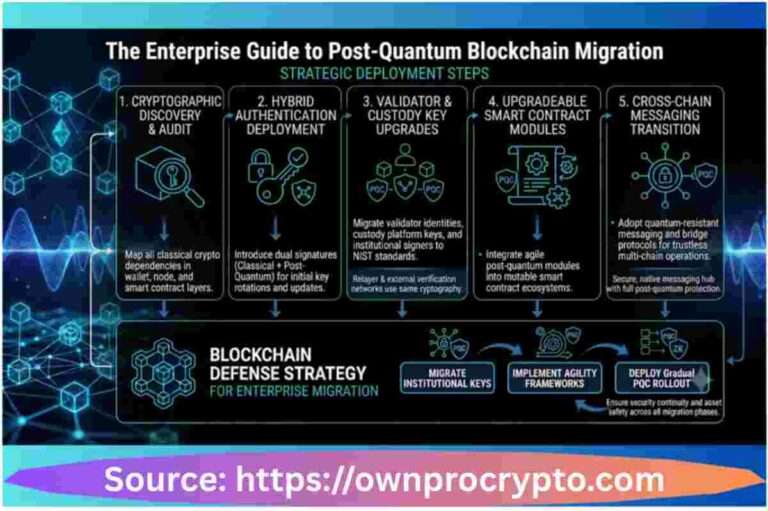
Table of Contents
TogglePost-Quantum Blockchain Migration is becoming essential as blockchain networks continue to rely on a single critical foundation: cryptography.
Every wallet signature, validator approval, governance decision, and cross-chain message depends on cryptographic algorithms designed for the era of classical computing.
As quantum computing advances, enterprises operating blockchain infrastructure face a new security challenge:
How do you upgrade the cryptographic foundation of a live decentralized network without disrupting users, assets, and operations?
Post-quantum blockchain migration is not a simple software update.
It requires coordinated changes across:
The organizations that prepare early will have a smoother transition because cryptographic migration requires testing, coordination, and gradual deployment.
Traditional cybersecurity upgrades usually focus on fixing vulnerabilities after they appear.
Quantum security requires a different approach.
The challenge exists because blockchain systems have long operational lifecycles.
A tokenized asset platform, institutional custody system, or digital identity network may need to remain secure for decades.
This creates the migration problem:
| Challenge | Enterprise Impact |
|---|---|
| Large existing user base | Wallet transition complexity |
| Immutable blockchain history | Difficult protocol changes |
| Global infrastructure | Coordination challenges |
| Multiple vendors | Compatibility issues |
| Long asset lifecycles | Early migration required |
A blockchain cannot simply replace every cryptographic component overnight.
The migration must preserve:
A successful migration follows a staged approach.
Phase 1
Cryptographic Discovery
        ▼
Phase 2
Hybrid PQC Deployment
        ▼
Phase 3
Native Quantum-Resistant Infrastructure
Each phase reduces risk while preparing the ecosystem for the next security standard.
The first step is understanding where vulnerable cryptography exists.
Many organizations underestimate the number of systems depending on classical algorithms.
A complete audit should identify:
The goal is creating a Cryptographic Bill of Materials (CBOM).
| Component | Information Required |
|---|---|
| Application | Where cryptography is used |
| Algorithm | ECDSA, RSA, Ed25519, etc. |
| Key size | Current security parameters |
| Dependency | Software library or service |
| Risk level | Migration priority |
| Replacement | Future PQC algorithm |
Example:
Enterprise Blockchain Stack

Wallet Layer
     ├── ECDSA Keys
     ▼
Validator Layer
     ├── Classical Signatures│
     ▼
Bridge Layer
     ├── Multisig Authentication
     ▼
Migration Target
ML-DSA
ML-KEM
Hash-Based Security
Without this inventory, organizations may leave hidden cryptographic weaknesses behind.
The safest transition strategy is hybrid cryptography.
Instead of immediately removing existing algorithms, systems operate with both:
This creates a migration bridge between current blockchain infrastructure and future quantum-resistant systems.
A transaction can require two independent approvals:
Transaction Request
        ├───────────────┐
        │               │
        ▼               ▼

ECDSA Signature     ML-DSA Signature
        └───────┬───────┘
                ▼
        Network Verification
                ▼
        Transaction Approved
Benefits:
| Advantage | Explanation |
|---|---|
| Compatibility | Existing systems continue working |
| Security | Protects against future quantum attacks |
| Testing | Allows PQC algorithms to mature |
| Flexibility | Easier future upgrades |
Hybrid deployment is especially important for:
After testing and ecosystem preparation, networks can move toward full post-quantum operation.
This stage involves:
Future blockchain architectures may rely on:
| Security Function | Post-Quantum Solution |
|---|---|
| Digital signatures | ML-DSA |
| Key exchange | ML-KEM |
| Long-term signatures | Hash-based cryptography |
| Secure proofs | Quantum-resistant ZK systems |
The final objective is a blockchain where quantum resistance is built into the architecture rather than added later.
Post-quantum migration affects more than blockchain code.
Organizations must evaluate their entire technology environment.
| Infrastructure Area | Required Upgrade |
|---|---|
| Hardware Security Modules | Support larger PQC keys |
| Custody platforms | Enable PQC signing |
| Cloud systems | Upgrade authentication protocols |
| Validator nodes | Replace key management systems |
| APIs | Support larger cryptographic payloads |
| Monitoring tools | Detect migration failures |
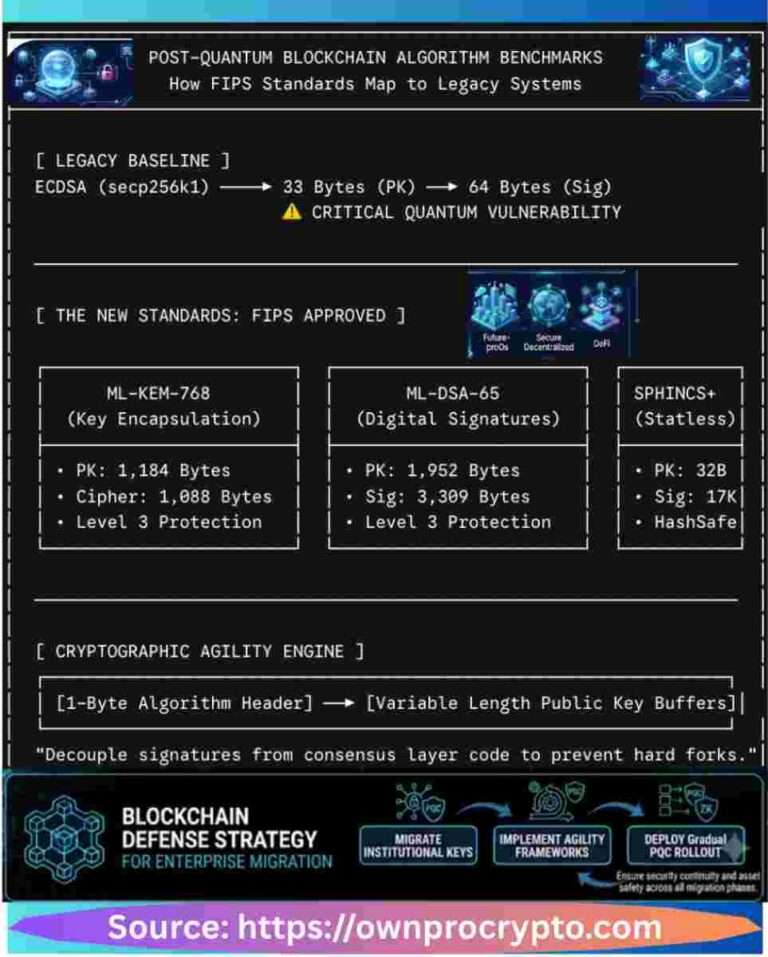
Post-quantum algorithms provide stronger protection but introduce engineering challenges.
The main trade-offs include:
| Metric | Classical Cryptography | Post-Quantum Cryptography |
|---|---|---|
| Key size | Smaller | Larger |
| Signature size | Compact | Larger |
| Storage requirements | Lower | Higher |
| Network bandwidth | Efficient | Increased |
| Hardware requirements | Mature | Developing |
Blockchain developers must optimize:
The assessment process is designed to make advanced blockchain security easier to understand.
Users begin by selecting their blockchain environment, infrastructure type, and security components. The Quantum-Resistant Blockchains Toolkit then evaluates factors such as cryptographic algorithms, validator models, bridge usage, custody design, and migration readiness.
After analysis, the system provides:
This approach helps technical teams, investors, and organizations make informed decisions without needing to manually analyze every cryptographic dependency. Tab to Access Quantum-Resistant Threats in Blockchain.
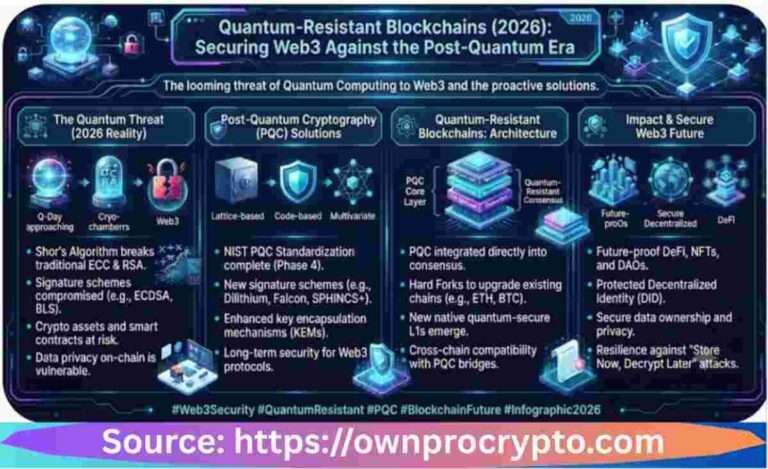
Quantum computing does not eliminate blockchain technology.
It challenges the cryptographic assumptions that blockchain networks were built upon.
The future of secure Web3 depends on proactive migration:
The strongest blockchain ecosystems will not be the ones that react after quantum threats arrive.
They will be the ones that redesigned their security foundations before the transition becomes urgent.
Quantum migration is becoming part of long-term cybersecurity planning.
Organizations should align their strategies with recognized post-quantum standards and security guidance.
Important frameworks include:
External reference resources:
| Migration Step | Status Goal |
|---|---|
| Audit cryptographic dependencies | Identify all vulnerable systems |
| Create CBOM inventory | Complete visibility |
| Design cryptographic agility | Future upgrade capability |
| Deploy hybrid signatures | Transition protection |
| Upgrade custody systems | Protect assets |
| Secure bridges and oracles | Reduce external risk |
| Upgrade validators | Protect consensus |
| Remove legacy algorithms | Complete migration |
Q: What is post-quantum blockchain migration?
Post-quantum blockchain migration is the process of upgrading blockchain cryptography so networks remain secure against future quantum computers.
Q: Why cannot blockchain networks upgrade instantly?
Because blockchains involve users, validators, exchanges, custody systems, applications, and infrastructure providers that must coordinate changes.
Q: What is the first step in enterprise quantum migration?
The first step is a complete cryptographic audit to identify vulnerable algorithms and dependencies.
Q: Why are hybrid cryptographic systems recommended?
Hybrid systems allow organizations to maintain compatibility while introducing quantum-resistant protection.
Q: What algorithms are expected to support future blockchain security?
Common candidates include ML-DSA for signatures, ML-KEM for key exchange, and hash-based cryptographic systems.
Q: Will users need new blockchain wallets after migration?
Many users may eventually require new wallet formats because post-quantum keys are larger and use different mathematical structures.
Q: How will post-quantum signatures affect blockchain performance?
Larger signatures can increase storage and bandwidth requirements, requiring protocol optimization.
Q: Can smart contracts become cryptographically agile?
Yes. Developers can design modular verification systems that allow future cryptographic upgrades.
Q: Are hardware wallets protected against quantum attacks?
Hardware wallets protect private keys from many attacks but cannot prevent vulnerabilities in the underlying cryptographic algorithms.
Q: When should enterprises begin migration planning?
Organizations managing long-term digital assets should begin planning early because migration requires years of testing and coordination.
Q: What happens if a blockchain ignores quantum migration?
A future quantum attack could compromise wallets, validators, bridges, and governance systems that rely on vulnerable cryptography.
Continue exploring the complete quantum-resistant blockchain security series:
Quantum-Resistant Blockchains (2026): Securing Web3 Against the Post-Quantum Era
Post-Quantum Cryptography in Web3: Algorithms & Cryptographic Agility
Learn how ML-KEM, ML-DSA, lattice cryptography, and cryptographic agility shape future blockchain security.
The 5 Primary Quantum Threat Vectors Facing Blockchain Infrastructure
Explore wallet attacks, validator compromise, HNDL risks, and future blockchain vulnerabilities.
Multi-Chain Interoperability: Why Cross-Chain Bridges Face the Highest Quantum Risk
Understand why bridges represent one of the most critical quantum attack surfaces.
The Enterprise Guide to Post-Quantum Blockchain Migration
We are here: Discover migration planning, hybrid deployment strategies, and enterprise readiness frameworks.
Crypto Security Hub (2026): Complete Guide to Digital Asset Protection
Anchor: “future digital asset security”
Cross-Chain Blockchain Security: Protecting Bridges & Rollups (2026 Guide)
Anchor: “cross-chain security risks”
Blockchain Interoperability: AI Agents & Cross-Chain Connectivity (2026)
Anchor: “next-generation blockchain interoperability”
Crypto Self-Custody Security Toolkit: Protect Your Digital Assets
Anchor: “self-custody security framework”
MPC vs Multi-Sig vs HSM Custody: Crypto Security Comparison (2026)
Anchor: “institutional custody security models”
The future of Quantum-Resistant Blockchains depends on trusted cryptographic standards that can withstand both classical and quantum attacks. The National Institute of Standards and Technology (NIST) leads the global effort by publishing the official Federal Information Processing Standards (FIPS 203, FIPS 204, and FIPS 205) for post-quantum cryptography. Blockchain developers, security researchers, and enterprise teams should follow these standards to ensure their networks remain compatible with future cryptographic requirements.
Official Resource:
https://csrc.nist.gov/projects/post-quantum-cryptography
Creating secure Quantum-Resistant Blockchains requires more than adopting new cryptographic algorithms. Organizations must also develop cryptographic agility, inventory vulnerable systems, and prepare long-term migration strategies. The Cybersecurity and Infrastructure Security Agency (CISA) publishes practical guidance to help enterprises and infrastructure providers prepare for the transition to post-quantum security.
Official Resource:
https://www.cisa.gov/quantum
The development of Quantum-Resistant Blockchains is closely tied to advances in quantum computing research. Organizations such as IBM Quantum and Google Quantum AI regularly publish research on scalable quantum hardware, error correction, and future computing capabilities. Following credible research helps developers better understand why blockchain networks are preparing years in advance for the arrival of cryptographically relevant quantum computers.
Official Resources:
IBM Quantum
https://www.ibm.com/quantum
Google Quantum AI
https://quantumai.google