
Search by title, topic or phrase
Use our Crypto Search Engine 🔍 to find the topics and keywords you're looking for.
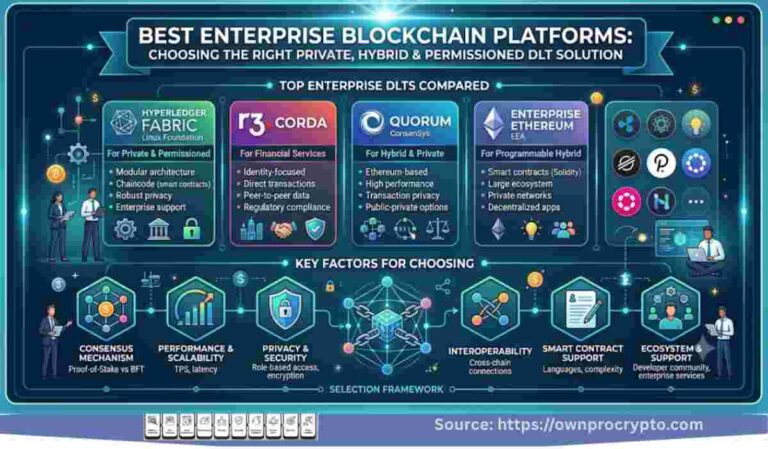
Table of Contents
ToggleEnterprise blockchain technology has evolved far beyond cryptocurrency. Today, organizations use enterprise blockchain platforms to streamline supply chain operations, tokenize real-world assets, automate business workflows, improve data integrity, enable secure cross-organization collaboration, and build privacy-focused digital ecosystems. Choosing the best enterprise blockchain platforms requires more than comparing technical specifications—it requires understanding governance models, privacy controls, scalability, interoperability, and long-term enterprise strategy.
Modern enterprise platforms support far more than distributed ledgers. They provide permissioned networks, private smart contracts, digital identity management, role-based access control, enterprise APIs, consensus frameworks, and integration with existing business systems such as ERP, CRM, cloud infrastructure, and digital asset platforms. Selecting the wrong platform can increase implementation costs, limit scalability, create vendor lock-in, and slow digital transformation initiatives.
This guide compares the best enterprise blockchain platforms in 2026 using a transparent enterprise evaluation framework covering architecture, governance, consensus mechanisms, privacy, interoperability, developer capabilities, operational maturity, and business readiness. Whether you’re a CIO, CTO, enterprise architect, digital transformation leader, or blockchain developer, you’ll learn how leading platforms compare, where each solution excels, and which platform best fits your organization’s technical and strategic requirements.
⚠️ Warning: Enterprise blockchain projects rarely fail because of blockchain technology—they fail because organizations choose a platform that doesn’t align with their business processes, governance requirements, integration strategy, or long-term scalability goals. Define your enterprise use case first, then evaluate platforms against measurable technical and operational criteria rather than brand recognition alone.

📋 Buyer’s Checklist
Before comparing enterprise blockchain platforms, clearly define your business objectives. A platform designed for supply chain traceability may not be the right choice for asset tokenization or interbank settlement. Evaluate platforms based on governance, privacy, scalability, interoperability, integration capabilities, developer ecosystem, and long-term operational support—not marketing claims alone.
Choosing the best enterprise blockchain platforms requires balancing technical capabilities with business requirements. While some platforms are designed for permissioned business networks and private smart contracts, others specialize in digital asset tokenization, financial settlement, or enterprise integration. Rather than asking which platform is universally “best,” organizations should identify the solution that best aligns with their architecture, industry, compliance requirements, and digital transformation strategy.
The comparison below evaluates leading enterprise blockchain platforms using consistent enterprise criteria, helping CIOs, CTOs, enterprise architects, and technology leaders make informed platform decisions.
Every platform in this guide is assessed using a transparent evaluation methodology focused on enterprise adoption rather than popularity. The framework measures each platform across technical architecture, governance, scalability, security, interoperability, developer experience, and operational maturity.
| Evaluation Factor | Why It Matters |
|---|---|
| Deployment Model | Supports private, public, hybrid, or consortium blockchain architectures. |
| Consensus Framework | Determines transaction validation, security, and performance. |
| Privacy Controls | Protects sensitive enterprise data and confidential transactions. |
| Governance & Permissioning | Enables role-based access, identity management, and organizational control. |
| Smart Contract Support | Automates enterprise workflows and business logic. |
| Scalability | Supports growing transaction volumes and enterprise expansion. |
| Interoperability | Connects with other blockchains, enterprise systems, and external services. |
| Integration Capabilities | Simplifies connections with ERP, CRM, cloud platforms, and APIs. |
| Developer Ecosystem | Documentation, SDKs, tooling, and community support. |
| Enterprise Readiness | Long-term support, operational maturity, and business adoption. |
| Platform | Best For | Deployment Model | Enterprise Ready |
| Hyperledger Fabric | Supply chain, manufacturing, consortium networks | Private / Permissioned | ✅ |
| R3 Corda | Financial services and regulated industries | Permissioned DLT | ✅ |
| Hyperledger Besu | Enterprise Ethereum applications | Private / Public | ✅ |
| Consensys Quorum | Private smart contracts and enterprise Ethereum | Private / Hybrid | ✅ |
| Kaleido | Rapid enterprise blockchain deployment | Hybrid Platform | ✅ |
The table below compares the core capabilities enterprise buyers evaluate during platform selection.
| Feature | Fabric | Corda | Besu | Quorum | Kaleido |
| Private Networks | ✔ | ✔ | ✔ | ✔ | ✔ |
| Permissioned Access | ✔ | ✔ | ✔ | ✔ | ✔ |
| Smart Contracts | ✔ | ✔ | ✔ | ✔ | ✔ |
| Tokenization Support | ✔ | ✔ | ✔ | ✔ | ✔ |
| Identity Management | ✔ | ✔ | ✔ | ✔ | ✔ |
| Enterprise APIs | ✔ | ✔ | ✔ | ✔ | ✔ |
| Cross-Chain Integration | Limited | Limited | ✔ | ✔ | ✔ |
| Cloud Deployment | ✔ | ✔ | ✔ | ✔ | ✔ |
Although many enterprise blockchain platforms appear similar, they are built with different design philosophies and business objectives. Some prioritize privacy and permissioned collaboration, while others focus on Ethereum compatibility, digital asset tokenization, or financial settlement.
Selecting the wrong platform can result in higher implementation costs, integration challenges, governance limitations, and unnecessary operational complexity. A structured comparison helps organizations align platform capabilities with real business requirements instead of selecting technology based on familiarity or vendor marketing.

Each platform is evaluated using the same framework to provide a balanced and consistent comparison.
Understanding which platform to choose is only one part of the decision. To evaluate enterprise blockchain platforms effectively, it’s equally important to understand the technologies that power them. In the next section, we’ll explain permissioned blockchains, distributed ledger technology (DLT), consensus frameworks, private smart contracts, governance models, interoperability, and enterprise blockchain architecture—the core concepts that separate enterprise blockchain platforms from traditional public blockchain networks.
🎓 Learn Before You Compare
Understanding the technologies behind enterprise blockchain platforms makes platform selection much easier. Concepts such as distributed ledger technology (DLT), permissioned blockchains, consensus frameworks, private smart contracts, and interoperability directly influence security, scalability, governance, and business performance. Evaluating these technologies first helps organizations compare platforms based on architecture rather than marketing claims.
Enterprise blockchain platforms are designed to solve business challenges that public blockchains cannot always address. Unlike open blockchain networks where anyone can participate, enterprise platforms provide controlled access, governance, privacy, and integration capabilities that support complex business operations across multiple organizations.
Modern enterprise blockchain solutions combine distributed ledger technology, permissioned networking, digital identity, smart contracts, and enterprise integrations to create trusted environments for secure collaboration, asset management, workflow automation, and data sharing.
Enterprise blockchain is a distributed ledger system built specifically for organizations that require privacy, governance, compliance, and controlled participation. Unlike public blockchain networks, enterprise platforms allow approved participants to access, validate, and manage business transactions according to predefined governance rules.
Enterprise blockchains are commonly used for supply chain management, financial services, healthcare, digital identity, trade finance, and asset tokenization.
Distributed Ledger Technology (DLT) is the foundation of enterprise blockchain platforms. Instead of storing information in a single centralized database, identical copies of the ledger are securely maintained across multiple authorized participants.
This shared architecture improves transparency, data consistency, and resilience while reducing dependence on a single controlling organization.
| Benefit | Business Value |
|---|---|
| Shared Data | Improves collaboration between organizations. |
| Tamper Resistance | Reduces the risk of unauthorized record changes. |
| Transparency | Creates a trusted transaction history. |
| Operational Resilience | Eliminates single points of failure. |
| Process Automation | Supports smart contract execution. |
Not every blockchain is designed for enterprise use. Different deployment models provide different levels of privacy, governance, and participation.
| Deployment Model | Best For | Key Characteristics |
| Public Blockchain | Open ecosystems | Anyone can join and validate transactions. |
| Private Blockchain | Single organizations | Controlled access with centralized governance. |
| Permissioned Blockchain | Business networks | Only approved participants can access the network. |
| Hybrid Blockchain | Enterprise collaboration | Combines private governance with selective public transparency. |
Most enterprise organizations adopt permissioned or hybrid blockchain architectures because they provide stronger governance, privacy controls, and regulatory flexibility while still benefiting from distributed ledger technology.
Consensus mechanisms determine how network participants validate and agree on transactions without relying on a central authority.
Unlike cryptocurrency networks that often prioritize decentralization, enterprise platforms optimize consensus for performance, governance, and predictable transaction processing.
| Consensus Framework | Common Enterprise Use |
| PBFT (Practical Byzantine Fault Tolerance) | Consortium and financial networks. |
| Raft | High-performance private blockchain deployments. |
| IBFT (Istanbul BFT) | Enterprise Ethereum implementations. |
| Proof of Authority (PoA) | Permissioned blockchain environments. |
Enterprise smart contracts automate business rules, approvals, and workflows without requiring manual intervention.
Typical use cases include:
Identity management is one of the biggest differences between enterprise and public blockchain platforms.
Organizations require the ability to verify participants, assign permissions, and control access to sensitive business information.
Large organizations rarely operate a single technology platform. Enterprise blockchain solutions must exchange information with existing business systems, external applications, and other blockchain networks.
Enterprise blockchain platforms typically consist of multiple technology layers working together to support secure business operations.
Business Applications
        ↓
Enterprise APIs & Integration Layer
        ↓
Identity & Access Management
        ↓
Smart Contract Layer
        ↓
Consensus Framework
        ↓
Distributed Ledger (DLT)│
        ↓
Infrastructure & Cloud ResourcesA well-designed enterprise blockchain architecture improves scalability, simplifies integration, strengthens governance, and reduces operational complexity across the entire technology stack.
The ideal architecture depends on organizational goals, regulatory requirements, and collaboration models.
| Business Requirement | Recommended Architecture |
| Internal business processes | Private blockchain |
| Multi-company collaboration | Permissioned blockchain |
| Supply chain ecosystems | Consortium blockchain |
| Digital asset tokenization | Hybrid blockchain |
| Cross-border settlement | Permissioned DLT with interoperability |
Key Takeaway: Enterprise blockchain platforms are much more than distributed databases. They combine governance, identity management, consensus frameworks, smart contracts, and interoperability into a secure digital foundation for modern business ecosystems. Understanding these technologies allows organizations to evaluate platforms based on long-term business value rather than individual product features.
⚠️ Critical Mistake
Many organizations choose enterprise blockchain platforms based on popularity, vendor reputation, or blockchain familiarity. Successful enterprise projects depend on much more than the underlying ledger. Governance, identity management, interoperability, scalability, operational maturity, and integration capabilities often determine whether a platform succeeds in production or becomes an expensive proof of concept.
Enterprise blockchain platforms must support far more than distributed transactions. They become part of an organization’s digital infrastructure, connecting business applications, enterprise systems, partners, regulators, and customers through secure, governed, and scalable distributed networks.
The most successful enterprise platforms combine technical excellence with operational maturity, allowing organizations to deploy blockchain solutions that remain reliable, secure, and adaptable as business requirements evolve.
Every organization has different infrastructure, security, and compliance requirements.
Leading platforms should support:
Governance is the foundation of every successful enterprise blockchain implementation.
Evaluate whether the platform supports:
Enterprise organizations frequently exchange sensitive commercial information that cannot be exposed across an entire network.
Look for:
Business automation is one of the primary reasons organizations adopt enterprise blockchain platforms.
| Capability | Why It Matters |
|---|---|
| Smart contract support | Automates business workflows. |
| Contract lifecycle management | Simplifies upgrades and maintenance. |
| Programming language support | Expands developer flexibility. |
| Testing tools | Improves deployment quality. |
| Version management | Reduces operational risk. |
Blockchain platforms must integrate with existing enterprise technology rather than replace it.
Enterprise workloads continue to grow as blockchain adoption expands.
Organizations should compare:
Consensus mechanisms directly affect performance, security, and governance.
Compare platforms based on:
Modern enterprises operate across multiple technology ecosystems.
Leading platforms should support:
Developer productivity influences implementation speed and long-term maintenance.
Operational maturity becomes increasingly important after deployment.
Evaluate:
Enterprise platforms should support secure operations while integrating with organizational compliance requirements.
(Detailed compliance and security topics can be explored in dedicated cluster articles.)
Enterprise blockchain investments should support long-term innovation.
Consider whether the platform supports:
| Capability | Startup | Mid-Size Business | Enterprise |
| Deployment Flexibility | Important | High | Critical |
| Governance | Medium | High | Mandatory |
| Privacy | Medium | High | Mandatory |
| Integration | Important | Critical | Mandatory |
| Scalability | Medium | High | Critical |
| Interoperability | Medium | High | Critical |
| Operations | Basic | Advanced | Enterprise |
| Future Readiness | Important | High | Strategic |
Enterprise blockchain platforms should be evaluated using a structured business framework rather than technical specifications alone. Organizations that prioritize governance, privacy, interoperability, integration, and operational maturity are better positioned to build scalable blockchain solutions that deliver measurable business value.
💡 Expert Insight: The strongest enterprise blockchain platforms are not necessarily those with the most features. Long-term success depends on balancing governance, interoperability, operational maturity, scalability, and integration with existing enterprise systems. Organizations should evaluate platforms as strategic business infrastructure rather than standalone blockchain technologies.
⚠️ Implementation Warning
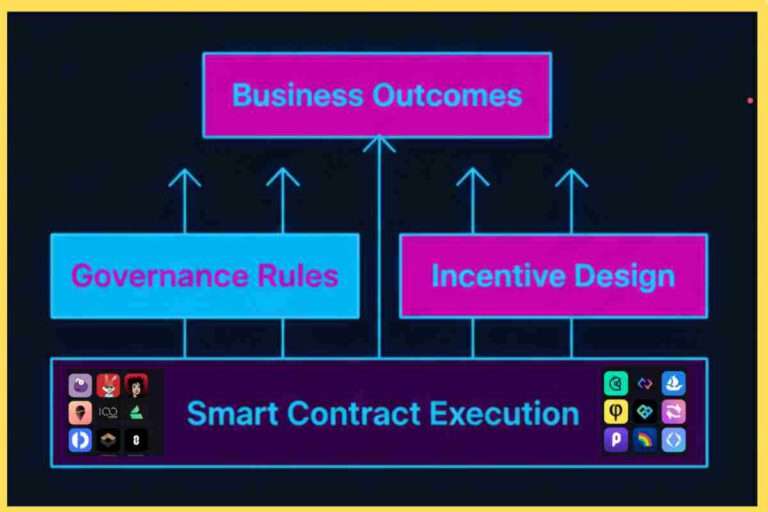
Selecting the right enterprise blockchain platform is only the first step. Long-term success depends on effective governance, privacy controls, operational management, and integration with existing business processes. Organizations that establish clear operational frameworks from the beginning are more likely to achieve successful enterprise adoption.
Enterprise blockchain platforms are designed for long-term business operations rather than experimental deployments. As blockchain networks expand across departments, partners, and jurisdictions, organizations need governance models, operational procedures, and privacy controls that ensure security, accountability, and business continuity.
Unlike public blockchain ecosystems, enterprise networks allow organizations to define who can participate, what information they can access, and how transactions are validated and audited.
A governance framework defines how an enterprise blockchain network is managed throughout its lifecycle.
Effective governance typically includes:
Most enterprise applications process information that cannot be shared with every network participant.
Organizations should evaluate:
Identity is a core component of permissioned blockchain platforms.
Enterprise identity management commonly includes:
Blockchain platforms deliver the greatest value when connected with existing enterprise systems.
Production blockchain environments require continuous operational visibility.
Organizations should monitor:
Enterprise blockchain platforms should support resilient operations during planned maintenance and unexpected disruptions.
| Operational Area | Why It Matters |
|---|---|
| Backup procedures | Protect critical data and configurations. |
| Disaster recovery | Reduce service interruptions. |
| High availability | Improve business continuity. |
| Monitoring | Detect issues early. |
| Incident response | Minimize operational impact. |
Enterprise blockchain platforms should be operated as strategic business infrastructure rather than isolated technology projects. Governance, privacy, identity management, integration, and operational resilience form the foundation of reliable enterprise blockchain ecosystems, while deeper security and regulatory guidance can be addressed through dedicated compliance and infrastructure resources.
💡 Expert Insight: Technology alone does not guarantee successful enterprise blockchain adoption. Organizations that combine strong governance, privacy controls, operational monitoring, and business integration are more likely to achieve sustainable long-term value from their blockchain initiatives.
📋 Enterprise Buyer’s Checklist
Before selecting an enterprise blockchain platform, define your business goals first—not your technology preferences. The right platform should align with your industry, governance model, integration requirements, scalability plans, and long-term digital transformation strategy.
Choosing the best enterprise blockchain platform is a strategic business decision rather than a technology purchase. While technical capabilities such as smart contracts, consensus mechanisms, and privacy controls are important, organizations should also evaluate operational maturity, ecosystem support, deployment flexibility, and future business requirements.
A structured evaluation process helps reduce implementation risks and ensures the selected platform can support enterprise growth for years to come.
Every successful blockchain initiative starts with a clearly defined business problem.
| Business Question | Why It Matters |
|---|---|
| What business challenge are you solving? | Aligns technology with measurable outcomes. |
| Who will participate in the network? | Determines governance and permissioning needs. |
| Which industry regulations apply? | Influences deployment and compliance decisions. |
| Will external partners join? | Helps define consortium or hybrid models. |
| What systems require integration? | Impacts implementation complexity. |
Different enterprise projects require different blockchain architectures.
| Deployment Model | Best For |
| Private Blockchain | Internal enterprise operations |
| Permissioned Blockchain | Multi-organization collaboration |
| Consortium Blockchain | Industry partnerships |
| Hybrid Blockchain | Public verification with private business logic |
Beyond blockchain technology, compare platforms based on business readiness.
The lowest implementation cost does not always produce the lowest total cost of ownership.
Organizations should choose an operating model that matches their technical expertise and operational capacity.
| Approach | Best For |
| Self-Managed Platform | Large enterprises with dedicated blockchain teams |
| Managed Enterprise Platform | Organizations seeking faster deployment and reduced operational overhead |
| Hybrid Approach | Businesses balancing control with managed services |
| Organization Type | Recommended Platform Strategy |
| Startup | Managed enterprise blockchain platform |
| Mid-sized Business | Permissioned blockchain with cloud deployment |
| Large Enterprise | Private or hybrid blockchain with enterprise governance |
| Financial Institution | Permissioned DLT with advanced privacy controls |
| Supply Chain Consortium | Consortium blockchain platform |
| Tokenization Project | Hybrid blockchain with smart contract support |
The best enterprise blockchain platform is the one that aligns with your organization’s business goals, governance requirements, deployment model, and long-term digital strategy. A structured evaluation framework helps organizations select platforms that support sustainable growth while reducing implementation risk.
💡 Expert Insight: Enterprise blockchain projects deliver the greatest value when technology decisions are driven by business objectives rather than platform popularity. Organizations that prioritize governance, interoperability, operational maturity, and long-term scalability are better positioned to achieve successful enterprise adoption.
Enterprise Blockchain Platforms • Private Blockchain Platforms • Hybrid Blockchain Solutions • Permissioned Distributed Ledger Technology (DLT)
Compare the best enterprise blockchain platforms for digital asset management, tokenization, supply chain, financial services, and institutional Web3 adoption. Explore private, hybrid, and permissioned blockchain solutions that help enterprises improve security, interoperability, governance, compliance, and digital transformation.
These are authoritative, non-competing references that strengthen topical authority: NIST Blockchain Research — Government guidance on blockchain architecture, security, and digital asset infrastructure. OWASP Smart Contract Security — Industry best practices for smart contract security, threat modeling, and vulnerability assessment.
💼 Business Insight
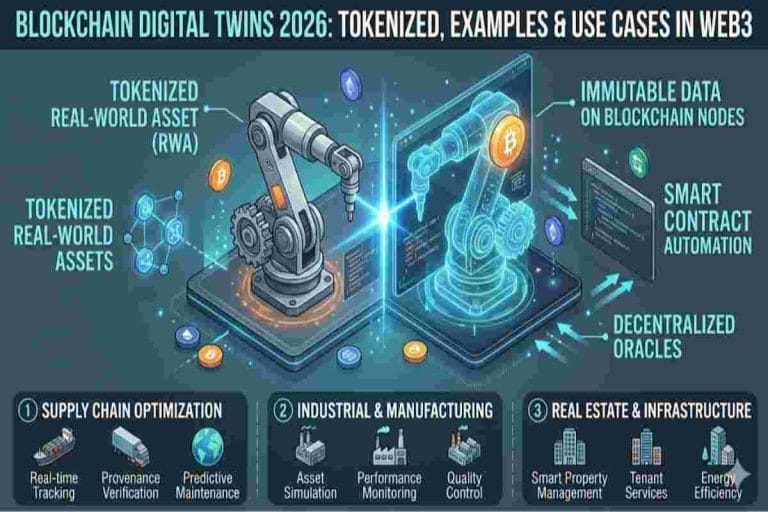
Enterprise blockchain platforms are not one-size-fits-all solutions. Every industry has different operational challenges, regulatory requirements, and collaboration models. Choosing a platform that aligns with your industry’s workflows, privacy needs, and ecosystem participants is often more important than choosing the platform with the longest feature list.
Enterprise blockchain adoption continues to expand across industries as organizations seek secure data sharing, workflow automation, digital asset management, and trusted collaboration between multiple parties. While the underlying technology remains similar, deployment strategies and business priorities vary significantly by sector.
Financial institutions use enterprise blockchain platforms to improve settlement efficiency, automate trade finance, support digital assets, and strengthen cross-border payment infrastructure.
Supply chain networks benefit from shared, tamper-resistant records that improve visibility across manufacturers, suppliers, distributors, and retailers.
Healthcare organizations use permissioned blockchain networks to improve collaboration while protecting sensitive patient and operational data.
Manufacturers leverage enterprise blockchain to streamline production processes, manage supplier ecosystems, and improve quality assurance.
Public sector organizations are exploring enterprise blockchain to improve transparency, reduce administrative complexity, and strengthen digital public services.
Enterprise blockchain platforms simplify ownership management, automate transactions, and support the tokenization of physical and financial assets.
| Industry | Primary Business Goal | Typical Deployment Model |
|---|---|---|
| Banking | Settlement and digital assets | Permissioned DLT |
| Supply Chain | Shared visibility and traceability | Consortium blockchain |
| Healthcare | Secure data collaboration | Private blockchain |
| Manufacturing | Operational transparency | Permissioned blockchain |
| Government | Trusted public services | Hybrid or permissioned blockchain |
| Real Estate | Digital ownership and tokenization | Hybrid blockchain |
Enterprise blockchain platforms support a broad range of industries, but the optimal deployment model depends on business objectives, governance requirements, integration needs, and ecosystem participants. Aligning platform capabilities with industry-specific use cases helps organizations maximize return on investment while reducing implementation risk.
💡 Expert Insight
Successful enterprise blockchain projects begin with a clearly defined business problem rather than a technology-first approach. Organizations that focus on measurable outcomes—such as faster settlement, improved traceability, automated workflows, or trusted data sharing—are more likely to realize long-term value from blockchain adoption.
What is an enterprise blockchain platform?
An enterprise blockchain platform is a distributed ledger solution designed for businesses that require controlled access, governance, privacy, and secure collaboration. Unlike public blockchains, enterprise platforms allow organizations to define network participants, permissions, and business rules while supporting scalable commercial applications.
What is the difference between blockchain and enterprise blockchain?
Public blockchains are open to anyone and prioritize decentralization, while enterprise blockchains operate in permissioned environments with defined governance, identity management, and privacy controls tailored for business operations.
What is Distributed Ledger Technology (DLT)?
Distributed Ledger Technology (DLT) is a shared database architecture where authorized participants maintain synchronized copies of the same ledger. Enterprise blockchain platforms use DLT to improve transparency, trust, and operational efficiency across multiple organizations.
Which industries use enterprise blockchain platforms?
Enterprise blockchain is widely used in banking, supply chain management, healthcare, manufacturing, insurance, government, real estate, trade finance, and digital asset management.
Why do businesses use enterprise blockchain?
Organizations adopt enterprise blockchain to improve collaboration, automate workflows, strengthen data integrity, reduce reconciliation, increase transparency, and streamline multi-party business processes.
Are enterprise blockchains secure?
Yes. Enterprise blockchain platforms typically include permission management, identity verification, encryption, governance controls, audit trails, and privacy features that support secure business operations.
What is a permissioned blockchain?
A permissioned blockchain only allows approved participants to access, validate, or manage the network. This model provides stronger governance and privacy than public blockchain networks.
What is a private blockchain?
A private blockchain is controlled by a single organization and is commonly used for internal enterprise operations where complete control over participants and data is required.
What is a consortium blockchain?
A consortium blockchain is jointly governed by multiple organizations that share responsibility for operating the network while maintaining agreed governance rules.
What is a hybrid blockchain?
A hybrid blockchain combines private business operations with selective public blockchain capabilities, allowing organizations to balance confidentiality and transparency.
Which deployment model is best for enterprises?
The best deployment model depends on business requirements. Permissioned and hybrid blockchain architectures are commonly selected because they balance governance, scalability, collaboration, and operational control.
Can enterprise blockchains connect to public blockchains?
Yes. Many enterprise platforms support interoperability through APIs, bridges, or cross-chain technologies, enabling selected data or assets to interact with public blockchain ecosystems.
What are enterprise smart contracts?
Enterprise smart contracts automate business rules, approvals, and transactions between authorized participants, helping organizations reduce manual processes and improve operational efficiency.
Can enterprise blockchain integrate with ERP and CRM systems?
Yes. Modern enterprise blockchain platforms commonly integrate with ERP, CRM, cloud services, identity providers, and business applications using APIs and middleware.
What consensus mechanisms are used in enterprise blockchain?
Enterprise platforms often use Practical Byzantine Fault Tolerance (PBFT), Raft, Istanbul BFT (IBFT), or Proof of Authority (PoA) because these mechanisms provide predictable performance and controlled governance.
Does enterprise blockchain support asset tokenization?
Yes. Many enterprise blockchain platforms support tokenization for real estate, securities, commodities, intellectual property, and other real-world assets through programmable smart contracts.
Can enterprise blockchain support cross-chain interoperability?
Many modern platforms support interoperability through APIs, messaging protocols, and blockchain bridges, enabling data and asset exchange across multiple blockchain networks.
What infrastructure is required for enterprise blockchain?
Production deployments typically require blockchain nodes, networking, cloud or on-premises infrastructure, identity services, APIs, monitoring, backup systems, and operational management tools.
How do organizations manage users on enterprise blockchains?
Organizations typically use digital identity systems, certificates, authentication services, and role-based access controls to manage network participants securely.
Can enterprise blockchain improve supply chain transparency?
Yes. Enterprise blockchain enables trusted record sharing, product traceability, shipment visibility, supplier verification, and auditability across supply chain participants.
Is enterprise blockchain suitable for regulated industries?
Yes. Permissioned blockchain platforms are widely used in regulated industries because they support governance, privacy, auditability, and controlled access.
How scalable are enterprise blockchain platforms?
Scalability varies by platform architecture, consensus mechanism, deployment model, and infrastructure. Most enterprise platforms are designed to support growing business workloads.
What are the biggest challenges of enterprise blockchain adoption?
Common challenges include governance design, integration complexity, organizational change management, interoperability, skills development, and selecting the right platform for long-term business goals.
How long does an enterprise blockchain implementation take?
Implementation timelines depend on project scope, integrations, governance requirements, and organizational readiness. Pilot projects may take a few months, while enterprise-wide deployments often require phased implementation.
What is the best enterprise blockchain platform?
There is no universal best platform. The right choice depends on industry requirements, deployment preferences, governance needs, integration capabilities, scalability objectives, and long-term business strategy.
How should enterprises compare blockchain platforms?
Organizations should evaluate deployment models, governance, privacy, interoperability, smart contract support, integration capabilities, scalability, operational maturity, and vendor ecosystem.
Should enterprises build or buy a blockchain platform?
Large organizations with specialized expertise may build customized solutions, while many businesses benefit from established enterprise platforms or managed services that reduce implementation complexity.
How much does an enterprise blockchain platform cost?
Costs vary depending on licensing, infrastructure, cloud resources, implementation services, integrations, support requirements, and ongoing operational management.
What trends are shaping enterprise blockchain in 2026?
Key trends include asset tokenization, AI integration, cross-chain interoperability, privacy-enhancing technologies, digital identity, enterprise automation, and increasing institutional adoption.
What should organizations do before choosing an enterprise blockchain platform?
Start by defining the business problem, identifying stakeholders, evaluating governance requirements, reviewing integration needs, comparing platform capabilities, and planning for long-term scalability rather than focusing only on initial implementation costs.
📌 FAQ Summary: Enterprise blockchain platforms continue to evolve from experimental technologies into strategic business infrastructure. Organizations that understand governance, architecture, deployment models, interoperability, and long-term operational requirements are better equipped to select platforms that support sustainable digital transformation.
🏆 Executive Summary
There is no single enterprise blockchain platform that is best for every organization. The right choice depends on your business objectives, industry requirements, governance model, integration strategy, privacy needs, and long-term digital transformation roadmap. Organizations that evaluate platforms using structured business and technical criteria are more likely to achieve successful enterprise blockchain adoption.
Enterprise blockchain platforms have evolved into strategic business infrastructure that enables trusted collaboration, workflow automation, secure data sharing, digital asset management, and multi-party process optimization. Rather than viewing blockchain as a standalone technology, modern organizations increasingly treat it as part of a broader enterprise architecture that integrates with cloud platforms, APIs, ERP systems, digital identity, and existing business applications.
After evaluating the leading enterprise blockchain platforms across deployment flexibility, governance, privacy, smart contracts, interoperability, scalability, integration capabilities, developer experience, and operational maturity, the best platform is ultimately the one that aligns with your organization’s current needs while supporting future growth.
| Organization Type | Recommended Platform Strategy | Primary Evaluation Focus |
|---|---|---|
| Startup | Managed enterprise blockchain platform | Speed, simplicity, cost efficiency |
| Mid-Sized Business | Permissioned blockchain platform | Integration, scalability, governance |
| Large Enterprise | Private or hybrid blockchain platform | Operational control, security, flexibility |
| Banking & Financial Services | Permissioned DLT platform | Privacy, compliance, settlement efficiency |
| Supply Chain Consortium | Consortium blockchain platform | Collaboration, transparency, traceability |
| Asset Tokenization Projects | Hybrid blockchain platform | Smart contracts, interoperability, digital assets |
| Government & Public Sector | Permissioned enterprise blockchain | Identity, governance, auditability |
Before selecting a platform, organizations should validate the following questions:
| Decision Area | Key Question |
|---|---|
| Business Objectives | Does the platform solve a measurable business problem? |
| Deployment Model | Is private, permissioned, consortium, or hybrid architecture the best fit? |
| Governance | Can participants, permissions, and policies be managed effectively? |
| Integration | Will it connect seamlessly with existing enterprise systems? |
| Scalability | Can it support long-term business growth and increasing workloads? |
| Interoperability | Does it enable collaboration across internal and external ecosystems? |
| Operations | Are monitoring, management, and support capabilities enterprise-ready? |
| Future Readiness | Can it adapt to emerging technologies and business requirements? |
Enterprise blockchain technology is rapidly evolving beyond isolated distributed ledgers into interconnected digital business ecosystems.
Over the coming years, organizations can expect greater adoption of:
As enterprise adoption accelerates, blockchain platforms will increasingly serve as foundational infrastructure supporting secure collaboration across industries, partners, and digital ecosystems.
💡 Expert Recommendation: Treat enterprise blockchain as a long-term business capability rather than a short-term technology project. Successful implementations begin with a clearly defined business objective, strong governance, thoughtful platform selection, and a roadmap that supports future integration, scalability, and organizational growth.
The best enterprise blockchain platforms are those that deliver measurable business value while supporting governance, privacy, interoperability, and long-term operational success. By evaluating platforms through a structured enterprise framework instead of focusing solely on technical features or vendor popularity, organizations can build resilient blockchain solutions that support digital transformation well beyond 2026.
Whether your goal is improving supply chain visibility, modernizing financial infrastructure, enabling asset tokenization, or creating secure multi-party business networks, enterprise blockchain should be approached as a strategic investment in the future of your organization’s digital infrastructure.
To ensure your architecture meets global institutional standards for digital ledger security and interoperability, refer to the technical guidelines provided by the National Institute of Standards and Technology (NIST).
🚀 Closing Thought: Enterprise blockchain adoption is no longer about asking whether the technology is ready. The real question is whether your organization is prepared to select, govern, and operate the right platform to create lasting business value.
Enterprise blockchain platforms represent one layer of a broader digital asset ecosystem. To build a complete enterprise blockchain strategy, explore these related topics: