
Search by title, topic or phrase
Use our Crypto Search Engine 🔍 to find the topics and keywords you're looking for.
Updated: September 2026
·
Focus: cross-chain applications, business value, execution and interoperability risk
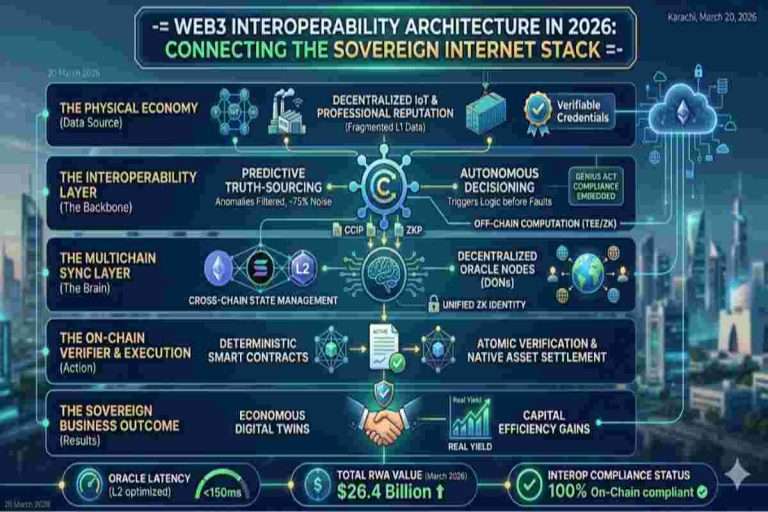
Web3 interoperability use cases 2026 are moving beyond the simple idea of connecting one blockchain to another. The more useful question is whether multiple networks can work together to solve a problem that a single network cannot solve efficiently.
Users, liquidity, digital assets, credentials, applications and enterprise systems increasingly operate across different blockchain environments. That creates practical problems around distribution, payments, execution, identity, settlement, liquidity and coordination.
This guide evaluates eight major cross-chain use cases through an application-first framework. Instead of simply listing bridges or blockchain networks, it asks what problem exists, why multiple networks are necessary, what actually crosses the boundary, who benefits, what value is created and what additional risk interoperability introduces.
Table of Contents
ToggleThe strongest Web3 interoperability use cases in 2026 include multi-chain asset distribution, payment routing, cross-chain liquidity, multi-network financial applications, portable credentials, enterprise workflows, distribution of tokenized assets and automated cross-chain execution. The common principle is simple: interoperability should improve the outcome of an application enough to justify the additional security, operational, compliance and recovery complexity.

The most useful cross-chain applications have a reason to operate across network boundaries. The table below provides a practical map of the eight use cases covered in this guide.
| Use case | Problem solved | Interoperability role | Primary value | Main constraint |
|---|---|---|---|---|
| Multi-chain asset distribution | Assets are concentrated on one network. | Moves or represents existing assets across environments. | Broader application and user access. | Security and accounting. |
| Multi-chain payment routing | Payer and recipient use different networks. | Coordinates routing, liquidity and settlement. | Less manual chain management. | Liquidity and settlement reliability. |
| Cross-chain liquidity | Capital is fragmented across networks. | Finds and routes useful liquidity. | Better capital access and execution. | Depth, cost and execution risk. |
| Multi-network finance | Financial state is distributed. | Coordinates value and application state. | Greater infrastructure flexibility. | State consistency and recovery. |
| Portable credentials | Users repeatedly prove the same attributes. | Makes credentials usable across applications. | Portability and lower friction. | Privacy, trust and revocation. |
| Enterprise workflows | Organizations use disconnected systems. | Coordinates verified data and events. | Less reconciliation and better visibility. | Governance and data quality. |
| Tokenized asset distribution | Tokenized assets are limited to one environment. | Extends access while preserving controls. | Market and application reach. | Legal and transfer restrictions. |
| Automated cross-chain execution | Users should not manage multiple networks manually. | Routes and coordinates execution automatically. | Simpler UX and execution choice. | Solver and settlement dependencies. |
Connecting networks is not automatically valuable. Interoperability earns its place when it produces a measurable improvement in access, execution, liquidity, coordination, user experience or operational efficiency.

A technically successful cross-chain transaction is not necessarily a useful application. The right starting point is the problem the application is trying to solve.
Before adding cross-chain functionality, identify the friction that exists without it. A legitimate interoperability requirement usually appears when valuable users, assets, information or execution capabilities are distributed across different environments.
| Cross-network object | Example | Application purpose |
|---|---|---|
| Asset | Token or digital value | Distribution or execution |
| Instruction | Transaction or intent | Remote execution |
| Data | Verified event | Coordination |
| Credential | Eligibility claim | Portable verification |
| State/result | Completed action | Conditional executio |

One of the clearest interoperability use cases is making an existing digital asset available in more than one application environment. The important distinction is that this section is about distribution after an asset already exists, not about creating or tokenizing the asset.
An asset may have users, liquidity or applications on another network. Keeping it confined to its original environment can limit its usefulness even when another network provides cheaper execution, a larger user base or a more suitable application ecosystem.
A well-designed system should preserve a coherent representation and supply model rather than casually creating disconnected versions of the same asset. The engineering and governance question is therefore how ownership, authorization, supply and settlement remain consistent across environments.
| Potential benefit | What to measure | Warning sign |
|---|---|---|
| Wider application access | Active destination users | Little real destination demand |
| Improved liquidity access | Useful liquidity and execution quality | Thin or artificial liquidity |
| Lower user friction | Steps and completion rate | More manual operations |
| Greater ecosystem reach | Relevant application integrations | Integration without users |
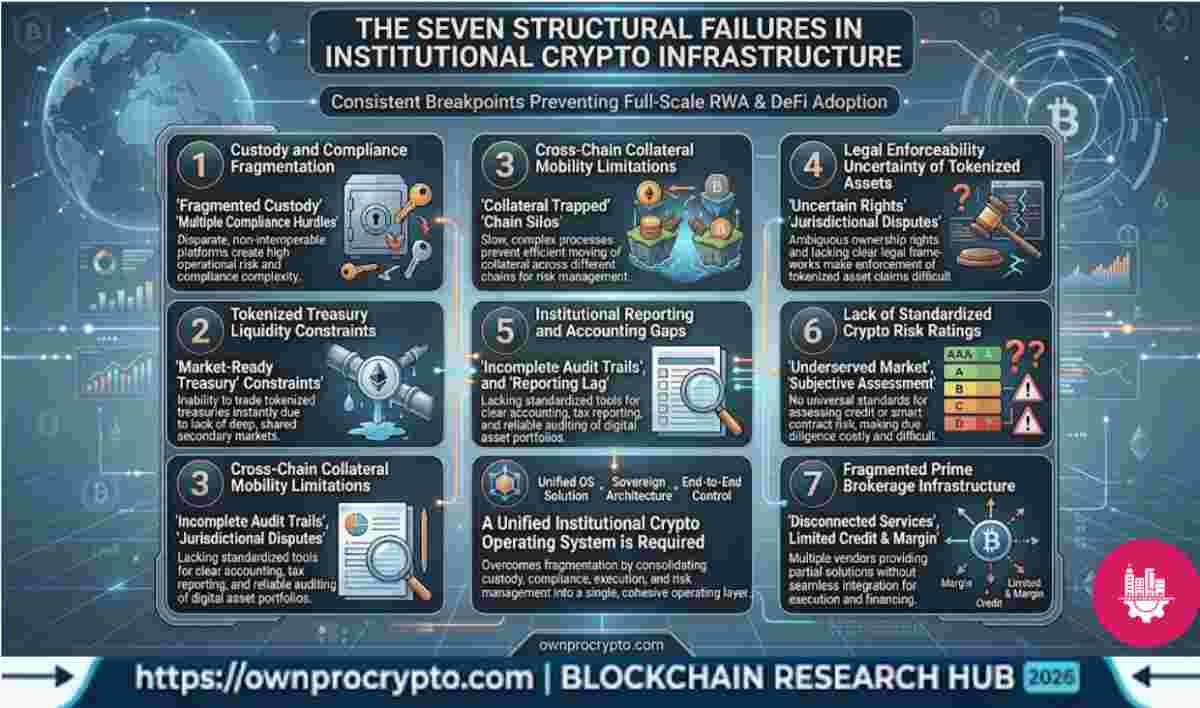
Payment interoperability addresses a specific problem: the payer and recipient may use different networks even when they agree on the economic outcome. The cross-chain question is therefore about routing the desired payment between environments, not about explaining payments themselves.
Imagine a payer holding an accepted asset on Network A while the recipient prefers settlement on Network B. A manual workflow can require asset acquisition, network switching, fee management, transfer and confirmation before the payment is complete.
Payer funds → route selection → liquidity / conversion → cross-network execution → recipient settlement → reconciliation
A payment application should not add networks simply to advertise multi-chain support. The relevant metrics are completion rate, total user friction, settlement reliability, effective cost and the availability of useful counterparties.
Boundary with stablecoin payments
Stablecoin payment mechanics, treasury operations, settlement infrastructure and payment strategy belong to the dedicated payments topic. This article focuses on the additional problem created when the payment participants operate across different networks.

Blockchain liquidity is fragmented. Different networks can have different users, capital pools, market makers, applications and execution conditions. Interoperability becomes useful when an application can access economically useful liquidity that is not available locally.
An application may have genuine demand but insufficient local liquidity. A cross-network route can potentially widen the set of available execution paths, provided the additional routing cost and risk do not erase the benefit.
| Factor | Question | Why it matters |
|---|---|---|
| Depth | Is useful liquidity actually available? | Determines execution quality. |
| Cost | What is the total route cost? | A theoretical price advantage may disappear after fees. |
| Latency | How long does settlement take? | Important for time-sensitive execution. |
| Risk | What dependencies are introduced? | More routing can mean more failure points. |
The objective is not to connect every liquidity pool. The objective is to make economically useful liquidity available where an application needs it while keeping routing, settlement and security risks proportionate to the benefit.
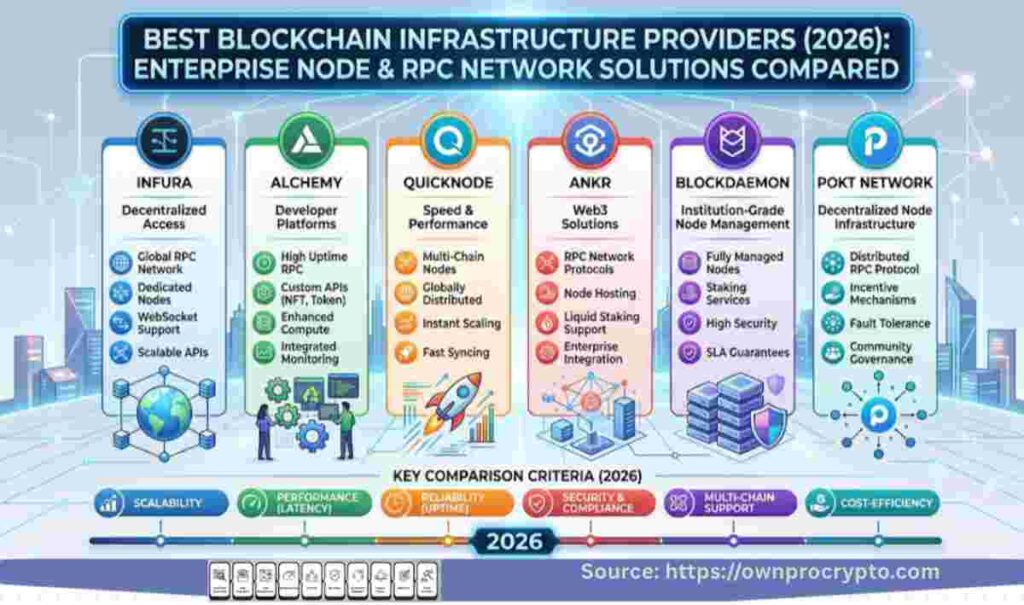
Some financial applications need access to capabilities distributed across several networks. The key interoperability challenge is not merely moving tokens; it is coordinating financial state, authorization and execution across environments.
A simple asset transfer can be understood as moving value from one environment to another. A multi-network financial workflow may instead require one network to recognize a condition created on another network before allowing a third action to occur.
| Requirement | Question to answer | Failure consequence |
|---|---|---|
| State verification | Did the source event really occur? | Incorrect destination action. |
| Finality | When is the source state sufficiently final? | Premature execution. |
| Idempotency | Can the same instruction execute twice? | Duplicate state change. |
| Recovery | What happens when a step fails? | Stuck or disputed workflow. |
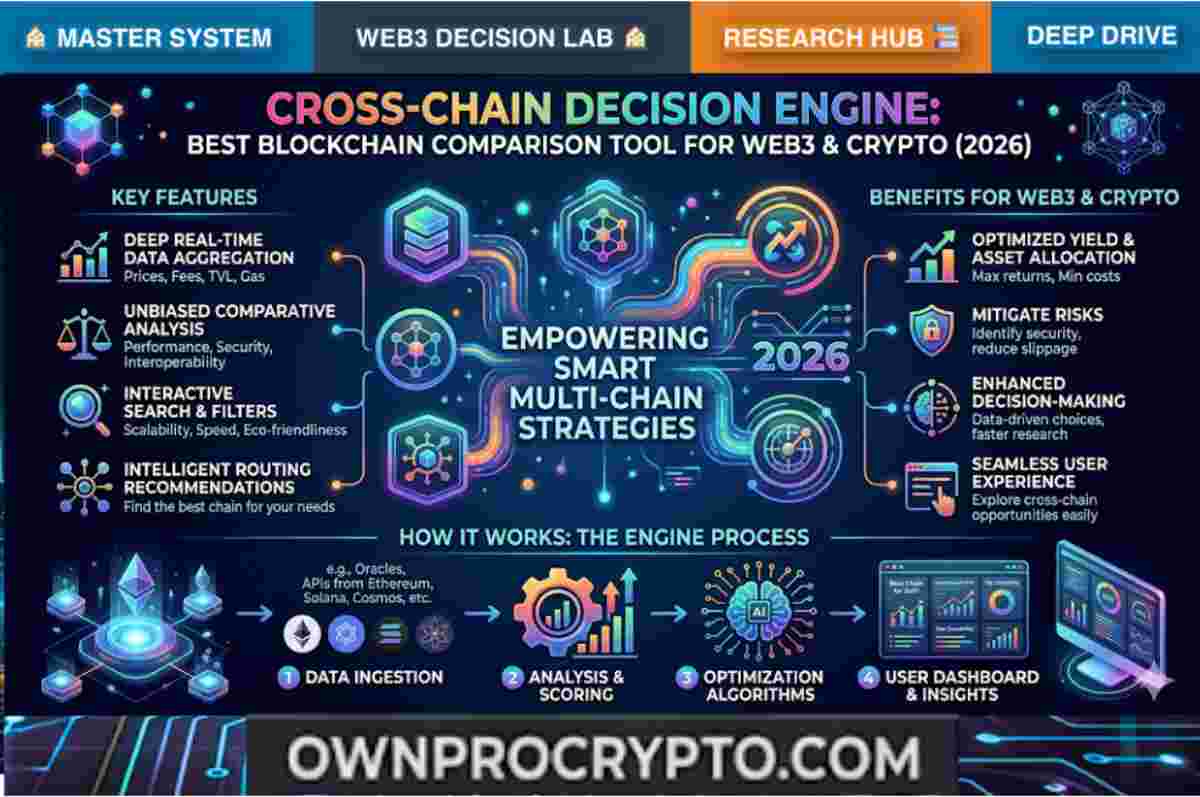
The decision engine transforms deployment planning into an interactive multi-criteria analysis. Rather than selecting networks based on subjective preference, users adjust priority weights to calculate weighted fit scores for leading networks including Ethereum, Polygon, Arbitrum, Optimism, Base, Avalanche, Solana, and BNB Chain.
To run a multi-criteria evaluation and find the optimal blockchain deployment environment for your protocol, configure your application requirements, select an ecosystem profile, and execute the scoring model as outlined below.
Identity interoperability is less about creating another identity system and more about making trusted credentials usable across independent applications and environments.
A user may have a credential establishing an attribute, qualification or eligibility condition. A different application may need to verify that attribute without forcing the user through a completely separate process.
Enterprise workflows can span ERP systems, logistics platforms, private networks, public blockchains, certification systems, payment infrastructure and existing databases. The practical interoperability opportunity is therefore often to connect blockchain-enabled components with systems that already exist.
A multi-party supply-chain workflow may involve provenance, supplier certification, logistics events, inspections, customs information, delivery confirmation and settlement. Different organizations do not need to replace every existing system with one blockchain for those events to become coordinated.
| Workflow problem | Interoperability opportunity | Potential outcome |
|---|---|---|
| Different records | Exchange verified events | Less reconciliation |
| Repeated verification | Portable evidence | Faster verification |
| Delayed coordination | Automated triggers | Faster exception handling |
| Disconnected participants | Shared verification layer | Better coordination |
Tokenization and interoperability solve different problems. Tokenization answers how an asset is represented digitally. Interoperability addresses what happens when that already-existing representation needs to interact with another network.
For regulated or permissioned assets, interoperability cannot simply mean unrestricted movement. The destination workflow may need to preserve eligibility, identity, jurisdiction, transfer restrictions, custody controls and other conditions attached to the asset.
| Control | Interoperability question | Why it matters |
|---|---|---|
| Eligibility | Is the destination holder eligible? | Prevents invalid transfers. |
| Jurisdiction | Can the asset operate in the destination environment? | Legal restrictions can follow the asset. |
| Supply | How is total supply reconciled? | Avoids inconsistent representations. |
| Custody | Who controls the asset during the workflow? | Maintains operational accountability. |
The RWA or tokenization question is “How is the asset created and governed?” The interoperability question is “How does an existing asset reach the environments where eligible users, applications and liquidity exist?”

Interoperability creates utility, but it also creates dependencies. A multi-chain application inherits the risks of its individual networks plus the risks created by the connections between them.
| Risk | What can fail? | Application response |
|---|---|---|
| Message verification | False or incorrectly interpreted source information. | Strong verification and explicit assumptions. |
| Bridge / transport security | Interoperability mechanism is compromised. | Limit trust and monitor dependencies. |
| Finality mismatch | Destination acts before source state is sufficiently final. | Use appropriate confirmation policies. |
| Liquidity failure | Expected route becomes uneconomic or unavailable. | Reroute, pause or reject. |
| Network outage | One environment becomes unavailable. | Fallback, queue, pause or recovery. |
| Duplicate execution | One event triggers multiple actions. | Idempotency and replay protection. |
| State inconsistency | Networks temporarily reflect different states. | Explicit state machine and recovery logic. |
| Dependency concentration | One provider becomes a critical dependency. | Redundancy and dependency monitoring. |
| Compliance mismatch | Rules differ across environments. | Policy-aware routing and eligibility controls. |
A serious cross-chain application should know what happens when a workflow does not complete normally.
The right question is not whether an application can become multi-chain. The better question is whether it should.
| Criterion | Question to ask | Strong signal |
|---|---|---|
| Business necessity | Does the application genuinely need multiple networks? | Important capability exists elsewhere. |
| User benefit | Does the user experience improve? | Fewer manual steps. |
| Liquidity | Does the route unlock useful liquidity? | Better execution after total costs. |
| Security | What new trust assumptions exist? | Assumptions are explicit and monitored. |
| Reliability | What happens if one network fails? | Defined fallback and recovery. |
| Compliance | Can controls remain enforceable? | Policy follows the workflow. |
| Total cost | Does routing actually improve economics? | Benefit exceeds infrastructure cost. |
| Complexity | How many additional dependencies exist? | Complexity is controlled. |
| Recovery | Can incomplete operations be resolved? | Clear recovery paths exist. |
| Long-term value | Does the use case solve a durable problem? | Value remains after the initial narrative fades. |
Teams can score each criterion from 1 to 5. A score of 1 indicates a weak case, 3 indicates an acceptable case and 5 indicates a strong case. The score should expose trade-offs rather than create an automatic deployment decision.
| Area | Score | Interpretation |
|---|---|---|
| Business necessity | 5/5 | Multiple environments provide genuinely different capabilities. |
| User benefit | 5/5 | Users avoid unnecessary network management. |
| Security | 3/5 | Risks exist but can potentially be controlled. |
| Recovery | 2/5 | Failure handling needs more engineering. |
| Long-term value | 5/5 | The application has a durable reason to operate across networks. |
A use case can have strong commercial value and still require staged deployment because security, recovery or operational controls are immature. The framework is designed to reveal that trade-off before capital and users are exposed to unnecessary complexity.

The next stage of interoperability is unlikely to be defined simply by adding more bridges. The more important shift is toward applications that coordinate multiple networks without forcing users to understand every underlying transaction.
A mature application can increasingly make network selection an infrastructure decision rather than a user decision. The application may determine the appropriate execution environment, liquidity route, fee mechanism and settlement path based on the user’s desired outcome.
Intent-based designs allow users to express an outcome rather than manually specifying every underlying step. Cross-chain intent standards such as ERC-7683 illustrate the direction: specialized solvers can evaluate and fulfill cross-network orders while the user focuses on the desired result.
Verifiable credentials provide another important direction. Instead of rebuilding trust relationships separately inside every application, credentials can be designed for machine-verifiable exchange across different environments while maintaining privacy and explicit issuer-verifier trust relationships.
That may be the most important usability question in Web3 interoperability. Early blockchain applications often required users to understand wallets, networks, gas assets, bridges, confirmations and chain switching. A more mature model moves those decisions behind the application interface.
User goal → application determines route → liquidity and execution are coordinated → cross-chain state is verified → destination action completes → user receives the outcome
| Useful interoperability | Unnecessary interoperability |
|---|---|
| Solves a real user or business problem. | Exists mainly because multi-chain sounds attractive. |
| Improves measurable outcomes. | Adds fees without meaningful benefit. |
| Has explicit security assumptions. | Hides critical dependencies. |
| Includes failure and recovery paths. | Assumes every transaction succeeds. |
| Makes the user experience simpler. | Forces users to manage more infrastructure. |
These questions address the practical search intent around cross-chain applications, interoperability value, security, payments, assets, identity and the future of multi-network Web3.
The strongest categories include multi-chain asset distribution, payment routing, liquidity access, multi-network financial workflows, portable credentials, enterprise coordination, tokenized-asset distribution and automated cross-chain execution. The strongest use cases are those where multiple networks provide capabilities that one network cannot efficiently provide alone.
Blockchain ecosystems have different execution environments, users, liquidity, costs and application capabilities. Interoperability can allow applications to use those differences rather than forcing every participant into one network.
A practical example is an application where users hold assets on one network but need to interact with an application or recipient on another. Instead of forcing the user to manually manage the network transition, the application can coordinate routing, execution and settlement behind one interface.
It can expand application reach, improve access to liquidity, reduce manual network management, coordinate enterprise workflows and allow applications to use specialized network capabilities. The benefit should be measured rather than assumed.
Interoperability describes the capability of different networks or systems to communicate, transfer value or exchange information. A cross-chain application uses that capability to solve a specific user or business problem.
Safety depends on the architecture and its trust assumptions. Cross-chain systems can introduce risks involving message verification, bridge or transport security, finality, liquidity, replay protection, network outages, dependency concentration and recovery. A system should be evaluated according to what must be trusted and what happens when a component fails.
The biggest problem is not simply moving information between networks. It is maintaining correct security, state, authorization, liquidity and recovery assumptions while the workflow spans multiple systems with different properties.
It can allow an already-tokenized asset to reach additional application environments, liquidity venues or eligible users. The interoperability layer must still preserve the asset’s ownership, eligibility, transfer, compliance and settlement requirements.
It can coordinate a payment when the payer’s assets and the recipient’s preferred settlement environment are different. The application can potentially manage routing, conversion, execution and settlement so the user does not have to perform every network operation manually.
Chain abstraction is the broader user-experience approach of hiding unnecessary network complexity behind an application. Instead of manually selecting networks and managing individual transaction steps, the application can determine where and how the requested outcome should be executed.
An intent lets a user specify a desired outcome rather than manually defining every underlying transaction. Solvers or execution infrastructure can then determine how the required actions, liquidity and settlement should be coordinated across networks.
Not necessarily. A mature application can potentially handle routing and settlement through infrastructure behind the interface. The user’s objective can remain separate from the technical process used to achieve it.
A bridge is one mechanism that can facilitate cross-network asset or message movement. Interoperability is the broader capability and architecture that allows networks or applications to coordinate. A cross-chain application may depend on one or several interoperability mechanisms rather than a single bridge.
It can in situations where another network provides cheaper execution or a more efficient route, but interoperability itself introduces costs. The correct comparison is the total cost of the complete cross-chain workflow rather than the fee of one individual transaction.
Enterprises can use interoperability to coordinate blockchain-enabled workflows with other blockchains, private networks, enterprise systems, verification services and settlement infrastructure. The strongest cases usually connect existing systems rather than requiring every participant to migrate to one blockchain.
That is a major direction for Web3 application design. Users increasingly benefit when network selection, liquidity routing, gas management and cross-chain execution are handled by application infrastructure rather than exposed as separate technical tasks.
The strongest Web3 interoperability use cases in 2026 are not simply examples of one blockchain communicating with another. They are applications where fragmented infrastructure creates a genuine problem and cross-network coordination produces a better outcome.
The eight major categories examined here—asset distribution, payment routing, liquidity access, multi-network finance, portable credentials, enterprise workflows, tokenized-asset distribution and automated execution—share the same underlying principle.
That is the difference between adding another blockchain integration and building a genuinely useful multi-network application. The goal is not to make cross-chain activity more visible. The goal is to make multiple networks useful without forcing users and businesses to carry the complexity themselves.
External references are provided for technical verification and further research. Protocols, bridge architectures, standards, and security assumptions can change; readers should review current primary documentation before making material deployment or investment decisions.
A reference article should remain useful after the current protocol names, narratives and market conditions change. This guide therefore focuses on architecture, verification, trust assumptions, security boundaries, liquidity coordination and decision criteria rather than treating any single interoperability protocol as permanently secure.