
Search by title, topic or phrase
Use our Crypto Search Engine 🔍 to find the topics and keywords you're looking for.
Modern Web3 developers must decide which application components belong on-chain and which should remain off-chain. This guide presents 10 practical Web3 architecture rules for balancing decentralization, security, performance, cost, privacy, and scalability.
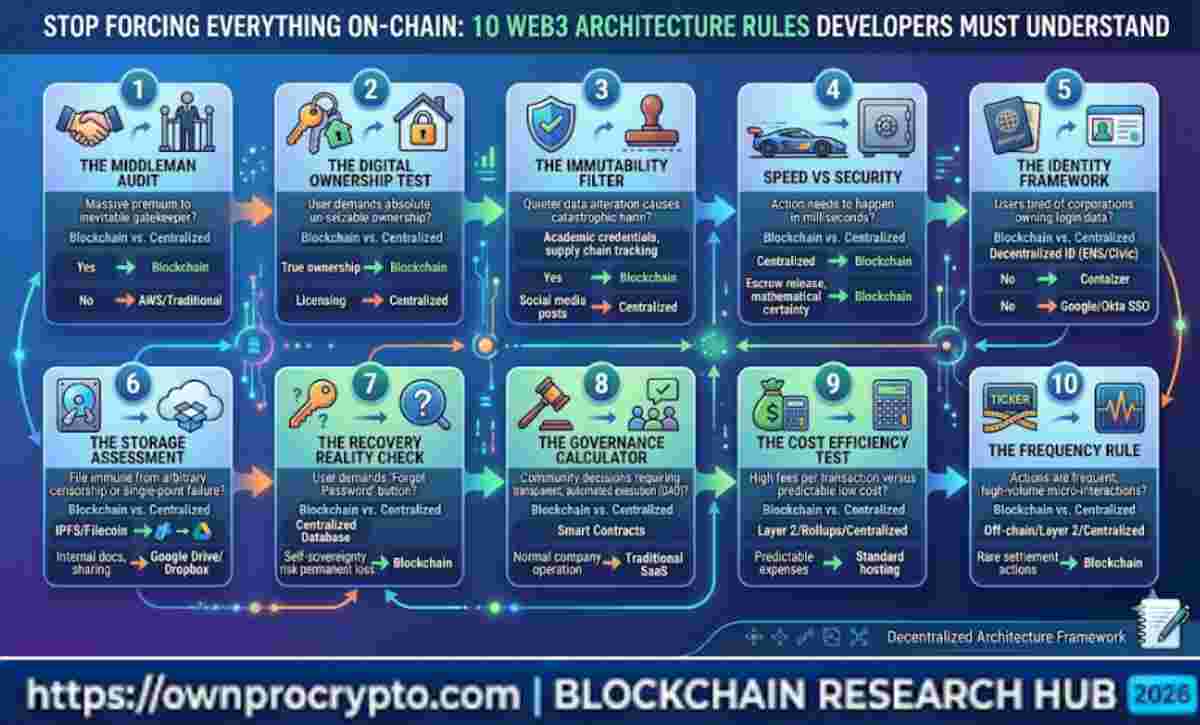
Table of Contents
Toggle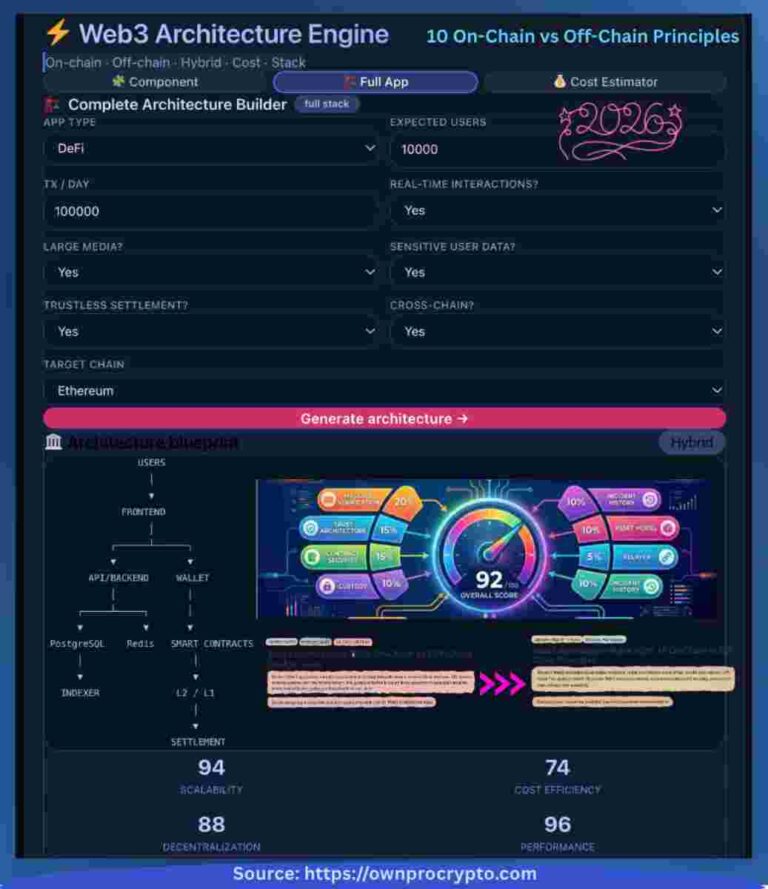
| Use Case | Why Blockchain Helps |
|---|---|
| Escrow | Trustless settlement |
| NFTs | Ownership verification |
| DAO voting | Transparent governance |
| Stablecoins | Permissionless transfer |
| Identity proofs | Tamper resistance |
| Supply chains | Immutable records |
| Requirement | Recommended System |
|---|---|
| Millisecond response | Centralized |
| Financial settlement | Blockchain |
| Social interactions | Off-chain |
| Asset ownership | On-chain |
| Real-time gaming | Hybrid |
| Escrow release | On-chain |
| Authentication Need | Best Solution |
|---|---|
| Mainstream SaaS onboarding | Google OAuth |
| Enterprise login | Okta/Auth0 |
| DAO participation | WalletConnect |
| Web3 identity portability | ENS |
| Anonymous access | Wallet-only auth |
| Data Type | Recommended Storage |
|---|---|
| Images | CDN/S3 |
| NFTs metadata | IPFS |
| Large video files | Cloud storage |
| Verification records | Blockchain |
| Application logs | PostgreSQL |
| Immutable proofs | On-chain hash |
| User Expectation | Recommended Architecture |
|---|---|
| Forgot password recovery | Centralized auth |
| Full self-sovereignty | Wallet custody |
| Enterprise support | Hybrid |
| Mainstream onboarding | OAuth + wallet optional |
| Anonymous access | Wallet-only |
| Governance Need | Recommended System |
|---|---|
| DAO treasury | Smart contracts |
| Startup operations | Traditional management |
| Community protocol upgrades | On-chain voting |
| Internal business strategy | Centralized execution |
| Token distribution | Smart contracts |
| Application Action | Blockchain Suitability |
|---|---|
| Financial settlement | High |
| NFT ownership | High |
| Chat messages | Low |
| Real-time gaming input | Low |
| Escrow contracts | High |
| Analytics tracking | Very low |
| Interaction Type | Recommended Layer |
|---|---|
| Likes/comments | Off-chain |
| Messaging | Off-chain |
| Escrow settlement | On-chain |
| NFT transfers | On-chain |
| Real-time gameplay | Off-chain |
| Ownership verification | On-chain |
| Application Component | On-Chain? | Primary Reason |
|---|---|---|
| Asset ownership | Usually yes | Verifiable ownership |
| Transaction settlement | Usually yes | Trust and finality |
| Large media files | Usually no | Cost and scalability |
| Private user data | Usually no | Privacy |
| High-frequency application data | Usually no | Performance and cost |
| Feature | Blockchain | Traditional Server |
|---|---|---|
| Speed | Slow | Fast |
| Trust | Mathematical | Organizational |
| Cost | Higher | Lower |
| Ownership | User-controlled | Platform-controlled |
| Recovery | Difficult | Easy |
| Scalability | Limited | High |
| Transparency | Public | Private |
| Immutability | Strong | Weak |
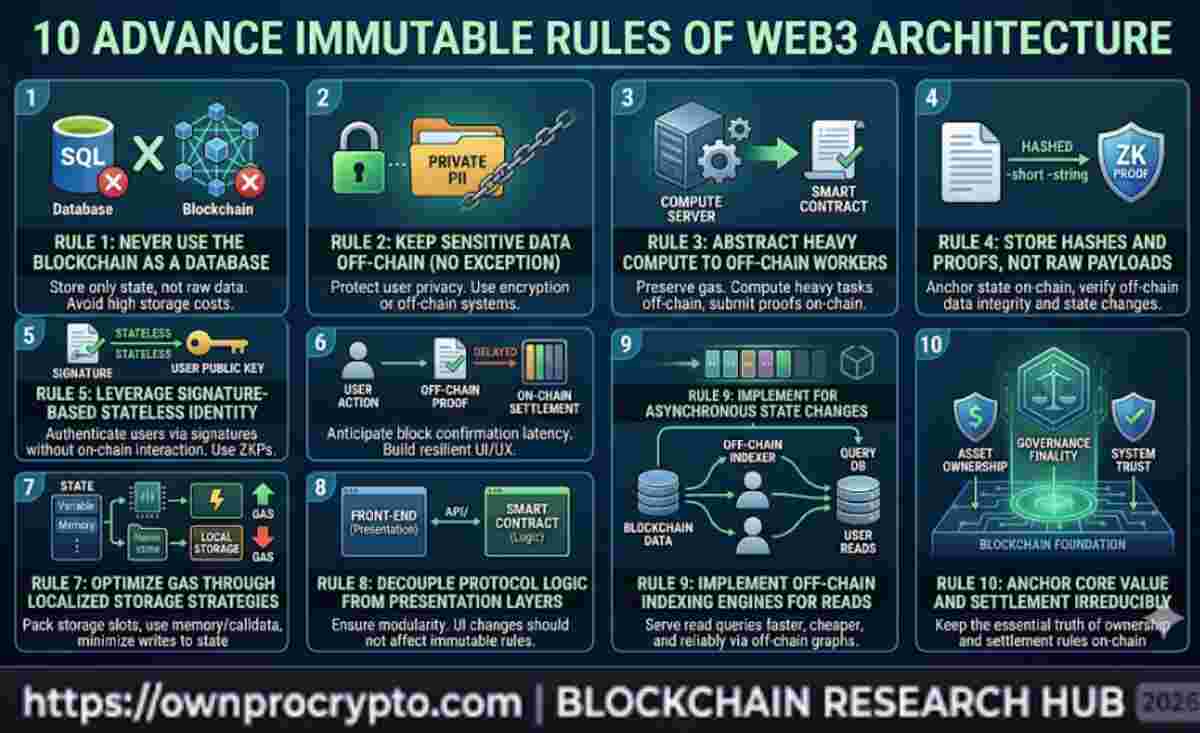
The 10 Web3 architecture rules above help determine whether a component should use blockchain infrastructure. These five technical principles take the next step: they explain how to design the on-chain and off-chain boundary efficiently once that decision has been made.
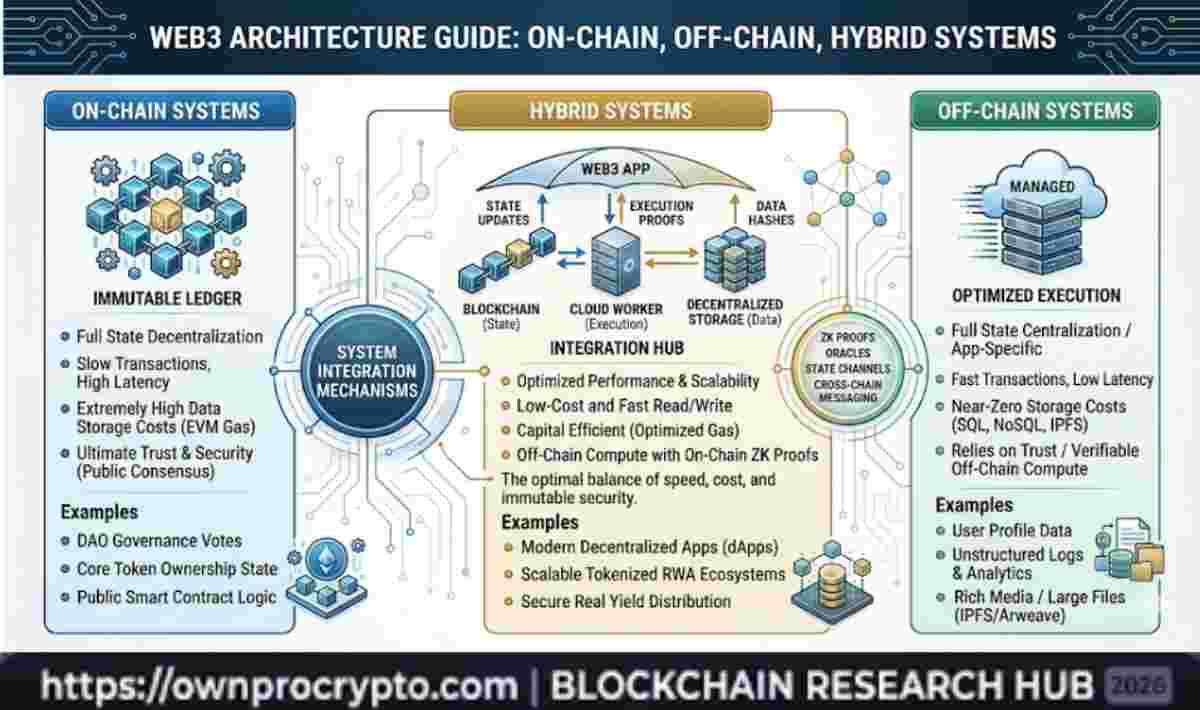
Modern Web3 applications rarely need every component to run directly on a blockchain. A practical architecture separates trust-critical state from workloads that are better handled by application servers, databases, decentralized storage, indexing systems, or other off-chain infrastructure.
Blockchains are designed for shared state, verification, ownership, settlement, and deterministic execution. They are not an efficient replacement for every database in an application stack.
Keep the state that benefits from decentralized verification on-chain, while large files, search indexes, analytics, frequently changing application data, and other high-volume datasets can remain in appropriate off-chain systems. This reduces unnecessary storage costs and keeps the blockchain focused on the information that actually needs network-wide verification.
Public blockchain data should be treated as potentially visible and independently verifiable. Personal information, private business records, credentials, and other sensitive application data should therefore remain outside the blockchain by default.
The blockchain can instead store the ownership, permissions, commitments, or verification information required by the application. This separates sensitive data from the public settlement layer while still allowing important claims to be independently verified.
Not every computation needs to execute directly inside a smart contract. Resource-intensive processing, complex calculations, analytics, high-volume application logic, and other workloads can often be handled by off-chain services when they do not require every blockchain participant to reproduce the computation.
The blockchain can then receive the result, commitment, proof, or settlement action that actually requires decentralized verification. This approach allows developers to preserve blockchain guarantees without forcing every workload through the most expensive execution environment.
When large data does not need to live entirely on-chain, an application can keep the payload in an appropriate off-chain system while recording a cryptographic hash, commitment, identifier, or other verifiable reference on-chain.
This approach allows the application to demonstrate that an off-chain document, dataset, media file, or other resource corresponds to a particular on-chain commitment without requiring the entire payload to be replicated as blockchain state.
Moving data and computation off-chain does not mean removing blockchain verification from the application. The key question is which parts of the system require a shared and independently verifiable source of truth.
Asset ownership, transaction settlement, critical protocol state, and rules that users need to verify without relying on a single intermediary are strong candidates for on-chain representation when the application’s requirements justify it.
The resulting architecture is usually hybrid: keep trust-critical state and settlement where decentralized verification adds value, while moving performance-sensitive, storage-heavy, private, or high-frequency workloads to appropriate off-chain infrastructure.
The complete framework combines the original 10 decision rules with these five technical principles. The first layer determines whether blockchain is appropriate; the second determines how the blockchain and off-chain components should work together.
| Layer | Purpose | Key Question |
|---|---|---|
| Rules 1–10 | Architecture decisions | Should this use blockchain? |
| Principle 1 | Storage architecture | Does this data actually need blockchain state? |
| Principle 2 | Privacy architecture | Should this information be publicly verifiable? |
| Principle 3 | Compute architecture | Does this computation need decentralized execution? |
| Principle 4 | Data integrity | Can the payload remain off-chain while its integrity is verifiable? |
| Principle 5 | Settlement architecture | What must remain independently verifiable on-chain? |
From business decisions → technical principles → hybrid architecture
Storage Principle
Sensitive Data
Heavy Computation
Not every problem needs a blockchain—and the strongest Web3 architectures begin by knowing where decentralization actually creates value. This decision tree provides a practical path for evaluating whether a workload belongs on-chain, off-chain, or in a hybrid architecture. It starts with the fundamental question of trustless verification, then examines ownership, settlement, critical state, privacy, data volume, transaction frequency, and computational requirements. Where blockchain provides meaningful guarantees, it is used deliberately; where traditional infrastructure is more efficient, the workload stays off-chain. The result is an architecture that combines verifiable trust, operational efficiency, scalability, and real-world usability—rather than forcing every component onto the blockchain.
A practical path from trust requirements to the final architecture
The strongest decentralized applications are not the ones that put everything on-chain. They are the ones that carefully separate execution, storage, identity, ownership, and settlement into the systems best suited for each task.By following these 10 rules, developers can build applications that are scalable, cost-efficient, user-friendly, and still preserve the core promises of decentralization.
The middleman audit asks whether a system actually needs to remove a trusted intermediary. If the answer is no, blockchain infrastructure may introduce more complexity than value.
Critical verification data like asset ownership, transaction settlement, identity proofs, and immutable records should be stored on-chain. Large files, private data, and high-frequency interactions should remain off-chain.
Keep data off-chain when it involves large files, private user information, high-frequency updates, or when performance and low cost are more important than immutable verification.
Blockchain storage is expensive, slow, and inefficient compared to traditional databases. Storing everything on-chain creates unsustainable gas costs, poor user experience, and scalability bottlenecks.
Gas costs make high-frequency or data-heavy operations economically prohibitive on-chain. This forces developers to move micro-interactions, large files, and frequent updates off-chain to keep applications viable.
High-frequency interactions should almost never execute directly on-chain. Distributed consensus systems are not optimized to handle the throughput requirements of actions like typing, likes, or cursor movement.
Immutability justifies on-chain storage when silent modification would create catastrophic trust failure, such as with academic credentials, legal notarization, medical logs, or financial settlement records.
The digital ownership test asks whether users truly control their assets. True digital ownership means assets cannot be revoked unilaterally, users control private keys, and assets survive platform shutdowns.
Identity data should be handled based on user needs. Retail users prefer OAuth, enterprise teams use Okta, DAOs use WalletConnect, and hybrid platforms often support both traditional and wallet authentication.
A Web3 architecture decision framework is a set of principles that helps developers decide which application components belong on-chain and which should remain off-chain, balancing trust, performance, cost, and user experience.
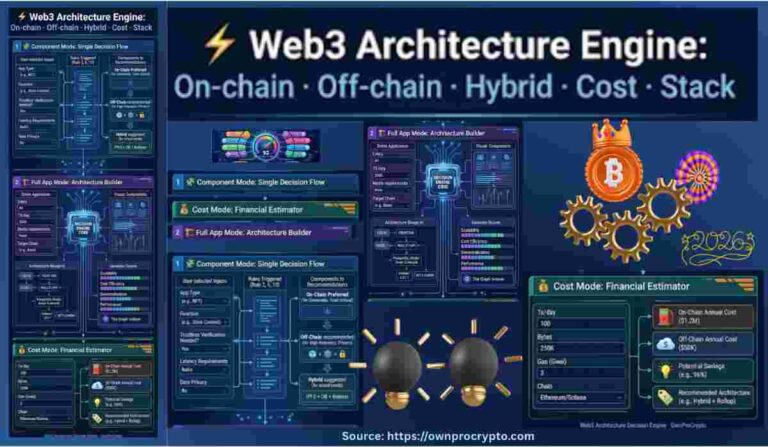
Ready to Benchmark Your Web3 Stack?
Compare trade-offs, estimate transaction fees, and choose the right on-chain vs. off-chain architecture before writing code. ⬇
Launch Interactive:
Web3 Architecture Decision Engine
Explore Blueprint:
10 On-Chain vs. Off-Chain Design Principles
⚡ Direct directional scoring for modular stacks, rollup settlement, and hybrid DA layers.