
Search by title, topic or phrase
Use our Crypto Search Engine 🔍 to find the topics and keywords you're looking for.
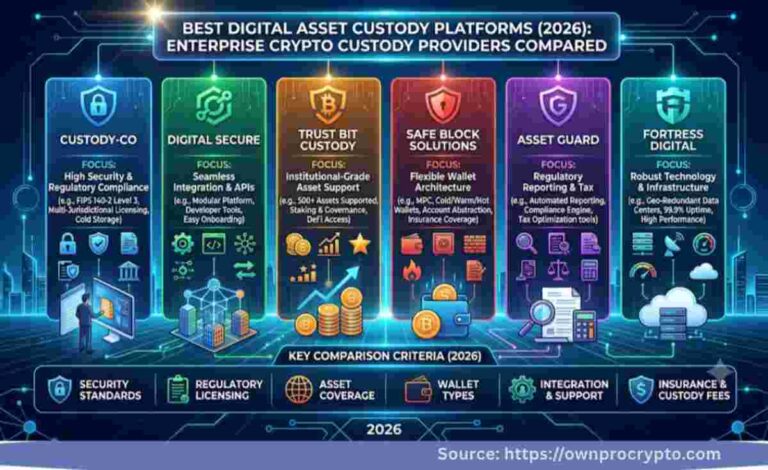
Table of Contents
ToggleNavigating the landscape of the Best Digital Asset Custody Platforms has evolved far beyond simply choosing a basic wallet. Whether you are an individual investor protecting long-term holdings, a startup managing treasury assets, an exchange securing customer deposits, or a global financial institution responsible for billions in tokenized assets, digital asset custody has become one of the most critical pillars of modern finance.
Managing digital assets has evolved far beyond simply choosing a wallet. Whether you’re an individual investor protecting long-term holdings, a startup managing treasury assets, an exchange securing customer deposits, or a global financial institution responsible for billions in tokenized assets, digital asset custody has become one of the most critical pillars of modern finance.
Today’s custody decisions affect far more than private key storage. Organizations must evaluate governance, regulatory compliance, disaster recovery, operational resilience, insurance coverage, staking support, API integrations, tokenization readiness, and multi-chain compatibility. A custody strategy that works for a retail investor can quickly become inadequate for an enterprise treasury or institutional asset manager.
This guide goes beyond comparing providers. Instead of focusing only on rankings, it explains how digital asset custody works, why institutions choose different custody models, what mistakes organizations commonly make, and how to build a custody strategy that aligns with your operational and regulatory requirements.
Throughout this guide, you’ll also find practical comparison tables, decision frameworks, security checklists, and links to free educational tools from OwnProCrypto to help evaluate custody risks, governance models, and infrastructure before selecting a provider.
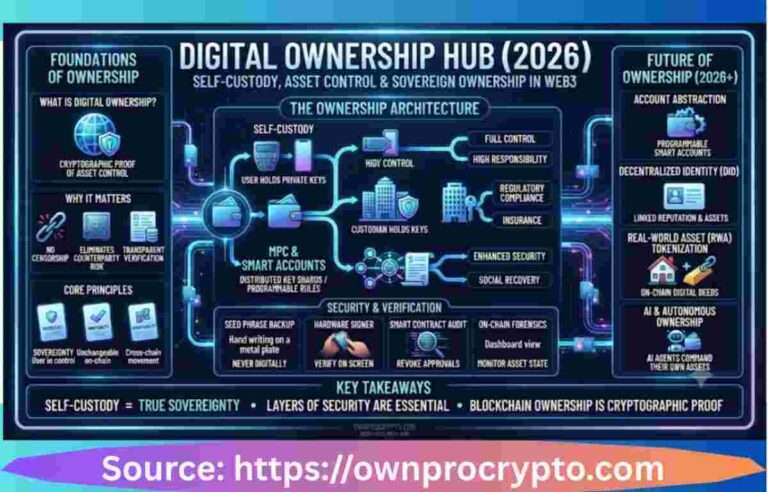
Core Purpose: Best Digital Asset Custody Platforms secure private keys, manage institutional treasuries, and protect cryptographic assets from unauthorized access or theft.
Security Standards: Institutional solutions utilize multi-party computation, hardware security modules, and multi-signature governance to eliminate single points of failure.
| Category | Overview |
|---|---|
| Primary Purpose | Secure storage and management of digital assets |
| Typical Users | Retail investors, enterprises, exchanges, banks, family offices, DAOs |
| Key Technologies | MPC, HSM, Cold Storage, MultiSig, Secure Enclaves |
| Security Goal | Protect private keys while maintaining operational access |
| Common Regulations | MiCA, SEC guidance, FINRA rules, FATF Travel Rule |
| Supported Assets | Cryptocurrencies, Stablecoins, NFTs, Tokenized Assets (RWAs), CBDCs |
| Enterprise Features | Governance, Treasury Management, APIs, Staking, Audit Logs |
| Main Decision | Choosing the right custody strategy before choosing a provider |
💡 Tip: The best custody platform is the one that matches your security model, compliance needs, and operational workflow—not simply the one with the most features.
This guide is designed to help multiple types of users make informed custody decisions.
| User Type | What You’ll Learn |
|---|---|
| New Crypto Investors | Understand custody basics and choose between self-custody and third-party custody |
| Professional Traders | Secure active trading balances while reducing operational risk |
| Family Offices | Build long-term wealth preservation and governance strategies |
| Crypto Startups | Select scalable custody infrastructure before launching products |
| Exchanges | Compare institutional custody solutions and operational controls |
| Banks & Financial Institutions | Evaluate qualified custodians, compliance, and enterprise-grade security |
| Asset Managers | Protect client assets while meeting fiduciary obligations |
| Tokenization Projects | Store and manage tokenized real-world assets securely |
⚠️ Warning: Choosing a custody provider before defining your operational requirements often leads to costly migrations later.

Digital asset custody is the practice of securely storing, managing, and controlling cryptographic private keys that provide access to digital assets such as cryptocurrencies, stablecoins, tokenized securities, NFTs, and other blockchain-based assets.
Unlike traditional banking, blockchain transactions are generally irreversible. A compromised private key, an unauthorized transaction, or an improperly designed approval workflow can result in permanent asset loss. Because of this, modern custody extends far beyond simple storage and includes governance, policy enforcement, compliance, recovery planning, transaction authorization, and continuous operational monitoring.
Today, digital asset custody supports a wide range of participants—from individuals securing a personal Bitcoin wallet to multinational institutions safeguarding billions of dollars in digital assets. As blockchain adoption expands into tokenized real-world assets (RWAs), stablecoin settlements, and institutional finance, custody has become foundational infrastructure rather than a back-office function.
A well-designed custody strategy typically addresses 7 core objectives:
💡 Custody Tip: Your custody model should be designed around risk tolerance, governance, and business operations—not around a specific vendor.
Digital finance depends on trust, but in blockchain systems, trust is established through cryptography rather than centralized intermediaries. This shifts responsibility for safeguarding assets to whoever controls the private keys.
As organizations expand into digital assets, custody becomes a strategic function rather than a technical task. A bank launching tokenized deposits, a family office allocating capital to Bitcoin, or an enterprise settling cross-border payments with stablecoins all require secure, auditable, and resilient custody infrastructure.
Effective custody helps organizations:
Without a structured custody framework, even advanced organizations can face governance failures, delayed recoveries, or security incidents that undermine operational resilience.
| Challenge | Business Impact | Recommended Focus |
|---|---|---|
| Weak key management | Increased theft risk | Robust key lifecycle management |
| Single-person approvals | Insider risk | Multi-level governance policies |
| Limited recovery planning | Operational disruption | Disaster recovery procedures |
| Regulatory uncertainty | Compliance exposure | Jurisdiction-specific controls |
| Poor integration | Workflow inefficiencies | API-enabled custody infrastructure |
⚠️ Common Mistake: Many teams invest in security tools before defining who can authorize transactions and under what conditions.
One of the most common misconceptions is that a wallet and a custody solution are the same thing. While both interact with blockchain networks, they serve different purposes.
A crypto wallet is primarily an interface for generating addresses, signing transactions, and accessing blockchain assets. A custody solution is a broader operational framework that governs how private keys are generated, protected, shared, recovered, and used within defined security and compliance policies.
| Feature | Crypto Wallet | Digital Asset Custody |
|---|---|---|
| Asset Access | ✔ | ✔ |
| Private Key Protection | Basic to Advanced | Enterprise-grade |
| Multi-User Governance | Limited | ✔ |
| Approval Workflows | Rare | ✔ |
| Audit Trails | Limited | ✔ |
| Disaster Recovery | Depends on wallet | Comprehensive |
| Regulatory Compliance | Usually not included | Core capability |
| Treasury Management | No | Often supported |
For individuals, a wallet may be sufficient. For enterprises managing treasury operations, client assets, or tokenized financial products, custody infrastructure provides the governance and operational controls required to manage risk at scale.
💡 Quick Check: If multiple people need access to the same assets, you’re evaluating a custody strategy—not just a wallet.
Most people search for the best digital asset custody platform because they want one simple answer.
Which provider should I choose?
Unfortunately, that is the wrong question.
The right question is
Which custody strategy fits my assets, my business, my security requirements, and my future growth?
A platform is only one piece of your custody architecture.
If your governance is weak, your approval workflow is poor, or your recovery plan does not exist, even the most expensive custody provider cannot fully protect your assets.
That is why this guide focuses on helping you understand the complete custody picture before comparing providers.
Think of it like buying a safe for your home.
Two families can buy the same safe, but one installs it correctly with alarms, insurance, backups, and access policies. The other leaves the recovery key in a drawer.
The safe is identical.
The security outcome is completely different.
Digital asset custody works exactly the same way.
A strong custody strategy combines people, technology, governance, compliance, and operational discipline.
The provider simply delivers the infrastructure.
💡 Custody Tip: Choose your custody strategy first. Choose your provider second.
The table below gives a high-level comparison of the leading enterprise custody providers.
Remember, no provider wins every category.
Different organizations have different priorities.
| Platform | Best For | Security | Tokenized Assets | Staking | API | Institutional Ready |
|---|---|---|---|---|---|---|
| Fireblocks | Enterprises | MPC | Excellent | Yes | Excellent | ⭐⭐⭐⭐⭐ |
| BitGo | Exchanges | MultiSig + MPC | Good | Yes | Excellent | ⭐⭐⭐⭐⭐ |
| Anchorage Digital | Banks | Institutional Custody | Excellent | Yes | Good | ⭐⭐⭐⭐⭐ |
| Coinbase Custody | ETFs & Institutions | Cold Storage | Good | Yes | Good | ⭐⭐⭐⭐⭐ |
| Fidelity Digital Assets | Traditional Finance | Cold Storage | Growing | Limited | Moderate | ⭐⭐⭐⭐⭐ |
| Copper | Trading Firms | MPC | Good | Yes | Excellent | ⭐⭐⭐⭐ |
| Taurus | Banks & Tokenization | MPC + HSM | Excellent | Yes | Excellent | ⭐⭐⭐⭐⭐ |
| Ripple Custody | Enterprise Payments | Enterprise Wallets | Excellent | Limited | Excellent | ⭐⭐⭐⭐ |
| Komainu | Institutional Investors | Institutional Custody | Good | Yes | Moderate | ⭐⭐⭐⭐ |
| Hex Trust | Asia Institutions | MPC | Good | Yes | Good | ⭐⭐⭐⭐ |
| Ledger Enterprise | Enterprise Wallets | Hardware + HSM | Moderate | Limited | Good | ⭐⭐⭐⭐ |
| Safeheron | SMEs & Web3 Teams | MPC | Growing | Yes | Excellent | ⭐⭐⭐⭐ |
No single provider is perfect.
Each one was designed for a different type of customer.
That is exactly why understanding your own requirements is more important than reading feature lists.
Security is still the number one reason organizations change custody providers.
Modern enterprise custody is no longer just about cold wallets.
Today’s platforms combine multiple technologies to reduce both external attacks and internal operational risk.
The strongest providers typically use a layered security model instead of relying on one technology.
                  Enterprise Security

          Governance & Approval Policies
                       ↓
          Identity & Access Management
                       ↓
             MPC or HSM Key Protection
                       ↓
        Hot • Warm • Cold Wallet Strategy
                       ↓
      Monitoring • Audit • Recovery • Backup
Think of security as layers.
If one layer fails, another layer should still protect the assets.
That is why institutions rarely rely on only one security technology.
| Technology | Security | Speed | Enterprise Usage | Best For |
|---|---|---|---|---|
| MPC | ⭐⭐⭐⭐⭐ | Fast | Very High | Treasury, Exchanges |
| HSM | ⭐⭐⭐⭐⭐ | Fast | Very High | Banks |
| Cold Storage | ⭐⭐⭐⭐⭐ | Slow | Very High | Long-term reserves |
| Hot Wallet | ⭐⭐⭐ | Instant | High | Daily transactions |
| MultiSig | ⭐⭐⭐⭐ | Medium | High | DAOs and Treasury |
| Secure Enclave | ⭐⭐⭐⭐ | Fast | Growing | Mobile Security |
Most institutions actually combine several of these technologies instead of choosing only one.
For example, an enterprise may keep 95 percent of reserves in cold storage, 4 percent in MPC wallets for treasury operations, and 1 percent in hot wallets for liquidity.
This layered approach balances security with operational efficiency.
⚠️ Common Mistake: Many companies compare features before defining their security requirements.
Every custody provider solves the same core problem.
Protect digital assets.
But they solve it in different ways.
Some platforms are designed for banks.
Some focus on exchanges.
Some specialize in tokenized assets.
Others are built for treasury teams, family offices, institutional investors, or Web3 companies.
That means the best provider for a crypto exchange may be a poor choice for a startup issuing tokenized real estate.
Instead of asking Which platform is the best, ask these 7 questions first.
| Question | Why It Matters |
|---|---|
| Who owns the assets | Different users require different custody models |
| Who approves transactions | Defines governance and insider risk |
| Which assets will you store | Crypto, Stablecoins, NFTs, RWAs and CBDCs require different capabilities |
| Which countries do you operate in | Regulations vary across jurisdictions |
| Do you need APIs | Important for automation and treasury systems |
| Will you stake assets | Not every provider supports institutional staking |
| Will your business grow | Migration later can be expensive |
Choosing the wrong provider often leads to operational migration within 12 to 24 months.
Choosing the right strategy can support growth for years.
Instead of comparing logos, compare capabilities.
Professional institutions usually score providers across these eight areas.
| Evaluation Area | Why It Matters | Priority |
|---|---|---|
| Security Architecture | Protects private keys | ⭐⭐⭐⭐⭐ |
| Compliance | Meets legal requirements | ⭐⭐⭐⭐⭐ |
| Governance | Controls internal approvals | ⭐⭐⭐⭐⭐ |
| Asset Support | Supports future expansion | ⭐⭐⭐⭐ |
| API Integration | Automates treasury operations | ⭐⭐⭐⭐ |
| Insurance | Reduces financial risk | ⭐⭐⭐⭐ |
| Scalability | Handles business growth | ⭐⭐⭐⭐ |
| Customer Support | Critical during incidents | ⭐⭐⭐ |
💡 Security Tip: Never judge a platform by one feature. Judge how its security layers work together.
Instead of asking Which platform is number one, start by identifying your role and your operational needs.
The best choice depends on what you are trying to protect, how often you move assets, and who needs access.
| If You Are… | Your Main Goal | What to Prioritize |
|---|---|---|
| Beginner Investor | Asset safety | Regulated custody, simple recovery |
| Long-Term Holder | Wealth preservation | Cold storage, governance |
| Crypto Startup | Fast growth | APIs, MPC, scalability |
| Exchange | Customer asset security | High transaction throughput, policy engine |
| Asset Manager | Fiduciary compliance | Qualified custodian, reporting |
| Family Office | Multi-generation wealth | Governance, inheritance planning |
| Bank | Regulatory compliance | Qualified custody, HSM, audit trails |
| Tokenization Project | Digital securities | Asset issuance support, token lifecycle |
| DAO Treasury | Shared control | Multi-party approvals, transparent governance |
Notice something important.
The platform is only the final decision.
Everything above it determines whether that platform is actually the right fit.
✅ Training Exercise: Write down your asset size, users, approval process, jurisdiction, and future plans before comparing providers. It will eliminate half the options immediately.
One of the biggest misconceptions in digital asset custody is that the cheapest platform offers the best value.
In reality, custody pricing is only one part of the total cost.
A platform with lower monthly fees may require additional spending on compliance, governance, insurance, integrations, or disaster recovery. On the other hand, a higher-priced enterprise solution may reduce operational risk, simplify audits, and save hundreds of staff hours every year.
Instead of asking How much does custody cost, ask What does secure custody actually include?
Most institutional providers build pricing around 5 cost categories.
| Cost Category | What It Covers | Why It Matters |
|---|---|---|
| Platform Fee | Access to custody infrastructure | Core service cost |
| Assets Under Custody | Percentage based on AUC | Common for institutional clients |
| Transaction Fees | Transfers, settlements, withdrawals | Impacts active users |
| Premium Features | Staking, governance, APIs, reporting | Enterprise functionality |
| Custom Integration | APIs, onboarding, dedicated support | Large organizations |
A startup securing $250,000 in digital assets has very different requirements from a global bank managing tokenized securities across multiple jurisdictions. That is why pricing should always be evaluated alongside operational needs.
💡 Pricing Tip
The lowest custody fee can become the most expensive choice if it lacks the security or governance your business needs.
Many enterprise custody providers do not publish fixed prices because contracts depend on assets under custody, transaction volume, deployment model, and support requirements. The table below provides a general comparison of how pricing is commonly structured.
| Platform | Pricing Model | Typical Entry Level | Best For |
|---|---|---|---|
| Fireblocks | Custom Enterprise | Mid to High | Enterprises, FinTechs |
| BitGo | Subscription + Usage | Medium | Exchanges, Institutions |
| Anchorage Digital | Custom Institutional | High | Banks, Asset Managers |
| Coinbase Custody | Assets Under Custody | High | ETFs, Institutional Investors |
| Fidelity Digital Assets | Enterprise Contract | High | Traditional Finance |
| Copper | Custom | Medium to High | Trading Firms |
| Taurus | Enterprise License | High | Banks, Tokenization Platforms |
| Ripple Custody | Enterprise Contract | Medium to High | Payment Providers |
| Komainu | Institutional Agreement | High | Family Offices, Institutions |
| Hex Trust | Custom | Medium | Regional Institutions |
| Ledger Enterprise | License + Hardware | Medium | Enterprises |
| Safeheron | Flexible Enterprise Plans | Low to Medium | Web3 Companies, Startups |
The right pricing model depends on how you use custody, not just how much you pay.
For example:
Not every organization should buy the most advanced custody platform.
Pay for the capabilities you actually need today while ensuring the platform can grow with you tomorrow.
| Business Stage | Focus | Suggested Investment |
|---|---|---|
| Individual Investor | Asset protection | Basic regulated custody or self-custody |
| Startup | Scalability | API-first custody with governance |
| Growing Enterprise | Automation | MPC, policy engine, audit trails |
| Exchange | High availability | Institutional custody with settlement tools |
| Bank | Compliance | Qualified custodian with HSM and reporting |
| Global Institution | Full infrastructure | Enterprise-grade custody ecosystem |
As your assets, users, and regulatory obligations grow, the value of governance and operational resilience often outweighs the platform subscription itself.
✅ Training Exercise: Do not compare providers first. Write your security requirements, compliance obligations, number of users, expected asset growth, and daily transaction needs on one page. Your ideal custody platform will become much easier to identify.
A common assumption is that higher prices always mean better protection.
That is not necessarily true.
Security depends on architecture, governance, and operational processes rather than price alone.
Think about these examples:
| Scenario | Better Choice |
|---|---|
| Small business holding long-term reserves | Strong cold storage with simple governance |
| Active treasury team | MPC with policy-based approvals |
| Global exchange | High-performance custody with continuous monitoring |
| Bank issuing tokenized assets | Qualified custodian with regulatory reporting |
| Family office | Secure recovery, inheritance planning, and multi-user governance |
The goal is to match your custody model to your business model.
A mismatch can increase both costs and operational risk.
Before requesting enterprise pricing, answer these 6 questions.
✔ How much digital value will you protect?
✔ How many people need access?
✔ Do you need automated treasury workflows?
✔ Which regulations apply to your organization?
✔ Will you support staking or tokenized assets?
✔ Can your current custody solution scale over the next 3 to 5 years?
If you cannot answer these questions, comparing provider quotes will not help you make the right decision.
                Start
                  ↓
      How much are you protecting?
                  ↓
      ┌───────────┴───────────┐
      ↓                       ↓
   Personal              Business
      ↓                       ↓
Need simple?          Multiple users?
      ↓                       ↓
Self or Regulated      Governance Needed
 Custody                      ↓
             Compliance Required?
                       ↓
          ┌────────────┴────────────┐
          ↓                         ↓
         Yes                       No
          ↓                         ↓
Qualified Custodian        Enterprise MPC Platform
⚠️ Common Mistake: Paying enterprise prices for features your team never uses can waste budget without improving security.

Choosing a custody platform is similar to choosing cloud infrastructure.
There is no universal winner.
Amazon Web Services is not automatically better than Microsoft Azure.
Google Cloud is not the right choice for every business.
The same principle applies to digital asset custody.
Every provider was built for different customers, different regulations, and different operational goals.
Some platforms prioritize institutional trading.
Some focus on banks.
Others specialize in tokenized securities, treasury automation, or digital asset infrastructure.
Use the reviews below as a starting point. Focus on the business problem each provider solves rather than its marketing claims.
💡 Quick Tip: A platform that perfectly fits a crypto exchange may be completely unsuitable for a family office or bank.
Enterprise treasury teams, exchanges, fintech companies, OTC desks, payment providers, and institutions managing high transaction volumes.
| Category | Rating |
|---|---|
| Security | ⭐⭐⭐⭐⭐ |
| Enterprise Features | ⭐⭐⭐⭐⭐ |
| API & Automation | ⭐⭐⭐⭐⭐ |
| Compliance | ⭐⭐⭐⭐ |
| Tokenization | ⭐⭐⭐⭐⭐ |
| Beginner Friendly | ⭐⭐ |
Fireblocks has become one of the most recognized enterprise custody platforms because it focuses on secure operational workflows rather than simple wallet storage.
Its MPC-based architecture allows organizations to approve transactions without exposing private keys in a single location. Combined with policy engines, approval workflows, API integrations, and treasury automation, it is particularly attractive for businesses handling frequent digital asset movements.
Fireblocks is often selected by exchanges, payment companies, and institutions that require scalable infrastructure across multiple blockchain networks.
Choose Fireblocks If
Consider Other Options If
Choosing a custody platform is similar to choosing cloud infrastructure.
There is no universal winner.
Amazon Web Services is not automatically better than Microsoft Azure.
Google Cloud is not the right choice for every business.
The same principle applies to digital asset custody.
Every provider was built for different customers, different regulations, and different operational goals.
Some platforms prioritize institutional trading.
Some focus on banks.
Others specialize in tokenized securities, treasury automation, or digital asset infrastructure.
Use the reviews below as a starting point. Focus on the business problem each provider solves rather than its marketing claims.
💡 Quick Tip
A platform that perfectly fits a crypto exchange may be completely unsuitable for a family office or bank.
Enterprise treasury teams, exchanges, fintech companies, OTC desks, payment providers, and institutions managing high transaction volumes.
| Category | Rating |
|---|---|
| Security | ⭐⭐⭐⭐⭐ |
| Enterprise Features | ⭐⭐⭐⭐⭐ |
| API & Automation | ⭐⭐⭐⭐⭐ |
| Compliance | ⭐⭐⭐⭐ |
| Tokenization | ⭐⭐⭐⭐⭐ |
| Beginner Friendly | ⭐⭐ |
Fireblocks has become one of the most recognized enterprise custody platforms because it focuses on secure operational workflows rather than simple wallet storage.
Its MPC-based architecture allows organizations to approve transactions without exposing private keys in a single location. Combined with policy engines, approval workflows, API integrations, and treasury automation, it is particularly attractive for businesses handling frequent digital asset movements.
Fireblocks is often selected by exchanges, payment companies, and institutions that require scalable infrastructure across multiple blockchain networks.
Choose Fireblocks If
Consider Other Options If
📚 Continue Learning: Read our Enterprise Crypto Custody Platform guide
Exchanges, custodians, institutional investors, trading firms, and organizations that require proven custody infrastructure.
| Category | Rating |
|---|---|
| Security | ⭐⭐⭐⭐⭐ |
| Enterprise Features | ⭐⭐⭐⭐ |
| Compliance | ⭐⭐⭐⭐⭐ |
| MultiSig Support | ⭐⭐⭐⭐⭐ |
| API Integration | ⭐⭐⭐⭐ |
| Beginner Friendly | ⭐⭐⭐ |
BitGo is one of the oldest names in institutional crypto custody and has built a reputation around secure multi-signature wallets, qualified custody services, and institutional asset protection.
Over time, the platform has expanded beyond MultiSig by introducing MPC capabilities and additional enterprise services, making it suitable for organizations that require both operational flexibility and regulatory confidence.
BitGo is widely used by institutions that value long-term custody experience and established operational processes.
• Enterprise onboarding may take time
• Some advanced services are designed primarily for institutional customers
• Pricing depends on organization size
💡 Custody Lesson: Experience matters, but always compare governance, recovery planning, and operational controls before making a final decision.
Banks, regulated financial institutions, investment advisers, asset managers, and organizations operating within highly regulated environments.
| Category | Rating |
|---|---|
| Security | ⭐⭐⭐⭐⭐ |
| Regulatory Focus | ⭐⭐⭐⭐⭐ |
| Banking Integration | ⭐⭐⭐⭐⭐ |
| Institutional Features | ⭐⭐⭐⭐⭐ |
| Tokenization Support | ⭐⭐⭐⭐ |
| Beginner Friendly | ⭐⭐ |
Anchorage Digital stands apart because of its strong focus on regulated institutional finance.
Rather than serving every segment of the crypto market, it concentrates on organizations that need banking-grade custody, governance, compliance, and operational controls.
Its platform is designed to support digital asset custody alongside institutional services such as staking, governance participation, and secure asset management.
For banks entering digital assets, Anchorage Digital is frequently evaluated because it aligns closely with traditional financial infrastructure.
⚠️ Warning: Regulated custody does not replace internal governance. Even the strongest custodian cannot fix weak approval policies or poor operational discipline.
Institutional investors, ETF issuers, family offices, corporations, and organizations seeking regulated custodial services with a familiar ecosystem.
| Category | Rating |
|---|---|
| Security | ⭐⭐⭐⭐⭐ |
| Compliance | ⭐⭐⭐⭐⭐ |
| Institutional Adoption | ⭐⭐⭐⭐⭐ |
| Ease of Use | ⭐⭐⭐⭐ |
| Asset Support | ⭐⭐⭐⭐ |
| API Features | ⭐⭐⭐⭐ |
Coinbase Custody is designed to provide regulated digital asset storage for institutions while integrating with a broader digital asset ecosystem.
Many institutional investors appreciate its emphasis on compliance, cold storage, and operational simplicity. It is often considered by organizations entering digital assets for the first time because of its established reputation and familiarity.
Rather than focusing on advanced treasury automation, Coinbase Custody prioritizes secure storage, regulatory alignment, and institutional confidence.
📚 Related Reading: Crypto Security Hub
Traditional financial institutions, wealth managers, pension funds, family offices, and long-term institutional investors.
| Category | Rating |
|---|---|
| Security | ⭐⭐⭐⭐⭐ |
| Institutional Trust | ⭐⭐⭐⭐⭐ |
| Compliance | ⭐⭐⭐⭐⭐ |
| Long-Term Storage | ⭐⭐⭐⭐⭐ |
| Treasury Features | ⭐⭐⭐ |
| Beginner Friendly | ⭐⭐⭐ |
Fidelity Digital Assets bridges traditional finance and digital assets by bringing institutional custody practices into the crypto ecosystem.
Organizations already familiar with conventional financial markets often view Fidelity as a natural extension of existing institutional relationships.
Its focus is not rapid blockchain innovation but disciplined asset protection, operational reliability, and long-term institutional custody.
✅ Training Exercise: After reading these reviews, don’t ask Which platform is the best? Ask Which platform matches my operational model, regulatory environment, transaction volume, and future growth? That single shift in thinking will help you make far better custody decisions.

Choosing a custody provider without understanding the technology behind it is like buying a security system without knowing whether you need a camera, alarm, vault, or access control.
Different custody technologies solve different problems.
Some protect private keys.
Some control access.
Some improve transaction speed.
Some help institutions meet regulatory requirements.
Modern digital asset custody usually combines multiple technologies into a layered security system.
A professional custody setup is rarely based on one solution.
It usually combines:
💡 Custody Tip: Strong custody is not one technology. It is multiple security layers working together.
Understanding the Digital Asset Security Stack
Before looking at individual technologies, it helps to understand where each solution fits.
Digital Asset Custody Security Model

                 Digital Assets

              Transaction Control
                       ↓
        ┌──────────────┼──────────────┐
        ↓              ↓              ↓
      MPC            HSM          MultiSig
        │              │              │
        └──────────────┼──────────────┘
                       ↓
             Key Management Layer
                       ↓
            Governance & Policies
                       ↓
        Monitoring, Recovery, Compliance
Each layer solves a different risk.
For example:
A private key can be secure, but if one employee can approve unlimited transactions alone, the organization still has a governance problem.
Security is not only about preventing hackers.
It is also about preventing mistakes.
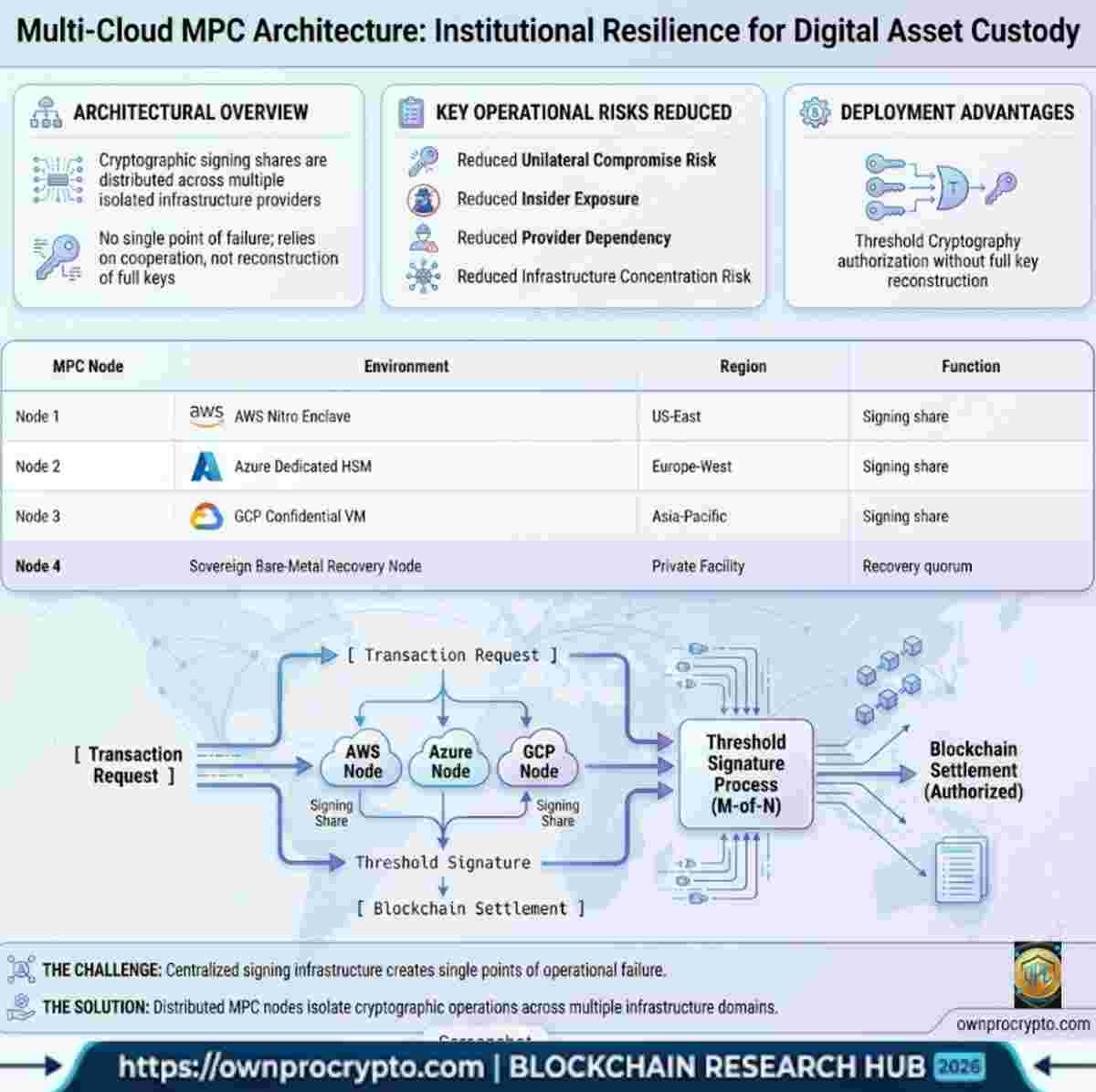
MPC stands for Multi-Party Computation. (i always say Multi Private Key Custody)
Instead of keeping one complete private key in one location, MPC divides the signing process across multiple independent parties or devices.
The complete private key does not exist in one place.
This reduces the risk of:
A simple example:
Private Key
      ↓
One Location
      ↓
Transaction ApprovalKey Share A
+
Key Share B
+
Key Share C
↓
Secure Transaction ApprovalThe transaction can be approved without rebuilding the entire private key.
MPC has become popular among enterprises because it balances security and usability.
Traditional cold storage is extremely secure but can be slow for daily operations.
Hot wallets are fast but create higher security risks.
MPC attempts to provide:
| Requirement | MPC Benefit |
|---|---|
| Security | Removes single private key exposure |
| Speed | Enables faster transactions |
| Governance | Supports approval policies |
| Automation | Works with APIs |
| Scalability | Supports many users |
This makes MPC attractive for:
Many users ask:
Is MPC better than MultiSig?
The answer depends on the situation.
They solve similar problems differently.
| Feature | MPC | MultiSig |
|---|---|---|
| Key Structure | Distributed computation | Multiple blockchain signatures |
| Blockchain Visibility | Usually invisible on-chain | Visible on-chain |
| Transaction Speed | Fast | Depends on network |
| Governance | Excellent | Excellent |
| Recovery Options | Flexible | Depends on setup |
| Enterprise Adoption | Very High | High |
Neither technology is automatically superior.
The correct choice depends on:
💡 Security Lesson
The strongest custody systems usually combine technologies instead of depending on one solution.
MPC is usually suitable when:
Examples:
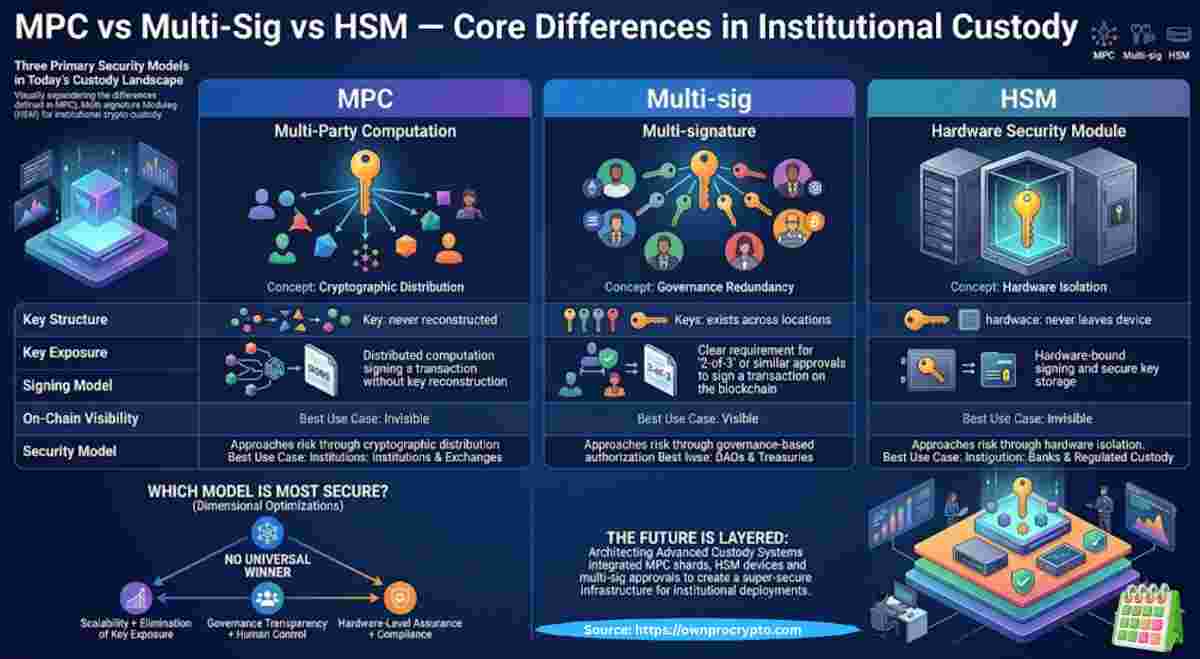
A Hardware Security Module is a specialized physical device designed to generate, store, and protect cryptographic keys.
HSMs have been used for decades in traditional finance, governments, payment networks, and banking systems.
Many institutions trust HSM technology because private keys remain protected inside dedicated hardware.
The key idea:
The private key can be used. But it cannot easily be extracted.
Simple example:
Private Key Created
        ↓
Stored Inside Secure Hardware
        ↓
Transaction Request
        ↓
HSM Approves Signing
        ↓
Blockchain Transaction
The sensitive cryptographic operations happen inside the protected environment.
Banks and regulated institutions often choose HSM because it aligns with existing security practices.
Benefits include:
| Benefit | Why It Matters |
|---|---|
| Physical protection | Reduces key theft risk |
| Compliance support | Matches financial security standards |
| Controlled access | Limits unauthorized usage |
| Audit capability | Supports reporting requirements |
| Long-term security | Proven technology |
HSM is commonly used for:
There is no universal winner.
Many advanced custody systems combine both.
| Need | Better Fit |
|---|---|
| Frequent transactions | MPC |
| – | – |
| Banking infrastructure | HSM |
| Developer integrations | MPC |
| Traditional compliance environments | HSM |
| Multi-user approval | Both |
| Maximum security architecture | Combination |
Large institutions may use:
💡 Security Lesson: The strongest custody systems usually combine technologies instead of depending on one solution.
Digital asset custody is a balance between security and usability.
The safest system in the world is useless if an organization cannot access assets when needed.
At the same time, the fastest system can become dangerous if security controls are weak.
Professional custody architecture usually separates assets into different environments.
A common institutional model:
                    Digital Asset Treasury
                            │
        ┌───────────────────┼───────────────────┐
        ↓                   ↓                   ↓
   Cold Storage        Operational Wallets    Trading Wallets
   Long Term           Daily Operations       Fast Settlement
   90% Assets          9% Assets              1% Assets
The exact percentage depends on the organization.
A bank, exchange, startup, and family office will all have different requirements.
💡 Custody Tip: The question is not Where can I store my assets? The question is How should I divide access and risk?
Cold storage means keeping digital asset keys offline or disconnected from internet-based systems.
The main purpose is reducing exposure to online attacks.
Because the private keys are not continuously connected to online environments, attackers have fewer opportunities to compromise them.
Cold storage is commonly used for:
Simple example:
Asset Reserve
      ↓
Offline Key Protection
      ↓
Limited Access Process
      ↓
Multi-Level Approval
      ↓
Transaction Execution
A withdrawal from cold storage is usually slower because additional security steps are required.
That delay is intentional.
Security and convenience always have a trade-off.
| Benefit | Why It Matters |
|---|---|
| Offline protection | Reduces online attack exposure |
| Long-term security | Suitable for large reserves |
| Lower daily risk | Less connected infrastructure |
| Institutional confidence | Common in regulated environments |
Cold storage is not perfect.
Organizations still need:
A lost recovery process can create the same risk as a cyberattack.
⚠️ Common Mistake: Companies protect against hackers but forget to prepare for internal mistakes.
A hot wallet is a digital asset wallet connected to online systems.
Its main advantage is speed.
Hot wallets are designed for frequent transactions.
Examples:
Customer Request
        ↓
Transaction System
        ↓
Hot Wallet
        ↓
Blockchain Network
Because hot wallets are online, they require stronger monitoring and controls.
| Benefit | Why It Matters |
|---|---|
| Fast transactions | Supports real-time operations |
| Automation | Works with APIs |
| Better user experience | Faster withdrawals |
| Business efficiency | Supports high-volume activity |
The main risks include:
That is why institutions rarely keep all assets in hot wallets.
A common approach:
Hot wallet = operational liquidity
Cold storage = strategic reserves
MultiSig means Multi-Signature.
Instead of requiring one private key, a transaction requires multiple approvals.
Example:
A 2-of-3 MultiSig wallet:
Person A Key
+
Person B Key
+
Person C Key


Need Any 2 Approvals
        ↓
Transaction Approved
This removes the risk of one person controlling everything.
MultiSig is popular because it creates shared control.
Useful for:
| Benefit | Purpose |
|---|---|
| Shared authority | Prevents one-person control |
| Transparency | Clear approval structure |
| Reduced insider risk | Limits unauthorized actions |
| Simple concept | Easy governance model |
MultiSig also creates challenges.
For example:
If three executives control a wallet and one loses access, recovery becomes complicated.
Organizations need:
Threshold signatures are closely related to MPC.
They allow multiple parties to participate in signing without creating a traditional MultiSig transaction.
Instead of multiple blockchain signatures, the signing process happens through distributed computation.
Example:
Participant A
    +
Participant B
    +
Participant C


Combined Secure Signing Process
             ↓
Single Blockchain SignatureThreshold signatures provide:
They are increasingly used in modern institutional custody systems.
A secure enclave is an isolated hardware environment designed to protect sensitive operations.
Many modern devices use secure enclave technology.
Its purpose:
Keep important information separated from the normal operating system.
Normal System
        ↓
Secure Enclave
        ↓
Protected Cryptographic Operation
Secure enclaves help reduce exposure from malware and unauthorized access.
| Technology | Main Purpose | Best For | Main Advantage |
|---|---|---|---|
| MPC | Distributed key control | Enterprises | Flexible security + automation |
| HSM | Hardware key protection | Banks | Proven institutional security |
| Cold Storage | Offline protection | Long-term assets | Maximum isolation |
| Hot Wallet | Fast transactions | Operations | Speed |
| MultiSig | Shared approvals | Teams | Governance |
| Threshold Signature | Distributed signing | Institutions | Privacy + efficiency |
| Secure Enclave | Protected computing | Modern systems | Hardware isolation |
| User Type | Recommended Approach |
|---|---|
| Beginner Investor | Hardware wallet + secure backup |
| Long-Term Holder | Cold storage strategy |
| Startup | MPC wallet infrastructure |
| Exchange | MPC + hot wallet controls + cold reserves |
| Bank | HSM + qualified custody |
| Asset Manager | Institutional custodian + governance |
| Tokenization Platform | MPC + smart contract controls |
| Family Office | Cold storage + multi-user approval |
Modern digital asset custody is moving away from simple wallet storage.
The future model looks more like financial infrastructure.
A complete custody system includes:
Security Technology
        +
Governance
        +
Compliance
        +
Automation
        +
Recovery Planning
        +
Human Controls
The strongest institutions understand one important lesson:
Custody failure usually does not happen because one technology failed. It happens because the entire system was poorly designed.
✅ Training Exercise: Before selecting a custody provider, identify your transaction frequency, number of users, asset value, compliance requirements, and recovery needs. Technology selection becomes much easier after that.
A professional custody platform is more than a secure wallet.
For institutions, custody becomes an operational system that connects:
A strong enterprise custody platform should answer five important questions:
💡 Enterprise Tip: Private key security protects assets. Governance protects organizations.
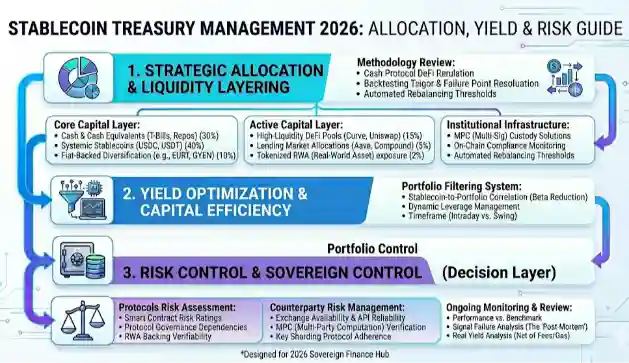
Treasury management is the process of controlling how an organization stores, moves, allocates, and monitors digital assets.
Traditional companies manage:
Digital asset companies manage:
The challenge is similar.
The difference is blockchain transactions are often irreversible.
A mistake cannot simply be cancelled like a traditional bank transfer.
Imagine a company holding $100 million in digital assets.
Without proper treasury controls:
A professional treasury system creates structure.
                Treasury Management
                       ↓
              Asset Allocation
                       ↓
        ┌──────────────┼──────────────┐
        ↓              ↓              ↓
   Cold Reserve    Operations     Trading
        ↓              ↓              ↓
Security Daily Usage Liquidity| Feature | Purpose |
|---|---|
| Wallet Organization | Separates assets by purpose |
| Balance Monitoring | Tracks holdings |
| Risk Limits | Controls exposure |
| Transaction Rules | Prevents mistakes |
| Reporting | Supports accounting |
| Automation | Reduces manual work |
A policy engine is a rule system that decides whether a transaction should be allowed.
Instead of relying only on employees, organizations create automatic security rules.
Example:
A company may create a rule:
Any transaction above $1 million requires two executives and compliance approval.
Transaction Request
        ↓
Policy Check
        ↓
Is Amount Allowed?
        ↓
Is Destination Approved?
        ↓
Required Approvals Completed?
        ↓
Transaction ExecutedWithout policies:
Employee permission = unlimited power
With policies:
Employee permission = controlled responsibility
| Rule | Example |
|---|---|
| Amount Limits | $500,000 maximum per transaction |
| Address Control | Approved wallet addresses only |
| Time Rules | No transfers outside business hours |
| Multi Approval | Two executives required |
| Asset Rules | Separate rules for BTC, ETH, Stablecoins |
⚠️ Common Mistake
Many organizations focus on preventing external hacks but ignore internal transaction mistakes.
Governance defines how decisions are made.
It answers:
Who can create transactions?
Who can approve them?
Who can change permissions?
Who reviews activity?
A company with $50 million in assets should not operate like a personal wallet.
Professional custody requires separation of duties.
Example:
Employee Creates Request
          ↓
Risk System Reviews
          ↓
Manager Approves
          ↓
Compliance Checks
          ↓
Transaction Completed| Model | Best For |
|---|---|
| Single Approval | Small personal accounts |
| Two Person Approval | Startups |
| Multi Department Approval | Enterprises |
| Board Level Approval | Large institutions |
APIs allow companies to connect custody infrastructure with their own systems.
Instead of manually logging into wallets, businesses can automate operations.
Examples:
A company processing thousands of transactions cannot operate manually.
Automation improves:
| Industry | API Purpose |
|---|---|
| Exchange | Automated withdrawals |
| FinTech | Stablecoin payments |
| Asset Manager | Portfolio management |
| Bank | Customer digital asset services |
| Web3 Project | User wallet infrastructure |
💡 Technology Tip: Enterprise custody without automation can become a bottleneck as transaction volume grows.
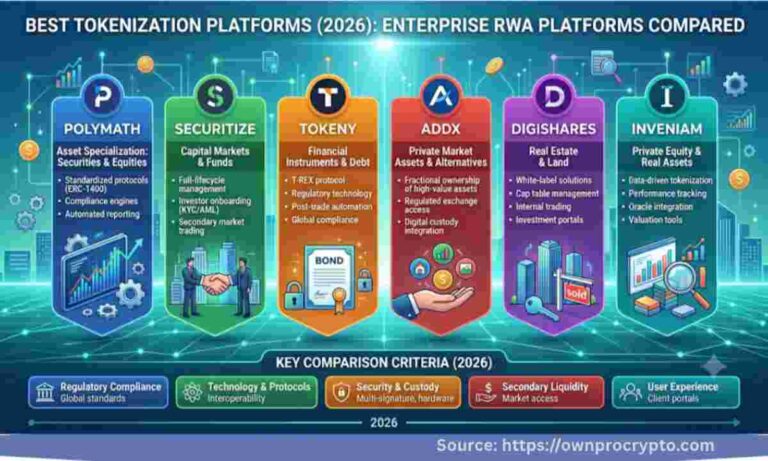
Digital asset custody is expanding beyond cryptocurrencies.
Institutions are increasingly exploring:
This creates new custody requirements.
| Traditional Crypto Custody | Tokenized Asset Custody |
|---|---|
| BTC, ETH | Real-world assets |
| Wallet security | Asset lifecycle management |
| Transfers | Ownership records |
| Private keys | Legal compliance |
| Blockchain access | Regulatory integration |
A tokenized asset platform may require:
This is why custody is becoming part of broader financial infrastructure.
Related resource:
Best Tokenization Platforms
https://ownprocrypto.com/best-tokenization-platforms/
RWA Tokenization Guide
https://ownprocrypto.com/rwa-tokenization-guide-2026/
Staking allows organizations to earn rewards by participating in blockchain networks.
However, institutions need controlled staking environments.
Organizations must consider:
| Risk | Example |
|---|---|
| Slashing | Validator penalties |
| Liquidity Risk | Locked assets |
| Smart Contract Risk | Protocol failures |
| Operational Risk | Incorrect validator setup |
Professional platforms should provide:
Institutions require reliable movement of assets.
Examples:
Settlement systems reduce:
Trade Executed
      ↓
Settlement Request
      ↓
Custody Verification
      ↓
Asset Transfer
      ↓
Audit Record
Audit trails create a complete history of:
They support:
For institutions, every important action should be traceable.
Security is not only about preventing attacks.
It is also about recovering after unexpected events.
Possible incidents:
| Area | Question |
|---|---|
| Key Recovery | Can access be restored safely? |
| Personnel | Who takes control during emergencies? |
| Documentation | Are procedures written? |
| Testing | Has recovery been tested? |
| Backup | Are backups protected? |
A mature custody system combines:
             Enterprise Custody
                    ↓
┌───────────────────┼──────────────────┐
 ↓                  ↓                  ↓
Security        Governance        Operations
MPC/HSM         Approvals         Treasury
Cold Storage    Policies          APIs
Recovery        Compliance        Reporting
The future of digital asset custody is not simply storing crypto.
It is building a complete financial operating system for digital assets.
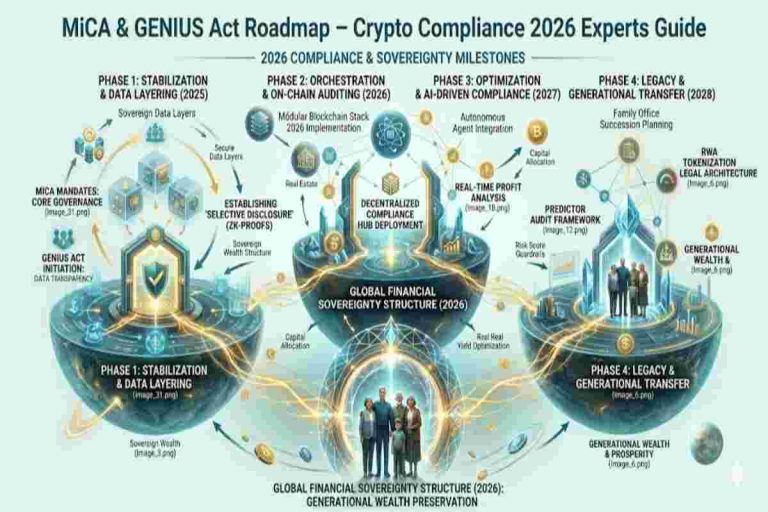
Digital asset custody is moving closer to traditional financial infrastructure.
As institutional adoption grows, organizations are no longer asking only:
How do we protect crypto?
They are asking:
How do we protect digital assets while meeting financial regulations?
A professional custody strategy must consider:
A custody provider is not only a technology company.
For many institutions, it becomes part of their financial control system.
💡 Compliance Tip: Security protects assets. Compliance protects the ability to operate.
A qualified custodian is a regulated entity that meets specific requirements for safeguarding client assets.
The concept comes from traditional finance, where investment advisers and institutions often need approved custodians to hold client assets.
In digital assets, qualified custody has become increasingly important because institutions need confidence that assets are:
Imagine an investment company managing $500 million in digital assets.
A basic wallet solution may provide technical security.
But investors, regulators, and auditors may require much more:
That is where qualified custody becomes important.
| Requirement | Purpose |
|---|---|
| Regulatory Oversight | Provides accountability |
| Asset Protection | Reduces custody risk |
| Record Keeping | Supports audits |
| Security Controls | Protects assets |
| Governance | Controls access |
| Feature | Regular Wallet | Qualified Custody |
|---|---|---|
| Private Key Control | Yes | Yes |
| Institutional Reporting | Limited | Advanced |
| Compliance Support | Limited | Strong |
| Governance | Basic | Advanced |
| Audit Support | Limited | Strong |
| Enterprise Usage | Low | High |
⚠️ Common Mistake: Owning a secure wallet does not automatically mean you have institutional-grade custody.
Security certifications help organizations evaluate whether a provider follows recognized security practices.
Two commonly discussed standards are:
SOC 2 evaluates how a company manages information security controls.
It focuses on areas such as:
| Area | Meaning |
|---|---|
| Security | Protection against unauthorized access |
| Availability | System reliability |
| Processing Integrity | Accurate operations |
| Confidentiality | Data protection |
| Privacy | Personal information handling |
For enterprises, SOC 2 reports provide visibility into how a provider manages security processes.
ISO 27001 is an international information security management standard.
It focuses on creating a structured security management system.
It includes:
A custody provider may have advanced technology.
But enterprises need evidence that security processes actually exist.
Standards help answer:
How does this company manage security every day?
MiCA stands for Markets in Crypto-Assets regulation.
It creates a regulatory framework for crypto asset services in the European Union.
For custody providers, MiCA introduces requirements around:
Before regulation, custody standards varied significantly between providers and regions.
Regulatory frameworks aim to create clearer expectations.
For institutions operating internationally, understanding regional requirements becomes essential.
| Area | Impact |
|---|---|
| Licensing | More formal authorization requirements |
| Governance | Stronger operational expectations |
| Security | Greater protection requirements |
| Reporting | Increased transparency |
💡 Institutional Lesson: Global companies must evaluate custody providers based on where they operate, not only where the provider is located.
Banks, broker-dealers, investment advisers, and asset managers operate under strict financial regulations.
Digital assets create additional questions:
Organizations may require:
| Requirement | Purpose |
|---|---|
| Asset Records | Ownership verification |
| Transaction Logs | Audit history |
| Access Controls | Prevent misuse |
| Reporting | Regulatory transparency |
| Risk Management | Operational protection |
The Financial Action Task Force (FATF) Travel Rule creates requirements around information sharing for certain virtual asset transfers.
The goal is improving transparency and reducing:
Institutions transferring digital assets may need systems that support:
Institution A
      ↓
Compliance Information
      ↓
Custody Platform
      ↓
Institution B
      ↓
Blockchain Transaction
Asset segregation means keeping customer assets separated from company assets.
This principle is common in traditional financial markets.
Imagine a company holds:
in one combined wallet system.
If the company experiences financial problems, ownership becomes complicated.
Segregation creates clearer ownership records.
| Model | Description |
|---|---|
| Individual Wallets | Each customer has separate storage |
| Segregated Accounts | Customer assets separated internally |
| Omnibus Wallets | Multiple users combined with accounting records |
Each model has advantages and trade-offs.
Insurance is often misunderstood.
Many users assume:
The custodian has insurance, therefore everything is protected.
That is not always true.
Insurance policies usually have specific limits and conditions.
| Coverage | Purpose |
|---|---|
| Theft | Protection against certain losses |
| Cyber Events | Certain security incidents |
| Employee Fraud | Internal risks |
| Physical Damage | Hardware-related incidents |
Before trusting a custody provider:
⚠️ Warning: Insurance is a backup layer. It is not a replacement for strong custody architecture.
These two concepts are often confused.
They solve different problems.
Proof of reserves attempts to demonstrate that a company holds enough assets to support customer liabilities.
Example:
A platform claims:
We hold enough Bitcoin and Ethereum to cover customer balances.
Proof of custody focuses on proving:
Who controls the assets?
How are keys protected?
Are assets actually secured?
| Feature | Proof of Reserves | Proof of Custody |
|---|---|---|
| Main Question | Are assets available? | Are assets controlled securely? |
| Focus | Asset quantity | Asset protection |
| Shows | Holdings | Security structure |
| Useful For | Transparency | Operational confidence |
Before choosing custody, organizations should evaluate:
| Category | Question |
|---|---|
| Regulation | Is the provider legally suitable? |
| Security | How are keys protected? |
| Governance | Who approves transactions? |
| Reporting | Are audits supported? |
| Insurance | What risks are covered? |
| Recovery | Can access be restored? |
| Compliance | Are required rules supported? |
✅ Training Exercise: Before signing a custody agreement, create a one-page checklist covering regulation, security, governance, insurance, recovery, and reporting. A good custody decision starts before onboarding.
The next generation of custody will not compete only on security.
It will compete on:
As digital assets become part of traditional finance, custody will increasingly resemble banking infrastructure.
The winners will not only protect assets.
They will create trust.
Choosing a digital asset custody solution is not about finding the platform with the biggest name.
It is about finding the custody structure that matches your:
A startup managing $500,000 in stablecoins and a bank managing $5 billion in tokenized assets do not need the same custody model.
The mistake many organizations make is choosing a provider first and designing their custody strategy later.
The correct approach is:
Business Requirements
        ↓
Security Model
        ↓
Governance Structure
        ↓
Custody Technology
        ↓
Provider Selection
💡 Decision Tip: The best custody platform is the one that fits your risk model, not the one with the most features.
Different users have different custody priorities.
There is no single custody model that works for everyone.
| User Type | Main Goal | Important Features |
|---|---|---|
| Individual Investor | Protect personal assets | Secure storage, recovery planning |
| High Net Worth Investor | Preserve wealth | Cold storage, inheritance planning |
| Crypto Startup | Scale operations | MPC, APIs, automation |
| Exchange | Protect customer assets | High availability, transaction controls |
| Asset Manager | Protect client assets | Reporting, compliance, qualified custody |
| Bank | Regulatory readiness | HSM, governance, audits |
| Family Office | Long-term wealth protection | Multi-user approval, recovery |
| Tokenization Project | Manage digital securities | Smart contract support, compliance |
Banks have some of the highest custody requirements because they operate under strict financial controls.
A bank custody solution usually requires:
Banks should prioritize:
| Requirement | Importance |
|---|---|
| Compliance | ⭐⭐⭐⭐⭐ |
| Security Controls | ⭐⭐⭐⭐⭐ |
| Audit Support | ⭐⭐⭐⭐⭐ |
| Governance | ⭐⭐⭐⭐⭐ |
| Transaction Speed | ⭐⭐⭐ |
A bank should not think like a crypto user.
It should think like a financial institution entering a new asset class.
Asset managers usually focus on protecting investor assets while maintaining transparency.
Their priorities include:
A strong custody solution helps asset managers answer:
Where are assets stored?
Who controls them?
How are transactions approved?
How can ownership be verified?
Exchanges require a different custody architecture.
They need:
A common exchange custody model:
Customer Deposits
        ↓
Hot Wallet
        ↓
Operational Liquidity
        ↓
Cold Storage Reserve
The challenge is balancing:
Speed
with
Security.
Tokenized assets introduce new custody requirements.
A tokenization company may manage:
They need more than wallet storage.
They need:
Related resource:
Best Tokenization Platforms
https://ownprocrypto.com/best-tokenization-platforms/
RWA Tokenization Guide
https://ownprocrypto.com/rwa-tokenization-guide-2026/
Startups often make one major mistake.
They choose a custody system based only on today’s needs.
A startup may begin with:
$100,000 in assets
Then grow to:
$100 million in assets
The custody architecture must grow with the business.
Startups should prioritize:
| Need | Why |
|---|---|
| APIs | Automation |
| MPC | Flexible security |
| User Management | Team access |
| Scalability | Future growth |
| Cost Efficiency | Early stage control |
Use this simple framework before selecting any provider.
| Question | If Yes | Priority |
|---|---|---|
| Do multiple people control assets? | Need governance | High |
| Are assets regulated or client-owned? | Need qualified custody | Very High |
| Are transactions frequent? | Need automation | High |
| Are assets long-term reserves? | Need cold storage | High |
| Do you issue tokenized assets? | Need token infrastructure | Very High |
| Do you operate globally? | Need regulatory coverage | Very High |
Before signing any custody agreement, ask:
1. Who controls the private keys?
Understanding key management is the foundation of custody.
2. How many people approve transactions?
Avoid single-person dependency.
3. What happens during an emergency?
A recovery plan is as important as prevention.
4. Does the provider support your assets?
Check current and future asset requirements.
5. Can the platform scale?
Migration becomes difficult after large asset growth.
6. What compliance standards are supported?
Regulatory needs should be evaluated before onboarding.
7. How are transactions monitored?
Visibility prevents operational mistakes.
8. What insurance protections exist?
Understand coverage limits and exclusions.
9. Can your systems integrate through APIs?
Automation becomes critical as volume increases.
10. What happens if you need to leave?
A good custody strategy includes exit planning.
⚠️ Common Failure Pattern
Many organizations plan how to enter custody but never plan how to recover, migrate, or exit.
The future of digital asset custody will not be decided only by wallet technology.
The winning custody models will combine:
Security
+
Compliance
+
Automation
+
Tokenization
+
AI Monitoring
+
Human Governance
Organizations that treat custody as financial infrastructure will be better prepared for the next phase of digital assets.
Digital asset custody is moving from a security function into a complete financial infrastructure layer.
In the early crypto market, custody mainly meant protecting private keys.
In the next phase, custody will include:
The future custody platform will not only store assets.
It will help organizations manage the complete lifecycle of digital ownership.
💡 Future Insight: The next generation of custody will combine blockchain security with traditional financial controls.
Artificial intelligence is becoming an important layer in digital asset security.
AI systems can help monitor:
Example:
A treasury system detects that a wallet suddenly attempts a transaction 50 times larger than normal.
AI monitoring can:
Transaction Request
        ↓
AI Risk Analysis
        ↓
Security Score
        ↓
Approval or BlockBanks are increasingly exploring digital assets because customers and markets are moving toward:
However, banks require custody systems that match existing financial expectations.
Future banking custody will require:
| Requirement | Purpose |
|---|---|
| Regulation | Legal operation |
| Security | Asset protection |
| Integration | Connect existing systems |
| Reporting | Financial transparency |
| Governance | Institutional control |
Tokenization is one of the biggest drivers of institutional custody growth.
Traditional assets being explored on blockchain include:
These assets require custody systems that understand:
Related resources:
Best Tokenization Platforms
https://ownprocrypto.com/best-tokenization-platforms/
RWA Tokenization Guide
https://ownprocrypto.com/rwa-tokenization-guide-2026/
Central bank digital currencies may create new custody requirements.
Future financial systems may include:
Custody infrastructure will become the bridge between:
Traditional finance
and
Blockchain-based financial systems.
The blockchain ecosystem is becoming increasingly multi-chain.
Institutions may hold assets across:
Future custody systems need:
Related resource:
Blockchain Interoperability Guide
https://ownprocrypto.com/blockchain-interoperability-2026/
The future of custody is not about whether institutions will use digital assets.
The bigger question is:
How will institutions manage them safely?
As digital assets become part of:
custody becomes a foundational financial layer.
What is digital asset custody?
Digital asset custody is the process of securely storing and managing blockchain assets such as cryptocurrencies, tokens, and digital securities.
Professional custody includes:
How does crypto custody work?
Crypto custody works by controlling access to blockchain private keys while allowing authorized users to manage assets.
A custody system usually includes:
What is a qualified custodian?
A qualified custodian is a regulated entity designed to safeguard client assets according to financial custody requirements.
Institutions often use qualified custodians because they provide:
Which custody platform is safest?
The safest custody platform depends on:
There is no single safest provider for every user.
Is MPC custody better than multisig?
MPC and multisig solve similar security problems using different approaches.
MPC:
Multisig:
The best choice depends on operational needs.
Related resource:
MPC vs Multi-Sig vs HSM Custody
https://ownprocrypto.com/mpc-vs-multi-sig-vs-hsm-custody/
Can banks provide digital asset custody?
Yes, banks can provide digital asset custody if they meet applicable regulatory and operational requirements.
Banks usually require:
What is institutional crypto custody?
Institutional crypto custody is a professional custody model designed for:
It includes stronger controls than personal wallets.
How are private keys protected?
Private keys can be protected through:
What is cold storage?
Cold storage keeps digital assets offline or isolated from internet-connected systems.
It is commonly used for long-term asset protection.
Which custody platform supports tokenized assets?
Platforms supporting tokenized assets typically provide:
The correct choice depends on the asset type and regulatory requirements.
Is self-custody better?
Self-custody provides direct control but requires the user to manage:
For individuals it can work well.
For large institutions, professional custody is often preferred.
How much do custody services cost?
Custody pricing varies depending on:
Enterprise pricing is usually customized.
What mistakes do institutions make with custody?
Common mistakes include:
Can institutions self-custody?
Yes, some institutions operate their own custody systems.
However, they must manage:
The best digital asset custody solution is not simply the provider with the strongest technology.
The best solution is the one that matches your:
A personal investor, startup, exchange, bank, and tokenization company all require different custody designs.
A balanced institutional custody model includes:
Enterprises should prioritize:
Banks should prioritize:
Tokenization projects should prioritize:
The strongest security strategy combines:
Technology
    +
Governance
    +
Human Approval
    +
Recovery Planning
    +
Continuous MonitoringDigital asset custody is becoming the foundation of the new financial system.
The future will not be defined only by who stores crypto securely.
It will be defined by who can manage digital ownership responsibly.
The organizations that succeed will combine:
secure technology
clear governance
strong compliance
and intelligent asset management.
Choosing custody is not only choosing a platform.
It is choosing the future operating system for digital assets.
Continue exploring digital asset custody, institutional security, MPC infrastructure, tokenized assets, enterprise blockchain architecture, and crypto risk management with these in-depth guides.
Best Institutional Crypto Custody Providers (2026): Compare Fireblocks, BitGo, Anchorage & Copper
Enterprise Crypto Custody Platform: Institutional Wallet Security Tool
Institutional Crypto Custody Simulator: Risk Dashboard & Security Analysis
MPC vs Multi-Sig vs HSM Custody: Crypto Security Comparison
MPC vs Multi-Sig Custody Risk Simulator: Compare Security Models
Best MPC Wallets (2026): Compare Fireblocks, Fordefi, Zengo & Coinbase Developer Platform
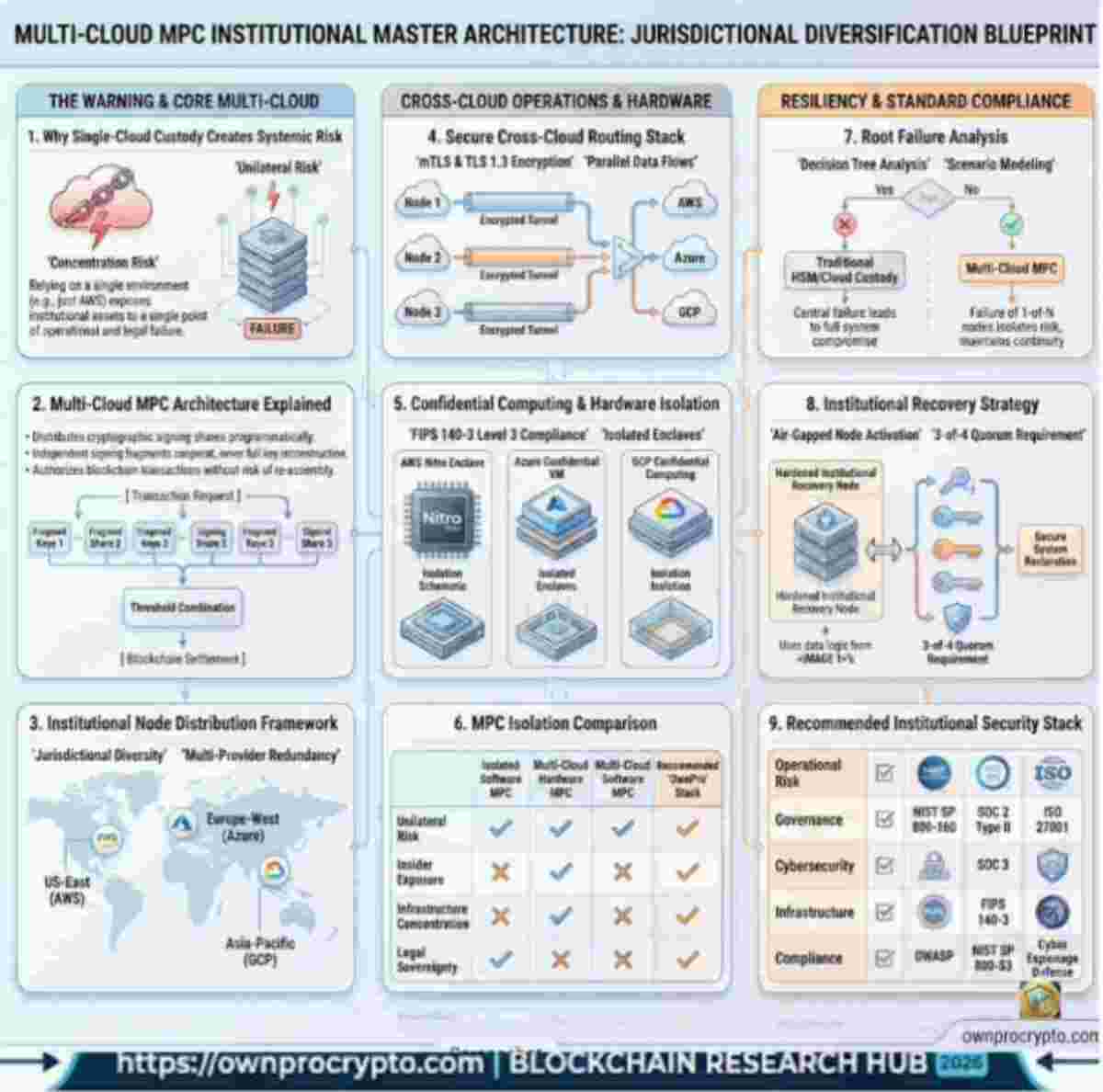
Multi-Cloud MPC Architecture: Secure Digital Asset Custody
Why Institutions Are Switching From Multi-Sig to MPC Custody (2026)
Crypto Security Hub (2026): Complete Guide to Digital Asset Protection
Crypto Self-Custody Guide (2026): Complete Guide to Secure Digital Asset Ownership
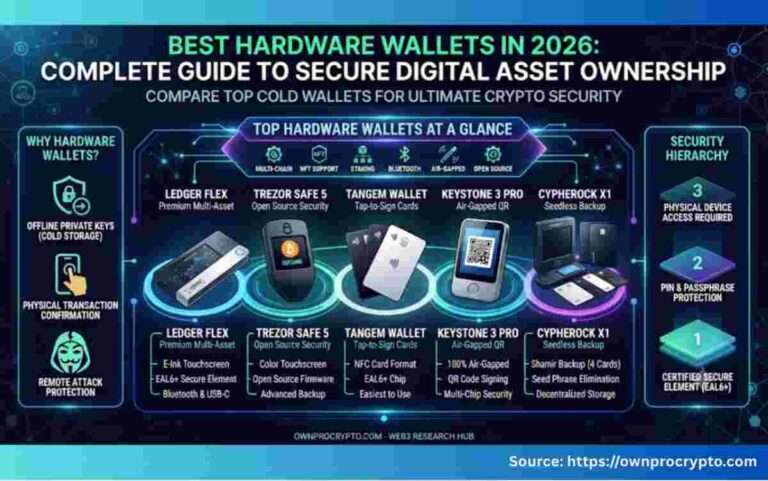
Best Hardware Wallets in 2026: Complete Guide to Secure Digital Asset Ownership
Explore the wider infrastructure behind institutional blockchain adoption, governance, treasury management, and digital asset operations.
Institutional Crypto Infrastructure: Governance & Legacy Integration
How Institutional Crypto Governance Works: Framework, Layers & Compliance
Crypto Decision Operating System: Trading Analysis Framework
Stablecoin Treasury Management: Yield & Risk Strategies
Digital asset custody is becoming a critical infrastructure layer for tokenized real-world assets, digital securities, and institutional blockchain markets.
Best Tokenization Platforms (2026): Enterprise RWA Platforms Compared
RWA Tokenization Hub (2026): Real-World Assets, Digital Ownership & Future of Capital Markets
RWA Tokenization Guide: Institutional Adoption & Digital Assets
Tokenized Asset Liquidity: How Institutions Improve Market Access
Use these tools and guides to evaluate wallet security, asset risk, scams, and operational weaknesses before they become failures.
Asset Risk Assessment Tool: Audit & Protect Crypto Portfolios
Crypto Security Checklist Tool: Wallet Safety & Self-Custody Audit
Crypto Threat Intelligence: Hacks, Exploits, Scam Patterns & Attack Vectors Explained
Crypto Transaction Simulator: Analyze Transactions Before Signing
For readers interested in the broader renewable energy, tokenization, and digital asset ecosystem, these authoritative resources provide additional research, technical standards, and industry guidance
Ethereum Foundation — Smart contracts, token standards, and decentralized application development.
World Bank – Climate Change — Sustainable infrastructure financing and climate investment resources.
Digital Asset Custody Master Hub
├── Security Layer
├──── MPC vs Multi-Sig vs HSM Custody
├──── MPC Wallet Infrastructure
├──── Crypto Security Framework
│
├── Institutional Layer
├──── Enterprise Custody Platform
├──── Institutional Governance
│
├── Tokenization Layer
├──── Tokenization Platforms
├──── RWA Tokenization Hub
├── Risk Management Layer
├──── Digital Asset Risk Assessment