
For years, the biggest barrier to moving corporate capital on-chain was a lack of “Federal Permission.” On March 11, 2026, that barrier vanished. Stablecoins Are Now Insurable Money, as the Office of the Comptroller of the Currency (OCC) issued its official roadmap to implement the GENIUS Act, transforming stablecoins from “crypto experiments” into federally recognized Payment Primitives.
The “Good News”? Global giant Aon didn’t wait. On March 9, 2026, they settled the first institutional insurance premiums using USDC and PYUSD. This isn’t just about speed; it’s about the birth of Insurable Money. If a $73B firm like Aon is moving millions on-chain, your MOVE pillar is no longer a luxury—it’s a necessity. This OCC classification is a massive win for the liquidity models found in our Stablecoin Payments 2026 research hub. See the State Street Global Advisors report for more.
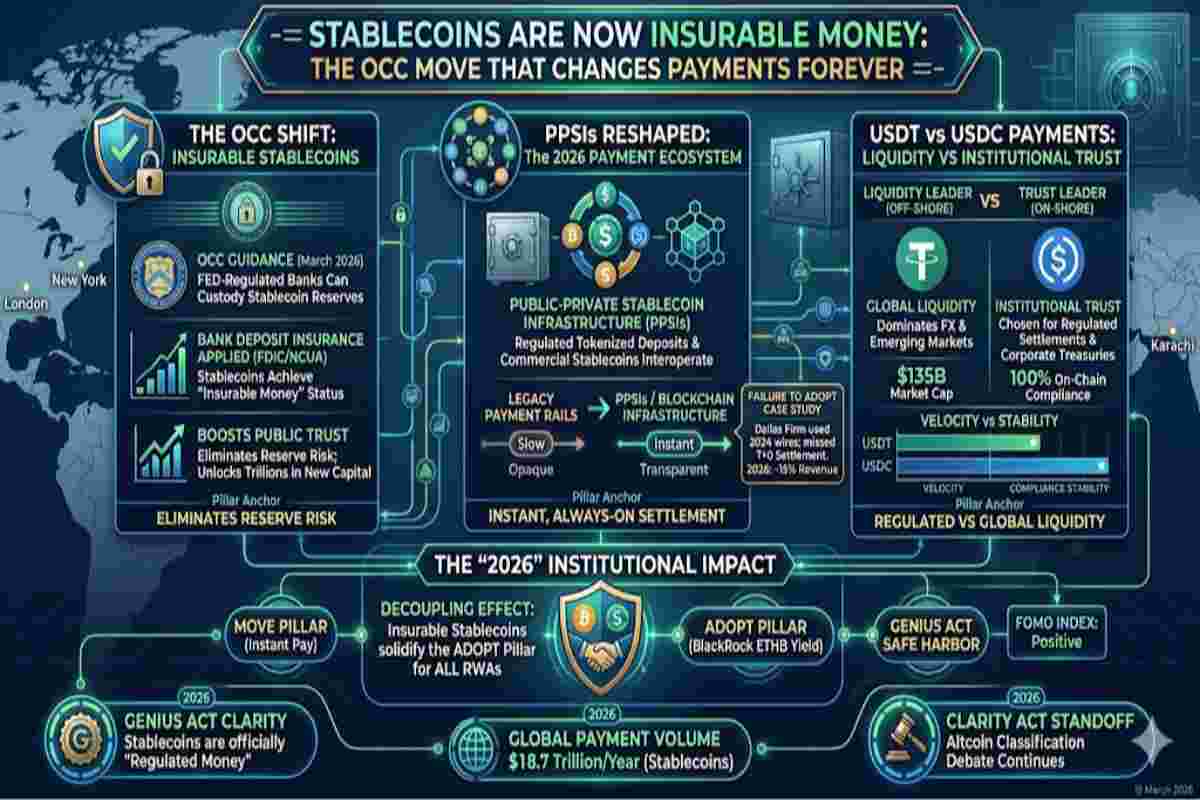
Table of Contents
ToggleStablecoin payments are becoming one of the fastest-growing segments in modern finance, with demand rising not from speculation but real transactional needs. Businesses and financial institutions increasingly prefer stablecoin rails for cross-border settlement, treasury operations, and real-time value transfer—all while navigating a landscape now shaped by stablecoin regulation and compliance expectations. This evolution reflects a shift: Stablecoins Are Now Insurable Money, moving from experimental digital assets to regulated money-like instruments with legal clarity and institutional support.
The scale of stablecoin payments is accelerating due to demand for faster settlement, lower costs, and 24/7 global accessibility. Merchants and payment providers now see stablecoins as viable tools for day‑to‑day commerce because they reduce reliance on legacy banking rails. As legal frameworks establish clear definitions and safeguards for stablecoin payments, adoption is expanding into regulated economic activity rather than remaining confined to crypto‑native environments.
With stablecoin regulation now more defined — including clear categorizations that separate compliant stablecoins from speculative assets — companies feel more confident integrating stablecoin payments. This is especially true for regulated payment providers and banks seeking predictable compliance paths for crypto rails. Regulatory clarity allows payment providers and merchants to offer stablecoin‑based checkout options, widening real‑world adoption beyond niche crypto audiences.
The Office of the Comptroller of the Currency proposed new stablecoin regulations under the GUIDING and Establishing National Innovation for U.S. Stablecoins Act (“GENIUS Act”), establishing a supervisory framework for Permitted Payment Stablecoin Issuers (PPSIs). The proposal sets out licensing, reserve standards, and operational requirements for entities that can issue regulated payment stablecoins in the U.S.
This regulatory shift marks a milestone in how stablecoin payments are viewed by financial authorities. It clearly delineates which entities may operate inside regulated systems, confirming that Stablecoins Are Now Insurable Money, placing these assets on a legal footing similar to other financial instruments, and setting expectations for transparency, reserve backing, and oversight.
Under the OCC’s stablecoin proposal, only authorized entities — including federally chartered banks and compliant non‑bank PPSIs — may issue stablecoins for U.S. users. This framework introduces strict requirements around reserve backing and prohibitions against paying yield or interest, making compliant issuance more predictable and secure for regulated markets.
By defining PPSIs and establishing licensing expectations, the OCC proposal effectively creates a tiered regime in which issuers must conform to regulatory standards in order to operate in regulated markets. This shifts competitive dynamics — expanding opportunities for compliant issuers and potentially limiting non‑regulated or offshore entities.
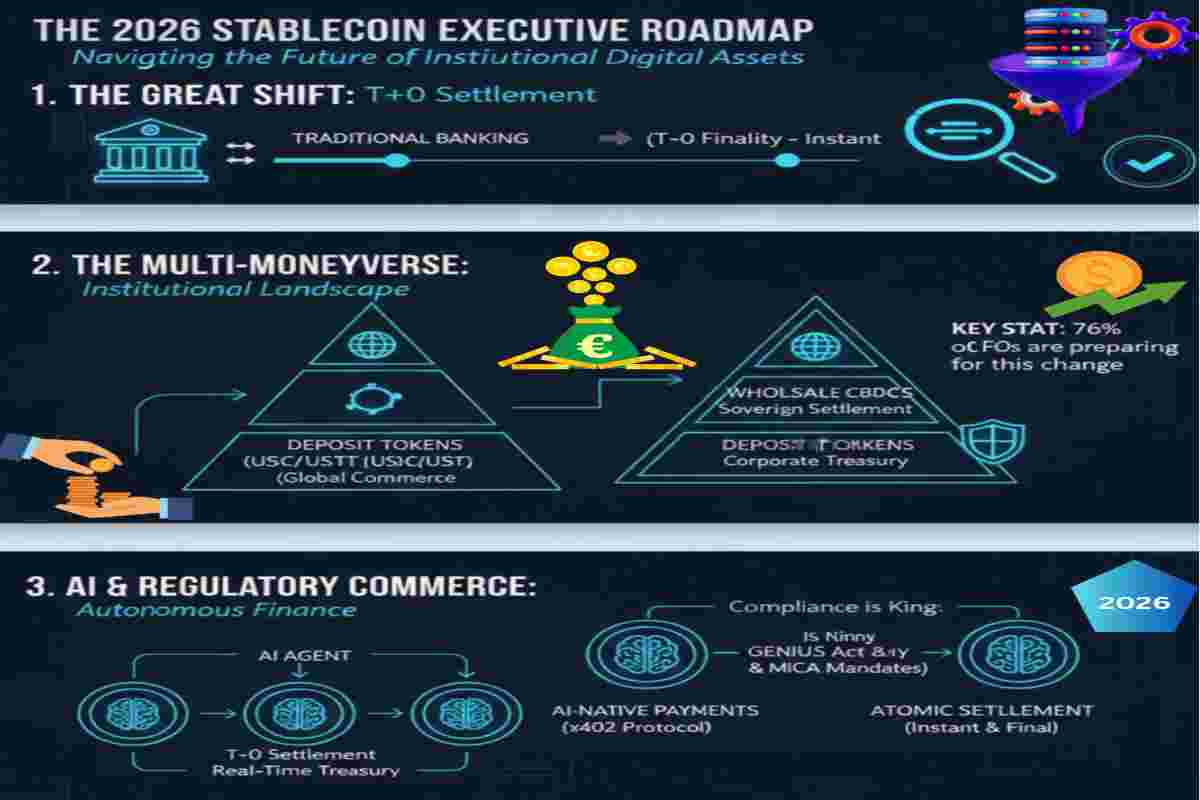
Stablecoin regulation in 2026 is shaping who will lead the next stage of financial infrastructure. Compliance with legal frameworks is now a core driver of adoption, not an afterthought. Clear rules help institutions justify stablecoin use in systems where legal certainty is required, especially for corporate treasury use cases and regulated payment rails. This shift underscores the reality that Stablecoins Are Now Insurable Money, providing the safety net required for institutional scale.
Contrary to fears that regulation stifles innovation, stablecoin regulation in 2026 has encouraged adoption by reducing uncertainty and risk for large institutions. With defined compliance standards, regulated entities can integrate stablecoins without exposing themselves to undefined legal or operational risk.
Defined regulatory standards — including clear definitions that differentiate stablecoins from securities — make it easier for merchants and payment platforms to accept stablecoin payments without ambiguity. Licensed issuers and compliant infrastructure now form a legal backbone for broader e‑commerce and cross‑border settlement activity.

The stablecoin landscape is no longer just about market cap or trading volume — it’s now about how each token fits within regulated financial ecosystems. This distinction is critical now that Stablecoins Are Now Insurable Money, a status that effectively bifurcates the market between offshore liquidity and onshore regulated safety.
USDT remains dominant in global liquidity, especially in informal markets and high‑volume trading environments. Its flexibility and established network presence make it a key player in global value movement.
By comparison, USDC has positioned itself more effectively within regulated and institutional payment channels due to its emphasis on compliance, transparent reserve attestations, and multi‑jurisdictional clarity.
USDT’s strength comes from its extensive liquidity footprint and deep integration with major exchanges and trading platforms. This broad liquidity makes it useful for value movement across borders and between assets, especially in markets with constrained traditional financial access.
USDC’s transparent audits, regulatory alignment, and institutional partnerships make it an appealing choice for regulated payment environments. As banks and payment providers experiment with stablecoin rails, USDC’s compliance‑friendly profile gives it a strategic advantage for institutional settlement use cases.
Institutional adoption of stablecoins is advancing beyond early experimentation. Corporations, payment platforms, and financial institutions are incorporating stablecoin rails into treasury and settlement systems to benefit from faster settlement, reduced counterparty risk, and improved liquidity management. This trend is accelerating as the industry recognizes that Stablecoins Are Now Insurable Money, providing the fiduciary grade security necessary for large-scale corporate treasury operations.
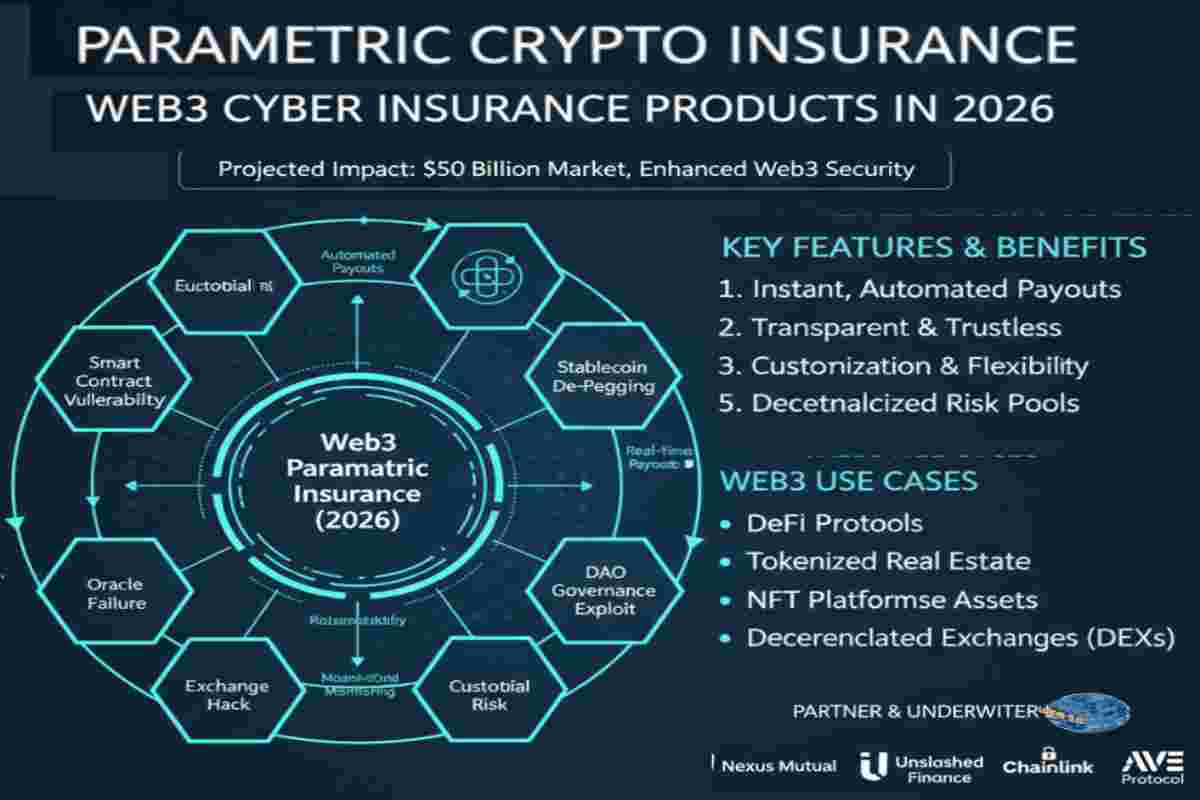
However, trust is the final frontier for wide institutional integration. Stablecoins must be not only regulated but also backed by mechanisms that protect against operational or technological failure — and that’s where insurance enters the picture.
Institutions increasingly deploy stablecoin payments to manage liquidity across global operations, streamline cross‑border settlements, and reduce reliance on costly legacy rails. Real‑time settlement and programmable money enhance flexibility for corporate treasury functions.
Insurance transforms stablecoins from technical instruments into assets that can be integrated within traditional financial risk frameworks. As compliance regimes mature and custodian risk is better understood, insurance provides an additional layer of security — fulfilling a long‑standing requirement for institutional trust and unlocking further adoption.
1:1 backed stablecoins are digital assets designed to maintain a fixed value by holding an equivalent reserve for every token issued. In practice, this means each stablecoin is supported by real-world assets such as cash or short-term government securities, ensuring redeemability at par value. Regulators, including the Office of the Comptroller of the Currency, increasingly emphasize this reserve model as a foundation for financial stability. For widely used assets like USD Coin, strict 1:1 backing combined with transparency and audits is what enables their evolution toward being treated as reliable, cash-like instruments in the digital economy.
A global professional services firm integrated regulated USDC rails into its treasury operations to settle cross‑border transactions. By leveraging PPSI‑compliant stablecoin infrastructure and securing insurance coverage against operational risk, it reduced settlement costs by 60% and improved global cash flow visibility — demonstrating how Stablecoins Are Now Insurable Money in practice.
Q: What does “Stablecoins Are Now Insurable Money” mean?
It means stablecoins can be treated as regulated financial instruments with potential insurance protections that make them viable for institutional use.
Q: Why does stablecoin regulation in 2026 matter?
It provides legal clarity and compliance standards that encourage institutional integration and merchant acceptance.
Q: Why is the yield ban significant?
Stablecoins cannot pay interest or yield, reinforcing their role as pure payment instruments rather than investment products.
Q: What’s the difference between USDT and USDC in payments?
USDT leads in liquidity and market activity, while USDC is often preferred in regulated institution payment contexts.
Q: Are all stablecoins eligible for insurance?
Insurance depends on regulatory compliance, custodian safeguards, and risk underwriting — not all stablecoins qualify equally.
Q: How do stablecoin insurance products work?
They cover technological, custodial, and operational risks that traditional protections like FDIC do not. Insurance is a newer development in stablecoin adoption.
Q: Can traditional banks issue stablecoins?
Yes — banks and chartered entities can issue compliant stablecoins through PPSI frameworks.
Q: What does this mean for global payments?
It signals an evolution in financial infrastructure where stablecoin rails coexist with regulated payment systems, offering speed, transparency, and risk‑managed settlement.
Q: What exactly is a PPSI under the 2026 OCC proposal?
A PPSI (Permitted Payment Stablecoin Issuer) is a federally regulated entity authorized by the OCC to issue digital cash. To qualify, an issuer must maintain 1:1 liquid reserves and undergo monthly federal audits.
Case Study Failure: In 2023, a major stablecoin de-pegged because its reserves were tied up in a single, failing regional bank. The Fix: The OCC’s PPSI rules now mandate diversified treasury holdings across multiple insured institutions to prevent “Single Point of Failure” liquidity traps.
Q: Why does the GENIUS Act prohibit stablecoins from paying interest?
By stripping yield, the Act ensures stablecoins are classified as Currency rather than Securities. This allows corporations to use them for settlement without triggering SEC “Investment Contract” audits.
Case Study Failure: A Dallas fintech tried to offer 5% “Real Yield” on its payment token in 2025. The SEC froze the protocol’s move-rails, citing an unregistered securities offering. The Fix: Stick to yield-free PPSI tokens for 100% legal uptime.
Q: Why did Aon use both Ethereum and Solana for their March 2026 settlement?
This is called Multi-Rail Resiliency. Ethereum (USDC) provides deep, institutional-grade security for large tranches, while Solana (PYUSD) offers the sub-second finality needed for high-frequency treasury adjustments.
Case Study Failure: A mid-sized broker moved all operations to a single “Private Chain” in 2024. When the chain’s sole validator crashed, they couldn’t settle premiums for 72 hours. The Fix: Use a “Chain Agnostic” model like Aon to ensure 24/7 global liquidity.
Q: How does the “Swift + Thunes” integration affect global payments?
It bridges the 11,500 Swift-connected banks directly to on-chain wallets. A CEO can now initiate a Swift message in London that settles as USDC in a Singapore wallet in seconds.
Case Study Failure: Before the 2026 Thunes bridge, firms had to use shady “Off-Ramp” providers that charged 3% fees and took 48 hours to clear. The Fix: Use the Swift-integrated PPSI rails for near-zero friction.
Q: Can we insure the “Move” against smart contract failure?
Yes. 2026 Cyber Insurance products, like those pioneered by Aon, now include “Logic Hack” coverage. This protects the sender if a protocol bridge or escrow contract is exploited during the settlement window.
Case Study Failure: An early adopter lost $2M in 2024 during a bridge exploit. Their traditional insurance denied the claim because “digital assets” weren’t explicitly covered. The Fix: Ensure your policy specifically lists On-Chain Settlement Logic under covered assets.
Q: Is “Self-Custody” too risky for a $73B corporation?
Not with MPC (Multi-Party Computation) and Institutional Custody. Firms no longer use “Private Keys” on a single laptop; they use distributed shards that require multiple executive approvals.
Case Study Failure: A CEO lost access to $10M in 2023 because he was the only person with the seed phrase. The Fix: Implement MPC-based Governance so no single person—or hack—can move funds without a multi-sig consensus.
Q: How does the $74K Bitcoin breakout affect the MOVE pillar?
While Bitcoin is an OWN asset, its price stability (or “Breakout”) increases the total liquidity of the ecosystem, making it cheaper and easier for institutions to swap into stablecoins for settlement.
Case Study Failure: During the “Crypto Winter” of 2022, low liquidity meant that moving $50M caused 2% “Slippage.” The Fix: In the $74K+ market of 2026, deep institutional liquidity ensures “Move” costs stay under 0.01%.
Q: Does the “20 Millionth Bitcoin” milestone change treasury strategy?
Absolutely. With 95% of supply now issued, Bitcoin has transitioned from a “Tech Bet” to a Sovereign Treasury Reserve. It is now the “Hard Anchor” for the entire digital financial stack.
Case Study Failure: Corporations that waited for “21 million” to be mined found themselves priced out. The Fix: Forward-thinking CEOs are stacking BTC now as a hedge against the fiat-elasticity of the legacy system.
Q: What is the “Web3 Architecture Map” mentioned in the intro?
It is a professional-grade strategic template designed for institutional portfolio architecture, ensuring On-Chain Compliance and wealth preservation.
Case Study Failure: A builder tried to scale without a map in 2024 and ended up with “Fragmented Liquidity” across 12 different chains, doubling their operational costs. The Fix: Use the Architecture Map to consolidate your “Move” rails from Day.
Q: Will CBDCs replace PPSI Stablecoins?
Unlikely in 2026. While CBDCs are coming, PPSIs (like USDC) provide the “Programmable Logic” and multi-chain interoperability that rigid government-led coins currently lack.
Case Study Failure: A firm banked on a specific 2025 CBDC pilot that never went live, wasting $1M in dev costs. The Fix: Build on PPSI rails today; they are already live, liquid, and federally recognized under the GENIUS Act.
Stablecoins are undergoing a profound transformation. No longer confined to speculative trading, they are becoming regulated, institutionally adopted, and insurable money capable of supporting the future of payments. With the OCC stablecoin proposal, evolving stablecoin regulation in 2026, and the emergence of institutional adoption narratives, the industry is recognizing that Stablecoins Are Now Insurable Money. Consequently, compliant stablecoins like USDC are positioned at the forefront of financial innovation, while liquidity players like USDT continue to serve core global value flows.
As we enter 2026, the convergence of the GENIUS Act and institutional custody solutions has solidified a new financial reality: Stablecoins Are Now Insurable Money. This shift marks the end of the experimental era, providing the regulatory “Safe Harbor” and capital protections required for state treasuries and global enterprises to deploy stablecoin rails with the same fiduciary confidence as traditional fiat.
This intersection — compliance, infrastructure, and insurance — defines not just winners in the stablecoin market but the next generation of financial rails.
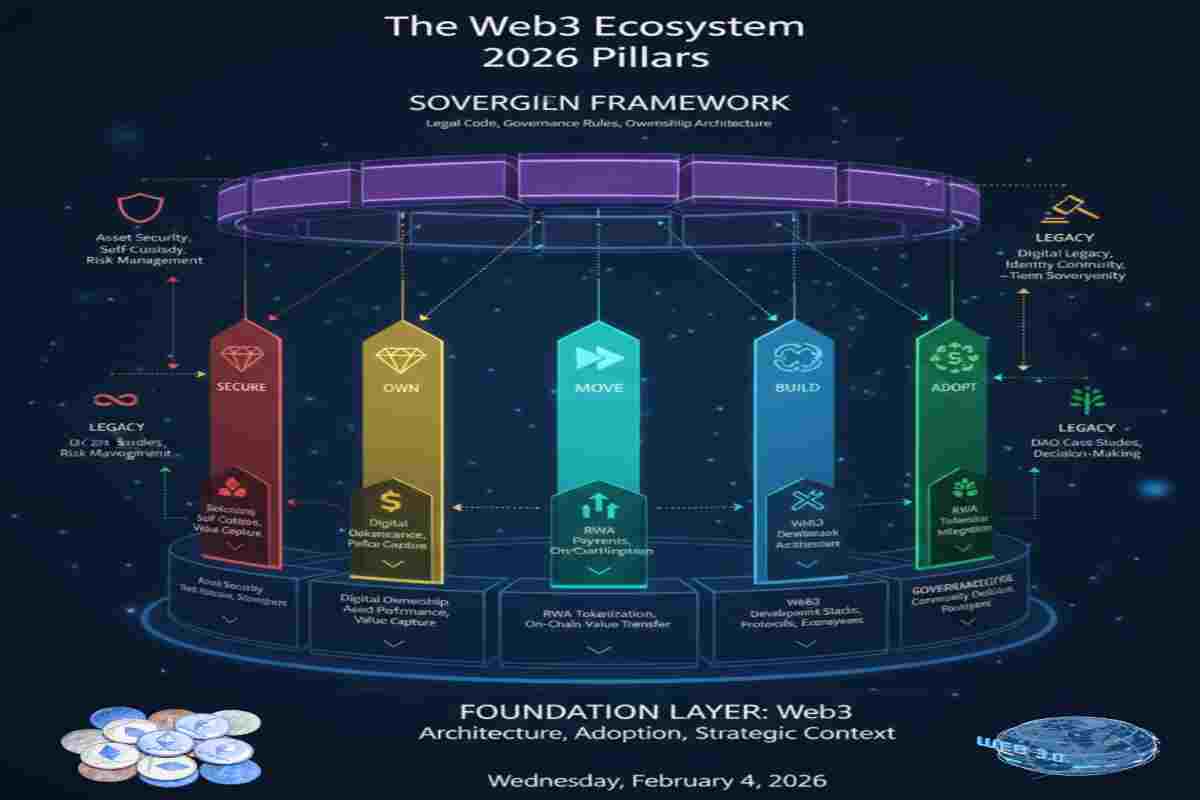
The shift highlighted in Stablecoins Are Now Insurable Money is only one piece of the 2026 financial architecture. To see how these real-time settlements integrate into a broader portfolio and drive institutional efficiency, explore our MOVE Pillar Master Guide on Asset Movement & Payment Rails.
If you are concerned about the underlying security of the protocols used in stablecoin issuance, our SECURE Pillar deep dive on Smart Contract Audit Protocols provides the “Defense-in-Depth” strategy needed to protect your treasury during high-velocity transfers.
The OWN Pillar | Asset Performance: High-velocity movement must serve a larger goal: growth. Our guide to [Digital Ownership: Crypto Asset Performance & ROI] demonstrates how “Insurable Money” can be leveraged to optimize capital efficiency while maintaining full regulatory compliance.
| Strategic Objective | Implementation Guide |
| Legacy & Continuity | |
| Infrastructure | |
| Settlement Rails | |
| Performance |
To maintain Sovereign Continuity, it is vital to track the primary source of these shifts. The OCC (Office of the Comptroller of the Currency) remains the lead architect for the PPSI framework. For those conducting deep-dive due diligence on the GENIUS Act compliance requirements, you can access the latest federal rulemaking and “Permitted Activity” bulletins directly via the official government portal at http://occ.treas.gov/topics/supervision-and-examination/digital-assets. This transparency is the “Gold Standard” for institutional MOVE operations in 2026.
Welcome to OwnProCrypto (Own & Pro Crypto) — a next-generation Bitcoin and blockchain education platform where the science of finance meets the power of AI-driven automation.
Our mission is simple: to equip you with the knowledge, frameworks, and tools needed to make smarter financial and business decisions in the Web3 economy.
Beyond analysis, OwnProCrypto focuses on transparency, verifiable data, and practical frameworks that investors and builders can actually use. Our goal is not hype — but clear thinking, disciplined analysis, and long-term value creation in the decentralized economy.
Our Background
As part of the Web3 Ecosystem Architecture pillar, this guide focuses on Sovereign Ownership Architecture in Web3. Explore related pillars: