
Table of Contents
ToggleThe crypto market has matured, but trader behavior has not.
Despite access to advanced Crypto Decision Operating System, real-time data, and thousands of signals, most traders still operate in a fragmented way. One tool for charts, another for signals, another for execution, and none of them actually enforce disciplined decision-making.
This gap is exactly where most losses happen.
In 2026, the edge is no longer about finding better signals or chasing short-term setups. It is about building a structured crypto decision system that governs how trades are evaluated before execution.
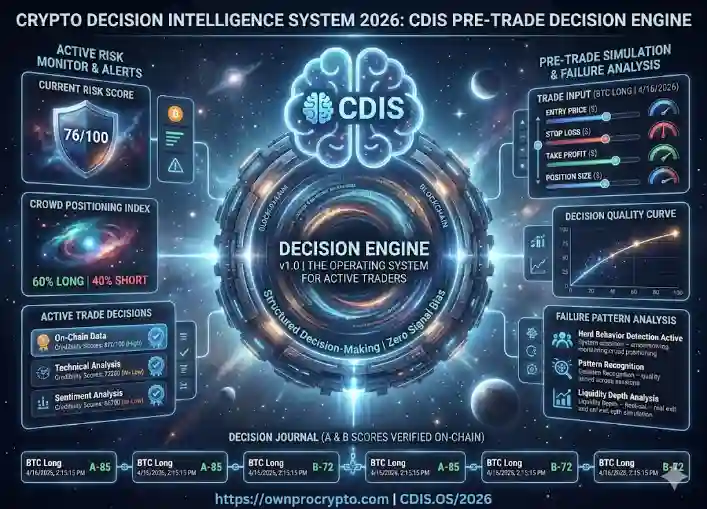
The Crypto Decision Operating System (CDIS) is designed as a complete crypto decision making system, where signal evaluation, trade filtering, and risk logic work together as one unified framework instead of disconnected tools. This article is part of the Crypto Trading Intelligence & Risk Systems 2026 cluster within the broader Institutional Infrastructure ecosystem. This cluster focuses specifically on how institutional traders evaluate signals, manage risk, and execute trades using structured frameworks instead of emotional or signal-based decision-making.
This cluster sits as a part of our Signal Intelligence layer inside Institutional Infrastructure and is designed to complement broader system-level topics such as custody, governance, and execution architecture.
It includes core pillars:
Crypto Decision Operating System (CDIS) 2026
Crypto Signal Evaluation Framework 2026
Why Crypto Signal Groups Fail (Institutional Breakdown)
Crypto Trade Filtering System 2026
Crypto Trading System: Crypto Decision Intelligence System CDIS-2026
Together, these pillars form a complete institutional-grade trading intelligence model covering signal validation, system failure analysis, and pre-trade filtering. Moving beyond retail noise is essential for the high-level execution found in our Crypto Trading Intelligence & Risk Systems 2026. Review the Financial Conduct Authority (FCA) warnings on social media financial promotions.
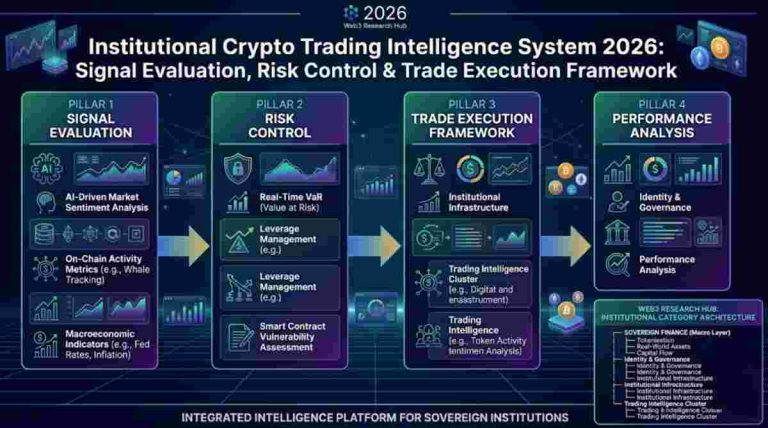
A crypto trading system is no longer just a set of indicators or strategies.
At a serious level, it is a decision framework that defines:
Most traders believe they have a system, but what they actually have is a collection of habits.
A real system produces consistent outputs from changing market inputs.

Most strategies do not fail because they are wrong.
They fail because they are incomplete.
| Problem Area | What Actually Happens |
|---|---|
| Signal dependency | Traders follow signals without validation |
| No filtering | Every setup looks tradable |
| Emotional execution | Decisions change under pressure |
| No feedback loop | Mistakes repeat without detection |
The issue is not strategy quality. It is the absence of a decision structure.
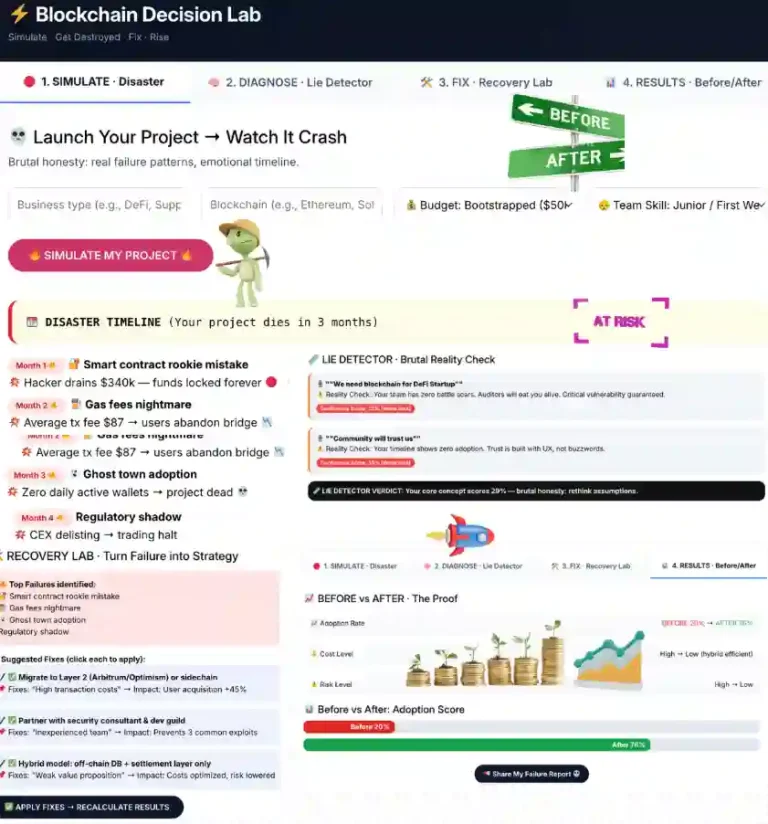
Institutional traders do not rely on signals the way retail traders do.
They operate through:
| Aspect | Retail Trading | Institutional Trading |
|---|---|---|
| Signals | Followed directly | Evaluated and scored |
| Risk | Reactive | Predefined |
| Execution | Flexible | Rule-based |
| Consistency | Variable | System-driven |
This shift is what CDIS is built to replicate in a practical way.
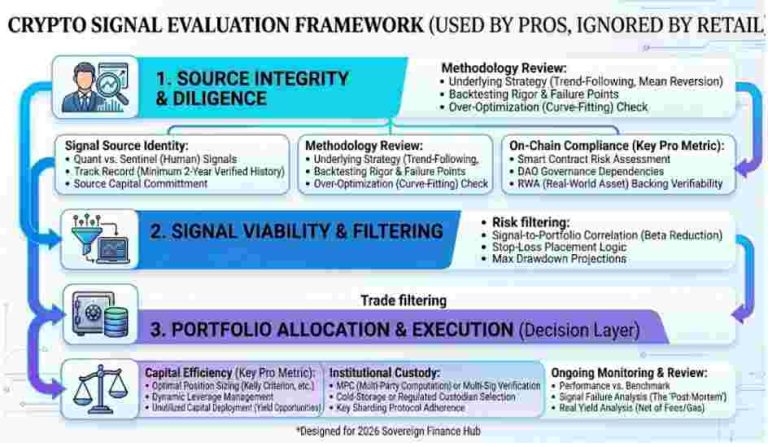
The Crypto Decision Operating System is built as a pipeline, not a dashboard.
Each stage exists to remove uncertainty before execution.
| Module | Role | Output |
|---|---|---|
| Signal Evaluation | Validates incoming signals | Signal Score |
| Failure Detection | Identifies hidden risks | Risk Flags |
| Trade Filtering | Removes weak setups | Trade Status |
| Decision Engine | Combines all inputs | Final Score |
This structure ensures that no trade moves forward without passing multiple layers of logic.
Signals are not inherently valuable. Their value depends on context.
A proper evaluation framework considers:
Without this, signals become noise.
CDIS converts signals into a measurable input, not a trigger.
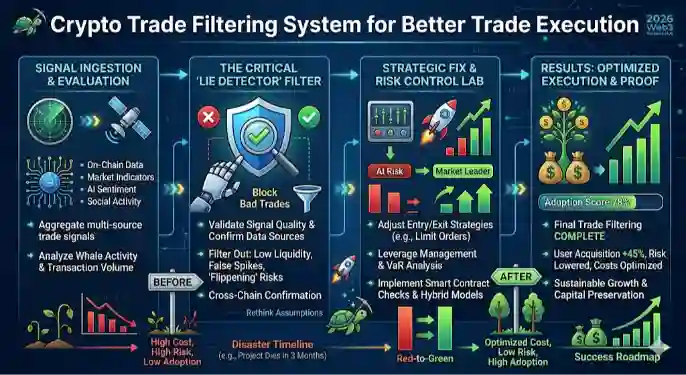
Not every valid signal should be traded.
Market conditions play a decisive role.
| Filter Type | Purpose |
|---|---|
| Market regime | Identifies trend vs chop |
| Liquidity check | Ensures exit feasibility |
| Volatility range | Prevents unstable entries |
| Exposure control | Avoids over-concentration |
Filtering is where most low-quality trades are eliminated.
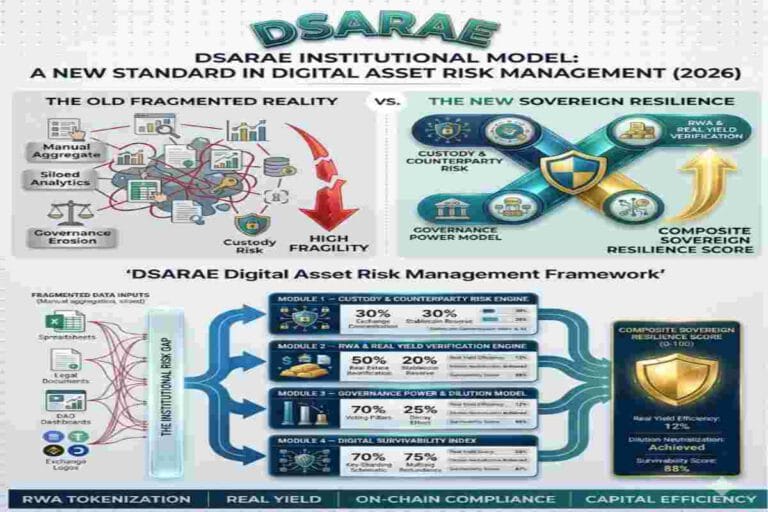
Most traders treat risk as a percentage.
Institutions treat it as a system-wide constraint.
In CDIS:
Risk is not applied after the decision.
It is embedded inside the decision itself.
This is where CDIS becomes fundamentally different.
Instead of asking
Should I take this trade
The system answers
How strong is this decision
| Component | Function |
|---|---|
| Signal Score | Measures signal strength |
| Risk Flags | Identifies hidden dangers |
| Filter Status | Confirms trade validity |
| Final Score | Combines all inputs |
The result is a decision score that determines:
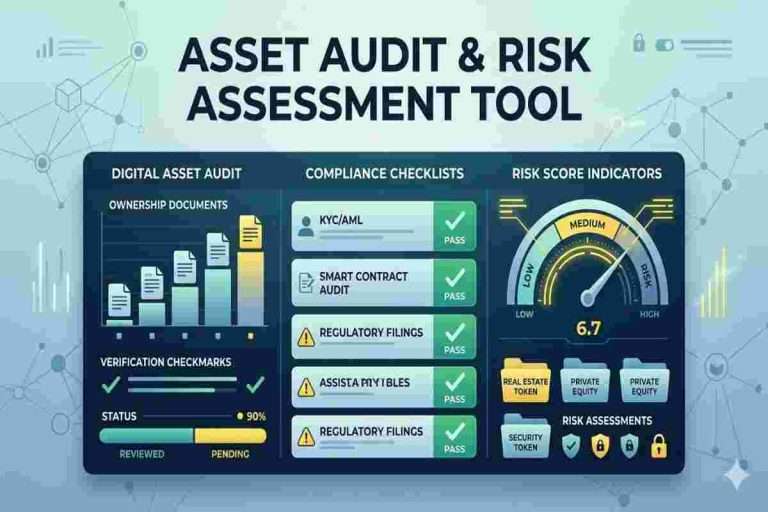
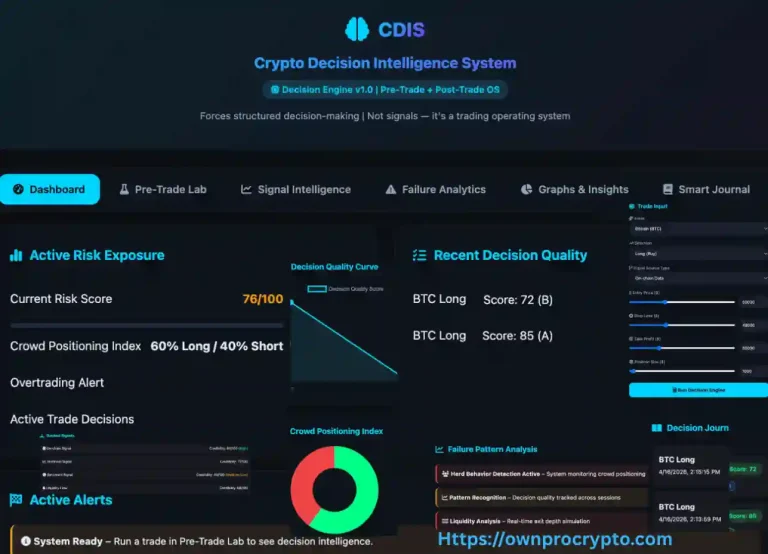
Most dashboards show price.
CDIS focuses on behavior and decisions.
| Graph Type | Insight |
|---|---|
| Decision vs Outcome | Quality of decisions over time |
| Risk Heatmap | Exposure across assets |
| Signal Accuracy | Which signals actually work |
| Trade Density | Overtrading patterns |
These visual layers turn trading into something measurable and improvable.
There is a fundamental difference between tools and systems.
Tools provide data.
Systems control actions.
| Category | Tools | CDIS |
|---|---|---|
| Function | Inform | Govern decisions |
| Usage | Optional | Required |
| Impact | Limited | Structural |
| Outcome | Inconsistent | Repeatable |
This is the gap CDIS is designed to close.
A proper trading dashboard is not about adding more widgets.
It should reflect the decision pipeline:
Everything shown should connect back to decision quality.
A trader spots a potential breakout on BTC after a short consolidation range.
Instead of entering directly, the idea is passed through CDIS.
Signal Type: Breakout Long
Asset: BTC
Timeframe: 4H
Entry Idea: Break above recent resistance zone
At this stage, most traders would already enter or wait for confirmation.
CDIS does not.
It starts evaluation.
The system checks:
Signal Score: 62 / 100
Reason: Breakouts in current regime have low continuation rate
Already, the system is not convinced.
Now CDIS looks at hidden risks.
Risk Flags:
This is where most traders get trapped.
Now the system asks a simple question:
Should this trade even be allowed under current conditions
Filters applied:
Trade Status: Conditional Rejection
Meaning: Allowed only with reduced size and strict invalidation
Now everything is combined:
Signal Score: 62
Risk Level: High
Filter Status: Weak Market Structure
41 / 100
Confidence Grade: D
Execution Permission: No or Very Low Size Only
| Behavior | Retail Trader | CDIS System |
|---|---|---|
| Decision | Enter breakout | Reject or reduce |
| Risk view | After entry | Before entry |
| Context awareness | Low | High |
| Outcome consistency | Random | Structured |
Later in the session:
Retail traders get trapped.
CDIS prevented exposure entirely.
The direction is clear.
Trading is moving toward:
Future systems will not just assist traders.
They will define how trading is done.
CDIS fits directly into this evolution.
The crypto market does not reward access to information anymore.
It rewards structured thinking.
A trader using ten tools without a system will always be at a disadvantage compared to someone using one system that enforces discipline.
The Crypto Decision Operating System is not about predicting the market.
It is about ensuring that every decision made within it is:
That shift alone changes everything.

A crypto decision making system is a structured process that combines signal evaluation, risk analysis, and market condition checks to support consistent and rule-based trading decisions.
To properly analyze crypto signals, traders must evaluate signal source reliability, historical performance, market regime compatibility, liquidity conditions, and confirmation strength before acting on them.
A crypto trading strategy 2026 approach focuses on system-based trading where strategies are validated through structured frameworks like trade filtering systems, decision scoring models, and risk-controlled execution rather than relying on standalone indicators.
A crypto decision system is a structured framework that evaluates, filters, and ranks trading opportunities before execution. It ensures that trading decisions are based on logic, not emotion or random signals. A structured framework that guides how trades are evaluated, filtered, and executed.
It focuses on decision quality rather than just providing data or signals.
Yes, because it simplifies complex decisions into structured outputs.
No, it enhances them by adding validation and filtering layers.
The process of assessing signal reliability before acting on it.
It removes low-quality setups that increase risk.
By enforcing the same decision logic across all trades.
Parts of it can be, but the core value is structured decision-making.
A combined metric that evaluates whether a trade should be taken.
Similar frameworks are already used in institutional trading environments.
Welcome to OwnProCrypto (Own & Pro Crypto) — a next-generation Bitcoin and blockchain education platform where the science of finance meets the power of AI-driven automation.
Our mission is simple: to equip you with the knowledge, frameworks, and tools needed to make smarter financial and business decisions in the Web3 economy.
Beyond analysis, OwnProCrypto focuses on transparency, verifiable data, and practical frameworks that investors and builders can actually use. Our goal is not hype — but clear thinking, disciplined analysis, and long-term value creation in the decentralized economy.
Our Background
As part of the Web3 Ecosystem Architecture pillar, this guide focuses on Sovereign Ownership Architecture in Web3. Explore related pillars: