Frequently Asked Questions: Sustainable DeFi & Real Yield
Fundamental Concepts & Definitions
Q: What is real yield in DeFi?
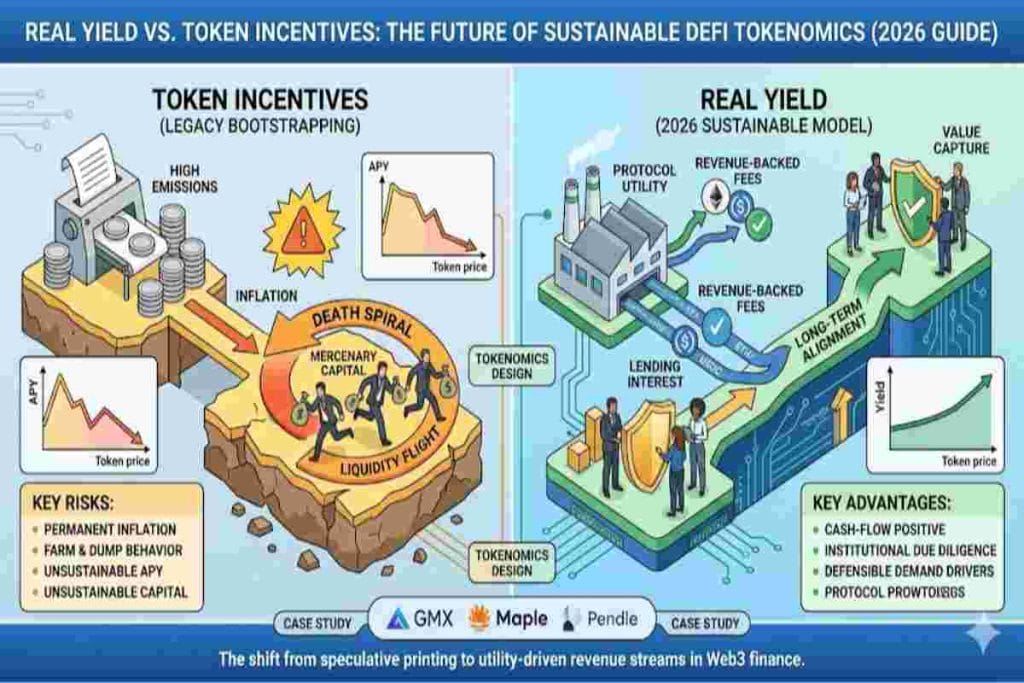
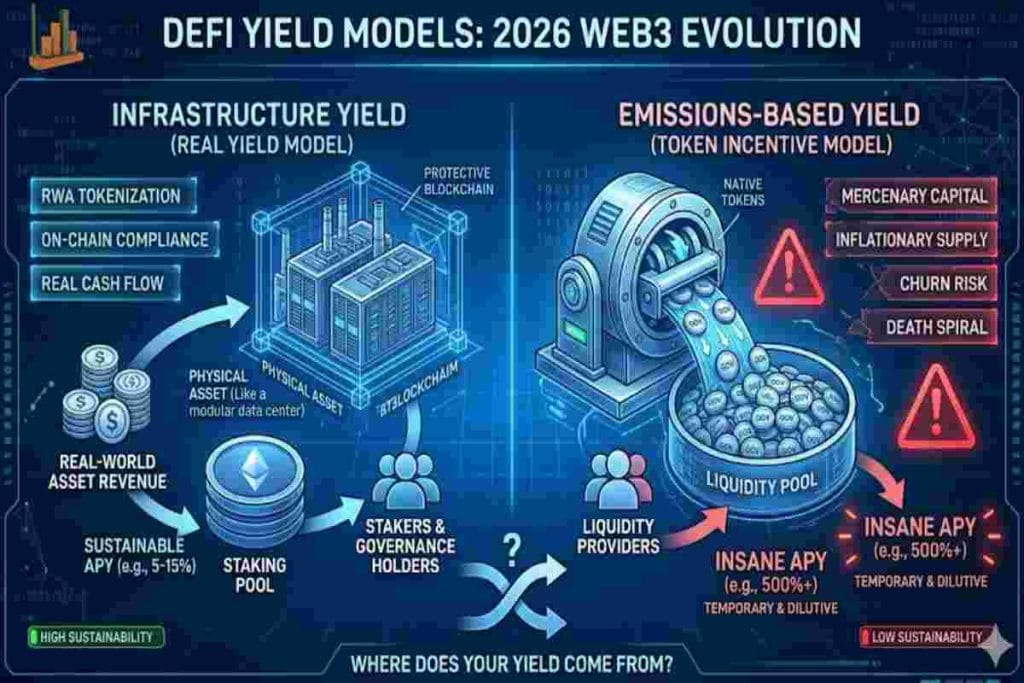
A: Real yield in DeFi refers to rewards generated from actual protocol revenue—such as trading fees, lending interest, or derivatives premiums—rather than newly minted tokens. Unlike inflationary rewards, real yield distributes income generated by real economic activity, making it a more sustainable model for long-term protocols. Rooted in Case Study Failure: Early “DeFi Summer” protocols often boasted 1,000% APYs that were 100% token emissions; when the printing stopped, the value vanished because there was no “real” income.
Q: How real yield works in crypto?
A: It works by capturing a portion of the value flowing through a protocol. When a user swaps tokens on a DEX or takes out a loan, they pay a fee. That fee (usually in a blue-chip asset like ETH or a stablecoin) is then distributed to the token holders or liquidity providers who secure the network.
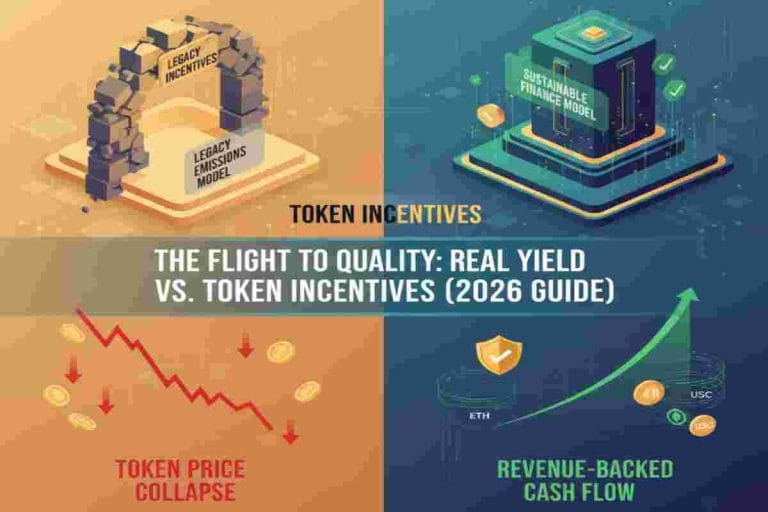
Q: What is the difference between real yield and token incentives? A: The main difference is the source of rewards. Real yield comes from genuine protocol revenue like trading fees or lending interest. Token incentives rely on issuing (minting) new tokens to attract liquidity. While incentives dilute the total supply, real yield aligns rewards with real economic activity and protocol growth.
Q: What is real yield in crypto protocols? A: It is essentially the “dividend” of the Web3 world. It is the net profit of a protocol that is shared with those who provide capital or governance, ensuring the token has fundamental value based on cash flow.
Sustainability & Tokenomics Design
Q: What makes a sustainable tokenomics model?
A: A sustainable model is defined by a Positive Revenue-to-Emission Ratio. It means the protocol earns more in organic fees than it pays out in newly minted token incentives. Key elements include capped supply, burn mechanisms, and utility-driven demand.
Q: Why are token incentives often unsustainable in DeFi?
A: They become unsustainable when protocols distribute rewards through high token emissions without generating enough revenue. This creates a “death spiral” of inflation and selling pressure, as yield farmers sell reward tokens immediately, leading to declining prices and reduced protocol value.
Q: Why do token emissions cause inflation?
A: Simple supply and demand economics. When a protocol constantly mints new tokens to pay for liquidity (emissions) without an equal increase in demand or a “burn” mechanism, the value of each individual token is diluted, leading to price depreciation.
Q: How protocol revenue supports token value?
A: Protocol revenue creates a “Value Floor.” When revenue is used to buy back tokens from the market or distributed as stablecoin yield, it creates a constant buy-pressure and a fundamental reason for investors to hold the asset, regardless of market speculation.
Q: Are token incentives sustainable in DeFi?
A: Only as a temporary bootstrapping tool. They are sustainable only if they successfully attract a “sticky” user base that eventually generates enough organic revenue to replace the need for further emissions.
Risks & Market Behavior
Q: Why does mercenary capital harm DeFi protocols?
A: Mercenary capital refers to users who only provide liquidity to “farm” high-emission rewards. They have no loyalty to the protocol and will pull their liquidity and dump their tokens the moment a higher APY appears elsewhere, causing massive slippage and price volatility.
Q: What are the risks of relying on token incentives for yield?
A: The primary risks include permanent token inflation, aggressive sell-side pressure from farmers, and “liquidity flight”—where the protocol’s Total Value Locked (TVL) collapses once the artificial incentives are reduced.
Q: Why do token incentives fail in crypto?
A: They fail when there is no transition plan to move from “emissions” to “revenue.” If the protocol’s service (trading, lending, etc.) isn’t useful enough to generate fees once the rewards stop, the project becomes a “ghost chain.”
Identification & Institutional Strategy
Q: How to identify real yield in crypto?
A: Look at the “Fee-to-Emission” data on platforms like DeFiLlama. If a protocol is paying out $1M in rewards but only earning $100k in fees, that yield is “fake.” Real yield is identified by transparent, on-chain revenue that covers the cost of rewards.
Q: Which DeFi protocols generate real yield?
A: Leading examples in 2026 include GMX (fees from perpetual trading), Maple Finance (institutional lending interest), and Aave (organic lending fees). These protocols share a portion of actual earnings with their token stakers.
Q: How can investors identify real yield in a crypto protocol?
A: Check if the rewards are paid in the native token (likely incentive) or in a different asset like ETH, SOL, or USDC (likely real yield). Real yield models prioritize distributing value that the protocol earned, not value it printed.
The Future of Web3 Finance
Q: Why is real yield important for sustainable DeFi?
A: It shifts the industry from “Ponzi-nomics” to Value Capture. By tying rewards to actual economic activity, it ensures that protocols are built to be profitable businesses, which is the only way to attract long-term institutional capital.
Q: How do DeFi protocols create sustainable yield?
A: By providing a valuable service—such as RWA tokenization, decentralized insurance, or efficient trade execution—where users are willing to pay a fee. That fee revenue is the engine of sustainable yield.
Q: Is real yield the future of DeFi tokenomics?
A: Absolutely. As the market matures and moves into the Institutional Era, revenue-backed incentives are becoming the industry standard. Analysts believe that by 2030, only protocols with proven real-world revenue streams will remain viable.