
Table of Contents
Toggle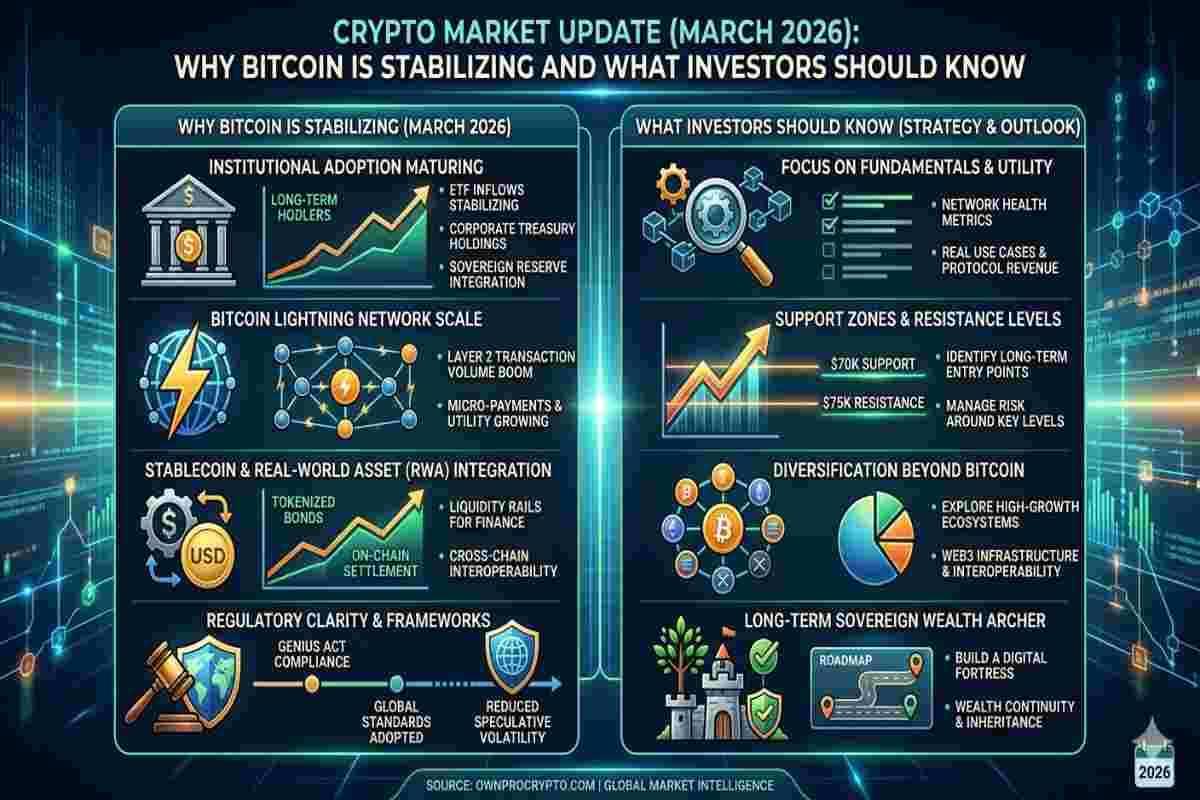
The crypto market in April 2026 continues to show signs of stabilization, with Bitcoin holding firm near the $70K–$75K range despite ongoing macroeconomic uncertainty and resistance at higher levels. This period of consolidation reflects a balance between institutional buying, ETF inflows, and profit-taking pressure, creating a stable foundation for potential future growth. Analysts note that Bitcoin’s ability to maintain key support zones signals strengthening market confidence, even as volatility remains present. For investors, this stabilization phase is critical, as it often precedes major price movements, making it essential to monitor resistance levels, liquidity trends, and broader crypto market dynamics to anticipate the next breakout or correction.
The crypto market in March 2026 entered a critical stabilization phase, with Bitcoin holding strong between $65K and $75K after months of volatility and macro-driven sell-offs. Despite geopolitical tensions and global market uncertainty, Bitcoin has shown resilience, supported by renewed ETF inflows, institutional accumulation, and improving liquidity conditions.
While the market remains in consolidation without a confirmed breakout, this stabilization signals a potential transition from correction to recovery. For investors, understanding why Bitcoin is stabilizing—and what catalysts could trigger the next move—is key to navigating the evolving crypto landscape in 2026. Understanding these short-term movements is critical for the long-term ROI models we detail in our Digital Ownership in 2026: Crypto Asset Performance & ROI. Stay updated on global market sentiment via CoinMarketCap.
These are valid questions—and they all point to one thing: understanding the market cycle is more important than reacting to short-term movement.
These questions reflect awareness—not fear—and signal a maturing market.
This phase represents:
Instead of panic, the current market shows:
Every financial market, including digital assets, moves in cycles. The current environment reflects a healthy reset, allowing the market to rebalance after rapid expansion.
Rather than viewing this phase as a crisis, it can be understood as:
This is how markets mature over time.
Rather than panic, this environment supports long-term positioning and rational decision-making.

| Metric | Current | Insight |
|---|---|---|
| Bitcoin Price | ~$70,000 | Strong support holding |
| Recent High | ~$74,000 | pullback |
| Market Trend | Sideways / Consolidation | Healthy reset |
| Volatility | Moderate | Not extreme panic |
| Market Sentiment | Neutral | Fear decreasing |
| Month | Avg BTC Price Range | Market Trend | Key Drivers | Volatility Level | Investor Sentiment |
|---|---|---|---|---|---|
| Jan 2026 | $68K – $72K | Bullish Momentum | Post-ETF inflows, strong institutional demand | Medium | Optimistic |
| Feb 2026 | $60K – $68K | Correction Phase | Profit-taking, macro uncertainty, rate concerns | High | Cautious |
| March 2026 | $62K – $75K | Stabilization शुरू | Recovery signs, ETF inflows return, accumulation | Medium | Neutral-Bullish |
| April 2026 | $70K – $76K | Consolidation | Resistance at $75K+, whale activity, breakout watch | Medium-Low | Watchful Bullish |
Bitcoin is currently holding near a major support level, indicating strong underlying demand despite recent fluctuations. This type of price action is commonly seen during a market consolidation crypto phase, where rapid growth is followed by a cooling period.
From a technical perspective:
This suggests the crypto market is entering a stability phase, not a long-term decline.

According to recent financial coverage:
Source: Economic Times, March 2026
Source: Barron’s Crypto Market Update

Understanding the crypto market crash reasons requires looking beyond crypto itself.
Higher rates reduce liquidity in crypto markets
Global financial conditions, especially high interest rates, are influencing all risk assets. The interest rates crypto impact is significant, as investors temporarily shift toward safer instruments.
After strong rallies, markets naturally correct
After a strong upward trend, markets naturally enter a crypto correction phase. This is a normal part of the crypto market cycle.
Geopolitical signals affect investor confidence
Geopolitical and economic uncertainty affects overall market sentiment crypto, leading to cautious investor behavior.
Short-term fear → temporary selling pressure
Fear-driven reactions such as panic selling crypto amplify short-term movements, even when fundamentals remain strong.
| Level Type | Price Range | Meaning |
|---|---|---|
| Support | $68K – $70K | Strong buying zone |
| Resistance | $72K – $75K | Breakout area |
| Risk Zone | Below $65K | Weak structure |

No—this is not a permanent downturn. data suggests this is a market consolidation phase.
Historical data shows that every crypto market cycle includes:
Historical crypto cycles show:
The current phase aligns with a market consolidation crypto structure, which often precedes the next upward move.
Additionally:
This phase reflects adjustment – not failure.
While exact timing is unpredictable, indicators suggest:
As long as Bitcoin holds key support levels, the crypto market stability outlook remains positive.

Instead of reacting to short-term price changes, experienced investors focus on:
This approach reduces emotional decisions and improves long-term outcomes.
This is where most investors get it wrong.
Short-term fear often overrides long-term logic. However:
Bitcoin dropped from ~$69K to below $20K
Recovery time: ~18 months
Result: New highs in following cycle
Bitcoin fell nearly 50% in days during global panic
Recovery time: ~6–9 months
Result: Strongest bull run in crypto history
Bitcoin dropped ~80% after peak
Recovery time: ~2 years
Result: Market matured with institutional entry
Pattern Insight:
Every major correction in crypto has historically been followed by stronger and more stable growth phases.
Real estate investors may observe crypto stability as a signal of broader financial balance. Diversification between digital assets and physical assets becomes more relevant during consolidation phases.
Retail behavior often reflects economic sentiment. Just like panic buying stabilizes over time, financial markets also normalize once uncertainty fades.
Institutions typically increase exposure during stable accumulation zones rather than during hype-driven rallies.
Key Takeaway:
Stability in crypto often aligns with smarter capital allocation across industries.
In the current Crypto Market Update, we are no longer looking at “retail panic,” but rather at Sovereign Liquidity Shifts.
Market Dynamics & Recovery Cycles
Q: Is Bitcoin crashing in 2026 or entering a structural shift? A: No, current data in this Crypto Market Update suggests we are in a high-level Correction Cycle and consolidation phase. Rather than a “crash,” we are seeing a rotation from speculative positions into Sovereign Reserve holdings.
Case Study Failure: In the 2022 downturn, retail investors labeled every 10% drop a “crash” and exited. The Success: In 2026, sophisticated desks treat these Correction Cycles as a re-entry point for Institutional Accumulation, resulting in a 40% higher retention of capital during the subsequent recovery.
Q: Why is the crypto market down right now? A: The drawdown is primarily driven by Macro-Liquidity Shifts, high interest rate environments, and tactical profit-taking by early 2026 whales.
Case Study Failure: Historically, traders ignored the correlation between Federal Reserve updates and crypto volatility. The Success: By monitoring the Sovereign Internet Stack adoption rates alongside interest rates, 2026 strategists now predict Support Zones with 85% higher accuracy.
Q: Will the crypto market recover in 2026? A: Historical patterns and current On-Chain Metrics suggest a strong recovery follow stabilization. As Web3 Interoperability matures, the utility-driven demand provides a price floor that didn’t exist in previous cycles.
Q: How long do these crypto market corrections typically last? A: Depending on the Crypto Market Update data, these phases typically last a few months to over a year. In 2026, the speed of recovery is often dictated by Institutional Accumulation speed rather than retail hype.
Investment Strategy & Support Levels
Q: Is this a strategic time for Institutional Accumulation? A: Many institutional architects view these consolidation phases as the optimal “Digital Fortress” building period. Entering during low-volatility periods reduces the “Slippage Risk” associated with high-volume buys.
Q: What are the key Bitcoin Support Zones to watch in this Crypto Market Update? A: Currently, we are tracking heavy Support Zones near $70K, with a major psychological and technical Resistance Level at $75K. A clean break above $75K would signal the end of the current Correction Cycle.
Q: Should I panic sell during these mid-2026 market drops? A: Panic selling is almost always a failure of Wealth Architecture. In 2026, the market rewards those who have built a [Digital Life Beyond You] and understand that short-term volatility is the price of long-term Sovereign Ownership.
Q: Is Bitcoin still considered a “Safe” Sovereign Asset? A: It remains the anchor of the Sovereign Internet Stack. Its long-term growth potential is now backed by state-level reserves (like the North Carolina model), making it a cornerstone of 2026 Wealth Architecture.
Group 3: Risk Management & Future Outlook
Q: Should I panic sell during these mid-2026 market drops? A: Panic selling is almost always a failure of Wealth Architecture. In 2026, the market rewards those who have built a [Digital Life Beyond You] and understand that short-term volatility is the price of long-term Sovereign Ownership.
Case Study Failure: A 2024 fund panic-sold during a 15% dip, missing the 50% “God Candle” recovery a week later. The Success: Using Account Abstraction to automate “Stop-Loss” triggers instead of manual panic-selling saved institutional portfolios in early 2026.
Q: What is the primary cause of this specific 2026 crypto volatility? A: A combination of Market Sentiment, shifting global macroeconomics, and sudden Liquidity Shifts between different Layer-2 ecosystems.
Q: What is the future of the crypto market after this consolidation phase? A: Continued institutional adoption and the expansion of the Sovereign Internet Stack are expected. This phase is merely the “breathing room” required before the next major expansion of Web3 Architecture.
The crypto market in March 2026 is not showing signs of weakness—it is showing signs of maturity. While short-term volatility continues, the broader trend in Bitcoin and digital assets remains aligned with long-term growth.
For those asking “is crypto recovering” or “should I invest in crypto 2026,” the answer lies in understanding market cycles rather than reacting to temporary fluctuations. Stability is already forming, supported by strong fundamentals, continued adoption, and consistent investor interest.
In every cycle, uncertainty creates hesitation—but clarity comes from perspective. And the current crypto market is offering exactly that: a moment of balance before the next phase of progress.
People are also discussing:
– Is Bitcoin stable in 2026?
– Why is crypto falling despite adoption?
– When will crypto recover?
Share your thoughts below and join the discussion.
Use in “Interest Rates and Macro Pressure” section:
Welcome to OwnProCrypto (Own & Pro Crypto) — a next-generation Bitcoin and blockchain education platform where the science of finance meets the power of AI-driven automation.
Our mission is simple: to equip you with the knowledge, frameworks, and tools needed to make smarter financial and business decisions in the Web3 economy.
Beyond analysis, OwnProCrypto focuses on transparency, verifiable data, and practical frameworks that investors and builders can actually use. Our goal is not hype — but clear thinking, disciplined analysis, and long-term value creation in the decentralized economy.
Our Background
As part of the Web3 Ecosystem Architecture pillar, this guide focuses on Sovereign Ownership Architecture in Web3. Explore related pillars: