
This tool helps you understand and control burn rate before failure happens
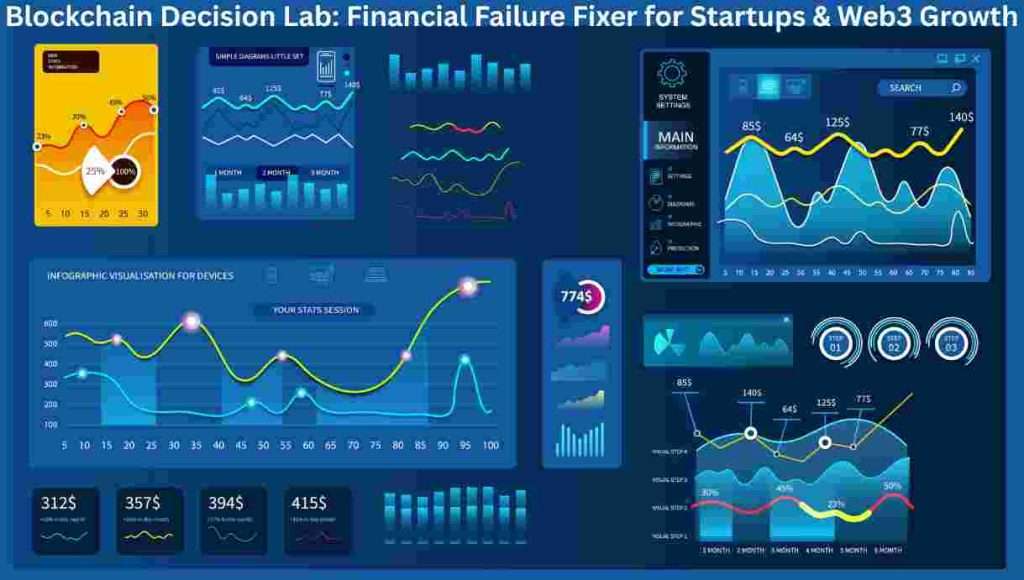
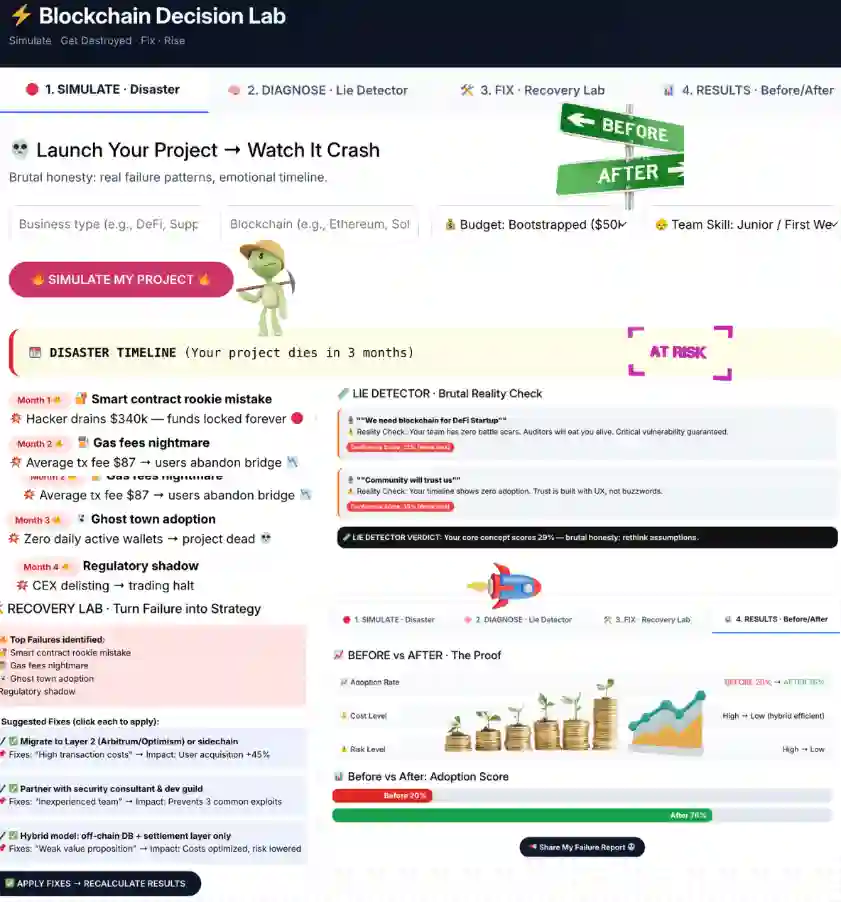
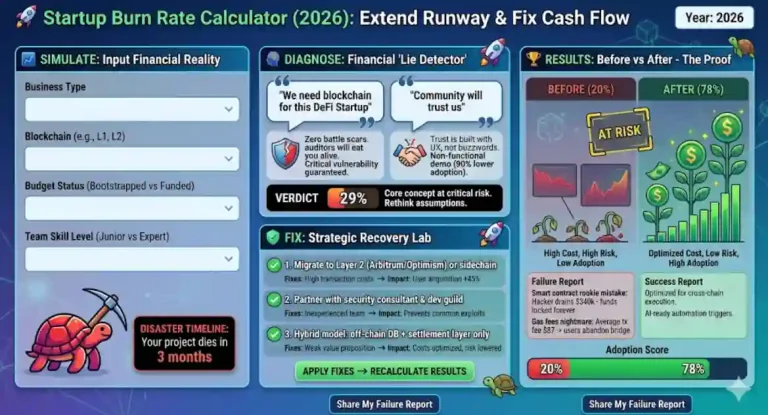
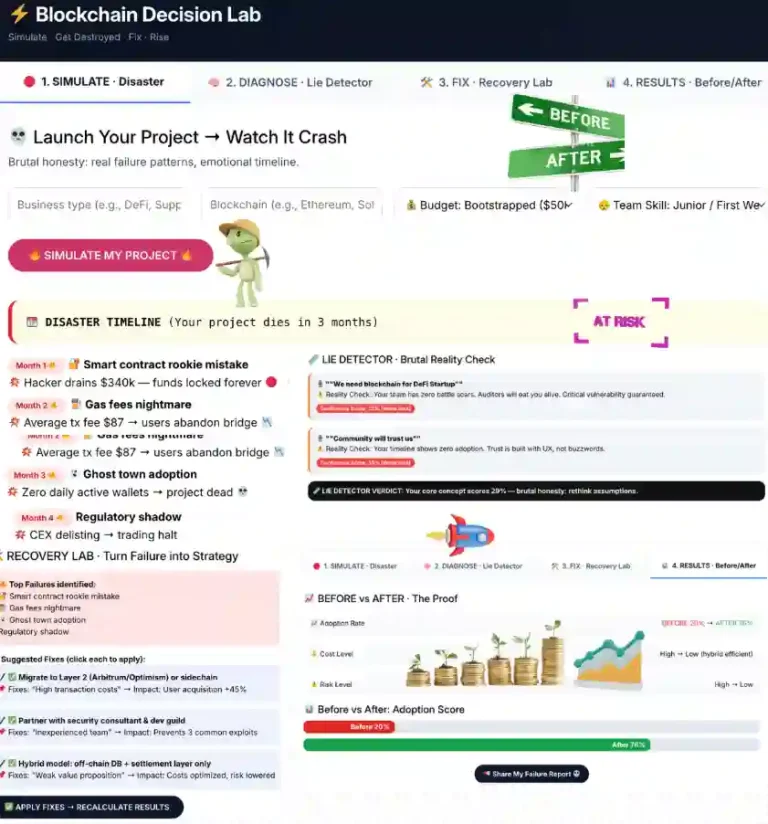
Startup Burn Rate Calculator informational dashboard. journey from the technical “Lie Detector” to the “Before vs. After” proof.
Table of Contents
ToggleManaging early-stage growth requires precise control over capital efficiency. Many startups fail not because of weak ideas, but due to poor financial visibility and uncontrolled operational costs that shorten their runway. The Startup Burn Rate Calculator (2026) is designed to help founders understand their monthly cash outflow, identify inefficiencies in spending, and apply practical strategies for startup cost optimization. By analyzing burn rate patterns and highlighting cash flow problems early, it supports better financial planning and enables a more structured financial turnaround strategy that extends runway and improves long-term stability.
Predicting failure points is a mandatory part of the architectural planning in our Web3 Development Guide (2026), RWA-Tokenization. Review CB Insights for the most recent post-mortem data on tech startups.
Burn rate refers to how quickly a business consumes its available capital each month before it becomes profitable.
It is one of the most critical indicators of financial health, especially for early-stage companies. When expenses consistently exceed income, the runway shortens, increasing financial pressure and operational risk.
Understanding your burn rate helps you make more informed decisions by allowing you to:
Most financial failures are predictable. The problem is visibility.
Common issues include:
Without proper analysis, these issues compound until recovery becomes difficult.
The tool acts as a financial diagnostic and simulation engine:
Enter:
The system calculates:
Test different decisions:
Visualize:
Startups fail not because of bad ideas—but because of poor financial visibility. A Financial Failure Fixer changes that by combining AI insights with blockchain financial analysis to detect issues before they become fatal. Whether you’re running a SaaS startup or a Web3 project, understanding your burn rate, revenue gaps, and inefficiencies is critical for survival and long-term growth.
A Financial Failure Fixer is an intelligent system designed to simulate business failure scenarios and recommend recovery actions. Unlike static dashboards, it actively guides founders through decisions using real-time inputs. It acts as a runway optimization tool, helping you understand how long your startup can survive and what actions can extend that timeline.

Why Web3 Projects Fail? The blind launch remains one of the most costly startup mistakes to avoid in the digital asset ecosystem. Most crypto project failure reasons are not driven by a lack of vision, but by weak Web3 financial management, poor alignment between technical execution and market volatility, and the absence of rigorous blockchain financial analysis. Without tools like a startup burn rate calculator or a structured business turnaround strategy, founders operate without clear visibility into risk, runway, or sustainability. For builders and researchers alike, understanding these startup mistakes to avoid is what separates scalable, resilient protocols from projects that quickly become cautionary tales in post-mortem reports.
| Metric | Meaning | Why It Matters |
|---|---|---|
| Burn Rate | Monthly spending | Shows how fast you’re losing money |
| Runway | Time before cash runs out | Shows how long you can survive |
Burn rate is the speed
Runway is the time left
You need both to make informed decisions.
Startup runway tells you how long your business can operate before running out of cash.
Runway = Total Cash ÷ Monthly Burn Rate
For example:
If you have $120,000 and spend $10,000/month → runway = 12 months
This tool automates the calculation and adds deeper insights by factoring in:
Reducing burn rate is not about cutting blindly—it’s about optimizing intelligently.
Effective strategies:
Small adjustments can significantly extend runway.

A strong financial turnaround strategy focuses on:
The goal is not just survival—but sustainable growth.
One of the most powerful features of this tool is simulation.
Instead of guessing, you can:
This turns financial planning into a data-driven process, not intuition.

| Problem | Objectives | Analysis / Situation | Implementation | Challenges | Results / Outcomes |
| Governance Deadlock: A DAO-based project faced a complete halt in decision-making during a market dip. | Ensure On-Chain Compliance: Restore the ability to execute emergency upgrades. | The simulation identified that the voting threshold was too high, a common startup mistake to avoid. | Adjusted the quorum requirements and integrated a multi-sig “Safety Break” for rapid response. | Balancing Sovereign Control with decentralization ideals. | Success: The project survived a 40% TVL drop without losing Capital Efficiency. |
| Problem | Objectives | Analysis / Situation | Implementation | Challenges | Results / Outcomes |
| Incentive Decay: A DeFi protocol’s yield dropped, causing a mass exodus of liquidity. | Model Real Yield: Identify the “Death Spiral” threshold before launch. | A detailed project risk analysis showed that the rewards were unsustainable against RWA Tokenization competitors. | Redesigned the tokenomics to include a buy-back mechanism funded by protocol fees. | Maintaining investor interest during the transition to lower, sustainable yields. | Success: Projected runway extended by 18 months. Identified core crypto project failure reasons before minting. |
This startup burn rate calculator is built for SaaS founders, startups, freelancers, and Web3 builders who need clear control over cash flow, operational costs, and financial planning. Whether you’re scaling a SaaS product, managing inconsistent freelance income, or operating a decentralized protocol, this tool helps you replace guesswork with data-driven clarity.
Success is not just about growth—it’s about control.
As Web3 and startup ecosystems evolve, tools like this will become essential—not optional—for survival and scaling. By understanding your financial structure, managing risk, and making disciplined decisions, you move from uncertainty to precision. Whether you’re building a startup, scaling a business, or operating in Web3, long-term success comes from mastering both opportunity and sustainability.
In 2026, financial clarity is a competitive advantage. The ability to understand burn rate, extend runway, and simulate decisions before execution separates sustainable businesses from those that fail under pressure. The Startup Burn Rate Calculator transforms financial management from reactive guesswork into proactive strategy—helping you stay in control, adapt faster, and build with confidence.
To ensure your architecture meets global institutional standards for digital ledger security and interoperability, refer to the technical guidelines provided by the National Institute of Standards and Technology (NIST).

Burn rate is the amount of money a business spends each month before generating profit.
Divide total available cash by monthly burn rate to estimate how long your business can survive.
Reduce unnecessary expenses, improve efficiency, and focus on high-return activities.
Due to poor cash flow management, overspending, and lack of financial planning.
Typically 12–18 months is considered safe, but it depends on your growth stage.
Yes. It works for both traditional startups and Web3 teams managing treasury and operational costs.
Most fail due to poor execution, weak tokenomics, lack of user adoption, and technical vulnerabilities.
By validating your idea, managing costs, optimizing technology, and testing assumptions before scaling.
Overbuilding, ignoring users, poor financial management, and choosing the wrong infrastructure.
Yes. The core principles of risk analysis and validation apply to all types of startups.
It is rarely a hack. Most often, why defi projects fail is due to “Economic Exploits”—where the protocol functions exactly as written, but the incentives are gamed by sophisticated actors to drain liquidity.
Investors in 2026 are looking for On-Chain Compliance and risk mitigation. Showing a comprehensive project risk analysis report proves you have accounted for the “Black Swan” events that kill 90% of Web3 startups.
Absolutely. Identifying crypto project failure reasons in a live environment allows for “Hot-Fix” deployments to architecture, preventing a total collapse and preserving Sovereign Asset Strategy.
Rooted in Case Study Failure: As seen in the “Protocol Collapse” simulation, failing to stress-test your governance leads to “Frozen Assets” that no amount of marketing can fix.
A financial failure fixer is a tool or system that identifies cash flow issues, cost inefficiencies, and revenue gaps, then provides actionable strategies to recover business performance.
Blockchain financial analysis improves transparency, tracks transactions in real time, and helps detect inefficiencies in decentralized finance systems.
Yes, Web3 financial management tools help manage token flows, operational costs, and decentralized revenue streams effectively.
A strong business turnaround strategy focuses on cost reduction, revenue growth, and operational efficiency improvements.
Welcome to OwnProCrypto (Own & Pro Crypto) — a next-generation Bitcoin and blockchain education platform where the science of finance meets the power of AI-driven automation.
Our mission is simple: to equip you with the knowledge, frameworks, and tools needed to make smarter financial and business decisions in the Web3 economy.
Beyond analysis, OwnProCrypto focuses on transparency, verifiable data, and practical frameworks that investors and builders can actually use. Our goal is not hype — but clear thinking, disciplined analysis, and long-term value creation in the decentralized economy.
Our Background
As part of the Web3 Ecosystem Architecture pillar, this guide focuses on Sovereign Ownership Architecture in Web3. Explore related pillars: