
Table of Contents
ToggleMost traders assume that receiving a crypto signal is enough to make a profitable trade.
Institutional investors think differently:
Signals are not decisions — they are inputs.
Without a structured evaluation system, even high-quality signals can lead to inconsistent results, emotional trading, and unnecessary drawdowns.
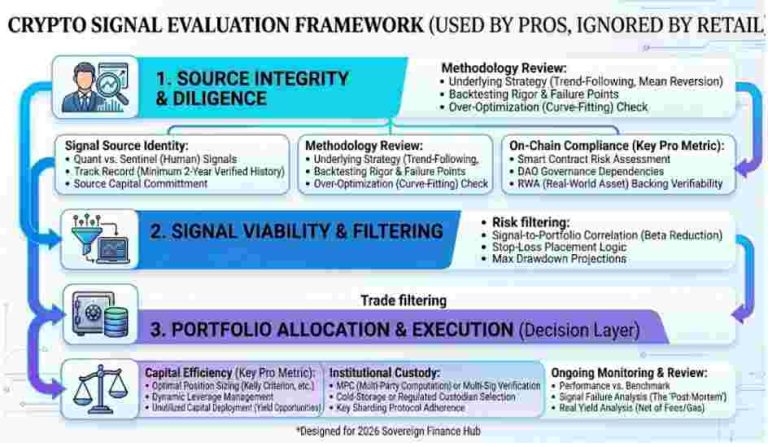
A professional 5-layer system used to evaluate crypto trading signals before execution. Built for traders, investors, and Web3 professionals.
This framework explains how professional traders evaluate signals before execution using a structured, repeatable model.
This is the Signal Layer of the Crypto Trading Intelligence & Risk Systems 2026 framework, operating within a broader institutional infrastructure ecosystem.
It includes three core pillars:
Together, these pillars form a complete institutional-grade trading intelligence model covering signal validation, system failure analysis, and pre-trade filtering. This framework is the analytical engine behind our Crypto Trading Intelligence & Risk Systems 2026. To see how institutional data feeds power these signals, explore the Bloomberg Crypto terminal insights.
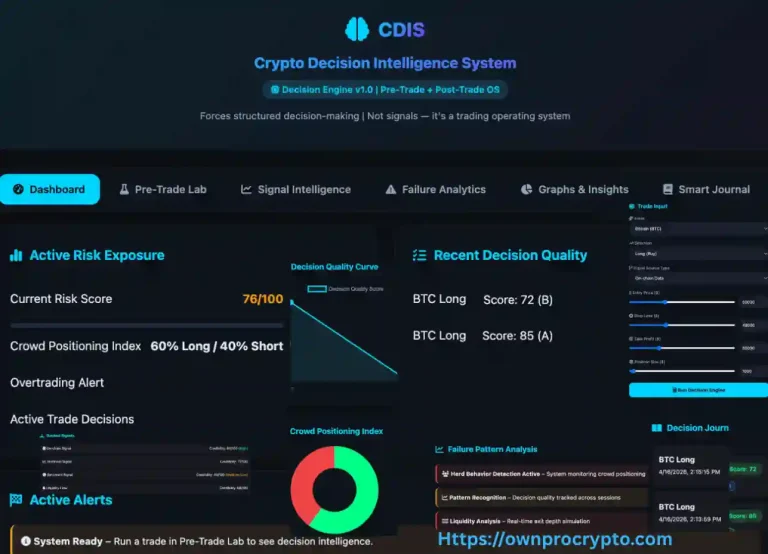
The Crypto Decision Operating System (CDIS) is designed as a complete crypto decision making system, where signal evaluation, trade filtering, and risk logic work together as one unified framework instead of disconnected tools. This article is part of the Crypto Trading Intelligence & Risk Systems 2026 cluster within the broader Institutional Infrastructure ecosystem. This cluster focuses specifically on how institutional traders evaluate signals, manage risk, and execute trades using structured frameworks instead of emotional or signal-based decision-making.
Before acting on any signal, evaluate the market context:
Signals against market structure carry significantly higher risk.
Every trade must be evaluated through risk logic before entry:
Related framework:
https://ownprocrypto.com/digital-asset-risk-management-framework/
Evaluate how the entry is constructed:
Non-repeatable entries are not institutional-grade signals.
Professional traders prioritize liquidity over direction:
Signals without liquidity context are incomplete.
Confirm whether price movement is supported:
Weak confirmation increases probability of failure.

Evaluate every signal using a simple scoring system:

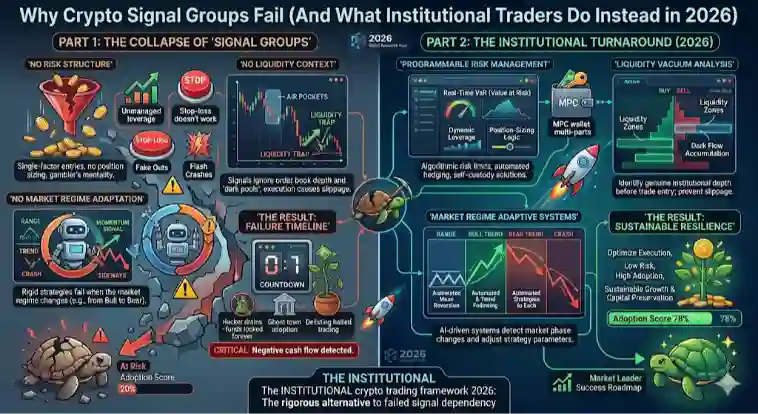
Institutional traders do not “follow” signals.
They:
Signals are secondary to internal models and execution systems.
Edge in trading does not come from prediction.
It comes from filtration.
Signal quality is irrelevant without a structured evaluation system.
Trading performance is determined by how signals are filtered, not how often they are followed.
For broader understanding of digital asset market structure and institutional adoption standards, refer to the public policy overview by the International Monetary Fund (IMF): https://www.imf.org/en/Topics/fintech

What is a crypto signal evaluation framework?
A crypto signal evaluation framework is a structured method used to assess trading signals before execution. It focuses on market structure, liquidity conditions, risk exposure, and trade logic to determine whether a signal is actionable.
Do crypto signals actually work?
Crypto signals can work, but not in isolation. Their effectiveness depends on how they are validated, the market environment, and the trader’s risk management. Blindly copying signals without context typically leads to inconsistent results.
Why do most crypto signals fail?
Most signals fail because they lack structured risk models, ignore liquidity dynamics, and do not account for changing market conditions. Without context, a signal is just a price suggestion—not a strategy.
How do professional traders evaluate crypto signals?
Professional traders treat signals as trade ideas rather than instructions. They evaluate risk-to-reward ratios, analyze market structure, look for multiple confirmations (confluence), and consider the historical reliability of the signal source before entering a trade.
How do institutional traders approach crypto signals differently?
Institutional traders focus on macro structure, liquidity conditions, and overall portfolio exposure. Their decisions are driven by risk-adjusted returns and capital preservation, not signal frequency or hype.
What metrics should be used to validate crypto signals?
Key metrics include risk-to-reward ratio, win rate, maximum drawdown, and execution factors such as slippage. More advanced traders may also use risk-adjusted performance measures like the Sharpe ratio.
How can you tell if a crypto signal is reliable or fake?
Reliable signals typically come with a verified track record, transparent reporting of both wins and losses, and consistent risk management practices. Signals that promise guaranteed profits or only showcase winning trades should be treated with skepticism.
Is following crypto signals profitable?
Not consistently on its own. Profitability depends more on disciplined execution, proper position sizing, and risk control than on the signal itself.
Are crypto signals worth paying for?
Paid signals are not automatically better than free ones. Their value depends on transparency, consistency, and whether they fit within a structured trading framework. Without validation, paid access does not guarantee improved performance.
What risk management rules do professionals use with trading signals?
Professionals typically risk a small percentage of capital per trade (often 1–2%), use stop losses consistently, avoid overtrading, and diversify exposure. Risk control is prioritized over maximizing returns.
Which timeframe is best for crypto signals?
There is no universally optimal timeframe. Short-term signals require rapid execution and constant monitoring, while longer-term signals depend more on broader market trends. The choice should match the trader’s availability and risk tolerance.
How do you backtest crypto signals effectively?
Effective backtesting involves applying historical signals to past market data, tracking performance metrics such as win rate and drawdown, and simulating realistic conditions including fees and slippage. This helps determine whether a signal strategy has actual edge.
What are the biggest mistakes when following crypto signals?
Common mistakes include entering trades too late, ignoring stop losses, overleveraging, following too many signal sources, and making emotionally driven decisions. These factors often matter more than the signal quality itself.
Can crypto signals be automated or copied with bots?
Yes, signals can be automated using trading bots, but automation does not remove risk. Issues like slippage, latency, and changing market conditions can still negatively impact performance. Active oversight remains necessary.
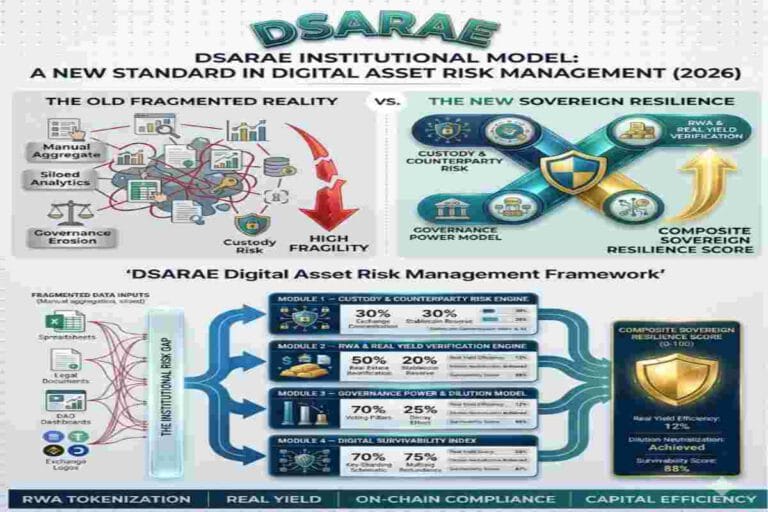
What is DSARAE in crypto risk management?
DSARAE is a structured digital asset risk assessment framework used to evaluate volatility, exposure, and overall portfolio risk.
Learn more: https://ownprocrypto.com/digital-asset-risk-management-framework/
What is MPC wallet architecture?
MPC (Multi-Party Computation) wallet architecture distributes private key control across multiple parties, reducing single-point failure risk in crypto custody systems.
Learn more: https://ownprocrypto.com/mpc-vs-multi-sig-crypto-custody/
How can beginners build a structured crypto signal strategy?
Beginners should start by defining a fixed risk per trade, using a checklist to validate signals, focusing on a limited number of strategies, and maintaining a trading journal. Over time, reviewing and refining this process helps build consistency and discipline.
Welcome to OwnProCrypto (Own & Pro Crypto) — a next-generation Bitcoin and blockchain education platform where the science of finance meets the power of AI-driven automation.
Our mission is simple: to equip you with the knowledge, frameworks, and tools needed to make smarter financial and business decisions in the Web3 economy.
Beyond analysis, OwnProCrypto focuses on transparency, verifiable data, and practical frameworks that investors and builders can actually use. Our goal is not hype — but clear thinking, disciplined analysis, and long-term value creation in the decentralized economy.
Our Background
As part of the Web3 Ecosystem Architecture pillar, this guide focuses on Sovereign Ownership Architecture in Web3. Explore related pillars: