
Table of Contents
ToggleMost crypto signal groups fail not because the signals are always wrong, but because the system behind them is structurally weak. Institutional traders do not rely on signal groups. They rely on internal validation models, risk frameworks, and market condition filters.
Most crypto signal groups fail due to weak risk structures and lack of institutional trading logic. Here’s what professionals do instead.
This article explains why most signal systems fail and what professional traders actually do instead.
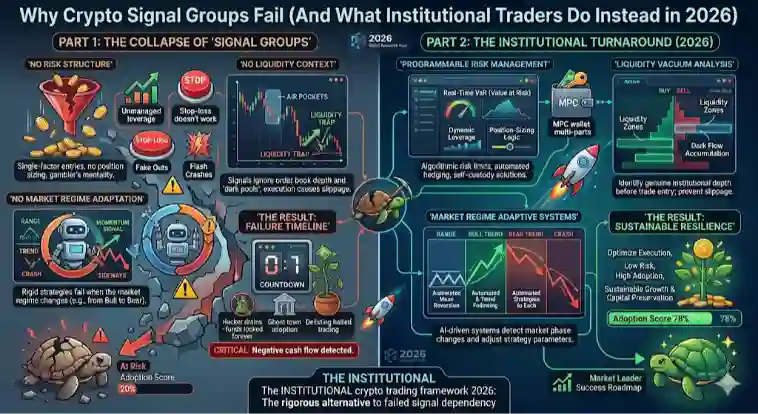
By 2026, the era of the “Guru-led” telegram group has effectively collapsed, leaving behind a trail of liquidated retail accounts and broken promises. These groups failed because they treated the market as a static game, ignoring the fundamental shift toward high-frequency institutional dominance and algorithmic liquidity traps. Institutional crypto trading has evolved into a discipline of “Probability Engineering” rather than “Price Guessing.” While retail groups remain trapped in a cycle of signal dependency and emotional chasing, sophisticated players have moved toward an institutional crypto trading framework that prioritizes market regime adaptation and programmable risk over raw entry alerts.
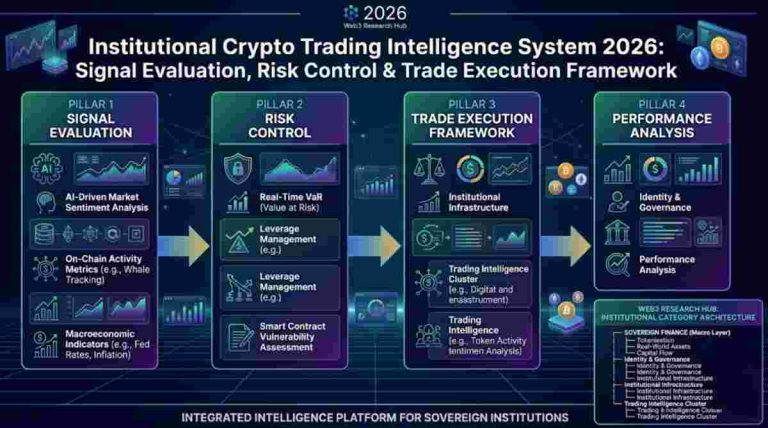
This is the Signal Layer of the Crypto Trading Intelligence & Risk Systems 2026 framework, operating within a broader institutional infrastructure ecosystem.
It includes three core pillars:
Together, these pillars form a complete institutional-grade trading intelligence model covering signal validation, system failure analysis, and pre-trade filtering. Moving beyond retail noise is essential for the high-level execution found in our Crypto Trading Intelligence & Risk Systems 2026. Review the Financial Conduct Authority (FCA) warnings on social media financial promotions.
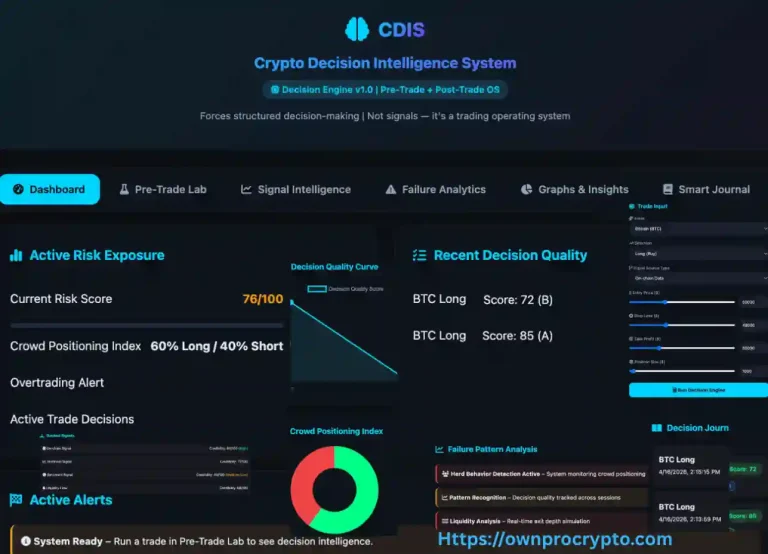
The Crypto Decision Operating System (CDIS) is designed as a complete crypto decision making system, where signal evaluation, trade filtering, and risk logic work together as one unified framework instead of disconnected tools. This article is part of the Crypto Trading Intelligence & Risk Systems 2026 cluster within the broader Institutional Infrastructure ecosystem. This cluster focuses specifically on how institutional traders evaluate signals, manage risk, and execute trades using structured frameworks instead of emotional or signal-based decision-making.
Signal groups create dependency instead of understanding:
Signals alone do not create consistency — systems do.
Most groups focus only on entry points, not downside protection.
Related framework: https://ownprocrypto.com/digital-asset-risk-management-framework/

High win rate marketing hides structural weakness:
Signals are often repeated across:
Without adapting to regime, signals fail.
Institutional systems constantly:
Signal groups rarely do this.
Most groups are designed for engagement, not performance:

Institutions do NOT rely on external signals.
They:
Internal architecture reference: https://ownprocrypto.com/mpc-vs-multi-sig-crypto-custody/
Instead of asking:
“What is the signal?”
They ask:
Even accurate signals fail when:
Consistency in trading does not come from signals.
It comes from the system that filters them.
Why do crypto signal groups fail?
Crypto signal groups fail because they lack structured risk models, fail to adapt to changing market conditions, and do not incorporate post-trade analysis. Without these elements, signals become inconsistent and unreliable over time.
Are crypto signal groups reliable?
They can occasionally provide accurate entries, but overall reliability breaks down without proper market structure analysis, liquidity awareness, and risk control. Consistency—not isolated wins—is where most groups fail.
What is the main problem with crypto signal groups?
The core issue is dependency. Traders rely on external signals instead of developing their own validation process, which leads to poor decision-making and inconsistent execution.
What is a trading signal dependency problem?
It refers to a trader’s reliance on external signals without independent analysis. This often results in emotional trading, lack of discipline, and an inability to adapt when market conditions change.
Why do most crypto signals fail in general?
Most signals fail because they ignore market context, liquidity shifts, and rely on static indicators instead of adaptive strategies. Markets evolve, but many signal systems do not.
Why do crypto signals fail in high-volatility environments?
In volatile conditions, many signals break down because they rely on lagging indicators and ignore real-time liquidity dynamics. Without a risk layer, traders cannot distinguish between genuine momentum and liquidity-driven traps, increasing the likelihood of losses.
How do professional traders evaluate crypto signals?
Professional traders treat signals as trade ideas, not instructions. They assess risk-to-reward ratios, analyze market structure, look for confluence, and evaluate the historical reliability of the source before executing any trade.
What do institutional traders use instead of signal groups?
Institutional traders rely on market structure analysis, liquidity tracking, and internal execution models. Their focus is on risk-adjusted decision-making rather than following external signals.
What are the biggest execution problems in crypto signal groups?
A major issue is signal decay—the loss of value between signal generation and execution. Delays, slippage, and crowd behavior reduce effectiveness. In some cases, late participants may unknowingly provide exit liquidity for earlier entries.
Why is risk management missing in most signal groups?
Many groups focus on entries rather than full trade management. They often lack guidance on position sizing, stop-loss placement, and adapting to market conditions, leaving traders exposed to unnecessary risk.
What is a real example of crypto signal group failure?
In one notable case, a signal provider issued a strong buy during a low-liquidity environment without validating order book depth. A rapid price drop followed, causing significant losses for followers due to the absence of proper risk controls and validation systems.
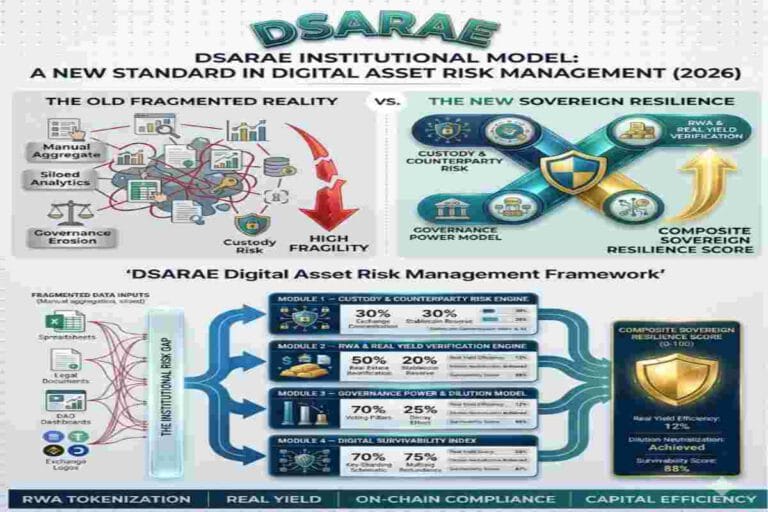
What is DSARAE in crypto risk management?
DSARAE is a structured digital asset risk assessment framework used to evaluate exposure, volatility, and overall portfolio risk.
Learn more: https://ownprocrypto.com/digital-asset-risk-management-framework/
What is MPC wallet architecture?
MPC (Multi-Party Computation) wallet architecture distributes private key control across multiple parties, reducing single-point failure risk in crypto custody systems.
Learn more: https://ownprocrypto.com/mpc-vs-multi-sig-crypto-custody/
How can traders avoid failing with crypto signal groups?
Traders can reduce risk by validating every signal independently, applying strict risk management, focusing on a limited number of strategies, and treating signals as inputs—not decisions. Building a structured framework is essential for long-term consistency.
Signal systems fail because they are designed for distribution, not discipline.
The transition from signal dependency to systematic execution is the line that separates a gambler from an institutional operator. By understanding why crypto signal groups fail, you can begin to build a structure that accounts for “Liquidity Vacuums,” “Dark Flow,” and the rapid shifts in market sentiment that define the 2026 landscape. Ultimately, success in this environment is not about finding the “perfect signal,” but about deploying a crypto risk management system that survives every market regime. Moving your operations into this institutional tier ensures that while the crowd is liquidated by noise, your capital remains protected by a framework built for sustainable, long-term resilience.
Professional trading is a system-driven process, not a signal-driven activity.
For global financial stability context and digital asset risk considerations, refer to the Bank for International Settlements (BIS) research portal:
https://www.bis.org
Welcome to OwnProCrypto (Own & Pro Crypto) — a next-generation Bitcoin and blockchain education platform where the science of finance meets the power of AI-driven automation.
Our mission is simple: to equip you with the knowledge, frameworks, and tools needed to make smarter financial and business decisions in the Web3 economy.
Beyond analysis, OwnProCrypto focuses on transparency, verifiable data, and practical frameworks that investors and builders can actually use. Our goal is not hype — but clear thinking, disciplined analysis, and long-term value creation in the decentralized economy.
Our Background
As part of the Web3 Ecosystem Architecture pillar, this guide focuses on Sovereign Ownership Architecture in Web3. Explore related pillars: