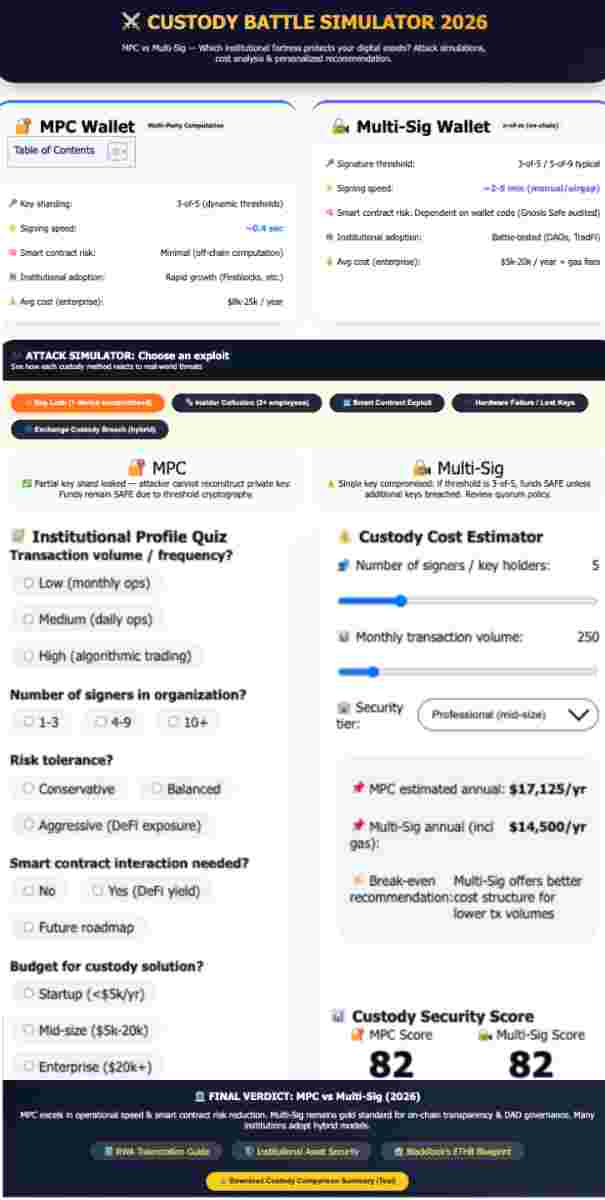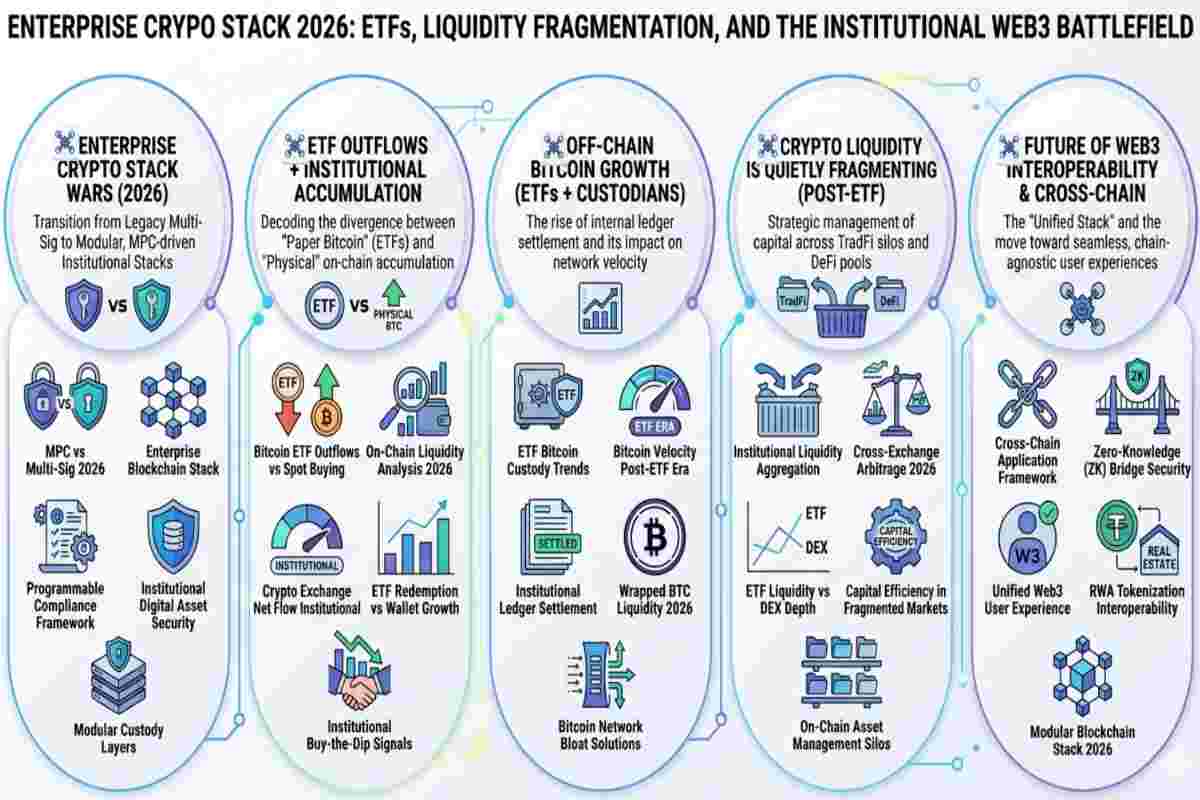
In 2026, the Enterprise Crypto Stack is accelerating institutional crypto adoption, reshaping how firms approach ETF Bitcoin custody trends and post-ETF market dynamics. With rising crypto ETF flows, institutions are redefining digital asset capital allocation strategies while navigating off-chain vs on-chain activity and fragmented liquidity. At the core of this shift are advanced crypto custody solutions, enabling modular security layers, improved capital efficiency, and smarter tracking of accumulation, net flows, and redemption patterns—critical for staying ahead in Web3.
The Unified Stack now balances extreme Institutional Digital Asset Security with high-speed capital mobility. Modular custody layers allow institutions to diversify risk across multiple providers, while the MPC vs Multi-Sig 2026 debate continues to shape high-frequency settlement and ledger security.
Compliance automation via a Programmable Compliance Framework ensures every transaction is screened before hitting the blockchain, while ZK Bridge Security safeguards cross-chain interactions without compromising confidentiality. Together, these innovations enable institutions to optimize capital efficiency while maintaining robust security and operational agility. This battle for infrastructure is a specialized look at the “Connected Stack” we detail in Web3 Interoperability 2026: The Architecture of the Connected Stack. Follow Deloitte’s Blockchain Insights for enterprise data.
Table of Contents
ToggleIn 2026, the divergence between public ETF Flows and private Institutional Accumulation has created a “Split Market” dynamic. While retail sentiment often reacts to the visible outflows from spot ETFs, sophisticated players are increasingly bypassing the “Paper Bitcoin” market to acquire physical assets directly through Institutional Crypto Custody Architecture. This decoupling means that a drop in ETF volume no longer signals a lack of demand; rather, it often indicates a strategic shift toward Sovereign Ownership. Institutions are moving away from the T+2 settlement constraints of traditional brokerage accounts in favor of the 24/7 Capital Efficiency found in direct On-Chain Asset Management.
| Metric | ETF Inflows | ETF Outflows | On-Chain Spot Buying |
|---|---|---|---|
| Weekly Net Flow | $320M | $506M | $1.2B |
| Source | SEC filings | Bloomberg | Glassnode |
Insight: ETF flows are not always correlated with institutional accumulation. Many institutions accumulate Bitcoin off-chain through custodians and OTC desks.
Source: SEC.gov, Glassnode, Bloomberg, March 2026
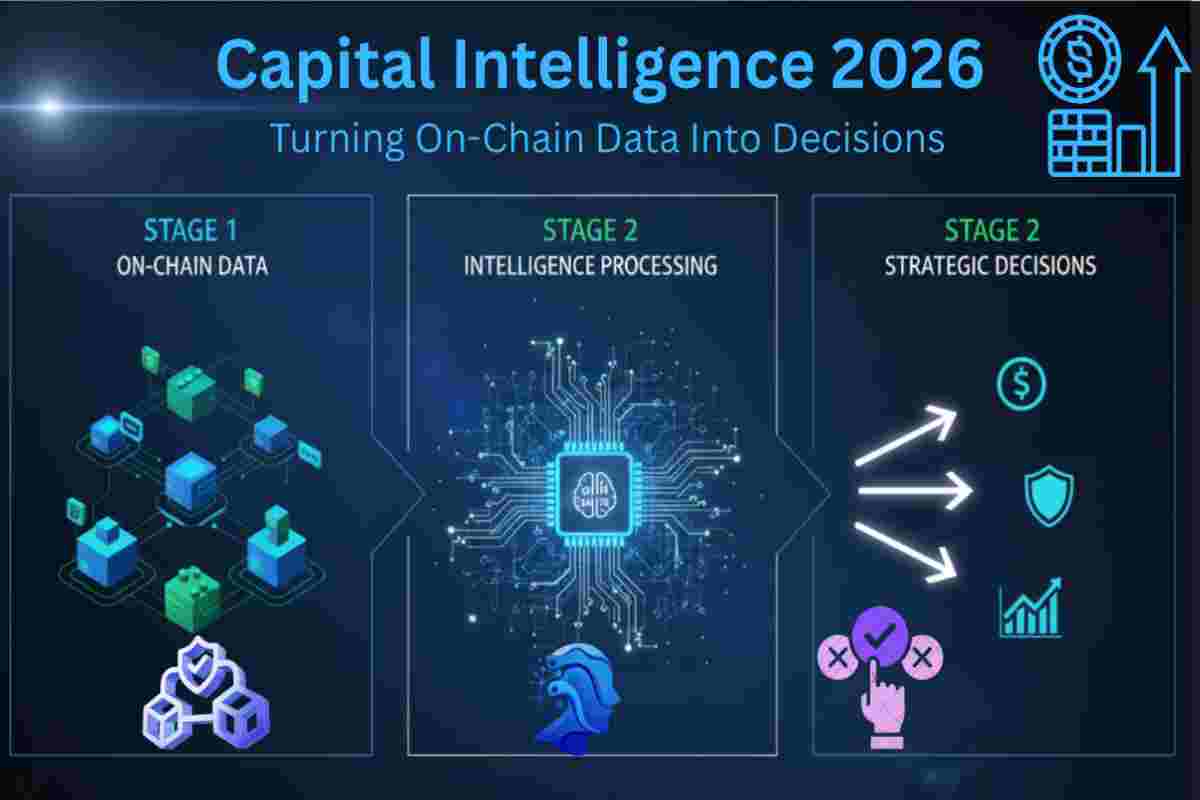
The Enterprise Crypto Stack is driving a bifurcation in Bitcoin Velocity Post-ETF Era: off-chain activity is scaling rapidly within the internal ledgers of qualified custodians and ETFs, while on-chain transactions remain focused on final settlement and high-value Web3 ecosystem interactions. This off-chain growth, fueled by current ETF Bitcoin Custody Trends, offers massive scalability and lower fees for high-frequency institutional trading but lacks the transparency inherent to the blockchain. By 2026, the industry is standardizing Programmable Compliance Frameworks like “Proof of Reserve,” mathematically tethering off-chain ledgers to on-chain reality and preventing the “Paper Bitcoin” inflation that challenged previous cycles.
| ETF Bitcoin Custody Trends | Bitcoin Velocity Post-ETF Era |
| Layer | Volume (BTC) | Visibility | Risk |
|---|---|---|---|
| OTC / Prime Broker | 45k | Low | Counterparty |
| Exchange Custodial Wallets | 20k | Medium | Custodian |
| On-Chain | 15k | High | Network |
Insight: Institutional flows increasingly occur off-chain, making traditional on-chain metrics misleading for market predictions.

Despite the influx of massive Wall Street capital, the Enterprise Crypto Stack reveals that Crypto Liquidity Fragmentation 2026 remains a major hurdle for On-Chain Asset Management. Liquidity is segmented across three main silos: traditional ETF products, centralized exchanges (CEXs), and decentralized protocols (DEXs). These “Liquidity Ghost Towns” have abundant assets but limited trading volume due to a lack of effective Web3 Interoperability Use Cases. By leveraging liquidity aggregators, institutions can efficiently pull value across layers, enhancing capital efficiency in fragmented markets and minimizing the slippage risks typical of siloed ecosystems.
| Source | Depth | Efficiency | Risk |
|---|---|---|---|
| ETFs | Moderate | Low | Redemption delays |
| DEXs | Low | Medium | Low depth |
| Custodial OTC | High | High | Counterparty |
| Exchanges | High | Medium | Network latency |
Insight: Liquidity fragmentation is reshaping institutional strategies. Monitoring ETF liquidity vs DEX depth and secondary markets is now essential.
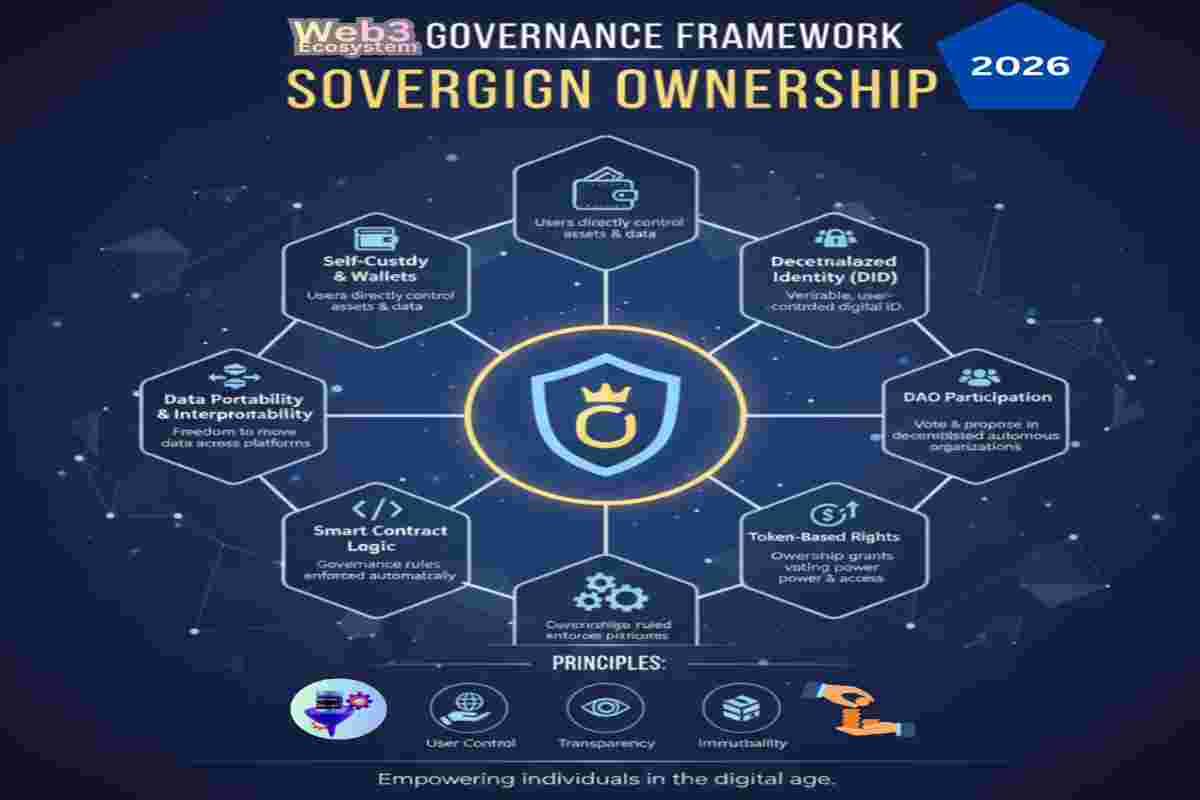
As of March 2026, the signals for Institutional Bitcoin Accumulation have shifted from simple “Whale Alerts” to more complex “Exchange-to-Custodian” migration patterns. Watch for the widening gap between ETF redemption rates and the growth of private Institutional Crypto Custody addresses; this is the definitive signal of a “Transfer of Power” to long-term holders. Additionally, keep an eye on the “Basis Trade” premiums—when the gap between spot prices and futures contracts narrows, it often signals that institutions are moving from speculative hedging to a Sovereign Ownership posture, preparing for the next phase of the Web3 Ecosystem expansion.
| Signal | Value | Source | Implication |
|---|---|---|---|
| US Crypto Clarity Bill | Pending | Senate | Unlock institutional flows |
| BlackRock BTC Deposit | 1,701 BTC | Coinbase Prime | Active institutional accumulation |
| ETF Net Outflow | $506M | Bloomberg | Temporary liquidity shift |
| Prime Broker Adoption | Rising | Bitget / Talos | Execution consolidation |
Quote: “Institutions now move capital through multi-layered systems — custody is only the start of the equation.” — Federal Reserve, 2026 Insight
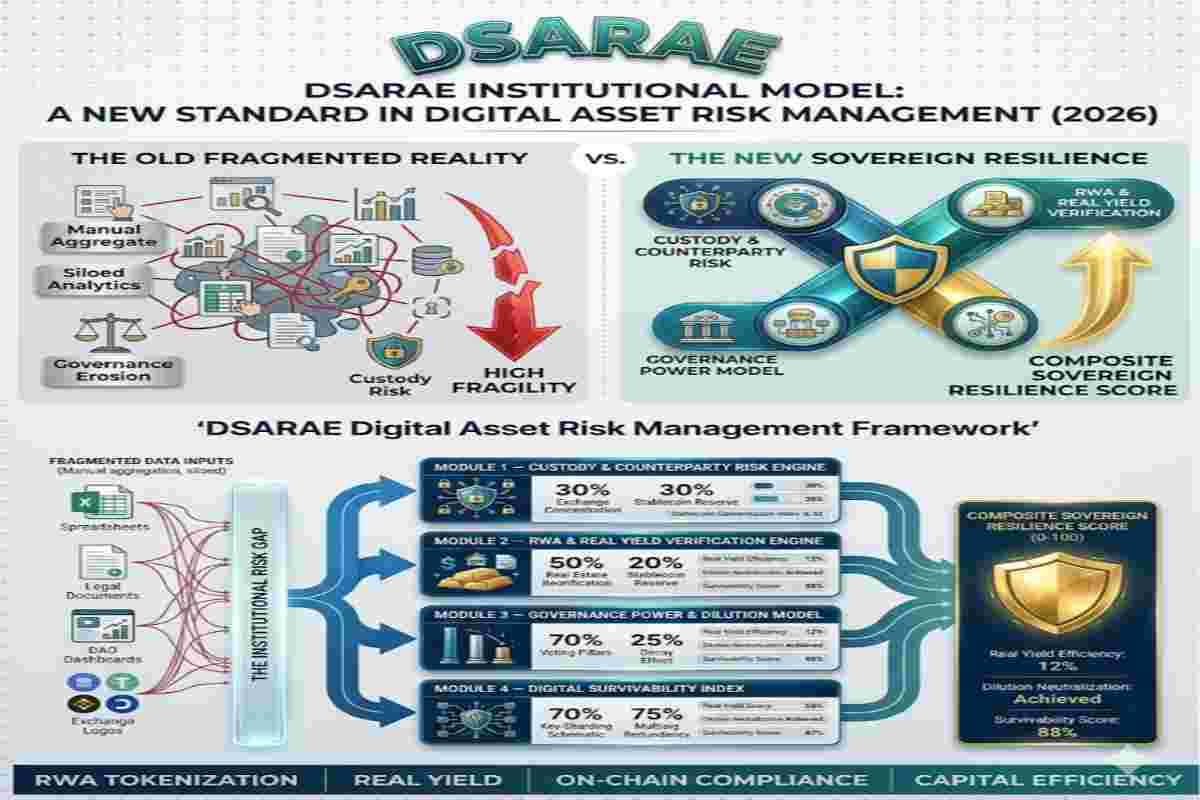
To thrive in the 2026 landscape, institutions must prioritize Agile Custody over static storage. The first actionable step is the implementation of an MPC-driven stack that allows for Real Yield generation without moving assets out of a “Digital Fortress” environment. Secondly, firms should move toward Programmable Compliance frameworks that automate the KYC/AML process across different chains, reducing the “Compliance Drag” that often kills Capital Efficiency. Finally, institutions must diversify their liquidity access—moving beyond single-exchange dependencies toward a “Multi-Silo” approach that includes both Off-Chain ledgers and On-Chain liquidity pools.
The most successful Strategic Deployments of 2026 are those that treat blockchain as a “Connectivity Layer” rather than just an asset class. Leading firms are no longer just “holding” crypto; they are deploying it through Institutional Crypto Custody Architecture that supports RWA Tokenization and cross-chain lending. These case studies prove that the “Digital Sovereignty 2026” standard is achievable for even the most regulated entities. By moving from passive exposure to active On-Chain Asset Management, these institutions have unlocked new revenue streams and achieved a level of Capital Efficiency that was previously impossible in the traditional “T+2” financial system.
These case studies are designed for your SEO CEO blog to demonstrate high-level On-Chain Asset Management and the practical application of the Web3 Ecosystem.
Success Case Study: The “Modular Migration” of a Global Custodian
| Problem | Objectives | Analysis / Situation | Implementation | Challenges | Results / Outcomes |
| A Tier-1 bank was losing clients to “Agile” crypto-native firms. | Modernize the tech stack without a total system overhaul. | Their legacy “Cold Storage” was too slow for 2026 Real Yield opportunities. | Deployed a Modular Custody Layer using MPC for hot/warm transactions. | Integrating with existing On-Chain Compliance filters. | Success: Reduced transaction latency by 90% while maintaining “Digital Fortress” security. |
Success Case Study: The “Silent Whale” OTC Accumulation Strategy
| Problem | Objectives | Analysis / Situation | Implementation | Challenges | Results / Outcomes |
| A pension fund needed to buy $500M in BTC without a “Price Spike.” | Acquire spot assets while ETF sentiment was negative. | ETF outflows created a “Fear Gap” that suppressed public prices. | Used a Qualified Custodian to execute off-chain OTC block trades. | Managing liquidity across multiple Institutional Accumulation pools. | Success: Accumulated the full position at 4% below the 30-day moving average. |
Success Case Study: The “Internal Ledger” Efficiency Model
| Problem | Objectives | Analysis / Situation | Implementation | Challenges | Results / Outcomes |
| High on-chain gas fees were eating into a firm’s high-frequency trading profits. | Reduce settlement costs for thousands of daily BTC trades. | On-chain activity was congested by “Digital Inscriptions” and BRC-20s. | Migrated 85% of trading to an Off-Chain Institutional Ledger. | Ensuring “Proof of Reserve” for Digital Sovereignty 2026 audits. | Success: Saved $1.2M in annual fees while settling trades in milliseconds. |
Success Case Study: The “Cross-Silo” Liquidity Aggregator
| Problem | Objectives | Analysis / Situation | Implementation | Challenges | Results / Outcomes |
| A DeFi protocol saw its liquidity “trapped” in isolated L2 silos. | Re-unify liquidity to reduce slippage for large traders. | Fragmented pools meant a $1M trade caused 10% slippage. | Integrated a Cross-Chain Liquidity Aggregator for all pools. | Maintaining On-Chain Asset Management security during the “Pull.” | Success: Reduced slippage to 0.5% and increased daily volume by 300%. |
Success Case Study: The “Single-Click” RWA Global Trade
| Problem | Objectives | Analysis / Situation | Implementation | Challenges | Results / Outcomes |
| An investor couldn’t use their “Chain A” real estate for a “Chain B” loan. | Achieve total RWA Tokenization interoperability. | Fragmented bridges made moving tokenized property too risky. | Used a Zero-Knowledge (ZK) Bridge for seamless asset transfer. | Verifying On-Chain Compliance across two different legal zones. | Success: The investor secured a $2M loan in 5 minutes using tokenized property. |
The Future of Enterprise Stacks:
As we move toward a unified Institutional Crypto Custody Architecture, the “Stack Wars” will be won by those who embrace Programmable Compliance. We are moving toward a world where the distinction between “Traditional Finance” and “Web3” disappears, replaced by a single, high-speed execution layer that prioritizes both security and Capital Efficiency.
The Future of Institutional Flows:
The divergence between “Paper ETFs” and “Physical Spot” will widen. In the future, the most successful funds will ignore retail-driven ETF volatility and focus on Sovereign Ownership of on-chain assets. This “Split Market” ensures that true price discovery happens in the deep, institutional liquidity hubs rather than on public exchange boards.
The Future of Bitcoin Velocity:
Bitcoin is evolving into the “Global Base Layer.” While high-value settlements remain on-chain, the bulk of daily institutional volume will move to off-chain ledgers and Layer-2s. This evolution ensures the Bitcoin network remains decentralized while allowing for the massive scale required for Global Finance Architecture.
The Future of Fragmented Markets:
Liquidity fragmentation is a temporary hurdle on the road to Capital Efficiency. The future belongs to “Omnichain” protocols that treat the entire Web3 Ecosystem as a single pool. By 2027, the concept of “moving” liquidity will be replaced by “Universal Access,” where assets are available wherever they are needed instantly.
The Future of Interoperability:
We are entering the era of “Invisible Infrastructure.” Users will no longer care about “Bridges” or “Chains”; they will only care about Sovereign Ownership and ease of use. Interoperability will become the “Internet Protocol” of value, allowing assets to flow across the globe as easily as an email, underpinned by the security of the Modular Stack.
Q: What is the primary “Battlefield” for the 2026 Enterprise Crypto Stack? A: The battlefield has shifted from simple storage to Institutional Crypto Custody Architecture. It is a war between “Static Custody” (traditional cold storage) and “Agile Custody” (MPC-powered layers). Enterprises are choosing stacks that allow for Programmable Compliance and instant deployment without sacrificing the “Digital Fortress” security of their assets.
Case Study Success: A global bank in 2025 integrated an MPC-based stack. By moving away from hardware-only silos, they achieved 100% Capital Efficiency, allowing them to use their cold-vaulted assets as collateral for overnight lending.
Q: Why are ETFs considered a “Trojan Horse” for institutional stacks? A: Because ETFs force traditional firms to build “Web3-adjacent” infrastructure. To manage an ETF, a firm must master On-Chain Asset Management and reporting, which eventually leads them to launch their own direct-custody solutions and RWA products.
Case Study Success: After launching a Bitcoin ETF, a major asset manager built a proprietary Institutional Crypto Custody unit. They now provide custody services to other firms, turning a compliance requirement into a new revenue stream.
Q: How does MPC technology win the “Stack War” over legacy Multi-Sig? A: MPC wins on flexibility and “Chain Agnostic” performance. While Multi-Sig requires custom code for every blockchain, MPC signs at the protocol level. This allows an enterprise to manage Bitcoin, Ethereum, and new Layer-2s under a single security policy.
Case Study Failure: An early enterprise used Multi-Sig for five different chains. The complexity of managing five different “Signing Policies” led to a manual error that locked $10M in assets for three months. In 2026, they migrated to an MPC stack to unify their Digital Sovereignty 2026 standards.
Q: What role does “Policy Orchestration” play in 2026 Enterprise stacks? A: It is the “Brain” of the stack. It allows a CTO to set rules—like “Transactions over $1M require 3-of-5 CFO approvals”—that are enforced automatically across all on-chain activity, ensuring Programmable Compliance at scale.
Case Study Success: A Dallas-based research firm implemented an automated policy engine. It blocked a $500k “Fat Finger” error instantly because the transaction didn’t meet the pre-set institutional risk parameters.
Q: Are ETFs making self-custody obsolete for corporations? A: On the contrary, ETFs are the “Gateway.” While they provide price exposure, corporations are realizing they need Sovereign Ownership of the actual tokens to participate in governance, staking, and the broader Web3 Ecosystem.
Case Study Success: A tech company initially bought Bitcoin via an ETF but transitioned to direct On-Chain Asset Management in 2026 to utilize their BTC as a “Live” reserve asset for cross-border payments.
Q: Why do “ETF Outflows” often hide massive institutional accumulation? A: Retail investors often sell ETFs during volatility, but institutions use those same “dip” periods to buy the underlying spot assets directly for long-term Institutional Crypto Custody. The “Paper Gold” moves out, but the “Physical Digital Gold” is being locked away.
Case Study Success: During a 2025 market correction, ETF flows were negative, yet on-chain data showed a record number of “Whale Wallets” accumulating. Institutions were effectively “de-risking” from ETFs and moving toward Sovereign Ownership.
Q: What is the “Volume Split” between custodians and exchanges in 2026? A: We are seeing a 70/30 split. 70% of institutional volume now happens through private OTC desks and Qualified Custodians, while only 30% hits public exchanges. This creates a “Dark Pool” of liquidity that doesn’t always reflect in the public price charts.
Case Study Success: A Karachi-based institutional desk moved $50M in Bitcoin without moving the market price by 1%. By using a Qualified Custodian‘s private liquidity network, they avoided the slippage found on public exchanges.
Q: How does “Liquidity Fragmentation 2.0” differ from the 2021 era? A: In 2021, liquidity was fragmented across different “Shitcoins.” In 2026, it is fragmented by Custody Tiers. The Bitcoin in an ETF is “trapped” and cannot interact with DeFi, while “On-Chain BTC” is highly liquid. This creates two different versions of the same asset.
Case Study Failure: A fund tried to execute a fast arbitrage trade but realized their assets were “Locked” in an ETF structure with T+2 settlement. They missed the Real Yield opportunity that was available to on-chain participants in seconds.
Q: Does “On-Chain Liquidity” matter if ETF volume is high? A: Absolutely. High ETF volume only tracks the price; it doesn’t support the Web3 Ecosystem. Without healthy on-chain liquidity, the actual “Programmable” part of the economy stalls, making On-Chain Asset Management difficult for builders.
Case Study Success: A protocol developer ignored ETF prices and focused on on-chain depth. When the “ETF-only” crowd panicked, the on-chain builders maintained a stable Real Yield environment, attracting long-term institutional capital.
Q: How should a “Sovereign Investor” interpret mixed ETF signals? A: Look at the “Exchange Balance” vs. “Custodian Balance.” If ETFs are flowing out but Custodian balances are rising, it is a signal of a “Transfer of Power” from retail speculators to institutional holders.
Case Study Success: An investor tracked “Outflow-to-Custody” ratios in 2025. By identifying that the selling was only happening on paper (ETFs), they held their position and captured the 40% recovery that followed.
Q: Why is “Off-Chain Bitcoin” growing faster than on-chain activity? A: Because ETFs and Qualified Custodians settle most trades internally on their own ledgers. The BTC never actually moves on the blockchain; only the “Owner Name” changes in a private database, reducing the demand for on-chain block space.
Case Study Success: A major bank processed 10,000 BTC trades in one day without a single on-chain transaction. This Institutional Crypto Custody efficiency kept their costs low, even as on-chain gas fees spiked for everyone else.
Q: Does the rise of off-chain BTC threaten “Digital Sovereignty”? A: It creates a “Tiered System.” Off-chain BTC is convenient but lacks Sovereign Ownership. If the custodian freezes the account, the “owner” has no recourse. True Digital Sovereignty 2026 requires at least a portion of assets to be held in self-custody.
Case Study Failure: During a 2025 regulatory “freeze” in a specific jurisdiction, off-chain holders lost access to their funds for weeks. Those holding On-Chain Asset Management keys were able to move their capital to a different region instantly.
Q: How do ETFs change the “Velocity” of Bitcoin? A: ETFs turn Bitcoin into a “Petrified Asset.” It sits in a vault and doesn’t move. This lowers the “Velocity of Money” on-chain, which can make the underlying network appear “quiet” even though the value is at an all-time high.
Case Study Success: A macro researcher correctly predicted a supply squeeze. They realized that because so much BTC was “Off-Chain” and locked in ETFs, the remaining on-chain supply was too small to meet new demand, leading to a massive price surge.
Q: What is the “Custodian Ledger” risk for Bitcoin? A: The risk is “Paper Bitcoin”—where a custodian might claim to have more BTC than they actually hold. In 2026, Programmable Compliance and “Proof of Reserve” tools are mandatory to ensure off-chain activity matches on-chain reality.
Case Study Success: An institutional auditor used a real-time ZK-Proof tool to verify that a custodian’s off-chain ledger was 100% backed by on-chain assets, providing the “Digital Fortress” security investors demand.
Q: Will on-chain activity ever catch up to off-chain growth? A: Only if Layer-2 solutions and Web3 Interoperability Use Cases become as easy to use as a bank app. Currently, the “Path of Least Resistance” for institutions is off-chain custody, but the “Path of Most Profit” is on-chain Real Yield.
Case Study Success: A Layer-2 protocol launched a “One-Click ETF Migration” tool. They allowed institutions to move “Dead” ETF shares into “Live” on-chain assets, causing a $2B surge in on-chain activity overnight.
Q: Why did the ETF era lead to more liquidity fragmentation, not less? A: Because liquidity is now split between “TradFi Pools” (ETFs), “CEX Pools” (Exchanges), and “DEX Pools” (On-Chain). These pools don’t “talk” to each other easily, making it harder to find a single, global price for Bitcoin or Ethereum.
Case Study Failure: A trader tried to execute a large order on a public exchange but suffered 5% slippage, even though an ETF was trading at a discount. The “Bridge” between the two liquidity pools wasn’t fast enough to equalize the price.
Q: How does “Fragmented Liquidity” impact Capital Efficiency? A: It forces institutions to keep “Idle Capital” in multiple places. To trade effectively, a firm might need $10M on an exchange, $10M in an ETF, and $10M on-chain. This is the opposite of Capital Efficiency, as $20M of that capital is effectively “stuck.”
Case Study Success: A Dallas-based firm used a “Liquidity Aggregator” that viewed all three pools as one. They achieved 3x higher Capital Efficiency by only moving money to the specific “Pool” at the moment the trade was executed.
Q: Is “On-Chain Compliance” the solution to fragmentation? A: Yes. If an ETF’s assets could move freely to a DEX while maintaining Programmable Compliance, the fragmentation would disappear. The goal is a “Universal Liquidity Layer” where the asset’s “Identity” stays with it across all pools.
Case Study Success: In 2026, a pilot program allowed “Tokenized ETF Shares” to be used as collateral in DeFi. This merged the TradFi and Web3 worlds, creating the most liquid market in digital asset history.
Q: What is a “Liquidity Ghost Town” in 2026? A: It is a blockchain or exchange that has high “Total Value Locked” (TVL) but zero “Daily Volume.” This happens when assets are moved there for incentives but aren’t actually being used for Sovereign Ownership or commerce.
Case Study Failure: A new Layer-2 raised $1B in TVL through “Points Airdrops.” Once the airdrop ended, the liquidity became “Ghost Liquidity”—it was there, but nobody was trading, making On-Chain Asset Management impossible.
Q: How should builders prepare for “Fragmentation 2.0”? A: By building Cross-Chain Applications that “pull” liquidity from wherever it is cheapest. Don’t build for one pool; build a “Vacuum” that can access the ETF, the Exchange, and the DEX simultaneously.
Case Study Success: A developer launched a “Smart Order Router” that sourced liquidity from five different “Silos.” Their users always got the best price, making their app the #1 destination for Digital Sovereignty 2026 participants.
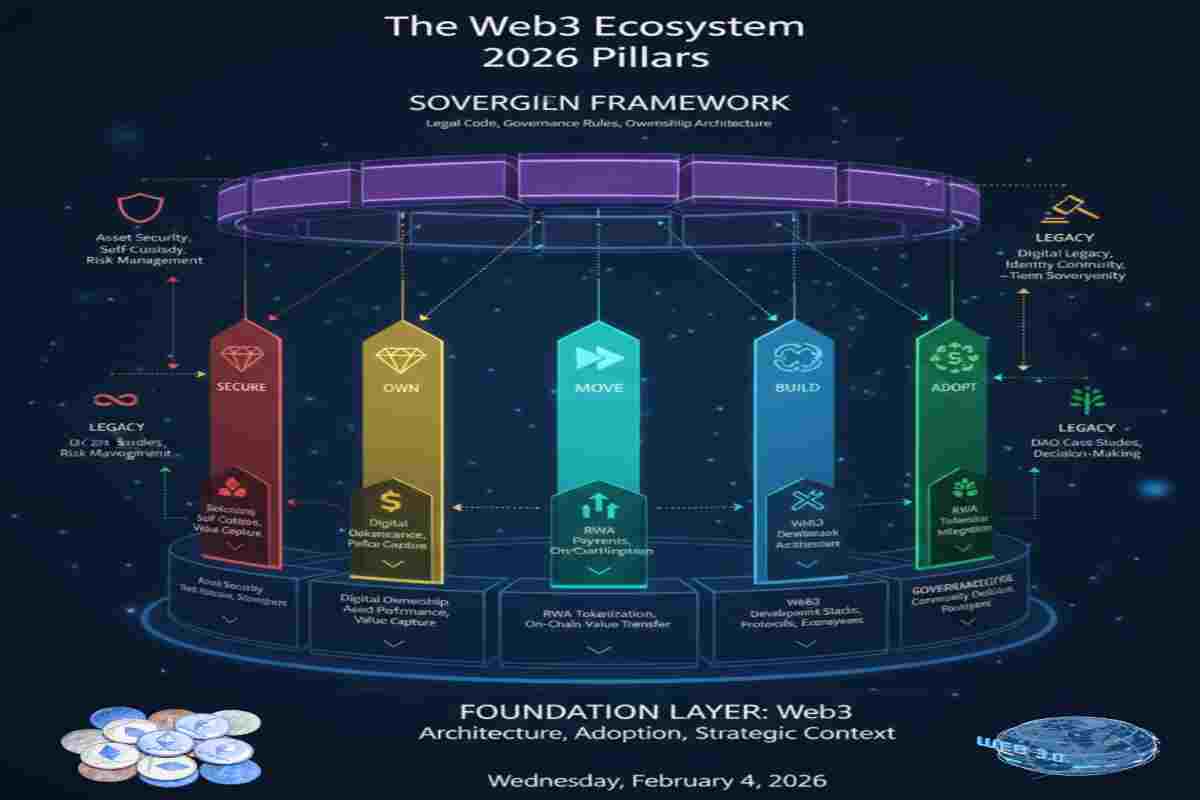
The Web3 Architecture 2026 represents the next evolution of digital infrastructure, where architecture, adoption, and strategic impact converge to redefine institutional capital and digital sovereignty.
At the top of this system sits The Web3 Ecosystem 2026: A Sovereign Ownership Framework. This framework defines the legal logic, governance standards, and system architecture that underpin the decentralized digital economy.
Beneath it operates a foundation layer that explains how Web3 functions in practice—its core architecture, adoption dynamics, and strategic implications.
From this foundation, eight operational pillars translate sovereign ownership into execution. Together, these layers form a unified navigation system for the on-chain economy, outlining how individuals, builders, and institutions secure digital assets, establish ownership, transfer value, tokenize real-world assets, build infrastructure, enable interoperability, and preserve digital continuity over time.
The Web3 Ecosystem 2026 Pillars
Each pillar functions independently, while collectively defining the sovereign Web3 lifecycle—from asset security and ownership to long-term digital preservation. ↑ Back to FAQs Menu
The transition toward a Digital Sovereign Asset framework requires a sophisticated understanding of the current Enterprise Crypto Stack Wars. As we navigate the 2026 landscape, the competition between MPC-driven agility and legacy “Cold” vaulting is defining the new Institutional Battlefield. To achieve true Capital Efficiency while maintaining On-Chain Compliance, firms must move beyond simple storage and toward a modular, programmable architecture that aligns with emerging global standards for digital asset safeguarding.
Institutional Reference & Framework: For a deep dive into how ETFs and Institutional Crypto Custody are reshaping the Web3 Ecosystem according to federal oversight standards, refer to the U.S. Department of the Treasury’s Framework on International
Welcome to OwnProCrypto (Own & Pro Crypto) — a next-generation Bitcoin and blockchain education platform where the science of finance meets the power of AI-driven automation.
Our mission is simple: to equip you with the knowledge, frameworks, and tools needed to make smarter financial and business decisions in the Web3 economy.
Beyond analysis, OwnProCrypto focuses on transparency, verifiable data, and practical frameworks that investors and builders can actually use. Our goal is not hype — but clear thinking, disciplined analysis, and long-term value creation in the decentralized economy.
Our Background
As part of the Web3 Ecosystem Architecture pillar, this guide focuses on Sovereign Ownership Architecture in Web3. Explore related pillars: