Table of Contents
ToggleDigital Asset Taxation has become one of the most critical aspects of investing in crypto and blockchain-based assets.
While many investors focus on returns, the reality is:
taxation determines net outcomes, compliance risk, and long-term sustainability
In 2026, governments worldwide are tightening reporting requirements, increasing transparency, and integrating digital assets into formal tax systems. Staying compliant with evolving tax rules is a requirement for the institutional models in our Web3 Governance Framework: Sovereign Ownership (2026). Track US crypto tax updates directly at the IRS Digital Assets page.
Recent regulatory trends:
The shift is clear:
from optional reporting → enforced compliance
What Is Digital Asset Taxation?
Digital asset taxation refers to how governments tax:
- cryptocurrencies
- tokens
- NFTs
- other blockchain-based assets
Core Principle
Most jurisdictions treat digital assets as taxable property or capital assets.

| Event | Tax Impact |
|---|---|
| Buying crypto | Usually not taxable |
| Selling crypto | Capital gains/loss |
| Trading crypto | Taxable event |
| Earning rewards | Income tax |
Every transaction can trigger a tax event

| Type | Description |
|---|---|
| Short-term | Higher tax rates |
| Long-term | Lower tax rates |
Gain = Selling Price – Purchase Price
Timing matters significantly for tax outcomes
| Category | Requirement |
|---|---|
| Trades | Full disclosure |
| Income | Taxable |
| Holdings | May require reporting |
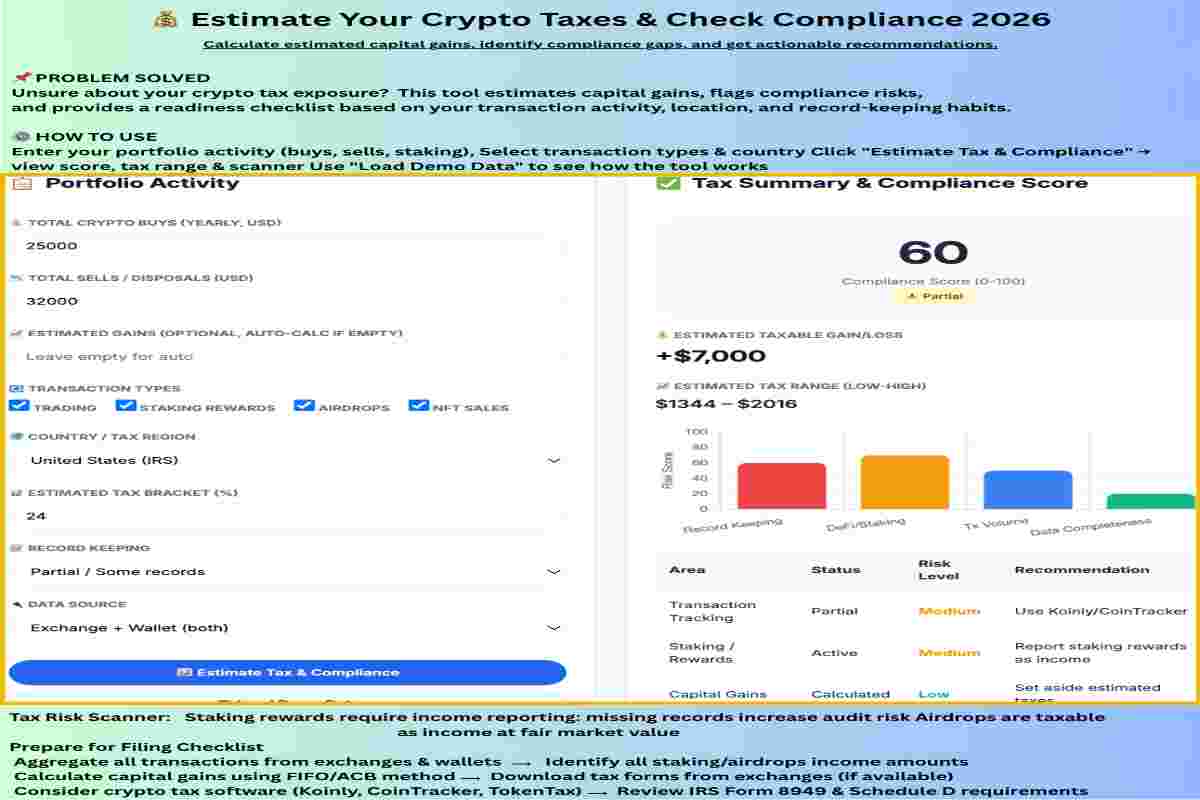
Simplify Your Crypto Tax Reporting with Our 2026 Tax Estimator
Understanding digital asset taxation can be complex, especially with evolving reporting rules and compliance requirements. Our Crypto Tax Estimator & Compliance Tool helps you quickly assess your potential tax exposure and identify reporting gaps. By entering your transaction activity, staking income, and portfolio details, you’ll receive an estimated tax range, a compliance score, and actionable recommendations to improve your reporting accuracy. This tool transforms complex tax frameworks into a clear, structured overview, helping you stay aligned with 2026 regulations while managing your crypto investments more effectively. Calculate estimated capital gains, identify compliance gaps, and get actionable recommendations.
Capital Gains Crypto Tax in 2026 requires a shift from simple retroactive reporting to real-time On-Chain Compliance. As digital assets are integrated into the broader Sovereign Wealth Structure, tax liabilities are no longer calculated annually but are monitored at the point of every transaction—whether it’s a trade, an NFT sale, or a yield-bearing event. Most jurisdictions now distinguish between short-term gains (assets held for less than a year) and long-term gains, which often benefit from reduced rates to encourage Wealth Preservation. To maintain maximum Capital Efficiency, sophisticated investors utilize “Tax-Loss Harvesting” tools that automatically offset gains with losses across fragmented DeFi protocols, ensuring the “tax drag” on their Real Yield is minimized while staying fully transparent with global regulatory mandates.
Different countries treat digital assets differently.
| Model | Approach |
|---|---|
| Capital Gains | Most common |
| Income Tax | For earnings |
| Hybrid | Combined systems |
Investors must consider:
jurisdiction-specific rules

Complexity increases with:
| Strategy | Benefit |
|---|---|
| Holding | Lower tax rates |
| Loss harvesting | Offset gains |
| Structuring | Reduce exposure |
This connects to your previous post.
Internal link:
Stablecoin Regulations & CBDC Primer

Taxation directly impacts financial control.
| Factor | Impact |
|---|---|
| Regulation | Compliance burden |
| Reporting | Transparency |
| Enforcement | Risk |
Internal link:
Financial Sovereignty & Global Risk
Tax systems are becoming:
digital + integrated + enforced
As digital assets become mainstream, understanding taxation is critical for compliance and long-term wealth preservation.
most people still don’t see this part →
Digital Asset Taxation (2026)
How are digital assets taxed?
Most digital assets are treated as property or capital assets, meaning profits are subject to capital gains tax.
this is where it starts getting interesting →
Financial Sovereignty
Do I pay tax on crypto gains?
Yes, in most jurisdictions, profits from selling or converting crypto are taxable.
the obvious narrative is wrong →
Crypto Security Standards
What is capital gains tax in crypto?
It is the tax applied to profits earned from selling digital assets at a higher price than the purchase cost.
look closer →
Digital Ownership
What triggers crypto taxes?
Selling, trading, converting, or earning crypto through staking, mining, or payments typically triggers taxes.
small detail, big shift →
Crypto Profit Analysis Tool
Are crypto trades taxable?
Yes, each trade between cryptocurrencies is usually considered a taxable event.
this part →
Stablecoins vs Bitcoin
Are DeFi earnings taxable?
DeFi income such as staking rewards, yield farming, and liquidity incentives is generally treated as taxable income.
it’s subtle, but it matters →
Real Yield vs Token Incentives
Do stablecoins trigger taxes?
Yes, converting or trading stablecoins can result in taxable events depending on jurisdiction.
this doesn’t match the headlines →
Stablecoin Regulations
How do I report crypto taxes?
You must report all transactions, gains, and income to relevant tax authorities using proper documentation.
don’t ignore this →
Top Blockchain Mistakes
Can I reduce crypto taxes legally?
Yes, strategies like long-term holding, tax-loss harvesting, and proper record-keeping can reduce tax liability.
been tracking this quietly →
Family Office Investment Strategy
What records should I keep for crypto taxes?
Keep detailed records of transactions, purchase prices, dates, and wallet activity for accurate reporting.
not everyone’s ready for this yet →
Digital Family Office Architecture
What happens if I don’t report crypto taxes?
Failure to report can result in penalties, fines, audits, or legal consequences depending on jurisdiction.
weird signal forming here →
Global Asset Decoupling
Are crypto tax laws changing in 2026?
Yes, regulations are evolving rapidly as governments adapt to digital asset adoption and global financial shifts.
before this flips →
Crypto Trends 2026
Digital asset taxation is no longer optional or secondary.
It is a core part of:
Understanding tax rules ensures:
compliance
efficiency
long-term sustainability
To ensure your Digital Portfolio is fully prepared for the 2026 tax landscape, you must align your internal bookkeeping with the new international standards for automated transparency.
OECD Crypto-Asset Reporting Framework (CARF) 2026 Guidelines – As of January 1, 2026, over 75 jurisdictions have officially commenced mandatory data collection under this framework to standardize cross-border digital asset tax reporting.
Welcome to OwnProCrypto (Own & Pro Crypto) — a next-generation Bitcoin and blockchain education platform where the science of finance meets the power of AI-driven automation.
Our mission is simple: to equip you with the knowledge, frameworks, and tools needed to make smarter financial and business decisions in the Web3 economy.
Beyond analysis, OwnProCrypto focuses on transparency, verifiable data, and practical frameworks that investors and builders can actually use. Our goal is not hype — but clear thinking, disciplined analysis, and long-term value creation in the decentralized economy.
Our Background
As part of the Web3 Ecosystem Architecture pillar, this guide focuses on Sovereign Ownership Architecture in Web3. Explore related pillars: