
Table of Contents
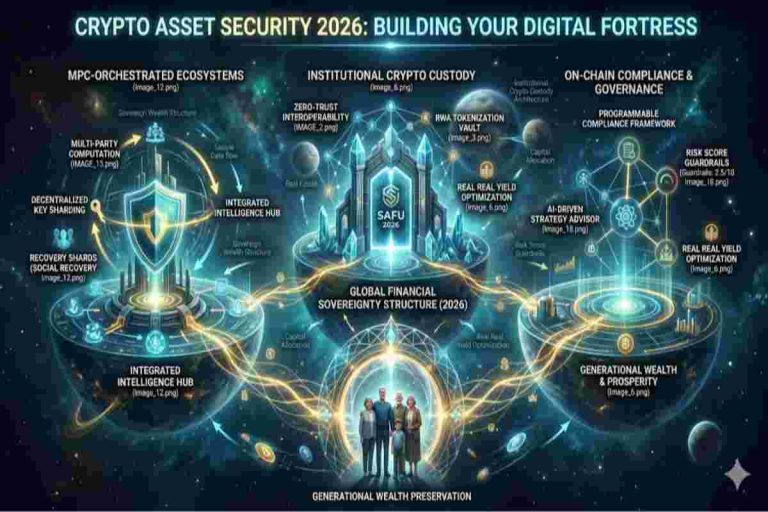
ToggleIn 2026, security is no longer a feature—it is the foundation of the entire digital financial stack. As we move into a $13 Trillion Institutional Bitcoin era, the “Single Point of Failure” is the enemy. Whether you are a retail holder or a Digital Family Office, the goal is to shift from reactive security to Proactive Resilience.
This hub breaks down the transition from traditional cold storage to MPC-based orchestrated ecosystems, providing a deep-dive into Crypto Asset Security 2026. We analyze the evolving debate of MPC vs Multi-Sig to determine which framework best serves a modern Institute Crypto Stack. By evaluating the SAFU 2026 protocols of global giants like Binance, we provide the exact Crypto Self-Custody Toolkit required to maintain true sovereign control over your assets.
Our goal is to bridge the gap between institutional liquidity and the Self-Custody Toolkit necessary to ensure your Real Yield is never compromised by third-party vulnerability. Building a fortress requires the specific technical layers we outline in our primary Asset Security 2026 framework. For global standards on digital custody, consult the Financial Action Task Force (FATF) guidelines.
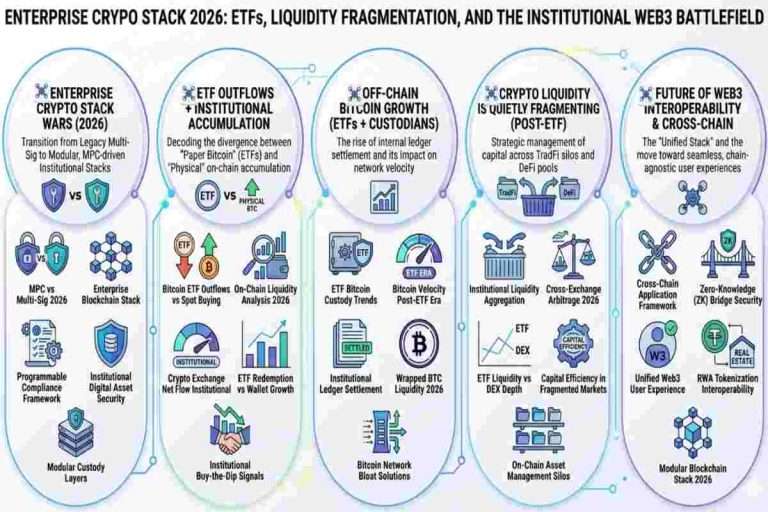
For those managing significant capital, the choice between Multi-Sig and MPC is the most critical architectural decision of 2026.
While self-custody is the goal, centralized rails remain the primary entry point. We audit the world’s largest exchange to see if it meets 2026 standards.
Let’s be clear: You cannot avoid centralized exchanges—but you must control your exposure.
In 2026:
Key risks:
The strategy is simple:
Use exchanges → Exit to self-custody immediately
“Not your keys, not your coins.” These tools allow you to eliminate counterparty risk and operate as your own bank.
This is where sovereignty becomes real.
A proper 2026 setup includes:
This is no longer “advanced”—this is the minimum standard
In mid-2026, a Dallas-based family office managing $450M in RWA Tokenization assets recognized that their legacy Multi-Sig setup was creating “Approval Latency.” The objective was to implement a more fluid Institute Crypto Stack that could respond to 2026 market volatility in real-time. By transitioning to an MPC-based orchestrated ecosystem, the office eliminated the need for multiple hardware-key participants to be physically present for every transaction.
This shift to Crypto Asset Security 2026 standards allowed them to execute a “Flight to Quality” during a sudden stablecoin de-peg event, moving $100M into a private Sovereign Vault in under six minutes. The implementation of this specialized Crypto Self-Custody Toolkit resulted in a 100% preservation of capital, while peers using traditional Multi-Sig faced a 48-hour “Governance Lock” that cost them 15% in slippage.
A high-net-worth research group attempted to secure their Real Yield portfolio using an outdated Multi-Sig framework that lacked the flexibility of a modern MPC vs Multi-Sig hybrid approach. The core problem was “Key Fragmentation”—one of the three primary key-holders lost access to their biometric backup during a 2026 hardware update. Because their Institute Crypto Stack did not include a Crypto Self-Custody Toolkit with social recovery or “Account Abstraction,” their $25M treasury became cryptographically “Gated” for three months. While their assets remained “safe” from external hackers, the lack of Capital Efficiency meant they could not pay their On-Chain Compliance fees or rebalance their RWA Tokenization holdings during a market peak.
This failure demonstrated that in 2026, a security system that is “too rigid” is just as dangerous as one that is “too open,” resulting in a total Opportunity Loss of $3.2M.
Not hacks. Not scams.
Single-Key Dependency
If one key = full access
You don’t have security! you have a liability

A system where no device, user, or transaction is trusted automatically—every action must be verified. This model is increasingly applied in cross-chain systems like Zero-Trust Interoperability 2026.
A layered approach:
For a complete system, see Crypto Asset Security 2026.
Relatively secure for transactions, but not for long-term storage. Always move assets to self-custody. Full breakdown here: Binance Review 2026.
Multi-Party Computation splits private keys into fragments so no single entity has full control. It is widely used in institutional custody models like those explained in Institutional Asset Security 2026.
Best approach: hybrid system. Learn more in Institutional Asset Security 2026.
Single point of failure—especially single private key setups. Avoid this by implementing systems outlined in Crypto Self Custody Security Toolkit 2026.
Yes—but only if combined with:
Best practices are covered in Crypto Security Standards 2026.
A system where cross-chain transactions are verified without exposing private keys or relying on insecure bridges. Full concept explained in Zero-Trust Interoperability 2026.
Yes, but mostly at institutional level. Retail protection is still limited. This trend is evolving alongside Stablecoin Payments 2026 and regulated financial integration.
Through:
These systems are detailed in Enterprise Crypto Stack 2026.
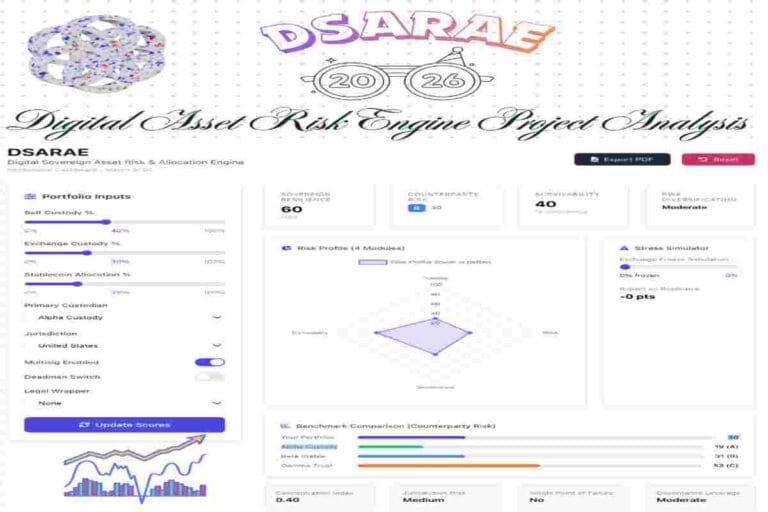
As the digital asset landscape evolves, leveraging a robust crypto asset risk analysis tool like DSARAE is no longer optional—it’s foundational. By combining advanced analytics with a crypto risk management tool, a scalable blockchain risk analysis platform, and intelligent insights from a crypto portfolio risk analyzer, investors can transition from reactive decisions to proactive security. Positioned as a comprehensive digital asset risk assessment tool, DSARAE empowers users to build resilient, self-sovereign portfolios designed to withstand emerging threats and regulatory shifts—turning risk awareness into long-term strategic advantage.
Deep Study & Reference: https://www.nist.gov/cyberframework
Welcome to OwnProCrypto (Own & Pro Crypto) — a next-generation Bitcoin and blockchain education platform where the science of finance meets the power of AI-driven automation.
Our mission is simple: to equip you with the knowledge, frameworks, and tools needed to make smarter financial and business decisions in the Web3 economy.
Beyond analysis, OwnProCrypto focuses on transparency, verifiable data, and practical frameworks that investors and builders can actually use. Our goal is not hype — but clear thinking, disciplined analysis, and long-term value creation in the decentralized economy.
Our Background
As part of the Web3 Ecosystem Architecture pillar, this guide focuses on Sovereign Ownership Architecture in Web3. Explore related pillars: