Table of Contents
ToggleBlockchain Interoperability in 2026 is entering a transformative phase driven by AI agents and universal connectivity across decentralized networks. As the blockchain ecosystem evolves beyond isolated chains, interoperability has become the foundation for seamless data exchange, cross-chain execution, and intelligent automation powered by AI systems. This new era enables AI agents to interact directly with multi-chain environments, optimizing transactions, decision-making, and real-time coordination across Web3 infrastructure.
With growing demand for scalable and connected ecosystems, blockchain interoperability is no longer a technical upgrade—it is becoming the core architecture of next-generation digital economies. The move toward universal connectivity is a major technical theme in our Web3 Interoperability 2026: The Architecture of the Connected Stack. Learn more about cross-chain standards at the Interchain Foundation.
Blockchain networks were originally designed as isolated ecosystems, but the demand for scalability led to the rise of multi-chain architectures. This shift created the need for blockchain interoperability as a core infrastructure layer rather than an optional feature.
Early blockchain systems operated independently, limiting data and asset transfer. Over time, ecosystems like Ethereum Layer 2s, Cosmos, and Polkadot introduced models that support inter-network communication. This evolution has turned interoperability into a foundational requirement for Web3 growth.
Cross-chain interoperability allows assets and data to move seamlessly between blockchains. This capability is essential for DeFi, gaming, and enterprise applications that rely on liquidity and composability across multiple chains. It also reduces fragmentation in the blockchain ecosystem.
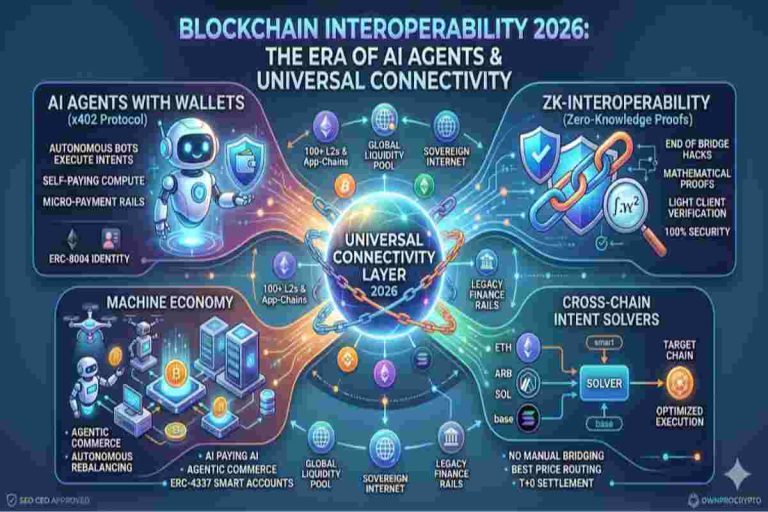
The integration of autonomous systems is redefining blockchain usage. In 2026, AI agents in blockchain are expected to act as independent economic participants, executing transactions, managing portfolios, and interacting across decentralized systems.
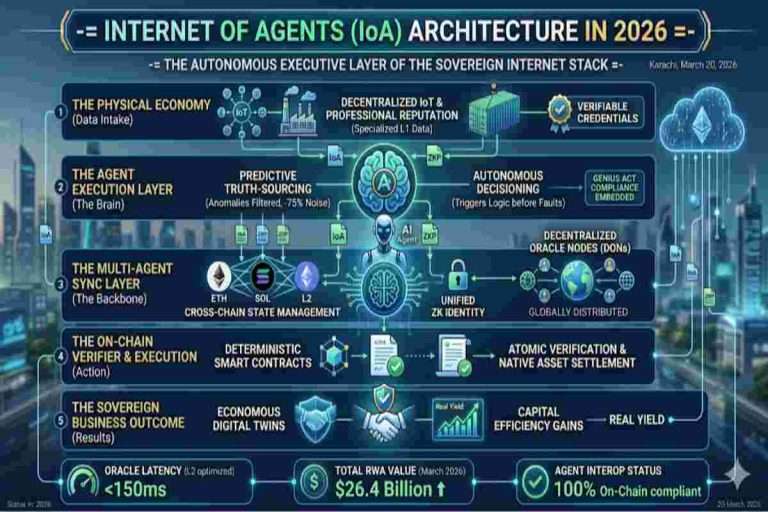
AI agents are being designed to perform tasks such as trading, governance voting, and liquidity management without human intervention. These agents rely heavily on interoperable systems to function efficiently across multiple blockchains.
A major shift is the emergence of machine-to-machine economies, where AI systems transact directly with each other. This requires high-speed cross-chain communication protocols to ensure secure and verifiable interactions across networks.
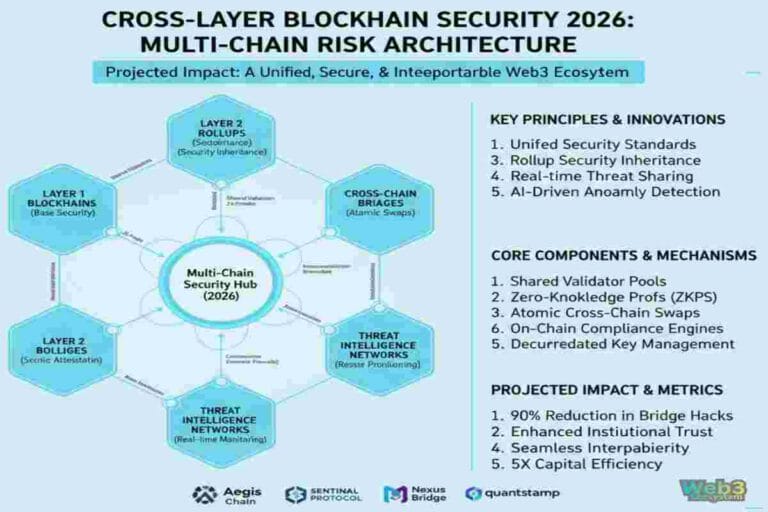
Modern blockchain ecosystems depend on advanced messaging systems that connect different networks. These cross-chain communication protocols form the backbone of interoperability.
Protocols like IBC-style messaging and bridge architectures enable secure data and asset transfers. These systems ensure that information remains consistent and verifiable across chains.
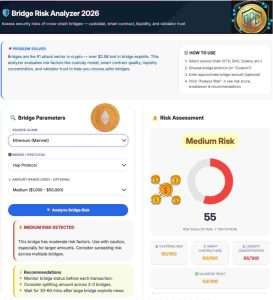
Despite progress, cross-chain systems still face risks such as bridge exploits and validator vulnerabilities. Improving cryptographic verification and decentralized validation remains a key focus for developers.
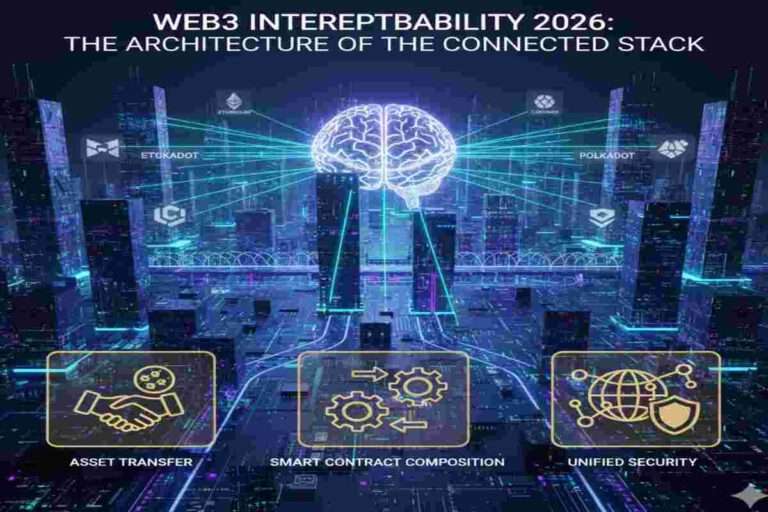
Enterprises are increasingly adopting blockchain technology, but fragmented ecosystems remain a challenge. Blockchain interoperability solutions help businesses integrate multiple networks into a unified infrastructure.
Banks and financial institutions are exploring interoperable blockchain systems for cross-border payments, settlements, and tokenized asset transfers. This reduces friction in global financial operations.
Interoperability enables seamless movement of tokenized real-world assets across networks. This is crucial for building scalable digital finance systems that connect traditional and decentralized markets.
The landscape of Blockchain Interoperability 2026 has fundamentally shifted—from fragile, high-risk bridging mechanisms to seamless, intent-based execution layers. The legacy model of “lock-and-mint” cross-chain transfers is rapidly becoming obsolete, replaced by intelligent systems that abstract complexity away from the user.
In this new paradigm, powered by Cross-Chain Intent architecture, users—and increasingly AI Agents with Wallets—no longer execute transactions manually. Instead, they simply define an outcome: “Buy 1 ETH on the cheapest chain” or “Move liquidity to the highest yield environment.”
From there, advanced interoperability protocols leveraging ZK-Interoperability and standards such as ERC-8004 handle routing, validation, and settlement across a fragmented ecosystem of Layer 2s, app-chains, and multichain networks. This marks the transition from manual cross-chain transactions to fully automated, intelligent execution across the omnichain liquidity layer.The move toward universal connectivity is a major technical theme in our Web3 Interoperability 2026: The Architecture of the Connected Stack. Learn more about cross-chain standards at the Interchain Foundation.
In 2026, more transactions are signed by code than by humans. These “Agents with Wallets” are the new power users of Web3.
AI Agents are:
This is the foundation of the Machine Economy—
where software becomes a first-class economic actor.
Blockchain Interoperability 2026: AI Agents with Wallets & x402
Why read this: How the x402 protocol allows AI to pay for its own compute and data via micro-payments.
ERC-8004 & Agent Identity: The Trust Layer for AI
Why read this: The new Ethereum standard that gives AI agents verifiable reputations and identities.
Agentic Commerce: How Bots Are Out-Trading Humans
Why read this: Case studies of AI swarms managing treasury rebalancing across multiple chains.AI Agents as Execution Layers
This hub serves as a definitive guide to Blockchain Interoperability 2026, with a focus on the emerging machine economy—a system where autonomous AI Agents with Wallets operate as economic actors, using blockchain as their native financial rail.
We explore the infrastructure enabling this transformation, including next-generation coordination layers such as the x402 Protocol, which facilitate trust-minimized communication between chains and agents. These systems are redefining blockchain interoperability, enabling secure, scalable, and near-instant cross-chain swaps and asset flows without reliance on centralized bridges.
By integrating ZK-Interoperability, intent-based routing, and programmable standards like ERC-8004, this ecosystem is evolving into a unified network of decentralized liquidity and universal connectivity. The result is a seamless environment where your sovereign stack—whether managed manually or by AI—can interact with global markets without friction, latency, or custodial risk.
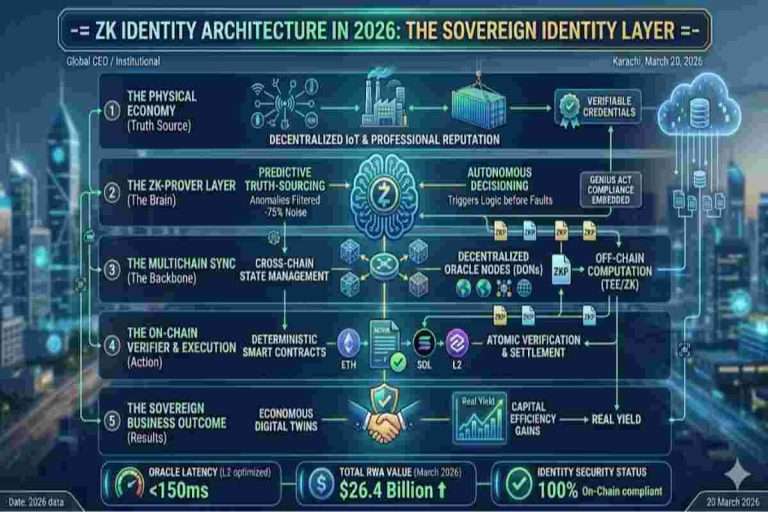
Forget multisigs. Forget custodial bridges.
ZK-based interoperability enables:
Security is no longer assumed—it’s proven.
The “Bridge Hack” is a relic of the past. 2026 infrastructure relies on mathematical proofs, not trusted third parties.
ZK-Interoperability: The End of the Bridge Hack Era
Why read this: How Zero-Knowledge proofs enable “Light Client” verification between chains for 100% security.
From Bridges to Intents. From Users to Autonomous Agents. From Fragmentation to One Unified Liquidity Layer.
Blockchain interoperability is no longer about moving assets between chains.
It’s about executing outcomes across an interconnected system of liquidity, computation, and intelligence.
In 2026:
You don’t transact. You declare intent.
Intent-Centric Design: Why You’ll Never “Bridge” Again
Why read this: Understanding how “Solvers” handle cross-chain complexity so the user doesn’t have to.
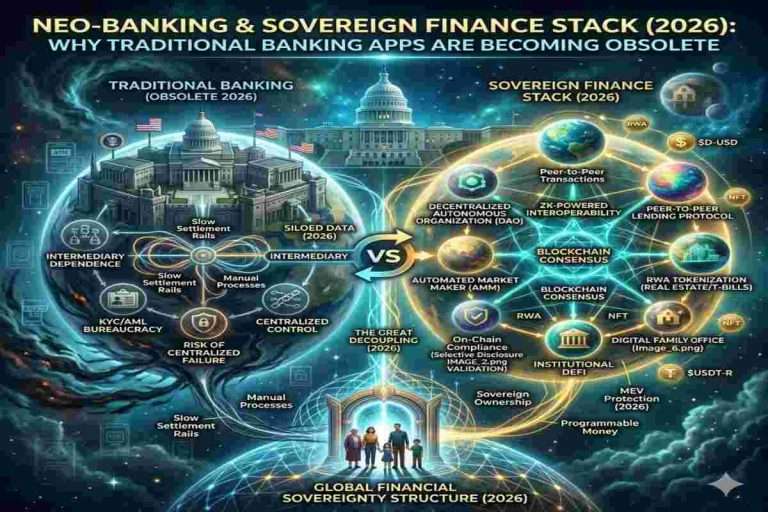
Interoperability isn’t just between chains—it’s between your private data and the public ledger.
Not everything is solved yet.
Current challenges include:
We’re early—but directionally correct.
Scenario:
A DAO treasury wants to optimize yield across 5 chains.
Old Model:
New Model:
Result:
Blockchain Interoperability 2026 has moved beyond manual bridging to a model of Universal Connectivity driven by autonomous logic.
Scenario:
User bridges assets via a traditional lock-and-mint bridge
What Happens:
Root Problems:
Lesson:
Systems that rely on trust fail. Systems that rely on proofs scale.
Universal Connectivity requires moving away from the “Lock-and-Mint” models that defined the early 2020s.
What is blockchain interoperability in 2026?
Blockchain interoperability in 2026 refers to the ability of different blockchains to communicate, share data, and execute transactions seamlessly—without relying on traditional bridges. It is powered by intent-based systems, zero-knowledge proofs, and unified liquidity layers, as explored in Blockchain Interoperability 2026.
Why is blockchain interoperability important for the future of crypto?
Interoperability unlocks global liquidity, enables scalable decentralized applications, and supports AI-driven economies. It allows assets and data to move freely across networks, creating a truly connected financial system.
What is the difference between multichain and omnichain ecosystems?
Multichain ecosystems consist of separate blockchains operating independently, while omnichain systems enable seamless interaction and liquidity flow between them, creating a unified user experience.
What is omnichain liquidity?
Omnichain liquidity refers to capital that is accessible across multiple blockchains as if it existed in a single shared pool, eliminating fragmentation. Real-world implementations are discussed in Web3 Interoperability Use Cases 2026.
How do Layer 2 solutions impact interoperability?
Layer 2 solutions improve scalability but increase fragmentation, making advanced interoperability systems essential for seamless cross-chain interaction.
What are cross-chain intents?
Cross-chain intents allow users or AI agents to define a desired outcome instead of manually executing each step of a transaction across chains.
How does cross-chain intent work in crypto?
Users specify an outcome (e.g., “buy ETH at the best price”), and solver networks automatically route, execute, and settle the transaction across multiple chains, optimizing for cost, speed, and efficiency.
What is intent-based architecture in blockchain?
Intent-based architecture abstracts transaction complexity by letting users define goals, while backend systems handle execution across chains. This model is closely linked with AI Agents in Web3 2026.
What are solver networks?
Solver networks are decentralized actors that compete to fulfill user intents by sourcing liquidity and determining the most efficient execution path.
What replaced traditional crypto bridges?
Traditional bridges are being replaced by intent-based execution layers and interoperability protocols that eliminate lock-and-mint models, reducing risk and improving efficiency. See Zero-Trust Interoperability 2026.
What is ZK-interoperability and why is it important?
ZK-interoperability uses zero-knowledge proofs to verify cross-chain transactions without revealing sensitive data. It enhances security, privacy, and scalability, forming the backbone of modern systems like Zero-Trust Interoperability 2026.
Are cross-chain transactions safe in 2026?
Cross-chain transactions are significantly safer due to ZK proofs, decentralized validation, and intent-based execution. However, risks such as solver centralization and smart contract vulnerabilities still exist. Risk mitigation strategies are covered in Digital Asset Risk Management Framework 2026.
How is interoperability different from bridging?
Bridging requires manually moving assets between chains, while interoperability enables seamless, automated interaction across chains without user involvement.
What are AI agents with wallets?
AI agents with wallets are autonomous programs that can hold, manage, and transact digital assets. They execute strategies, interact with smart contracts, and operate across multiple chains, as explained in AI Agents in Web3 2026.
How do AI agents use crypto?
They perform tasks such as trading, yield optimization, treasury management, and machine-to-machine payments without human intervention.
What is the machine economy?
The machine economy is a system where AI agents act as independent economic participants, transacting and coordinating using blockchain infrastructure.
What is ERC-8004 and how does it relate to interoperability?
ERC-8004 is an emerging standard designed to enable programmable, interoperable interactions between smart contracts, blockchains, and AI agents.
What is the x402 protocol in blockchain interoperability?
The x402 protocol is a next-generation coordination layer that facilitates secure communication and execution across chains, supporting intent-based systems and agent interactions.
What is a sovereign stack in Web3?
A sovereign stack refers to a user-controlled system of identity, assets, and data that operates across decentralized networks without reliance on centralized intermediaries. This concept connects closely with Digital Ownership 2026.
What are interoperable blockchain networks?
Interoperable blockchain networks are systems that allow different blockchains to communicate, share data, and transfer assets seamlessly without relying on centralized intermediaries. Instead of operating in isolation, these networks are connected through technologies like cross-chain protocols, messaging layers, and interoperability frameworks.
In modern Web3 infrastructure, interoperable blockchain networks play a critical role in enabling cross-chain interoperability, supporting decentralized finance (DeFi), and powering AI-driven applications. As blockchain ecosystems evolve in 2026, these networks are becoming the foundation for scalable, multi-chain environments where users, enterprises, and AI agents can interact across multiple platforms efficiently.
Why are interoperable blockchain networks important in 2026?
Interoperable blockchain networks are essential in 2026 because the digital economy is no longer built on a single blockchain. With the rise of multi-chain ecosystems, AI agents, and decentralized applications, seamless connectivity between networks is required for real-time data exchange and asset transfers.
They also reduce fragmentation, improve scalability, and enable advanced use cases like machine-to-machine transactions and cross-chain smart contract execution. This makes interoperability a key driver behind the future of blockchain interoperability and universal connectivity.
The future of blockchain lies in universal connectivity powered by interoperability and intelligent automation. As AI agents in blockchain become more advanced, they will rely on deeply integrated cross-chain systems to operate autonomously at scale.
By 2026, the combination of blockchain interoperability, AI-driven execution, and advanced communication protocols will define a new digital economy—one where networks are no longer isolated, but fully interconnected and machine-driven.
Interoperability is no longer a feature. It’s the foundation of everything being built next.
The question isn’t whether this shift is happening.
It’s whether you’re building for it.
Don’t just use the future. Build in it.
Official Frameworks & Verified Sources
European crypto regulatory standards under MiCA. EU Markets in Crypto-Assets (MiCA) Regulation
Welcome to OwnProCrypto (Own & Pro Crypto) — a next-generation Bitcoin and blockchain education platform where the science of finance meets the power of AI-driven automation.
Our mission is simple: to equip you with the knowledge, frameworks, and tools needed to make smarter financial and business decisions in the Web3 economy.
Beyond analysis, OwnProCrypto focuses on transparency, verifiable data, and practical frameworks that investors and builders can actually use. Our goal is not hype — but clear thinking, disciplined analysis, and long-term value creation in the decentralized economy.
Our Background
As part of the Web3 Ecosystem Architecture pillar, this guide focuses on Sovereign Ownership Architecture in Web3. Explore related pillars: